Triathlon Training Plans: How to Choose, Follow and Adapt One
A training plan is a tool for consistency, not a test to pass. How to choose the right plan for your distance, time and starting point, how to actually follow it, and how to adapt it.
By Lotte
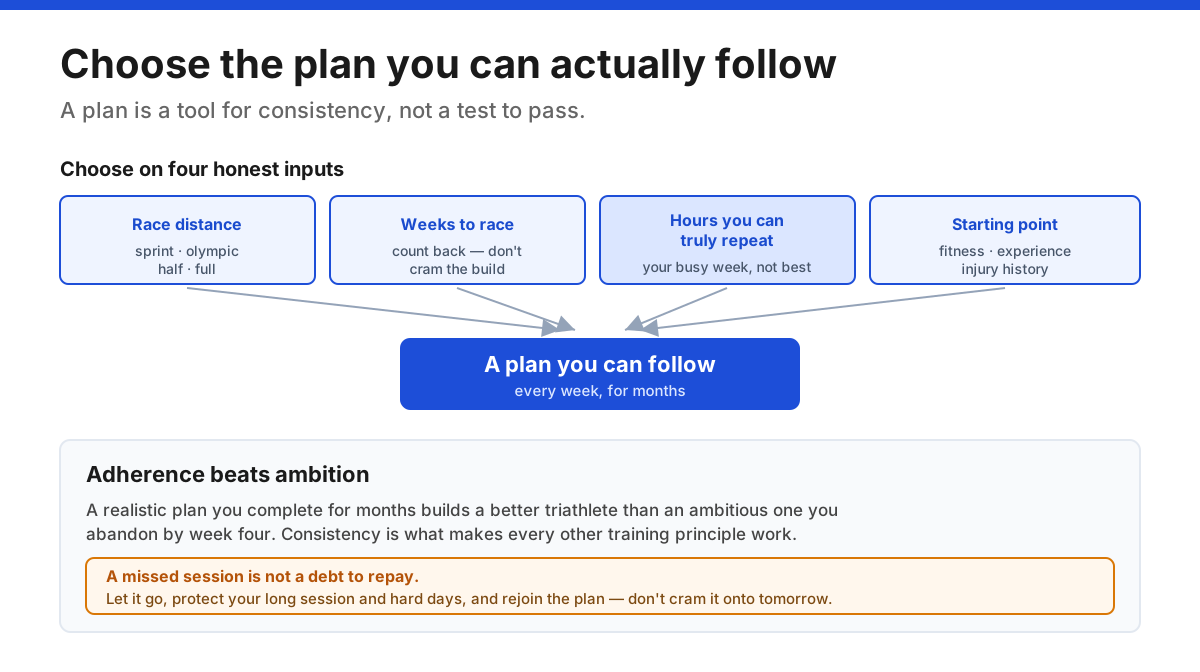
A training plan turns good intentions into a repeatable structure, and the best plan is not the most impressive one — it is the one you will actually complete week after week. This guide is about the decisions around a plan rather than a single schedule to copy: how to choose one from your distance, the weeks you have, the hours you can genuinely repeat and your starting point; what a good plan contains and why; how to follow it when adherence matters more than perfection; and how to adapt it to your life and body. It points you to the specific plans, the distance guides and the season-building tools rather than repeating them.
Key takeaways
- 1A plan is a tool for consistency, not a test — the best one is the plan you can complete reliably, not the most ambitious one you can start.
- 2Choose from four honest inputs: your race distance, the weeks until race day, the hours you can genuinely repeat each week, and your current starting point.
- 3A good plan progresses gradually, keeps most training easy with a little hard work, protects a weekly long session, and builds in recovery weeks and a taper.
- 4Adherence beats perfection: a missed session is not a failure to repay — drop the low-priority work and protect the key sessions and your consistency.
- 5This page is about choosing and using a plan — use the linked distance guides, specific plans and periodization tools to build or pick the actual schedule.
In this article
- 1A plan is a tool for consistency, not a test to pass
- 2Choose a plan on four honest inputs
- 3What a good training plan actually contains
- 4Match the plan to the distance
- 5Follow the plan: adherence beats perfection
- 6Adapt the plan to your life and your body
- 7Signs your plan is wrong for you
- 8Template, self-built, or a coach?
- ⚖How a triathlon plan scales by distance (a starting-point guide)
- ?Frequently asked questions
A plan is a tool for consistency, not a test to pass
Before choosing a training plan it is worth being clear about what a plan is for. Its job is not to extract the maximum possible training from you; it is to convert vague good intentions — "I should swim more," "I need to get my long ride in" — into a specific, repeatable structure so you do the right work in the right order without renegotiating it every day. A plan removes decisions, and that is most of its value.
Which leads to the single most important principle on this page: the best plan is the one you can actually follow. A realistic schedule you complete week after week for months builds a far better triathlete than an ambitious one you start strong and abandon by week four. Consistency is the ingredient that makes every other training principle work, and no clever session structure survives being skipped. Keep that test — can I genuinely repeat this? — in front of every decision below.
This guide stays at the level of choosing and using a plan. The actual schedules, the distance-specific demands and the methods for building your own each have their own guides, linked throughout, so this page is the decision layer rather than a single plan to copy.
Choose a plan on four honest inputs
Picking the right plan comes down to four questions, and the word that matters most is honest — plans go wrong when the inputs are aspirational rather than real.
- Your race distance. This sets the overall shape and volume. The demands of each distance are covered in the sprint, Olympic, half and full guides — read the one you are targeting so you know what the plan is preparing you for.
- The weeks until race day. Count back from your event. If you do not have the typical build for your distance, the answer is usually to pick a shorter, less demanding goal now rather than to cram — an over-compressed plan mostly buys injury.
- The hours you can genuinely repeat. Not your best week — your ordinary, busy-week total. A plan built around six hours you reliably hit beats a ten-hour plan you miss a third of. Be ruthless here; this is the input people most often lie to themselves about.
- Your starting point. Your current fitness, multisport experience and injury history change what an appropriate plan looks like. Coming from another sport shifts the emphasis — see runner to triathlete and cyclist to triathlete for how.
Get these four right and the plan almost chooses itself. Get them wrong — especially the hours — and even a well-written plan will not fit your life.
What a good training plan actually contains
Whether you download a template, follow one of ours or build your own, the same principles separate a good plan from a random pile of sessions. You do not need to engineer these yourself, but recognising them helps you judge a plan and understand why it is shaped the way it is:
- Gradual progression. Load increases in small steps over time rather than in leaps, because sudden jumps in training are a common route to injury and burnout.
- Mostly easy, a little hard. The large majority of the work is comfortable aerobic training, with a small, deliberate amount of intensity — the distribution that actually builds endurance. The session-level version of this is in triathlon training basics.
- A protected long session. Each week has a clearly longest session that builds endurance and durability; it is the one to guard when time is short.
- Recovery weeks and a taper. Every few weeks the load eases so your body absorbs the work — see the recovery week and deload guide — and the final week or two before the race is a taper that drops volume so you arrive fresh.
- All three sports, plus bricks and strength. Balanced swim, bike and run, with brick workouts to rehearse running off the bike and some strength work to stay durable.
How these stack across a whole season — base, build, peak and taper — is the job of triathlon periodization; this page's point is simply that a plan worth following will contain all of the above.
Match the plan to the distance
Plans scale predictably with race distance: longer races need more weeks, more weekly hours, and above all a longer long session, but the shape — mostly easy, one long day, recovery weeks — stays remarkably constant. The table below is a starting-point map of how a typical plan grows from sprint to full; treat it as a guide to what you are signing up for, not a prescription, since the right numbers depend on your own starting point and life.
For the actual week-by-week schedules, this guide hands off to the specific plans: how to train for a triathlon in 12 weeks is a solid first-timer and sprint-to-Olympic plan, and the Olympic-distance 12-week plan is a distance-specific build. If your constraint is time rather than distance, the simplest plan for busy weeks shows how little can still work. And to see what a single week of any of these actually looks like written out, the training week examples lay out beginner, intermediate and advanced weeks day by day.
Follow the plan: adherence beats perfection
A plan only works if you run it, and the athletes who improve are rarely the ones who complete every session perfectly — they are the ones who keep showing up across months without derailing. So the skill of following a plan is as important as choosing it.
The mindset that makes this work is that a missed session is not a debt to repay. Life will take a day — a work crunch, a sick child, a bad night's sleep — and the right response is almost never to cram the missed session in on top of the next one, which just turns one skipped workout into two compromised ones. Instead, let it go and rejoin the plan where it is. When you have to cut, cut the lowest-priority work and protect the sessions that matter most — your weekly long session and your one or two genuinely hard sessions — along with your rest. A quietly consistent 80% of the plan, sustained for months, beats a heroic 100% that collapses into a lay-off. For fitting all of this around a full-time job, training around work tackles the real-world scheduling directly, and how to structure a training week covers arranging sessions around fixed commitments.
Adapt the plan to your life and your body
No template is written for you specifically, so expect to adjust it — a plan is a starting framework, not a contract. A few principled adjustments cover most situations:
- Bias toward your weakest discipline. If swimming is your limiter, it is reasonable to add a swim and trim elsewhere; a plan should serve your gaps, not ignore them.
- When time is tight, consolidate rather than skip. Replacing two separate sessions with one brick, or shortening rather than dropping, keeps the stimulus while fitting the day.
- Move sessions by purpose, not by guilt. If a hard session has to move, keep it away from your other hard day and your long session; if an easy session gets squeezed out, it is usually fine to simply lose it.
- Back off when your body says so. Persistent fatigue, disrupted sleep, a sinking mood or a niggle that is sharpening are signals to add recovery, not to push through. Adaptation happens in recovery, and an unplanned easy week is far cheaper than an injury.
The mechanics of rearranging a week around your real availability are covered in depth in how to structure a triathlon training week; use this page for whether to adjust and that one for how.
Signs your plan is wrong for you
A plan should feel challenging but sustainable. Two failure modes are worth watching for, because both are fixable once you name them:
The plan is too much. The tell-tale signs are chronic fatigue that does not lift after a rest day, a string of missed or dreaded sessions, disrupted sleep, a flat mood, or recurring niggles. This is the more common problem, and the fix is almost always to reduce — fewer hours, more recovery, a less ambitious goal — not to grind harder. A plan you resent is a plan you will quit.
The plan is too little. Less common, but real: if you are comfortably completing everything, never feeling stretched, and your fitness has plateaued, the plan may no longer be progressing you. The fix is a gradual increase in load or a more structured build, not a sudden doubling. If you are unsure which of these you are in, or you keep landing in one of them, that uncertainty is one of the clearest signals that outside help is worth it — which is the next section.
Template, self-built, or a coach?
There are three honest ways to get a plan, and the right one depends on your goal, experience and budget.
Follow a template — like the plans linked above — when you are newer, targeting a standard distance, and want a proven structure without having to design it. It is the right default for most first-timers and busy age-groupers.
Build your own once you understand the principles well enough to arrange them around your life — the mostly-easy distribution, progression, the long session, recovery weeks and a taper. Triathlon periodization and training basics are the tools for that, and the reward is a plan shaped exactly to your constraints.
Hire a coach when the stakes, complexity or your own history justify personalised guidance and accountability — a first long-course race, a stubborn plateau, a demanding life that needs constant plan-juggling, or an injury history that needs managing. How to find a triathlon coach and, for long course specifically, do you need an Ironman coach help you decide. None of these is more virtuous than the others; the best choice is simply the one that gets you to the start line fit, healthy and consistent.
How a triathlon plan scales by distance (a starting-point guide)
| Sprint | Olympic | Half | Full | |
|---|---|---|---|---|
| Typical build | 8-12 weeks | 12-16 weeks | 16-20 weeks | 20-30 weeks |
| Hours/week | 4-6 | 6-8 | 8-12 | 12-16 |
| Swim / Bike / Run | 2-3 each | 2-3 / 2-3 / 3 | 3-4 / 3 / 3-4 | 3-4 each |
| Long bike | ~60 min | ~90 min | 3-4 hours | 5-6 hours |
| Long run | ~30 min | ~60 min | 90+ min | 2.5+ hours |
| Bricks/week | 1 | 1 | 1-2 | 1-2 |
| What decides it | Consistency | Adding intensity | Endurance + fuelling | Volume + life fit |
Sources
Sources are listed so readers can verify consequential claims and dated details.
- The training intensity distribution among well-trained and elite endurance athletes — Frontiers in Physiology (2015) (accessed September 18, 2026)
- Training-load changes and injury: systematic review — International Journal of Sports Physical Therapy (accessed September 18, 2026)
Frequently asked questions
How do I choose the right triathlon training plan?
Choose on four honest inputs: your race distance, the number of weeks until race day, the weekly hours you can genuinely repeat (not your best week), and your current fitness and experience. The distance sets the shape, the weeks set whether the goal is realistic, and the hours matter most — a plan built around the time you reliably have beats a bigger one you constantly miss. Read the guide for your target distance so you know what the plan is preparing you for.
Can I train for a triathlon in 8 weeks?
For a sprint distance, yes, provided you already have some baseline fitness and can swim, bike and run individually. Focus on consistency and include a weekly brick to rehearse running off the bike. For Olympic distance and longer, eight weeks is usually too compressed to build the required endurance safely — it is better to pick a shorter race now or a later date than to cram, which mostly buys injury.
What matters more, the plan or following it consistently?
Following it, by a wide margin. A realistic plan completed consistently for months builds far more fitness than an ambitious one you start and abandon. This is why the honest weekly-hours question matters so much when choosing, and why a missed session should be let go rather than crammed in on top of the next one. Protect your key sessions and your consistency, and the exact plan matters less than sticking to it.
How many rest days should a triathlon plan include?
At least one full rest day a week, and many plans include one to two rest or easy active-recovery days. Rest is part of the plan, not a gap in it — adaptation happens during recovery. On top of weekly rest, a good plan eases the load every few weeks with a recovery week. If you are constantly fatigued despite your scheduled rest, that is a signal to add more, not to push through.
Should I build my own plan, follow a template, or hire a coach?
Follow a template if you are newer and targeting a standard distance and want a proven structure. Build your own once you understand the principles — progression, mostly-easy training, a long session, recovery weeks and a taper — and want it shaped to your life. Hire a coach when the stakes or complexity justify personalised guidance and accountability, such as a first long-course race, a persistent plateau, or an injury history to manage.