Do You Need an IRONMAN Coach? How to Decide (2026)
Decide whether a coach, written plan or one-off consultation would solve a specific Ironman training gap.
By Lotte
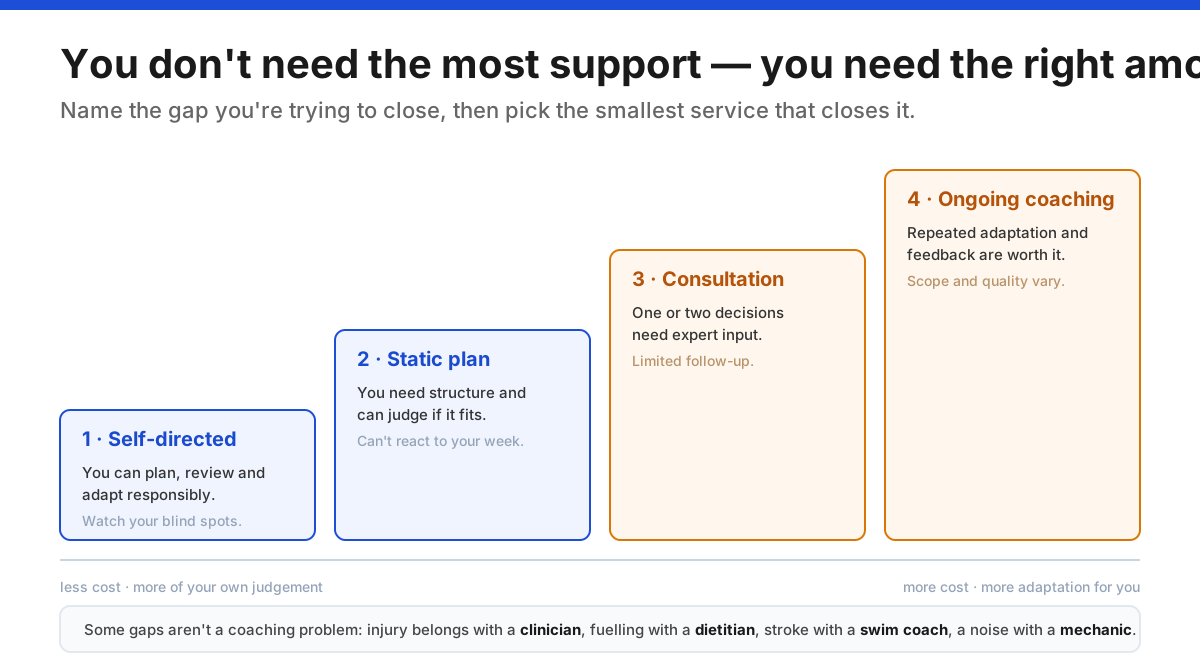
You do not automatically need an IRONMAN coach — many people finish self-coached off a good plan, and a coach can also be worth every penny. The decision isn't 'coach or not' but 'what gap am I closing, and what's the smallest support that closes it?' This guide helps you name the problem, match it to the right kind of help, and choose between a plan, a consultation and ongoing coaching — while keeping ownership of your own preparation.
Key takeaways
- 1A coach is a tool for specific gaps, not a guarantee of finishing or qualifying
- 2Name the actual problem first — some gaps need a clinician, dietitian, swim coach or mechanic, not a coach
- 3Choose the smallest level of support that closes the gap, then reassess each season
- 4Ongoing coaching earns its cost most clearly for a chaotic schedule, an injury history, or an unexplained plateau
- 5Judge coaching by whether your decisions improve — keep ownership of your body, goals and plan
In this article
- 1The honest answer up front
- 2Start by naming the gap you're closing
- 3The four levels of support
- 4When ongoing coaching genuinely earns its cost
- 5When you probably don't need one
- 6Audit a static plan before you assume you need more
- 7What good coaching actually does — and what it can't
- 8Budget for the whole preparation, not coaching alone
- 9Define success before you hire — and keep ownership
- 10How to decide this season
- ⚖Four levels of support, and when each fits
- ?Frequently asked questions
The honest answer up front
No, you do not automatically need an IRONMAN coach — plenty of people finish full-distance races self-coached off a good plan. And yes, a coach can be genuinely worth every penny. Both are true, because "do I need a coach?" is the wrong question. The useful question is: what specific problem am I trying to solve, and is a coach the best tool for it?
A coach is a tool, not a talisman. Hire one to close a real gap — a schedule you can't make work, a plateau you can't explain, an injury history that needs managing — and it can transform your preparation. Hire one because "serious triathletes have coaches," and you may pay a lot for a calendar you could have downloaded.
One thing no coach can sell you is certainty. A responsible coach improves your decisions and consistency; they cannot guarantee a finish or a Kona slot, because health, conditions, preparation and race-day luck all still apply. Keep that framing and the rest of this decision gets much clearer.
Start by naming the gap you're closing
Before you compare services, write down the unresolved issues in your preparation. Common ones for long course:
- Fitting 10–15+ hours a week around work, shifts or family
- Balancing three disciplines when one keeps getting neglected
- Interpreting fatigue — is this normal, or the start of overtraining?
- Returning safely after an injury or a long layoff
- Pacing and fuelling a demanding course you've never raced
- A plateau you can't account for despite consistent work
Now match each to the right kind of help, because not every gap is a coaching problem. A stubborn shoulder niggle needs a physiotherapist, not a training calendar. A gut that rebels on long rides needs a sports dietitian. A stroke that won't improve needs a swim coach's eyes in the water. A creaking bottom bracket needs a mechanic. And if the real issue is simply that you train better with company, a club or a training partner may do more than any paid plan.
A coach earns their place when the gap is genuinely about planning, adapting and decision-making across the whole build — the connective tissue the specialists don't own.
The four levels of support
Support isn't binary — "coach or no coach" hides the options that suit most age-groupers best. There are really four levels, and they climb in cost and in how much adaptation someone else does for you:
- Self-directed training — you plan, review and adapt yourself.
- A static plan — a structured schedule you follow and adjust by your own judgement.
- A targeted consultation — you pay an expert to resolve one or two specific decisions.
- Ongoing coaching — a professional adapts your plan continuously to your feedback.
The comparison table below lays out when each fits and where each falls short. The principle that ties them together: choose the smallest service that resolves the real problem, then reassess. More contact is not automatically better — a weekly call that produces a plan which never actually changes is worse than a single sharp consultation that fixes your scheduling for the whole season. Start low, move up only when the gap demands it.
When ongoing coaching genuinely earns its cost
There are situations where individual, continuous coaching is the highest-value money in your whole build. The strongest cases:
- A genuinely chaotic or variable schedule. If your available hours change week to week — rotating shifts, travel, unpredictable family demands — a static plan is fighting you constantly. Continuous adaptation is exactly what you're paying for, and it's worth a lot.
- An injury or health history that needs managing. Not treating (that's a clinician's job) but training around — loading carefully, spotting early warning signs, backing off at the right moment.
- A plateau you can't explain. An experienced outside eye often sees the obvious thing you've normalised: too much grey-zone intensity, chronic under-recovery, a neglected discipline.
- A first full-distance race with high personal stakes. The step up to 140.6 introduces decisions — long-day fuelling, pacing, taper, durability — you've simply never made. Guidance here buys confidence and reduces expensive mistakes.
- Conflicting goals or events that need a coherent season built around them.
Notice the theme: coaching pays off when complexity and consequence are high, not when you simply want to feel official.
When you probably don't need one
It's just as important to know when to keep your money. You likely don't need ongoing coaching if:
- You can already plan, review and adapt responsibly. If you understand progressive overload, recovery, and how to shuffle a week when life intervenes, a good plan plus your own judgement may be all you need. Be honest about your blind spots — but don't manufacture a problem you don't have.
- Your schedule is stable and your history is clean. A repeatable week and no injury red flags is the ideal setting for a well-chosen full-distance plan.
- Your real need is motivation, not decisions. Accountability is valuable, but a training club, a partner, or a group program often supplies it at a fraction of coaching cost.
- A single decision is the whole problem. If you just need your taper sorted or your fuelling mapped, buy a consultation, not a season of supervision.
Self-coaching well is a legitimate, common path to an Ironman finish — not a compromise. The goal is the right amount of help, not the most.
Audit a static plan before you assume you need more
Often the honest question isn't "coach or not" but "can a good plan plus my own judgement cover this?" Audit a plan properly before deciding:
- Prerequisites and starting workload — does it assume a base you don't have, or hours you can't give?
- Long-session demands — can you realistically fit the long ride and long run every week?
- Recovery and progression — does it build sensibly and include real down weeks?
- How it handles reality — crucially, read how the plan treats missed sessions, illness and changed goals. A plan that silently assumes every workout is completed will need your judgement (or qualified help) the moment life diverges — which it always does.
Use the full-distance plan and the Ironman training-hours guide to make this concrete against your calendar. If a well-chosen plan survives this audit and you can adapt it when needed, you may have just answered the coaching question for free. If it falls apart at "how do I handle a missed week," that's your gap — and possibly your reason to pay for adaptation.
What good coaching actually does — and what it can't
It helps to be precise about what you're buying, so you can judge whether you're getting it. Good coaching delivers some mix of:
- Adaptation — the plan changes in response to your fatigue, life and progress. This is the core of what a static plan can't do.
- Decision support — an experienced person helps you make the calls you're unsure about (push or rest, race or skip, how to taper).
- Objectivity — an outside eye that catches the pattern you're too close to see, and talks you out of the hero week that would break you.
- Accountability — someone expects the work, which for many people simply gets it done.
What coaching can't do: guarantee outcomes, replace medical or dietetic care, or substitute for your own consistency. A good coach works within their competence and refers out — injuries to clinicians, complex nutrition to dietitians. Be wary of anyone who promises a finish, a time or a slot; a calendar that never changes despite repeated problems isn't individual coaching, whatever the invoice says.
Budget for the whole preparation, not coaching alone
Coaching competes for the same money as everything else in an Ironman build: equipment, travel, race entry, pool access, nutrition, and — easy to forget — your own time. Frame it as a trade-off, not a standalone purchase.
Ask what you'd give up to fund coaching, and whether that swap actually improves your preparation. Sometimes it clearly does: if your schedule is the limiting factor, ongoing adaptation can be worth far more than another wheel upgrade. Sometimes a much cheaper option solves the real problem — a handful of swim lessons, or one planning consultation to structure your season, may fix the main gap for a fraction of a full coaching fee.
Avoid budgeting from a guessed "average" coaching price you saw online. Prices vary enormously by format (group vs one-to-one), contact level and coach experience, and they change over time. Get current quotes tied to the specific services you actually need, then compare them against the rest of your build — not against zero.
Define success before you hire — and keep ownership
If you do decide to pay for support, decide first what "better" would look like, so you can tell whether it's working. Concrete markers beat a race result: a schedule you can actually repeat, clearer explanations of why each session exists, timely adjustments when life shifts, or more confident race execution. A single result — good or bad — won't tell you whether the coaching was useful, because so much else feeds into it.
When hiring, use the beginner coach-selection guide to vet credentials, communication style and contract terms — that page is the hiring process once you've decided you want help; this page is the decision about whether to. Set a review point and an agreed way to change or end the arrangement if the fit is poor, and keep training records so switching later doesn't lose your history.
Above all, keep ownership. A paid plan is advice you've chosen to follow, not an order. You remain the authority on your own symptoms, preferences and life — the best coaching relationships treat you as a partner, not a passenger.
How to decide this season
Pull it together into a short sequence you can actually run:
- Name the gap. What specific problem is blocking a good build?
- Check it's a coaching problem. If it's injury, nutrition, stroke or mechanical, hire the right specialist instead.
- Try the smallest fix first. Can a good plan you can adapt, or a one-off consultation, close it? If yes, start there.
- Escalate only for real complexity. Chaotic schedule, injury history, unexplained plateau, or a high-stakes first full — these are where ongoing coaching earns its cost.
- Set success markers and a review date, then reassess next block.
The right answer isn't fixed for life. You might self-coach a first season off a plan, buy a consultation before your first 140.6, and add ongoing coaching only when a promotion wrecks your schedule. Match the support to the season you're actually in — and revisit it when the season changes.
Four levels of support, and when each fits
| Level of support | Best when | Main limitation | Cost & commitment |
|---|---|---|---|
| Self-directed training | You can plan, review and adapt responsibly | You must catch your own blind spots | Lowest — your time and judgement |
| Static plan | You need structure and can judge if it fits | Can't respond to your actual week | Low — one-off, no adaptation |
| Targeted consultation | One or two decisions need expert input | Little or no follow-up | Moderate — pay per question |
| Ongoing coaching | Repeated adaptation and feedback are worth it | Scope and quality vary; no guarantees | Highest — recurring; get quotes |
Sources
Sources are listed so readers can verify consequential claims and dated details.
- USA Triathlon coaching resources — USA Triathlon (accessed September 19, 2026)
Frequently asked questions
Can a coach guarantee I will finish an Ironman?
No responsible service can guarantee a finish, regardless of health, preparation, conditions and race-day events. A useful coaching agreement defines the support, communication and review process. Judge it by whether your decisions improve and the programme stays appropriate — not by certainty that no plan can provide.
Is it possible to finish an Ironman without a coach?
Yes — many people complete full-distance races self-coached off a well-chosen plan. Self-coaching is a legitimate, common path, not a compromise. It works best when you can plan, review and adapt responsibly, your schedule is fairly stable, and you have no injury red flags to manage.
When is a coach most worth the money for long course?
When complexity and consequence are high: a chaotic or variable schedule that a static plan can't track, an injury history you need to train around, an unexplained plateau, or a first 140.6 with decisions you've never made. Coaching pays off for continuous adaptation and decision support, not simply for feeling official.
What's the difference between a coach and just buying a training plan?
A plan is a fixed schedule you adapt yourself; a coach adapts the plan continuously to your feedback, fatigue and life. If your weeks are predictable and you can adjust sensibly, a plan may be enough. If your weeks keep changing or you're unsure how to adjust, that ongoing adaptation is exactly what you'd be paying a coach for.
Do I need a coach or a different specialist?
Match the gap to the help. A persistent pain belongs with a clinician, gut or fuelling problems with a sports dietitian, a stubborn stroke with a swim coach, and mechanical issues with a mechanic. A coach is for planning, adapting and decision-making across the whole build — hire one when that's the real gap.
How should I budget for coaching?
Treat it as a trade-off against the rest of your build — equipment, travel, entry, pool access and your own time — not a standalone cost. A single consultation or a few swim lessons may solve the main problem cheaply. If the schedule is your limiter, ongoing adaptation can be worth more than another gear upgrade. Get current quotes tied to the services you need rather than budgeting from a guessed average.