Full Distance Triathlon (Ironman): The 3.8km / 180km / 42.2km Guide
What the full-distance (Ironman) triathlon really demands — the 3.8km swim, 180km bike and marathon — why it is an all-day management race won on execution, not speed.
By Lotte
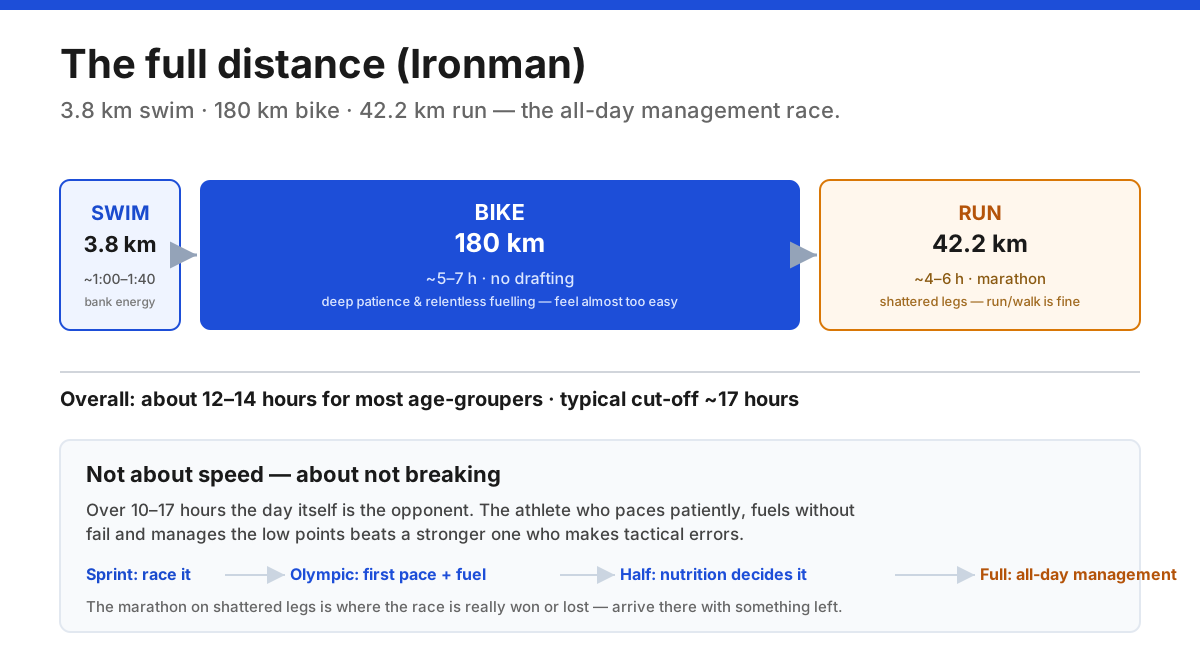
The full distance — a 3.8km swim, 180km bike and 42.2km marathon, branded Ironman — is one of the hardest single-day endurance events in the world, and it is different in kind from the shorter distances, not just longer. Across 10 to 17 hours, the day itself becomes the opponent: the race is won by the athlete who paces patiently, fuels relentlessly and manages their mind, not the one with the most raw speed. This guide is the overview of the distance — its format, typical times and demands leg by leg — and it points to the dedicated guides that own training, long-course fuelling, pacing and recovery rather than repeating them.
Key takeaways
- 1The full distance (Ironman) is a 3.8km swim, 180km bike and 42.2km marathon, with most age-groupers finishing in about 12 to 14 hours against a typical 17-hour cut-off.
- 2It is an all-day management race: execution, fuelling, pacing and mental control decide it far more than raw speed.
- 3It is a lifestyle commitment — roughly 20 to 30 weeks of training, best attempted after a half, with real family and work support.
- 4The marathon is where the race is truly decided, run on shattered legs — and a run/walk strategy is a legitimate, often faster, way to finish it.
- 5This page is the distance overview — use the linked guides for long-course nutrition, training, pacing, coaching and recovery.
In this article
- 1The full distance at a glance
- 2Why the full is different in kind, not just degree
- 3The day itself is the opponent: pacing, patience and the mind
- 4The swim: 3.8 kilometres
- 5The bike: 180 kilometres
- 6The run: a marathon on shattered legs
- 7Nutrition and special-needs planning
- 8Is the full distance right for you?
- ⚖The full distance segment by segment
- ?Frequently asked questions
The full distance at a glance
The full-distance triathlon is a 3.8km swim, 180km bike and 42.2km run — a full marathon to finish. It is universally known by the Ironman brand and the 140.6-mile total, and it sits at the very top of the standard distance ladder, above the sprint, Olympic and half.
A few defining facts frame everything else:
- Most age-groupers finish in about 12 to 14 hours, with a typical overall cut-off around 17 hours and intermediate cut-offs for the swim and bike. It is a genuine all-day event, often starting at dawn and finishing after dark.
- It takes months, not weeks. A typical build is around 20 to 30 weeks of structured training, and that is on top of an existing endurance base — most people come to it having already raced a half.
- It is one of the hardest single-day endurance events there is. The swim alone would be a hard session; stacked in front of a 180km ride and a marathon, the challenge is less any single leg than the sheer accumulated duration.
For where this sits relative to the other distances — and to help decide whether to target it — see the triathlon distances overview and, for the step up specifically, the 70.3 vs full Ironman comparison; this page goes deep on the full distance itself.
Why the full is different in kind, not just degree
It is tempting to think of the full as simply a longer half, but it is better understood as a different event that happens to use the same three sports. The defining truth is this: the full distance is not about speed, it is about not breaking. Over 10 to 17 hours, the athlete who paces patiently, fuels without fail and stays calm through the low points routinely beats a stronger athlete who makes tactical errors — because at this length, errors are not recoverable.
It helps to see the full as the far end of a spectrum. A sprint is short enough to simply race hard; the Olympic is the first distance you must pace and fuel at all; the half is where nutrition and pacing become decisive over five to seven hours. The full takes that one crucial step further: the day is so long that management — of effort, fuel, heat, mind and body — dominates everything, and fitness only earns you the right to manage a long day rather than a slightly shorter one. This is why full-distance racing rewards temperament and discipline as much as engine, and why "execution" is the word that comes up again and again.
The day itself is the opponent: pacing, patience and the mind
Because the full is so long, its central skill is doing less than you feel able to for as long as possible. Almost every full-distance disaster traces to going too hard, too early — on the swim, on the bike, or in the first few miles of the run — and paying for it across hours you cannot claw back.
Three habits define a well-managed Ironman. Pace with deep restraint: ride the bike well within yourself, resisting every urge to chase the riders surging past, because that effort is borrowed directly from your marathon; the general principles are in race pacing strategy. Fuel relentlessly and early: you cannot make up a calorie deficit once you are behind, so fuelling is a continuous job from the start, not a rescue for later. And manage your mind: break the day into small, digestible pieces — the next aid station, the next 30 minutes — and never dwell on the total distance remaining, because the full is as much an emotional event as a physical one, with genuine dark patches that pass if you keep moving. Planning the whole day in advance, rather than improvising it while exhausted, is what makes this possible; the broader framework is in race-day preparation.
The swim: 3.8 kilometres
The full swim is 3,800 metres, almost always in open water and usually in a wetsuit, taking most age-groupers somewhere between about 1 hour and 1 hour 40. It is a long swim, but in the context of a 12-hour-plus day it is a small opening act, and it should be treated as one.
The entire goal is to get through it efficiently and calmly while spending as little energy as possible — you want to exit the water feeling like you have barely started, not like you have raced. Steady sighting, an easy sustainable rhythm and drafting where you can all matter far more than swim speed, and composure through the crowded start is worth more than any few seconds gained by fighting for position. The open-water skills that make this leg a non-event are covered in the open-water swimming guide. Bank your energy here; the day has barely begun.
The bike: 180 kilometres
The 180km bike is the longest leg by far — typically five to seven hours — and it is where the race is quietly set up or thrown away. For nearly all full-distance races it is ridden non-drafting, an individual effort over a very long time.
The defining skill is patience, and it is harder than it sounds because the consequences of over-riding do not arrive until the marathon. A disciplined full-distance ride sits at an effort that feels almost too easy for the first few hours — because that restraint is exactly what preserves your legs and your stomach for the run. The bike is also your main fuelling window: with hours in a stable position, it is where the bulk of your race nutrition goes in, which means pacing conservatively and eating steadily are really the same job. Riding the bike to a strong-feeling effort and then walking the marathon is the classic Ironman mistake; riding it with humility and finishing with a run in your legs is the whole art. Fuelling a day this long is its own discipline — coordinating carbohydrate, fluid, sodium and caffeine over many hours — and it belongs to the long-course nutrition guide and the gut-training guide rather than a number here.
The run: a marathon on shattered legs
The full-distance run is a 42.2km marathon, run after a 3.8km swim and 180km bike, and it is where the race is truly decided. Most age-groupers run it far slower than their fresh marathon time, and it is routinely described as the hardest, most humbling part of the sport.
The old wisdom holds: the race does not really begin until the marathon. Everything before it is preparation for arriving at the run with something left. The habits that hold it together are starting far more slowly than feels necessary, walking the aid stations deliberately to take on fuel and fluid, and continuing to eat and drink even when you do not want to. Crucially, a run/walk strategy is entirely legitimate — and for many athletes a disciplined run-then-walk pattern is actually faster than trying to run continuously and blowing up into an involuntary walk. There is no shame in walking an Ironman marathon; it is a tool, not a failure. Because recovering from an effort this extreme is a real process in itself, the days and weeks afterward have their own guide in the post-Ironman recovery protocol.
Nutrition and special-needs planning
Nutrition is genuinely the fourth discipline at the full distance — a day this long burns and demands far more energy than any shorter race, and getting it wrong is the single most common reason strong athletes fail to finish. But the specifics are individual and depend on your size, sweat rate, gut tolerance and the conditions, so this overview deliberately hands the numbers to the guides built for it: long-course nutrition for coordinating fuel, fluid, sodium and caffeine across the day, race fueling for the race-day plan, and hydration for fluids and electrolytes. The one non-negotiable is rehearsal: your exact plan, practised in long training sessions until it is routine, because race day is never the place to try something new.
A feature unique to long-course racing is special-needs bags — bags you pack in advance and collect at set points on the bike and run, holding backup nutrition, fresh supplies and comfort items. Treat them as your Plan B made physical: extra fuel in case a bottle is lost, dry socks, anti-chafe, a caffeine source for late in the day. A special-needs bag can rescue a race when the primary plan falters, which over a day this long is a real possibility to plan for rather than hope against.
Is the full distance right for you?
The full is a genuine lifestyle commitment, and the honest question is not just whether you can finish one but whether now is the right time to take it on. A few things should be in place first:
- A half-distance finish behind you. The full is best approached as a progression, not a first triathlon. Racing a half teaches the pacing and fuelling that the full then magnifies.
- The time and life support for months of training. Peak weeks of double-figure hours have to fit alongside work, family and rest for the better part of a year — and that is a decision the people around you are part of. The realistic weekly demands are laid out in Ironman training hours.
- A readiness for the mental side. The full asks you to keep going through low points that shorter races never reach, and being prepared for that is part of being ready.
Because the stakes, complexity and time investment are so high, this is the distance where coaching most often pays for itself. Whether a coach is right for you is covered in do you need an Ironman coach and how to find a triathlon coach; for building or choosing the plan itself, see training plans and periodization. And if a tough day means you do not make a cut-off, triathlon cut-off times and what happens if you DNF put it in perspective — not finishing a full is common, and it is not a catastrophe.
The full distance segment by segment
| Segment | Distance | Typical age-group time | What it demands here |
|---|---|---|---|
| Swim | 3.8 km | ~1:00–1:40 | Efficient and calm — barely dip into your reserves |
| T1 | — | 5–10 min | An unhurried, complete changeover |
| Bike | 180 km | ~5–7 h | Deep patience and relentless fuelling |
| T2 | — | 5–10 min | Settle in for the marathon |
| Run | 42.2 km | ~4–6 h | Managing a marathon on shattered legs; run/walk is fine |
| Overall | — | ~12–14 h | Execution and fuelling, not speed |
Sources
Sources are listed so readers can verify consequential claims and dated details.
- The training intensity distribution among well-trained and elite endurance athletes — Frontiers in Physiology (2015) (accessed September 18, 2026)
- Training-load changes and injury: systematic review — International Journal of Sports Physical Therapy (accessed September 18, 2026)
Frequently asked questions
What are the full-distance (Ironman) triathlon distances?
A full-distance triathlon is a 3.8km (3,800m) swim, a 180km bike and a 42.2km run — a full marathon — totalling 140.6 miles. It is universally known by the Ironman brand and sits at the top of the standard distance ladder, above the half (70.3), Olympic and sprint.
How long does a full-distance triathlon take, and what is the cut-off?
Most age-group athletes finish in about 12 to 14 hours. The standard overall cut-off is typically around 17 hours, with intermediate cut-offs for the swim and bike along the way. Faster age-groupers finish in the 9 to 11 hour range. Because it is an all-day event, pacing and fuelling across the whole day matter far more than any single fast split.
How long does it take to prepare for a full-distance triathlon?
For an athlete coming from the half distance, a structured build of roughly 20 to 30 weeks is typical. If you are newer to endurance sport, plan on a year or more, racing shorter distances along the way to build experience. The full is best treated as a progression after a half rather than a first triathlon, both physically and for learning the pacing and fuelling it magnifies.
Can I walk the marathon in a full-distance triathlon?
Yes, and many athletes do. A deliberate run/walk strategy is completely legitimate and is often faster than trying to run continuously and blowing up into an involuntary walk. Planned walk breaks — at aid stations or on a timer — also make it easier to take on fuel and fluid. There is no shame in walking an Ironman marathon; it is a pacing tool, not a failure.
Do I need a coach for a full-distance triathlon?
Not strictly, but it is the distance where coaching most often pays for itself, because the stakes, the time investment and the consequences of training or fuelling errors are all high. A coach adds personalised structure, accountability and someone to adjust the plan when life interferes. Whether it is right for you depends on your experience, budget and how much plan-juggling your life demands.