Sprint Distance Triathlon: The 750m / 20km / 5km Guide
What the sprint-distance triathlon really is — the 750m swim, 20km bike and 5km run — why it is the best first race, and what makes it the distance you race hard rather than ration.
By Lotte
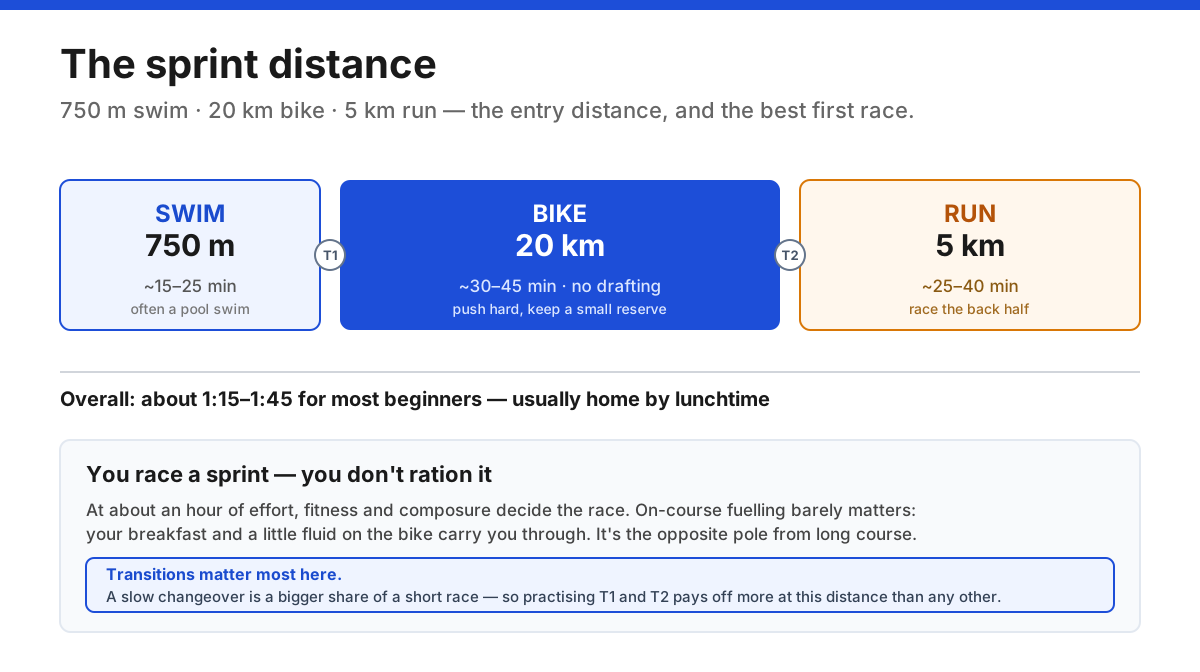
The sprint distance — a 750m swim, 20km bike and 5km run — is the most popular entry point to triathlon and, for most people, the ideal first race. It is short enough to finish in roughly one to two hours and to race at a genuinely hard, sustained effort rather than carefully rationing energy, which makes it the opposite pole from the longer distances: fitness and composure carry a sprint, not fuelling and patience. This guide is the overview of the distance itself — its format, typical times and demands leg by leg — and it points you to the dedicated guides that own first-race preparation, training plans, transitions and the sprint-versus-Olympic decision rather than repeating them.
Key takeaways
- 1The sprint distance is a 750m swim, 20km bike and 5km run, and most beginners finish in about 1:15 to 1:45 — usually home by lunchtime.
- 2It is the best first race for most people: short enough to be approachable, long enough to feel like a real achievement, and forgiving of the mistakes everyone makes early.
- 3Unlike longer races you largely race a sprint rather than ration it — fitness and composure decide it, and on-course fuelling barely matters.
- 4Transitions count for proportionally more here than at any other distance, because a slow changeover is a bigger share of a short race.
- 5This page is the distance overview — use the linked guides for your first-race plan, training schedule, transitions and whether to step up to the Olympic distance.
In this article
- 1The sprint distance at a glance
- 2Why the sprint is triathlon's best first race
- 3You race a sprint — you don't ration it
- 4Transitions matter more here than at any other distance
- 5The swim: 750 metres
- 6The bike: 20 kilometres
- 7The run: 5 kilometres off the bike
- 8Super-sprint and try-a-tri: the rung below
- 9Are you ready — and how to train for it
- ⚖The sprint distance segment by segment
- ?Frequently asked questions
The sprint distance at a glance
The sprint-distance triathlon is a 750m swim, 20km bike and 5km run. It is the most popular distance in the sport and the entry point most people start at, sitting at the bottom of the standard distance ladder below the Olympic (1.5/40/10), half (70.3) and full (140.6).
A few defining facts frame everything else:
- It is short and same-day-friendly. Most beginners finish in roughly 1:15 to 1:45; stronger age-groupers come in around 1:00–1:15, and the fastest dip under 55 minutes. Add a couple of hours for setup and celebration and you are still usually home by lunchtime.
- The swim is often in a pool. Many sprint races — especially beginner-focused ones — use a pool swim with athletes seeded by predicted time, which removes a lot of the open-water intimidation. Others use a short open-water swim.
- There is a rung below it. Most regions also offer super-sprint or try-a-tri events with even shorter legs, which are excellent for absolute beginners, nervous swimmers or younger athletes. More on those below.
For where this distance sits relative to all the others — and to help choose between them — see the triathlon distances overview; this page goes deep on the sprint distance specifically.
Why the sprint is triathlon's best first race
If you are wondering where to start, the answer is almost always here. The sprint distance is the friendliest introduction the sport has, and not only because the distances are short.
- The time commitment is realistic. Most people can prepare properly on something like four to six hours a week over eight to twelve weeks — a training load that fits around a normal life rather than taking it over.
- It is long enough to be a real achievement. A sprint is not a token effort. Stringing three sports together, learning transitions, and racing for over an hour is a genuine accomplishment that feels like one when you cross the line.
- It forgives the beginner mistakes. Everyone makes them — a panicky swim start, a fumbled transition, going out too hard. Over a sprint, those cost you minutes and a story to tell, not your whole day. That low stakes-to-reward ratio is exactly what makes it the ideal place to learn.
This is why the sprint is the classic first race and the best rehearsal for everything longer. If this is your entry into the sport, your first triathlon covers the fundamentals a distance guide assumes, and the step-by-step first-triathlon guide walks through preparing for one in order.
You race a sprint — you don't ration it
Here is the single idea that most defines the sprint distance and sets it apart from every longer race: at roughly an hour of effort, you are racing the whole way, not conserving for later.
The longer distances are exercises in restraint and fuelling — the Olympic distance is the first race you must genuinely pace, and the half and full are dominated by nutrition and patience from the gun. A sprint is the opposite pole. It is short enough that a fit athlete can hold a strong, sustained effort across all three legs, and on-course nutrition barely features: your pre-race breakfast and perhaps some fluid on the bike is usually all it takes. That changes what the distance actually tests. Winning a sprint — or simply racing it well — is about fitness, composure and smooth execution, not about eating on schedule or metering out your energy over hours.
That does not mean you sprint from the gun with no plan. You still start the swim controlled so you do not blow up in the first 100m, and you still hold a little back on the bike so the run does not fall apart. But the margins are about pushing a hard effort intelligently, not about the deep pacing discipline the longer distances demand. If you are weighing whether to start here or step straight up, the sprint vs Olympic comparison walks through that decision, and the Olympic-distance guide explains what changes when pacing and fuelling start to matter.
Transitions matter more here than at any other distance
Transitions — the changeovers from swim to bike (T1) and bike to run (T2) — are often called the fourth discipline, and they matter at every distance. But they matter proportionally more at the sprint distance than anywhere else, for a simple reason: they are a bigger fraction of a short race.
A fumbled, three-minute transition is a small slice of a five-hour Ironman but a meaningful chunk of a seventy-minute sprint. Two athletes with identical fitness can finish a sprint a minute or more apart purely on how smoothly they move through transition — a gap that is much harder to make up over such a short course. That makes the sprint the distance where practising transitions pays off most, and it is one of the best reasons to treat your first sprint as a skills race as much as a fitness one. The rehearsable details — how to lay out your kit, the order of operations, mounting and dismounting the bike — live in the transition strategies guide; this page's point is simply that at this distance, they are worth the attention.
The swim: 750 metres
The sprint swim is 750 metres — long enough to respect, short enough that it is rarely where the race is decided. Most beginners take somewhere in the region of 15 to 25 minutes.
What makes the sprint swim beginner-friendly is that it is often held in a pool, with athletes started individually or in small groups by predicted time, which removes the washing-machine chaos of a mass open-water start. If your race is a pool swim, knowing the etiquette — seeding yourself honestly, overtaking at the wall, not tailgating — matters more than raw speed; the pool lane etiquette guide covers it. If it is an open-water swim, the priorities shift to sighting a straight line and starting calmly, both covered in the open-water swimming guide.
Either way, the swim is short enough that you can start under control and still push. The goal is to reach T1 having found a rhythm without panicking — the single most common sprint-swim mistake is sprinting the first 100m, getting breathless, and spending the rest of the leg recovering.
The bike: 20 kilometres
The 20km bike takes most age-groupers roughly 30 to 45 minutes, and for the vast majority of races it is ridden non-drafting — you keep a set distance behind the rider ahead and only use the space alongside to overtake.
Because the run that follows is only 5km, you can afford to push the bike harder than you would at a longer distance — but not recklessly. The classic sprint error is emptying yourself on the bike and then shuffling through a run you had the fitness to race. A good rule of thumb is to ride at a strong, controlled effort and hold a small reserve back for the run, then spend it in the second half of the 5km if the legs are there. The bike is short enough that you do not need on-course food; a few sips of fluid is usually all it takes. For the general principles of how hard to ride relative to your run, see race pacing strategy.
The run: 5 kilometres off the bike
The sprint run is a 5km — a distance many people have run before — but it is run on legs that have just swum and cycled, and that first few hundred metres feels strange and heavy. That sensation is normal and it passes within a few minutes if you start controlled rather than panicking that your legs "won't work."
At this distance the run is short enough that you can genuinely race it: after the initial heavy-legged phase, most athletes can build effort through the 5km and finish hard. The skill of running well immediately off the bike is trained with brick workouts — even a handful before your race dramatically reduces the shock of that first kilometre. Because the run is so short, grit carries you through the back half; there is no long, slow unravelling to manage the way there is at longer distances, which is part of what makes finishing a sprint feel so achievable.
Super-sprint and try-a-tri: the rung below
If even a sprint feels like a lot for a first race, there is a friendlier step below it. Super-sprint and try-a-tri events shorten every leg — a common shape is something like a 400m swim, 10km bike and 2.5km run, though formats vary widely by event, and some are pool-only with very short bike and run legs.
These shorter races are ideal for absolute beginners, nervous or newer swimmers, younger athletes and anyone who wants to experience the full sequence — swim, transition, bike, transition, run — without committing to sprint-distance training. Many people do a super-sprint first, enjoy it, and sign up for a sprint with all the race-day logistics already demystified. If you are choosing which race to enter, the choosing your first race guide and the distances overview can help you match the format to your current comfort in the water and your available training time.
Are you ready — and how to train for it
The sprint distance is within reach of most reasonably active people with a focused block of preparation. Before race day you want a few basics in place:
- Able to cover each leg's distance in training, not necessarily fast or back-to-back: swim 750m without stopping, ride 20km, and run or run-walk 5km.
- A consistent training habit — typically around four to six hours a week across the three sports over roughly eight to twelve weeks.
- Some transition and brick practice, so race day is not the first time you run off the bike or move through T1 and T2.
You do not need to complete the full race distance in one go during training — stringing the three together is what race day is for. For a structured schedule, follow a first-triathlon plan such as how to train for a triathlon in 12 weeks or the week-by-week first-triathlon roadmap, and for how any plan is built and progressed, training plans. Sprint-race cut-off times are generally generous, but if you are worried about finishing in time, triathlon cut-off times explains how they work.
When the sprint starts to feel comfortable and you are eyeing the next challenge, the natural progression is up a rung — the sprint vs Olympic comparison and the Olympic-distance guide cover what changes as the race gets longer and pacing and fuelling begin to matter.
The sprint distance segment by segment
| Segment | Distance | Typical beginner time | What it demands here |
|---|---|---|---|
| Swim | 750 m | ~15–25 min | Start controlled; sighting or pool etiquette |
| T1 | — | 1–3 min | A calm, rehearsed changeover (worth practising) |
| Bike | 20 km | ~30–45 min | A strong, non-drafting effort with a small reserve |
| T2 | — | 1–2 min | Quick change; brace for heavy legs |
| Run | 5 km | ~25–40 min | Push through the first km, then race it |
| Overall | — | ~1:15–1:45 | Fitness and composure, not fuelling |
Sources
Sources are listed so readers can verify consequential claims and dated details.
- World Triathlon Competition Rules (sprint and standard-distance formats) — World Triathlon (accessed September 18, 2026)
- USA Triathlon multisport competitive rules — USA Triathlon (accessed September 18, 2026)
Frequently asked questions
What are the sprint-distance triathlon distances?
A sprint-distance triathlon is a 750m (0.75km) swim, a 20km bike and a 5km run. It is the most popular entry distance and sits at the bottom of the standard ladder, below the Olympic (1.5/40/10), half (70.3) and full (140.6). Many races also offer shorter super-sprint or try-a-tri options below it.
How long does a sprint triathlon take?
Most beginners finish in about 1 hour 15 minutes to 1 hour 45 minutes. Competitive age-groupers come in around 1:00–1:15, and the fastest athletes dip under 55 minutes. Your time depends on the course, the conditions and your transitions, so for a first race it is far better to aim to finish strong and enjoy it than to chase a number.
Is the sprint distance good for beginners?
Yes — it is the ideal first race for most people. It is short enough to prepare for on a realistic four to six hours a week over eight to twelve weeks, long enough to feel like a genuine achievement, and forgiving of the mistakes every beginner makes. If even a sprint feels like a lot, a super-sprint or try-a-tri event is an even gentler introduction.
Do I need to eat during a sprint triathlon?
Almost never. At roughly one to two hours, a sprint is short enough that your pre-race breakfast and perhaps some fluid on the bike will carry you through — on-course fuelling barely matters. This is one of the things that sets the sprint apart from longer distances, where nutrition becomes a decisive factor. Just don't skip your normal pre-race meal.
Can I do a sprint triathlon with no training?
It is not recommended. The distances are short, but doing three sports back to back without preparation risks injury and a miserable day. Even a few weeks of consistent training across the three disciplines, plus some transition and brick practice, makes an enormous difference to both safety and enjoyment. Follow a structured first-triathlon plan rather than winging it.