Triathlon Race Week: An Adaptable Seven-Day Schedule
Plan triathlon race week around your existing taper, official check-in deadlines, travel and recovery. Includes a flexible schedule and disruption checklist.
By Lotte
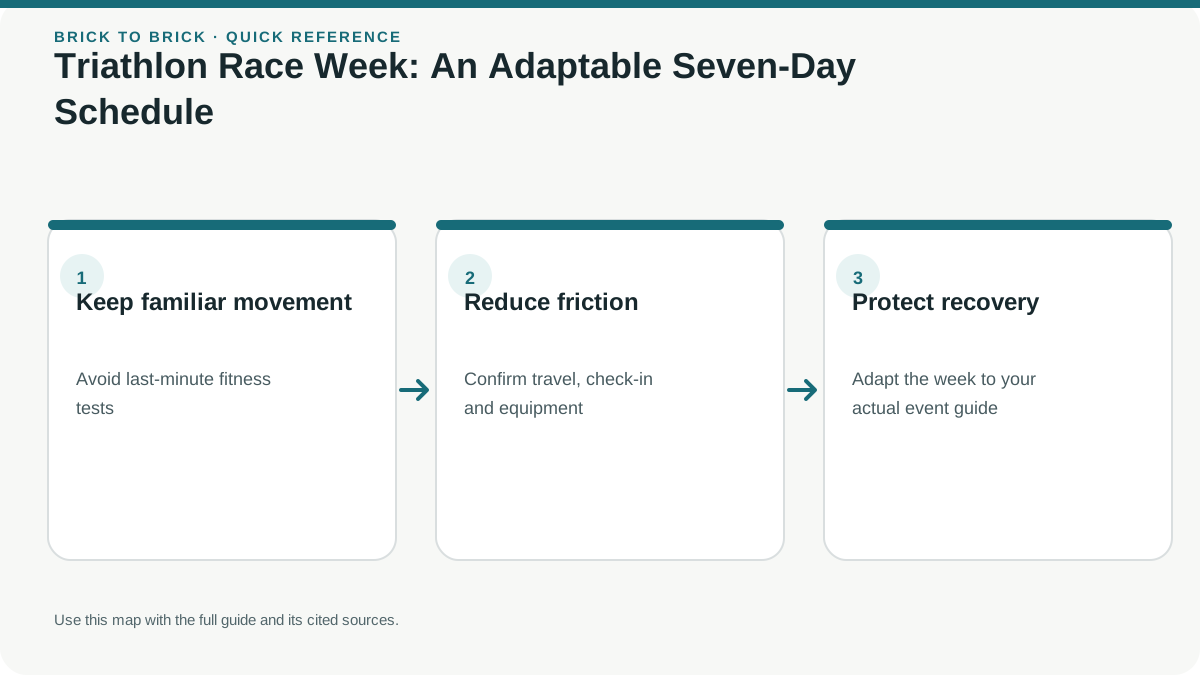
A useful triathlon race-week schedule starts with the event's current athlete guide, then fits your existing training taper around travel and deadlines. Use a relative-day plan, keep meals and equipment familiar, and adapt safely if illness, delays or event changes disrupt the week.
Key takeaways
- 1Start with the current athlete guide for your event, year and race category; check-in windows, transition access and cutoffs vary.
- 2A schedule organizes an existing taper. It cannot replace missed training or prescribe a universal final-week workout plan.
- 3Use days-before-race labels so a Saturday, Sunday or midweek start fits the same planning method.
- 4Build travel, equipment, familiar meals, sleep opportunity and supporter communication into the timetable.
- 5If you become ill, injured or unusually fatigued, prioritize appropriate medical advice and the event's withdrawal process.
In this article
- 1Start with the event calendar and your existing taper
- 2Seven to five days before: close the open questions
- 3Four to three days before: rehearse decisions, not fitness
- 4Two days before: inspect and orient
- 5The day before: make tomorrow simpler
- 6Race day and the first recovery arrangements
- 7Resolve race-week dependencies before they become urgent
- 8Adapt the week for a Saturday race or a late start
- 9Leave the next day manageable
- 10Build the timetable from fixed deadlines backwards
- 11Separate a race-week schedule from a training prescription
- 12Plan travel without turning arrival day into another workout
- 13Use event information as a versioned document
- 14Protect routine, sleep opportunity and ordinary meals
- 15Use a decision table for common disruptions
- 16Prepare supporters and plan how you will leave the venue
- ⚖Race-week disruption: what to check and what to do
- ?Frequently asked questions
Start with the event calendar and your existing taper
A taper reduces training load before competition. Research supports tapering in endurance sport, but it does not establish one seven-day recipe for every athlete. A full-distance athlete may already be tapering before this final week begins.
Put registration, briefing, travel, bike check-in and bag deadlines into the calendar first. Use “race minus six days” rather than Monday so the plan works for a Saturday or midweek event.
If you are ill, injured or unusually fatigued, seek appropriate advice and adjust participation. The calendar does not make racing mandatory.
Seven to five days before: close the open questions
Confirm the course, start procedure, travel and equipment requirements. Address a known mechanical problem while there is still time for help. Check your permitted race kit and complete any documents.
Training should follow your existing taper, with familiar sessions shortened or simplified as appropriate. Do not add a hard test because you feel uncertain about fitness. New strength exercises or a demanding long brick can introduce soreness without resolving the uncertainty.
Write down remaining tasks with an owner and a deadline. “Sort the bike” is vague; “check brakes and shifting before Wednesday” is actionable.
Four to three days before: rehearse decisions, not fitness
Review your pacing, food and fluid plans against the forecast and latest guide. Check that the actual products are available and packed. A short familiar session can confirm equipment and movement without becoming a test.
Arrange meals and sleep opportunities around travel. Do not impose a universal carbohydrate load or aggressive drinking schedule on every race distance. Use the nutrition approach you have rehearsed, with professional advice where needed.
If travel consumes the day, dropping an optional shakeout may be more useful than squeezing it in late and losing sleep.
Two days before: inspect and orient
After bike travel, complete reassembly and a controlled functional check. Locate registration and identify the route between accommodation, parking, transition and the swim start.
Read the current briefing. Ask officials about any unresolved rule or cutoff question. Course familiarisation must stay within venue permissions; a race swim course is not necessarily open for unsupervised practice.
Check what must be left overnight and what can be accessed in the morning. Split your bags accordingly so essential morning items do not disappear behind a closed transition gate.
The day before: make tomorrow simpler
Lay out clothing and breakfast supplies, charge needed devices, check alarms and put documents where you can reach them. Use the packing checklist to verify items once.
A brief familiar movement session is optional and should leave you comfortable. Do not compare your legs with how another athlete says a taper should feel. Avoid changing bike position, shoes, food or supplements because of last-minute advice.
Use the race-morning timetable to work backward from official deadlines. Share the meeting and withdrawal plan with supporters.
Race day and the first recovery arrangements
Follow the prepared sequence while responding to official updates and how you feel. Check safety-critical equipment, begin under control and use the event support process if needed.
Before leaving accommodation, know how you will return after finishing or withdrawing. Have food, comfortable clothing and help with equipment available. A successful week includes the trip home, not just the start line.
Afterward, note which logistical tasks were rushed and which were unnecessary. Keep that record for the next race so the schedule becomes specific to your circumstances rather than increasingly elaborate.
Resolve race-week dependencies before they become urgent
A dependency is an action that cannot happen until another action is complete. For example, you cannot collect a bike from a mechanic after travelling, and you may not be allowed to rack it before registering.
| Task | Depends on | Useful fallback |
|---|---|---|
| Travel with bike | Packing complete and baggage confirmed | Mechanic or rental option researched early |
| Race registration | Identification and required documents | Copies stored where accessible |
| Final course check | Latest organiser update | Ask at briefing if information conflicts |
| Post-race departure | Bike collection and realistic recovery time | Flexible transport where possible |
Put these in calendar order before adding optional short workouts. That makes race week a preparation sequence instead of seven days of unrelated advice. If work or travel disrupts the week, protect the requirements first and adapt familiar movement around them. A missed easy swim during travel does not create a debt to repay with an extra hard session before the start.
Adapt the week for a Saturday race or a late start
A Monday-to-Sunday example is only an organising convention. If your race is on Saturday, move the event-specific deadlines and preparation accordingly rather than squeezing Sunday's assumed tasks into race morning. If your start is late in the day, check food access, shade, bag storage and how long you will be waiting after leaving accommodation.
The training taper should follow the workload you actually completed and your response. Do not add a session merely because another version of the calendar has one. Keep familiar short movement where it serves a purpose and where recovery, travel and conditions allow it.
For an overnight trip, separate the packing deadline from the registration deadline. Your final opportunity to obtain a missing item may be before departure, while the final organiser briefing may occur afterward. Put both in the schedule. A bike dropped at transition the previous day may require you to carry different items on race morning.
Choose when to stop checking optional information. Read required updates, but avoid continually rebuilding the plan from unrelated race stories. If a new organiser instruction arrives, change the affected task and communicate it to anyone relying on your schedule.
Leave the next day manageable
Before travelling, arrange how you will return home, collect equipment and resume ordinary responsibilities. An ambitious post-race drive or a very early work commitment can make the end of the event harder than expected. Choose arrangements compatible with safe travel and your circumstances, and use support when needed.
Keep a short list of things that can wait, such as a detailed race report or a complete training review. Race week includes preparing for the transition out of the event, not only counting down to the start.
Build the timetable from fixed deadlines backwards
Race week has two clocks: the training plan and the event's administrative schedule. Put the event clock in first. Record when registration closes, when the briefing happens, when a bike or transition bag must be checked in, when transition opens and closes, and when athletes must report to the start. Add the location and the source for every time. A time without a venue can still leave you late if registration and transition are on opposite sides of town.
Start at the race start and work backwards to calculate your departure, arrival, parking, security, changing, toilet and transition set-up buffers. Use times stated by the organizer rather than a generic internet schedule. Some races permit race-morning bike check-in; others require it the day before. World Triathlon's event procedures and IRONMAN athlete guides show how much these details vary by competition. The current guide for your exact event, category and year is the authority.
Make a second version of this timeline for a delay or missed connection. Keep the organizer's contact details, accommodation address, mechanic details and transport plan together. A backup is not a reason to ignore an official deadline; it is a way to know what question to ask before the deadline passes.
If you race with a partner, assign responsibilities clearly. One person can check route updates while the other confirms transport, but both should know the start location, check-in time, emergency contact and withdrawal process. Share a copy that works offline in case mobile reception is poor. The calendar should show only tasks that must happen, leaving optional workouts around them rather than allowing a short session to compete with registration or sleep.
Separate a race-week schedule from a training prescription
A seven-day calendar can help organize your final approach, but it cannot tell every athlete how much to swim, ride or run. The appropriate reduction in training load depends on the preceding training, event distance, experience, recovery, injury or illness, and the athlete's response. A 2023 systematic review and meta-analysis found performance benefits from tapering across endurance studies, but the underlying studies are not a universal triathlon prescription for each age-group athlete. Use the coach or plan you have already followed to determine sessions, duration and intensity.
Use this page to place those planned sessions onto your real week. Label each as required by your plan, optional, or logistical. If travel, work or an event briefing collides with an optional session, drop or move it rather than compressing it into a late night. Do not compensate for missed training by making an easy day hard, doubling a session or extending a workout that no longer fits. The race is close; an unplanned fitness test has little diagnostic value and can create fatigue or soreness.
Keep short movement familiar. “Short” does not mean a mandatory number of minutes or intervals. It means a session scaled to the athlete's established plan and purpose, with no new exercise, equipment or intensity experiment. A rest day is also a valid plan choice; it is not lost fitness. If a clinician or coach has asked you to modify exercise, follow that individualized direction rather than copying a template.
Consider the priority of the race. A low-priority event within a larger training block may not use the same taper as a season goal. Conversely, a long-course race after a demanding build may need a taper that began before this final calendar week. The schedule should describe the plan you are actually following, not imply that race week alone creates readiness.
Plan travel without turning arrival day into another workout
Travel plans affect more than the training diary. List transport departure, arrival, bike collection or assembly, accommodation check-in, meal access, registration and the route to the venue. Leave time for delays, and identify which pieces of equipment must stay with you rather than go into checked luggage. For air travel, confirm the airline's current bicycle packaging, size, weight, fee and battery rules directly; policies differ and can change. Keep necessary medication and essential race items accessible according to the relevant travel rules.
After a journey, prioritize arriving safely and resolving practical issues. If the bike traveled separately, inspect its assembly and operation before riding; a quick check of brakes, steering, wheels, shifting and tyres is more useful than treating arrival as an opportunity for a hard ride. If you find a fault, contact a qualified mechanic or event service rather than improvising an unfamiliar repair under time pressure. Confirm the route from your accommodation to check-in and the start area in daylight if practical.
Plan food around availability rather than assuming a shop or restaurant will be open. Bring familiar shelf-stable options if allowed and suitable for your needs. If travelling internationally, check entry restrictions for food, medication and supplements with official authorities; do not rely on a forum post or assume a product can cross a border. Store important documents, emergency contacts and the athlete guide offline.
The schedule should have a version for a late arrival: which official deadlines remain, who to contact, what task can be simplified, and whether you still have enough time to participate safely. If a missed connection means arriving after mandatory check-in, ask the organizer; do not assume exceptions are available. For bike-specific travel detail, use the separate flying with a triathlon bike guide.
Use event information as a versioned document
Race information can change as an event approaches. Save the athlete guide with its publication date and check the organizer's official event page or email for updates. Make a short change log: what changed, when you learned it, and which part of your schedule it affects. If the venue, route or start time changes, update travel and supporter meeting arrangements as well as the workout calendar.
Prioritize information in this order: direct instructions from the race organizer for your event; the current event-specific athlete guide and briefing; the governing body's current rules where applicable; then general training articles for background. An old guide for last year's race can help you understand the kinds of details to look for, but it does not establish this year's cutoff, transition policy or course. If two official documents conflict, ask the organizer or head referee which instruction is current and retain the answer.
During the briefing, note the details that alter a decision: swim format and start process, course markings, drafting rules, cutoff points, penalty handling, transition access, emergency contact, and the procedure for withdrawing. You do not need to copy every announcement word-for-word. Write down the change and the action it requires. If you have an accessibility need or a medical device or medication question, contact event staff in advance and confirm the practical arrangement at check-in.
If weather or water conditions prompt an event modification, wait for the official announcement that applies to your category. Do not assume that a previous year's swim cancellation procedure or another athlete's interpretation applies. Update your start time, equipment, warm-up and supporter plan only after the new version is clear. This keeps the schedule useful when the event itself changes.
Protect routine, sleep opportunity and ordinary meals
A practical race week makes familiar routines easier to keep; it cannot guarantee perfect sleep or remove the stress of competition. Plan a reasonable opportunity to sleep around travel and early check-in, and avoid filling every open block with tasks. If your room, travel or household schedule is noisy, consider realistic options such as earplugs if you already tolerate them, a quiet period, or moving nonessential work earlier. Do not use a new sedative or supplement on race week without advice from an appropriate clinician.
Eat familiar meals that suit your normal needs and the race distance. A training reduction does not mean you should automatically cut food sharply, and a longer event does not make a last-minute loading strategy suitable for everyone. Follow a practiced plan or ask a qualified sports dietitian when an individualized strategy is important. Keep access to any prescribed medication clear and follow its instructions; do not change a dose to suit race logistics without the prescriber's guidance.
Hydration is also individual. Keep your established approach rather than forcing extra fluid because a checklist says to “hydrate well,” or restricting fluid to avoid a toilet stop. Pay attention to conditions and the plan you have rehearsed. For a new symptom, significant illness, fever, vomiting, injury or unusual fatigue, get appropriate medical advice and reconsider whether racing is safe. The event's medical team can help on race day, but it cannot make the decision to ignore serious symptoms safe.
Make the schedule forgiving: one planned meal location, one backup food option, and a bedtime window rather than a required exact sleep score. If the night before is imperfect, follow the plan you practiced and avoid making abrupt changes to food, caffeine, medication or training in response to worry.
Use a decision table for common disruptions
The useful part of a schedule is not predicting every problem; it is deciding what to protect when a problem happens. Write a brief response beside the most likely disruptions for your trip and event. Keep the response aligned with official rules and your existing training or medical advice.
| Disruption | First check | Sensible next step |
|---|---|---|
| Travel is delayed | Current check-in deadline and organizer contact | Ask the event whether options exist; do not assume an exception |
| Bike arrives late or damaged | Airline status, mechanic availability and safe assembly | Resolve safety-critical faults before riding or racing |
| A planned short session is missed | Whether it was optional or part of an individualized plan | Skip or ask your coach; do not cram it into a late night |
| Athlete guide conflicts with an email | Date, category and official event source | Ask the organizer which instruction supersedes the other |
| Weather changes the course | Official announcement for your start group | Rebuild only the affected travel, kit and supporter details |
| Illness or injury worsens | Symptoms and clinician guidance | Prioritize health and ask about withdrawal or deferral procedures |
This table is a starting point, not a universal decision rule. An event may have a specific plan for missed check-in, bike collection, medical withdrawal or transport from the course. Record the relevant contact and deadline on your own schedule. If the event cannot safely accommodate a late arrival or a course change, a backup plan can include not starting. Participation is optional; your investment in travel and training does not remove the need to respond to safety information.
Prepare supporters and plan how you will leave the venue
Supporters can help most when they know where they may go, what time information is reliable and how to reconnect if the plan changes. Share the spectator map, restricted areas, likely travel route and an agreed meeting point outside transition. Tell them which updates come from the organizer and which timing estimates are only estimates. Phone service can be patchy, batteries run down, and race timing can lag; agree on a backup contact or meeting location before the event.
Avoid sending a supporter into an athlete-only area to retrieve a bag or bike unless the event explicitly permits it. Check what identification, wristband, bib or collection credential is needed and who must be present. If you receive medical attention or withdraw, tell event staff and follow their instructions for leaving the course and collecting equipment. A person waiting at the finish may not know where you are if the race-day plan changes, so establish a simple “if we lose contact” method.
Make the trip home part of the week plan. Work out how the bike and bags will be returned, whether transport allows them, who can drive, and whether you need more time before a long journey. Fatigue after an endurance event can affect judgment and comfort; choose transport arrangements that allow you to travel safely. Put nonurgent tasks such as a detailed performance analysis, laundry or unpacking on another day.
After the event, keep only a few notes while they are fresh: a deadline you nearly missed, an item that was difficult to access, a useful official update, and one thing you would change. The point is to make the next race week more suited to your life, not to build a longer checklist every season. For the event-day flow itself, see what happens on race day.
Race-week disruption: what to check and what to do
| Disruption | First check | Practical response |
|---|---|---|
| Travel delay | Current check-in deadline and official event contact | Ask whether options exist; do not assume an exception |
| Bike issue | Safe assembly and qualified mechanic availability | Fix safety-critical faults before riding or racing |
| Missed session | Whether it was part of your established plan | Do not cram it into a late night or make it harder |
| Conflicting event updates | Which official document is current for your category | Ask the organizer and update affected plans |
| Worsening illness or injury | Symptoms and clinician guidance | Prioritize health and confirm withdrawal procedures |
Sources
Sources are listed so readers can verify consequential claims and dated details.
- Effects of tapering on performance in endurance athletes — PLOS ONE (accessed September 13, 2026)
- Triathlon FAQs: event procedures and competition rules — World Triathlon (accessed September 24, 2026)
- Effects of tapering on performance in endurance athletes: a systematic review and meta-analysis — PLOS ONE (accessed September 24, 2026)
- 2026 IRONMAN Tours Métropole-Loire Valley event schedule — IRONMAN (accessed September 24, 2026)
- 2025 IRONMAN 70.3 St. George athlete guide — IRONMAN (accessed September 24, 2026)
- 2026 Europe Triathlon Sprint and Relay Championships Elblag race information — World Triathlon (accessed September 24, 2026)
Frequently asked questions
What should I do during triathlon race week?
Use the event's current athlete guide to schedule registration, briefings, equipment check-in and race-day arrival. Fit your established taper around those fixed tasks, travel and familiar routines. Avoid adding hard workouts to replace missed preparation.
Should I do a hard workout during race week?
There is no universal answer for every athlete and event. Follow your existing individualized training plan or coach's guidance; do not add a demanding test because you feel uncertain about fitness.
How much should I reduce training before a triathlon?
Taper design depends on prior training, event distance, athlete response and other factors. Research across endurance sports does not establish one final-week schedule for every triathlete. Ask a qualified coach for individualized guidance.
What if I miss a session or travel is delayed?
Do not cram a missed workout into a late evening. Check the event's current deadlines and contact the organizer if travel threatens mandatory check-in; exceptions are not guaranteed.
Should I change my diet or hydration during race week?
Use a familiar approach suited to your event and individual needs. Do not sharply restrict food, force extra fluid or introduce a new supplement as a last-minute response. A sports dietitian or clinician can advise on individual medical or nutrition needs.