Triathlon Periodization: Organise Training Around Your Season
Use preparation phases, review points and race priorities to organise a triathlon season without treating a fixed calendar as a personal prescription.
By Lotte
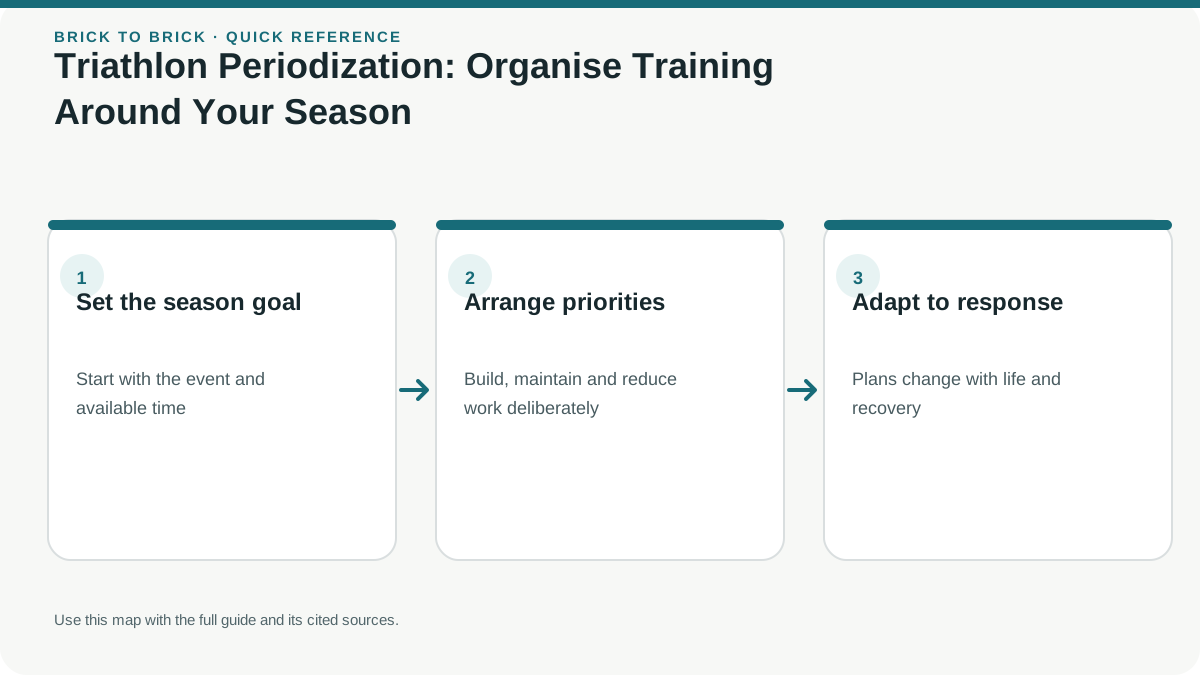
Periodization means organising training emphasis over time so preparation, specific rehearsals and recovery fit the event calendar. The phases are useful planning labels, but their duration and workload should reflect your starting point and response.
In this article
- 1Start with the race and the available runway
- 2Give each phase a practical job
- 3Use review points instead of automatic escalation
- 4Make event-specific work earn its place
- 5Taper from the work you actually completed
- 6Leave room after the finish
- 7Use a phase review with observable exit criteria
- 8Plan two events without overlapping every demanding week
- 9The three planning scales: season, training block and week
- 10Choose a planning model that answers your real constraint
- 11Balance the three sports by need, not by equal minutes
- 12A sample 16-week outline, with the assumptions made visible
- 13Use adaptation signals as information, not a pass-or-fail score
- 14Coordinate strength work, technique practice and endurance sessions
- 15Make missed training a planning problem rather than a debt
- 16A block-review worksheet you can use without specialist software
- ?Frequently asked questions
Start with the race and the available runway
Mark the event date, travel and any other races or major life commitments. Identify which event matters most and which can serve as practice. Several equally important races close together may create conflicting preparation demands.
Record current training capacity and the skills still missing. A calendar cannot compress months of skill development safely into a few weeks.
Use the first-race roadmap for beginner milestones. Periodization here explains how to organise emphasis across the whole season.
Give each phase a practical job
A foundation phase may emphasise consistent practice, technique and manageable endurance. A build phase can gradually develop the demands needed for the event. A specific phase tests pacing, equipment and supplies in relevant conditions.
A taper reduces load before racing, and a recovery phase allows the athlete to respond to the event and decide what comes next. These are functions, not mandatory blocks of identical length.
Do not label a phase “base” and then fill every session with moderate-hard work. The actual sessions determine the load, not the name.
Use review points instead of automatic escalation
At the end of a short block, review completion, symptoms, recovery and skill progress. Decide whether to repeat, progress or reduce. A lighter period can be placed when fatigue or life demands warrant it rather than only every fourth week.
Changing emphasis does not require increasing every discipline. You might maintain cycling while adding focused swim instruction, or keep running stable while learning strength exercises.
Keep one main change visible so the response can be interpreted. The training basics guide explains the variables involved.
Make event-specific work earn its place
Choose rehearsals that answer unresolved questions: can you handle the course terrain, carry supplies, maintain the intended bike position or start running under control? Do not reproduce the whole race repeatedly just because it feels specific.
Place these sessions early enough to adjust equipment or habits afterward. A rehearsal revealing a problem the day before the event leaves little room to respond.
Use brick workouts for transition questions and race fueling for the food-and-fluid system.
Taper from the work you actually completed
Endurance taper research supports reducing load before competition, but one percentage and duration does not fit every athlete. The appropriate approach depends on the preceding training and event.
Do not taper from an imaginary peak week that you never completed. Avoid using the final days to repay missed training or test fitness. Maintain familiar movement as appropriate while reducing avoidable fatigue.
The race-week schedule covers logistics and the final days. It does not replace an individual taper plan for a demanding event.
Leave room after the finish
Plan practical recovery and avoid committing immediately to another demanding block before you know how you respond. Physical and emotional recovery can differ between athletes and events.
Review what the season actually taught you: consistency, skills, equipment, scheduling and execution. Use those observations to select the next emphasis.
Periodization is useful when it makes decisions clearer. If the plan cannot adapt to illness, work or a delayed skill milestone, simplify it rather than treating the calendar as an instruction to ignore reality.
Use a phase review with observable exit criteria
Before moving from general preparation to more race-specific work, ask what the previous phase established. Are the routine sessions repeatable? Have you addressed the most important swim or handling gap? Can the calendar accommodate the next demand without sacrificing recovery?
Write two or three observations beside each phase rather than only its dates. For example, a build phase might include testing the intended bottle arrangement on a suitable ride and practising a controlled transition run. These are verifiable tasks, unlike a vague instruction to become race ready.
If the observations are not in place, repeat or simplify relevant work and reconsider the race timeline. Do not compress several phases into the remaining weeks because a chart says peak training should start. Periodization is a way to organise changing priorities, not evidence that every athlete adapts at the same speed.
Plan two events without overlapping every demanding week
Place both race dates on the calendar and identify travel and recovery time around them. Decide which event has priority and what the other is intended to provide. A shorter event might offer experience of procedures or a controlled rehearsal, but it still creates demands that need to be counted.
Avoid copying two independent plans into the same calendar. Their hardest sessions and tapers may conflict, and each assumes recovery that the other consumes. Keep one coherent progression and adapt it around the events, with qualified help when the combination is unfamiliar.
After the first event, review the actual response before continuing the next build. Finishing faster or slower than expected does not by itself establish what load is suitable immediately afterward. Consider symptoms, fatigue, logistics and the remaining preparation window.
If the second race becomes unsuitable, revise the objective rather than trying to preserve the original calendar at any cost. Periodization should make changing priorities understandable. It should not turn an early entry decision into an obligation to ignore new information about health, recovery or available time.
The three planning scales: season, training block and week
Periodization is easier to use when you separate three decisions that often get blended together. The season plan answers which events matter and when general preparation should give way to race-specific work. A training block sets one or two priorities for several weeks, such as swimming more consistently or improving steady-bike durability. The week turns those priorities into sessions that fit the athlete's actual calendar.
These scales influence one another, but they are not interchangeable. A weekly timetable cannot repair a season that has too many priority races. A season outline cannot tell you whether Tuesday is safe for hard intervals after a poor night's sleep. Use the season to establish direction, the block to choose a manageable focus, and the week to make decisions using current circumstances.
For example, an athlete targeting a late-summer Olympic-distance race might have a broad preparation period in spring, a more course-relevant block in early summer and a final reduction in load before the event. Inside a given week, that might mean three short swims, two rides and two runs, but the exact pattern depends on experience, access and recovery. The phases do not dictate a universal number of sessions.
Write a one-sentence purpose at each scale: “This is my priority race,” “This block develops comfortable bike duration,” and “This week protects the long ride and one coached swim.” If the purpose cannot be explained plainly, the plan may contain more complexity than you can act on.
Choose a planning model that answers your real constraint
Traditional phase labels such as preparation, build, competition and transition are a vocabulary for changing emphasis. They are not a proven sequence that every age-group athlete must follow with identical durations. A person learning to swim has a different limiting need from an experienced swimmer preparing for a hilly bike course. Organise the work around the demands you can identify, rather than treating a named model as a guarantee.
Some athletes prepare for one main event and can give its demands a gradual arc. Others have several races and need to decide which will be priorities and which are practice or participation events. A busy parent may use repeated three-week blocks because those match childcare and work cycles, while another athlete may need shorter blocks around shift changes. Consistency and review matter more than making the chart look sophisticated.
Keep hard training stress visible. A “base” month filled with frequent maximal tests is not easy just because it has a base label. A “recovery week” with a long race simulation is not a recovery week. Look at session purpose, duration, intensity, strength work, travel and non-training stress together. The International Olympic Committee's load consensus discusses training, competition and psychological demands as connected parts of the load picture; it does not offer a universal weekly progression formula (IOC consensus on training load and injury risk).
When choosing between planning models, ask which one helps you make the next useful decision. If the structure cannot explain what to do after illness, a missed week or an unexpectedly hard race, it is too rigid for real life.
Balance the three sports by need, not by equal minutes
A triathlon plan does not have to divide time evenly among swim, bike and run. Equal hours would often be an unhelpful target because the sports have different skill demands, injury costs, access requirements and event distances. Swimming may need frequent, relatively short practice because water feel and technique can fade when sessions are rare. Cycling may carry more aerobic duration for long-course preparation. Running usually deserves careful progression because additional impact can be harder to absorb.
Start by listing the event's key demands and your current gaps. For each discipline, note the minimum practice needed to maintain familiarity, the one quality you want to develop, and the recovery cost of adding work. A beginner whose main risk is losing composure in open water may benefit more from lessons and supervised exposure than from adding pool laps. A confident swimmer with limited bike endurance may direct more of the next block toward riding.
Do not let the weakest discipline automatically become the hardest discipline every week. Technique work can be deliberately easy, and a strength can still need maintenance. If the schedule forces every session to be long, hard or “make up” work, reduce the plan until all three sports and recovery can coexist.
Use a short review table at the end of each block: What improved? What still limits the event? What got skipped? What was hardest to recover from? The next emphasis should answer that review. This method makes the calendar responsive without changing the whole plan whenever one workout feels unusually good or bad.
A sample 16-week outline, with the assumptions made visible
The outline below shows how priorities can change; it is not a training prescription. Assume an athlete already exercises regularly, can swim continuously in a pool, has basic bike handling skills and has selected a local Olympic-distance race. Someone starting from a different place needs a different runway and may benefit from qualified coaching.
| Approximate period | Main planning question | Possible emphasis |
|---|---|---|
| Weeks 1–4 | Can the routine fit and repeat? | Establish regular low-stress practice across all three sports; address technique and equipment access. |
| Weeks 5–8 | Can training progress without recurring fatigue? | Add a modest duration or skill demand to selected sessions; maintain easy work and a planned lighter week if useful. |
| Weeks 9–12 | Which race demands still need rehearsal? | Practise relevant terrain, controlled transitions and familiar fueling logistics; avoid turning every session into a simulation. |
| Weeks 13–14 | What should be familiar by race day? | Complete only the key rehearsals that still answer a question; avoid last-minute equipment experiments. |
| Weeks 15–16 | How can fatigue be reduced while routine remains? | Reduce training load based on completed preparation, retain appropriate familiar movement and focus on logistics. |
The table says nothing about exact hours because the athlete's history, health, time and response are unknown. If a pool closure, illness or work trip removes a week, do not compress its work into the next one. Reassess what the race requires and what preparation remains possible. A calendar estimates the path; it does not establish that the body has adapted to every scheduled step.
Use adaptation signals as information, not a pass-or-fail score
A useful review combines planned work with how the athlete is coping. Record sessions completed, but also note unusual fatigue, pain, sleep disruption, motivation, work stress and whether easy efforts still feel easy. No single measure is a reliable diagnosis or a complete picture of readiness. Wearable estimates and training-load scores can make patterns easier to notice, but they do not determine what an individual can safely tolerate.
Compare similar sessions under reasonably similar conditions. A heart-rate value from a hot day, a hilly route or an emotionally stressful morning is not a clean comparison with a cool, flat, relaxed session. A missed interval workout because of work may indicate a scheduling problem rather than poor motivation. A repeated inability to complete planned easy work may signal that the plan, recovery or health needs attention.
Use a simple traffic-light conversation with yourself or a coach: green means routine work is manageable; amber means a specific stressor or symptom calls for adjustment; red means stop the relevant training and seek appropriate medical advice when symptoms warrant it. This is a communication aid, not a medical screening tool. Chest pain, fainting, severe breathlessness or other alarming symptoms need urgent evaluation rather than calendar edits.
When the pattern points to under-recovery, first remove avoidable load. Do not respond to declining readiness by adding more tests. If unusual fatigue, recurrent illness, persistent pain or a major change in mood continues, speak with a qualified clinician. Periodization is most valuable when it helps you respond early instead of explaining away warning signs.
Coordinate strength work, technique practice and endurance sessions
The season has more than one training ingredient. Strength work, swim instruction, bike skills and easy aerobic sessions compete for time and recovery. Treat each as part of the same schedule rather than placing strength or technique into an imaginary spare week. If the principal adaptation you want is endurance, a strength session that leaves you sore for several days may interfere with it; if the priority is learning safe bike handling, the skill session should happen while you are alert rather than at the end of an exhausting ride.
Keep a priority order for limited weeks. A coached lesson may be difficult to reschedule; a low-priority extra spin may be easier to omit. Combine sessions only when the combination is practical and safe. For example, some athletes place brief strength work after an easy session to protect a separate rest day, while others need more separation. There is no single optimal arrangement independent of work, sleep and experience.
As a race approaches, some athletes reduce strength-session volume to avoid soreness while retaining familiar movements. That choice should be based on the athlete's established practice, not on a late introduction of heavy lifting. Similarly, race-specific bike-to-run practice has a cost: it can be useful for learning pacing and transition feel, but it is still training stress that belongs in the load picture.
Write the purpose beside each demanding session and identify what it displaces. If two high-priority sessions repeatedly collide with poor recovery, move one, reduce one or ask a coach to sequence them. A week with fewer well-chosen sessions can support the season better than a week full of competing objectives.
Make missed training a planning problem rather than a debt
Work travel, childcare, illness, weather and pool closures are normal parts of an age-group season. Treating each missed session as debt encourages risky compression: extra doubles, back-to-back hard days or a long workout inserted into a week already carrying fatigue. A session is not a bank deposit that must be repaid before race day.
When something changes, sort the missed work by function. Was it a key skill lesson, a routine easy session, a long aerobic outing or a race-specific rehearsal? Some sessions matter more to the athlete's preparation, but the answer depends on current gaps and remaining time. Keep what can be moved without disrupting recovery, let low-priority volume go, and re-evaluate the event plan if essential preparation is no longer realistic.
For a short interruption, returning to the last workload that felt repeatable may be more sensible than jumping to the week printed on a plan. Illness requires particular care: training decisions should follow symptom severity and appropriate medical advice, especially after systemic or chest symptoms. There is no universal number of days after which everyone can resume hard exercise.
If interruptions happen repeatedly at the same time, change the structure. Move the key session away from a predictable work commitment, identify an indoor alternative, or deliberately schedule a lighter week. Periodization should make the plan fit the person and the season; it should not make ordinary life feel like non-compliance.
A block-review worksheet you can use without specialist software
At the end of a block, write a short review before selecting the next one. The worksheet below is deliberately small; it focuses attention on decisions rather than producing another score.
- Event demand: What part of the race is least familiar or most likely to constrain a safe, satisfying day?
- Starting evidence: What have recent sessions actually shown about that demand? Separate observation from guesswork.
- Block focus: What single quality or routine will receive more attention for the next few weeks?
- Protection: Which easy session, rest opportunity or life commitment must remain protected for the focus to be sustainable?
- Exit signal: What observation would make you repeat, progress or stop this emphasis?
- Contingency: What is the simpler option if time, sleep, weather or health changes?
An example answer could be: “I want a more reliable open-water routine; in two supervised sessions I still needed frequent stops to reorient; this block includes a weekly coached or supervised swim when access is available; no solo open-water sessions; if the venue closes, use pool sighting practice and reschedule rather than swimming alone.” That statement is useful because it identifies context, a specific aim and a safety boundary.
Keep the previous review. After several blocks, it helps distinguish a real pattern from a single bad week and shows where the plan repeatedly failed to fit. If you work with a coach, share the page rather than only a training app's totals. The conversation can then address both the sessions and the circumstances in which they occurred.
Sources
Sources are listed so readers can verify consequential claims and dated details.
- Effects of tapering on endurance performance — PLOS ONE (accessed September 14, 2026)
- Physical activity and sedentary behaviour guidelines — World Health Organization (accessed September 14, 2026)
Frequently asked questions
Should I peak for every race on my calendar?
That is rarely a practical planning assumption. Decide which events are priorities and which serve another purpose, such as experience or a controlled rehearsal. Recovery and preparation between them still matter. Label those purposes clearly so every event does not trigger an overlapping maximal training block.