Triathlon Training Week Examples: Beginner, Intermediate & Advanced
Three fully worked sample triathlon weeks — around 4-5, 7-9 and 12-15 hours — with the reason behind every session and how to read and adapt them to your own week.
By Lotte
Three complete example weeks — roughly 4-5, 7-9 and 12-15 hours — laid out day by day, with the reason behind where each session sits. They are illustrations to learn the pattern from, not prescriptions: pick the week closest to the time you can genuinely repeat, read why it is shaped the way it is, then adapt it to your own calendar. For the method of arranging sessions around your life, and for full multi-week plans by distance, this page points you to the guides that own those jobs.
Key takeaways
- 1Pick the week that matches the hours you can repeat every week, not the biggest one you can survive once.
- 2All three examples share one shape: mostly easy training, only one or two genuinely hard sessions, hard days kept apart, one long session, and at least one full rest day.
- 3The sample weeks are illustrations, not prescriptions — treat the sessions as a pattern to copy, and set your own durations and intensities from your current fitness.
- 4Every third or fourth week, keep the same layout but cut volume by roughly a third so your body absorbs the work.
- 5These examples show what a week looks like; a separate guide covers how to arrange sessions around your real availability, and full plans cover how weeks stack over a season.
In this article
- 1How to use these example weeks
- 2What every good week has in common
- 3Beginner example week — about 4-5 hours
- 4Intermediate example week — about 7-9 hours
- 5Advanced example week — about 12-15 hours
- 6How the same week changes across a season
- 7Recovery weeks: the easy week that makes the hard ones work
- 8How to adapt these examples to your real life
- ⚖The three example weeks at a glance
- ?Frequently asked questions
How to use these example weeks
Most people meet triathlon training as a wall of numbers — hours, zones, percentages — without ever seeing what an ordinary week actually looks like when it is written out. That is what this page is for. Below are three complete weeks at three different time budgets, laid out day by day, with a short note explaining why each session sits where it does.
Two things to hold in mind before you read them:
- These are illustrations, not prescriptions. They show a pattern — the order and spacing of sessions — that you can copy. The exact durations and intensities should come from your own current fitness and history, not from a number printed here. A "30-minute easy run" means different things to different people.
- Pick the week you can repeat, not the one you can survive. The most common mistake is choosing the biggest week you could get through once on a good week. Consistency over months is what builds a triathlete, so choose the level whose hours you can realistically hit most weeks, including the busy ones.
This page shows what a week looks like. Two neighbouring guides own the jobs around it: for how to place these sessions around work, family and pool times, use how to structure a triathlon training week; to understand how to read a single session — its frequency, duration, intensity and purpose — use triathlon training basics. When you are ready for a full schedule that stacks weeks toward a race, move to training plans.
What every good week has in common
Before the specifics, notice the shape all three examples share. Once you can see it, you can build or fix a week yourself instead of copying one.
- Mostly easy, a little hard. The bulk of every week is comfortable, conversational training, with only one or two genuinely hard sessions. Endurance athletes who train well spend the large majority of their time at low intensity and a small, deliberate slice at high intensity — the "hard" sessions are effective precisely because they are rare.
- Hard days are kept apart. A hard bike and a hard run are separated by an easy day or a rest day, never stacked back to back, so that each hard session is done in a recovered state and each easy day stays genuinely easy.
- One session is the long one. Each week has a clearly longest session — usually a ride, often at the weekend when time allows — that builds durability. Everything else is shorter.
- At least one day is real rest. A rest day is part of the training, not a gap in it. Adaptation happens during recovery, not during the session itself.
- The week is repeatable. The test of a good week is not whether you finished it, but whether you could do something similar again next week without accumulating fatigue, niggles or dread. Sudden jumps in training load are associated with higher injury risk, which is why progression is gradual and why a repeatable week beats a heroic one.
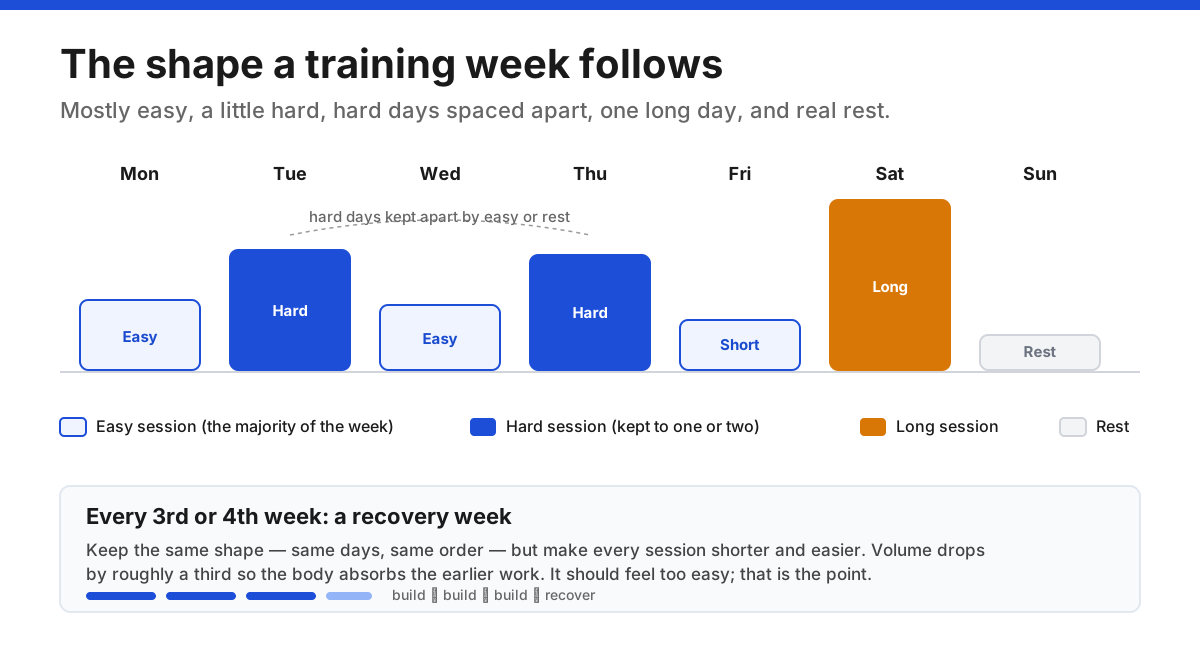
The diagram above shows this shape at a glance: easy blocks most days, one or two taller "hard" blocks spaced apart, a long block at the weekend, and a rest day — with a lighter recovery week every third or fourth week. Every example below is just this pattern scaled to a different number of hours.
Beginner example week — about 4-5 hours
This week suits someone new to multisport, or returning after a long break, aiming at a sprint or an early-season olympic-distance race. The whole point is consistency and comfort in all three sports, not intensity.
| Day | Session | Purpose |
|---|---|---|
| Monday | Swim 30 min — technique and drills | Skill practice while fresh |
| Tuesday | Run 30 min easy — run/walk intervals are fine | Gentle impact, easy effort |
| Wednesday | Bike 45 min steady | Comfortable aerobic time |
| Thursday | Swim 30 min continuous | Build swim endurance |
| Friday | Rest | Absorb the week |
| Saturday | Brick — Bike 40 min + Run 15 min | First taste of running off the bike |
| Sunday | Easy walk or full rest | Recover for next week |
Total: about 4.5 hours.
How to read it. The two swims sit early in the week and start with technique, because skill is learned best when you are fresh, not fatigued. The one slightly novel session — the brick, a bike immediately followed by a short run — is parked on Saturday when you have time and no work pressure, and it is kept short so the legs learn the transition without being overloaded. Nothing here is hard in the interval sense; "easy" and "steady" are doing the heavy lifting. Friday is a true rest day, and Sunday is optional, so a missed session never derails the week. If life takes a day, drop the lowest-priority session rather than cramming it into the weekend.
Intermediate example week — about 7-9 hours
This week fits an athlete with a season or two of consistency, training for an olympic or half-distance race, who is ready to add structured intensity on top of a reliable easy base.
| Day | Session | Purpose |
|---|---|---|
| Monday | Swim 45 min — drills + main set | Skill plus aerobic work |
| Tuesday | Run 50 min including ~20 min at tempo | The week's hard run |
| Wednesday | Bike 75 min with 3 × 8 min controlled hard | The week's hard bike |
| Thursday | Swim 45 min — open-water skills | Race-specific practice |
| Friday | Run 30 min easy + strength 30 min | Easy day; supporting work |
| Saturday | Long bike ~2 h steady + 20 min run off the bike | Endurance + brick |
| Sunday | Long run 60 min easy | Aerobic durability |
Total: about 8 hours.
How to read it. Now there are two genuinely hard sessions — the tempo run on Tuesday and the bike intervals on Wednesday — and notice they are not on the same day and are wrapped in easier work. Thursday's swim and Friday's easy run keep those two hard days apart from the demanding weekend. The weekend carries the two longest sessions: a long ride with a short run off it, then a long easy run the next day, which teaches the body to run on tired legs the way a race demands. The strength work is deliberately placed on an easy day and after the run, not before a hard session. Every easy session must stay honestly easy — if Tuesday and Wednesday are done at the right intensity, the temptation is to make the "easy" days moderately hard, which quietly turns a well-shaped week into a uniformly tiring one.
Advanced example week — about 12-15 hours
This week reflects an experienced athlete with years of consistency training for a half or full-distance race, who can recover from two sessions on some days. It is included to show how the same shape scales up — not as a target to jump to.
| Day | Session | Purpose |
|---|---|---|
| Monday | Swim 60 min speed set + strength 30 min | Quality swim; supporting strength |
| Tuesday | Bike 90 min intervals + 30 min run off the bike | The week's hard bike + brick |
| Wednesday | Swim 60 min endurance + run 50 min tempo | Aerobic swim; the week's hard run |
| Thursday | Bike 75 min recovery + swim 30 min easy | Deliberate easy day |
| Friday | Run 45 min with intervals | Shorter quality run |
| Saturday | Long bike 3-4 h + 30 min run off the bike | Key endurance session |
| Sunday | Long run 90 min easy | Aerobic durability |
Total: about 13 hours.
How to read it. The volume comes from doubles — two sessions on several days — not from making every session hard. Even here, the hard sessions are a minority: the bike intervals, the tempo run, the Friday quality run, and the long weekend work. Thursday is an explicit recovery day sitting between the mid-week quality and the big weekend, and the recovery ride is meant to be genuinely gentle. The long ride plus run off the bike on Saturday is the single most important session of the week; everything else is arranged to protect it. Reaching this volume safely takes months of progression, which is where a full multi-week structure and, often, a coach come in — see training plans and triathlon periodization for how a week like this is built up to, rather than dropped into.
How the same week changes across a season
A single week is a snapshot. Over months, the shape above stays remarkably constant while the emphasis shifts — this is periodization, and it is why one example week cannot describe a whole season.
- Base phase: more easy volume, longer steady sessions, very little hard work. The week looks like the examples with the intensity dialled down and the long session emphasised.
- Build phase: the hard sessions become more race-specific — the tempo and interval work in the intermediate and advanced weeks sharpens toward your event's demands.
- Peak phase: volume plateaus or eases slightly while the key sessions rehearse race pace and race nutrition.
- Taper: in the final week or two, volume drops sharply but a little intensity is kept, so you arrive fresh rather than flat.
The examples on this page are drawn from a build phase, which is why they include structured intensity. If you want to understand how these phases fit together across a full block, read triathlon periodization explained; for the final stretch specifically, see how to taper for a triathlon. This page stays deliberately in the "one week" frame so the two guides do not repeat each other.
Recovery weeks: the easy week that makes the hard ones work
None of the three example weeks should be repeated indefinitely. Roughly every third or fourth week, insert a recovery week: keep the same layout — the same days, the same session types in the same order — but cut the volume by around a third and ease the intensity of the hard sessions.
The purpose is to let your body absorb the training you have already done. Fitness is built in the recovery after hard work, not during it, and a recovery week is that principle applied at the scale of a month. It will feel too easy, and that unease is the most reliable sign you are doing it right. Resist the urge to "make up" the missing hours; the point of the week is the missing hours.
How often you need one, and how deep it goes, depends on your age, life stress and how much you are training — it is one of the most individual parts of the sport. For a fuller treatment of when and how to back off, including the warning signs that you have left it too late, see the triathlon recovery week and deload guide.
How to adapt these examples to your real life
A week that fits perfectly on paper still has to survive contact with your actual calendar. Adapt these examples rather than obeying them:
- Start from the closest level, then adjust the total. If the intermediate week is a stretch, take its shape — two hard days apart, a long weekend session, a rest day — and run it at beginner hours. The pattern matters more than the total.
- Move sessions by purpose, not by guilt. If a hard session has to move, keep it away from the other hard day and away from your long session. If an easy session gets squeezed out, it is usually fine to simply drop it — not every workout carries equal weight.
- Protect the long session and the rest day first. When time is tight, these two are the last to go. Trim the middle of the week before you touch either end of it.
- Count everything, including the hidden load. A commute by bike, a lunchtime swim's travel and changing time, and heavy days at work all add to the load your body is managing, even when they are not on the plan.
The mechanics of fitting sessions around fixed commitments — pool times, childcare, daylight, work — are covered in depth in how to structure a triathlon training week, and, for genuinely time-poor stretches, in the simplest plan for busy weeks. If juggling training with a full-time job is the core challenge, training around work tackles that directly. Use those for the how; use the examples above for the what.
The three example weeks at a glance
| Beginner | Intermediate | Advanced | |
|---|---|---|---|
| Total time | ~4.5 h | ~8 h | ~13 h |
| Swim / Bike / Run | 2 / 1 / 2 | 2 / 2 / 3 | 2 / 3 / 3 |
| Hard sessions | 0 (all easy) | 2 | 3-4 |
| Longest session | Brick ~55 min | Long bike ~2 h | Long bike 3-4 h |
| Doubles (2/day) | None | Weekend brick | Several days |
| Rest days | 1-2 | 1 | 1 |
| Main focus | Consistency & skill | Endurance + intensity | Race-specific volume |
Sources
Sources are listed so readers can verify consequential claims and dated details.
- The training intensity distribution among well-trained and elite endurance athletes — Frontiers in Physiology (2015) (accessed September 17, 2026)
- Training-load changes and injury: systematic review — International Journal of Sports Physical Therapy (accessed September 17, 2026)
- Physical activity and sedentary behaviour guidelines — World Health Organization (accessed September 17, 2026)
Frequently asked questions
How many hours a week should I train for a triathlon?
Enough that you can repeat the week reliably, which for most beginners aiming at a sprint or olympic race is around 4-6 hours, rising to 7-9 hours for a committed olympic or half-distance athlete and 12-15+ hours for advanced half and full-distance training. The examples on this page show what those levels look like. Choose the total you can hit in an ordinary busy week, not your best week, because consistency over months matters far more than any single big week.
Are these example weeks a plan I can just follow?
Treat them as illustrations of a pattern, not a prescription. They show the order and spacing of sessions you can copy, but the exact durations and intensities should come from your own current fitness. For a structured schedule that progresses week to week toward a specific race distance, use a full training plan rather than repeating a single example week.
Why is most of the week easy instead of hard?
Endurance fitness is built mainly through a large volume of comfortable, aerobic training, with only a small, deliberate amount of hard work. Athletes who train well spend the majority of their time at low intensity. Making the easy days moderately hard is the most common way a well-shaped week quietly turns into a uniformly tiring one that is harder to recover from and easier to get injured on.
Can I move the long ride and long run off the weekend?
Yes. The weekend is convenient for most people, not compulsory. Place your longest sessions wherever you have the time and can recover around them, but keep them away from your hard interval days and try not to stack the two longest sessions on consecutive days unless that fatigue is part of your goal.
How often do I need a recovery week?
A common rhythm is every third or fourth week, but it is individual — older athletes, those under high life stress, and those training more hours often need them more frequently. Keep the week's usual shape but cut volume by around a third and ease the hard sessions. If you feel stale, unusually fatigued or your motivation drops, that is a signal to take one sooner rather than later.