How to Improve Your Triathlon Performance: Prioritise for the Biggest Gains
Getting faster is a prioritisation problem, not an effort problem. Diagnose your real limiter, rank improvements by return on training time, and run an improvement cycle that actually sticks.
By Lotte
Most triathletes try to get faster by training harder or buying something. But with a fixed number of hours in your week, getting faster is really a prioritisation problem: the question is not how to improve every discipline at once, it is which single change returns the most race time per hour you invest. This guide gives you a way to diagnose your true limiter, rank every possible improvement by return on training time, understand why you have plateaued, and run a short test-target-train-retest cycle. It deliberately does not re-teach how to swim, ride with power or pace a race — it points you to the guides that own each of those jobs, and stays focused on the decision of what to work on first.
Key takeaways
- 1Getting faster is a prioritisation problem: with limited hours, the winning move is choosing the one change that returns the most time, not doing everything harder.
- 2Diagnose your limiter from your own race and training data before you train it — the discipline that costs you the most time relative to similar athletes is usually not the one you enjoy training most.
- 3Rank improvements by return on training time: weigh how much time a change could save against how many hours it costs and how trainable it actually is right now.
- 4For most age-groupers the biggest levers are boring — consistency and aerobic base, then the weakest discipline, then race execution — while gear and marginal gains come last.
- 5Work in focused four-to-six-week blocks: test where you are, target one limiter, train it, then retest to confirm the change was real before moving on.
In this article
- 1Getting faster is a prioritisation problem, not an effort problem
- 2Before anything clever: is your base actually consistent?
- 3Diagnose your limiter before you train it
- 4Rank every improvement by return on training time
- 5The hierarchy of gains: where age-groupers actually find time
- 6Why you have plateaued
- 7Run an improvement cycle: test, target, train, retest
- 8When your biggest limiter isn't the one to fix right now
- ⚖Ranking improvements by return on training time
- ?Frequently asked questions
Getting faster is a prioritisation problem, not an effort problem
Once you have a season or two behind you, the honest reason most triathletes stop improving is not that they train too little or want it too little. It is that they spread a fixed number of hours thinly across everything — a bit more swimming, a bit more riding, a new gadget, a harder Saturday — and hope the sum adds up to a faster race. It rarely does.
The useful reframe is this: you do not have a fitness problem, you have an allocation problem. Your week holds a fixed, roughly non-negotiable number of training hours. Getting faster is the question of where those hours buy the most race time. A change that saves you four minutes for two focused weeks of work is worth far more than one that saves thirty seconds for three months of grind — and yet athletes routinely pick the second because it is the discipline they enjoy or the gear they can buy.
This guide is not another list of ways to get faster; the individual how-tos already have their own homes on this site, and they are linked throughout. What this page owns is the decision underneath all of them: what to work on first, and how to know. Everything below is a way of answering that. If you are earlier in the journey and still building the habit itself, start with triathlon training basics and come back here when your limiter is a specific thing rather than "everything."
Before anything clever: is your base actually consistent?
Almost every plateau in age-group triathlon has the same unglamorous first cause, and it is worth ruling out before you diagnose anything more sophisticated: inconsistent, interrupted training. Three good weeks followed by a missed one, repeated across a season, does not build the same athlete as ten steady weeks in a row, even if the total hours look identical on a spreadsheet.
So the very first question in any improvement plan is not "what should I train?" but "am I actually stringing weeks together?" If your training history has holes in it — from illness, work crunches, motivation dips or over-ambitious weeks you could not repeat — then the highest-return change is simply a plan you can complete, week after week, at a volume you can genuinely sustain. That single fix outperforms almost anything else on this page.
Two ideas do most of the work here, and both have their own guides, so this page will not repeat them:
- Volume you can repeat beats volume you can survive. A realistic, sustainable week done fifty times a year builds far more than a heroic week done ten times. For how to build one around your actual life, see training plans.
- Most of that volume should be genuinely easy. Well-trained endurance athletes spend the large majority of their time at low intensity, which is what lets them absorb the small, deliberate slice of hard work that actually drives adaptation. If your "easy" days are secretly moderate, you are training in a grey zone that is too hard to recover from and too easy to build speed. The physiology of that is covered in zone 2 training explained.
If, and only if, your base is genuinely consistent and mostly easy, does it make sense to go looking for a more specific limiter. Ninety per cent of the time, do this step first.
Diagnose your limiter before you train it
Your overall finish time is limited by the disciplines and skills where you leak the most, relative to athletes of similar overall ability. The mistake is to assume you know which one that is — most of us train our strongest discipline because it is the most enjoyable, and quietly avoid the one that actually costs us the race. Diagnosis fixes that. Here is how to find your real limiter from data you already have:
- Compare your splits to similar athletes, not to your own history. Pull the results of a recent race and look at where you sit in your age group by discipline. If you are 40th on the swim, 15th on the bike and 20th on the run, your swim is bleeding time — even if it feels fine — because that is where you are furthest from your peers. A discipline you are already good at has less time left to give.
- Separate the "which discipline" question from the "which quality" question. Losing time can mean you lack endurance (you fade badly in the back half), top-end fitness (you cannot hold a hard effort), skill and economy (you work harder than others for the same speed), or execution (you had the fitness but paced or fuelled it away). Endurance and top-end fitness are trained very differently, so naming the quality matters as much as naming the sport.
- Look at the shape of your fade. A run split that collapses in the final third usually points to durability, pacing or fuelling — not a lack of run speed. A structured way to see whether you are actually holding aerobic effort or drifting is the aerobic decoupling / heart-rate-drift test.
- Trust objective measures over feel where you can. On the bike, training with a power meter and an honest FTP test tell you whether your cycling is genuinely limiting or just uncomfortable; in the water, most athletes over-estimate their swim fitness and under-estimate their technique loss.
The output of this step is one sentence: "My limiter is [discipline] + [quality]." For example, "my limiter is swim economy," or "my limiter is bike endurance in the back half," or "my limiter is run execution, not run fitness." You cannot rank improvements until you have written that sentence.
Rank every improvement by return on training time
Once you have a limiter, you will usually find several plausible ways to attack it, plus a pile of tempting distractions. To choose between them, score each candidate on three axes — and be honest, because this is where wishful thinking creeps back in:
- Time it could save. Roughly how much finish time is genuinely on the table? A discipline where you are far behind your peers has a lot; a discipline where you are already strong has little, no matter how hard you push it.
- Training cost. How many weeks and hours does the change realistically take to show up in a race? Skill and execution changes are often cheap; deep endurance and top-end fitness are expensive.
- How trainable it is right now. Some limiters respond quickly (technique, pacing, fuelling); others are slow and constrained by your life stage, time budget or injury history. A change you cannot actually commit to is worth zero, however large its ceiling.
The best first project is the one with a high time-saved, low training-cost, high-trainability profile — which is very often a skill, economy or execution change rather than a raw-fitness one. That is why "get a swim technique lesson" or "practise pacing" so often outperforms "add another two hours of riding": the return per hour is simply higher. Use the table below as a starting map, then adjust it for your own diagnosis — your numbers are personal, but the ordering logic is general.
The hierarchy of gains: where age-groupers actually find time
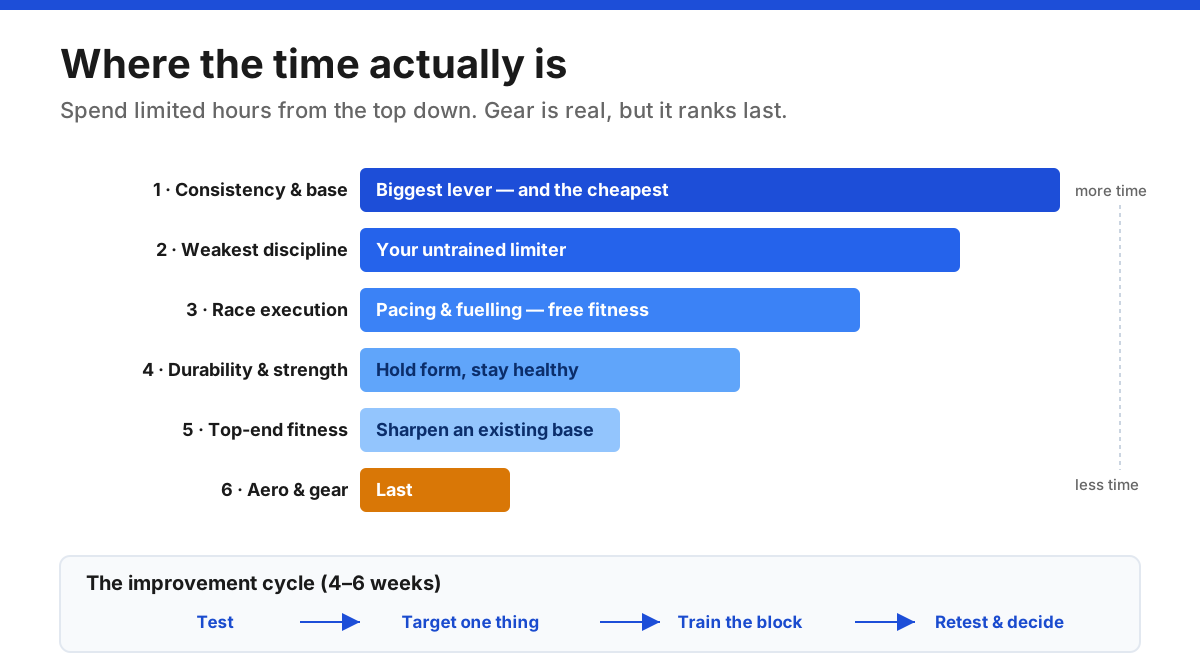
Across a lot of amateur triathletes, the levers that return the most time fall into a fairly stable order. Think of it as a hierarchy — spend from the top down, and do not skip a tier because a lower one is more fun or easier to buy.
- Consistency and aerobic base. The single largest lever, and the cheapest, because it costs organisation rather than money. Nothing below matters if this is leaking.
- Your weakest discipline. The place you are furthest from your peers has the most time to give. This is almost always where the second-biggest gains live, and almost always the training you least want to do.
- Race execution. Pacing, fuelling and transitions convert the fitness you already have into a result. An athlete who blows up at 30 km can find minutes here without getting one watt fitter — see pacing strategy for how to actually execute it.
- Durability and supporting work. The ability to hold form and output deep into a race, plus strength training to resist the fade and protect against injury, so you can train consistently in the first place.
- Top-end fitness. Threshold and VO2 work sharpen an athlete who already has the base — useful, but a smaller and slower return than the tiers above for most age-groupers. See threshold vs sweet-spot training and VO2 max explained.
- Marginal gains and gear. Aerodynamics genuinely matter at speed — a lower position, clip-on aero bars and an aero helmet really do save time — but they sit last for a reason: they are the smallest and most expensive slices, and they cannot rescue a leaking base or an untrained limiter. Buy them once the tiers above are handled, not instead of them.
The reason the order matters is that most triathletes invert it: they shop at tier six while tiers one and two go unaddressed. Getting faster efficiently means spending your attention from the top of this list downward.
Why you have plateaued
If you were improving and then stopped, the plateau almost always traces to one of a small set of causes. Naming yours tells you which lever to pull:
- Your body adapted and the stimulus didn't change. Doing the same week forever produces the fitness that week supports, then stops. Progress needs the load to advance gradually over time — which is the whole point of structuring a season. If your training has been flat for months, periodisation is the fix, not more of the same.
- You live in the grey zone. Training that is always moderately hard — too hard to be recovery, too easy to be a real stimulus — is the most common plateau of the committed amateur. The fix is to make easy days truly easy and hard days truly hard, so each does its job.
- You are under-recovered, not under-trained. Adaptation happens during recovery, not during the session. If you are training more but racing the same or worse, the missing ingredient is usually sleep and recovery and properly placed recovery weeks, not another hard session.
- You keep training your strengths. A plateau in your overall time is often just an untrained limiter dressed up as bad luck. Re-read your diagnosis: are you actually working the weakest link, or the one you like?
Ramping load too aggressively to break a plateau tends to backfire, because sharp increases in training load are associated with higher injury and illness risk — and nothing stalls progress like three weeks off. Advance the work, but advance it gradually.
Run an improvement cycle: test, target, train, retest
Diagnosis and ranking are worthless if you never close the loop. The way to actually convert them into a faster race is a short, disciplined cycle — usually four to six weeks — repeated across a season:
- Test. Establish an honest baseline for your limiter. That might be an FTP test, a swim time-trial over a set distance, a run off the bike at target effort, or a decoupling test. Write the number down. A change you cannot measure is a change you cannot confirm.
- Target one thing. Pick the single highest-return improvement from your ranking and commit the block to it. One limiter at a time is a feature, not a limitation — chasing three at once is how athletes make no measurable progress on any of them.
- Train the block. Bias the block toward that limiter while keeping the other two disciplines ticking over enough not to regress. Protect your consistency and your easy volume throughout; the limiter work is the seasoning, not the whole meal.
- Retest and decide. Repeat the same test under the same conditions. Did the number move? If yes, bank it and pick the next limiter. If no, ask whether the diagnosis was wrong, the stimulus too small, or the recovery too poor — then adjust before you move on.
This loop is what separates "training a lot" from "getting faster." It forces you to work on the thing that matters, and it gives you evidence — rather than vibes — about whether it worked. For the broader habit of turning your own numbers into decisions, data-driven triathlon training goes deeper on the measurement side; this page stays focused on the choice of what to measure and change.
When your biggest limiter isn't the one to fix right now
The hierarchy and the ranking assume you can act on your top limiter. Sometimes you cannot, and that is a legitimate reason to work on a different one — as long as you choose it deliberately rather than drifting.
- Life constraints can veto a lever. If your biggest gain is swim volume but you have pool access twice a week at best, the executable improvement — the one you will actually do — may be a technique change or a bike-execution gain instead. A smaller change you complete beats a bigger change you skip.
- Injury and health come first. If a limiter is being caused or masked by a niggle, the real project is addressing that, not grinding through it. You cannot train consistently, which is the top of the whole hierarchy, from the sidelines.
- The calendar decides the lever. Deep endurance is a base-season project; race execution and sharpening belong closer to the event. Working the right thing at the wrong time of year is its own kind of misallocation — match your limiter work to the phase you are in.
- Distance changes the ranking. The limiter that costs you a sprint is not the one that costs you an Ironman. As the race gets longer, durability, fuelling and pacing climb the hierarchy and raw top-end speed falls; re-run your diagnosis for the specific event you are training for.
The thread through all of it is the same: get faster by deciding, on purpose, where your limited hours do the most good — then testing whether they did. That is the whole discipline, and it is what turns another season of training into another season of actually improving. When you are ready to pressure-test your plan against the errors that quietly cost time, the companion guide on common triathlon mistakes covers the root causes worth auditing before your next block.
Ranking improvements by return on training time
| Improvement | Typical time saved | Training cost | How trainable now | Where it ranks |
|---|---|---|---|---|
| Consistency & aerobic base | Very high | Low (organisation) | High for most | First — fix before anything |
| Weakest-discipline fitness | High | Medium–high | Medium (slow build) | Second — the untrained limiter |
| Skill & economy (esp. swim) | High per hour | Low–medium | High (responds fast) | High — best return per hour |
| Race execution (pacing, fuel) | High on the day | Low | High | High — free fitness you already own |
| Strength & durability | Medium | Medium | Medium | Middle — protects consistency |
| Top-end / threshold fitness | Medium | High | Medium | Lower for age-groupers |
| Aero & gear | Low–medium (at speed) | Money, not hours | Immediate | Last — after the tiers above |
Sources
Sources are listed so readers can verify consequential claims and dated details.
- The training intensity distribution among well-trained and elite endurance athletes — Frontiers in Physiology (2015) (accessed September 18, 2026)
- Training-load changes and injury: systematic review — International Journal of Sports Physical Therapy (accessed September 18, 2026)
Frequently asked questions
How do I actually find my triathlon limiter?
Compare your discipline splits from a recent race against similar athletes in your age group rather than against your own history. The discipline where you sit furthest back is usually your limiter, even if it feels fine. Then separate whether the problem is endurance, top-end fitness, skill and economy, or execution — those are trained very differently, so naming the quality matters as much as naming the sport. Objective measures like a power meter on the bike or a swim time-trial help you avoid training your favourite discipline by default.
What is the most cost-effective way to get faster at triathlon?
For most age-groupers it is not gear — it is consistency, then a skill or execution change with a high return per hour. Making your training genuinely repeatable and mostly easy is the biggest and cheapest lever. After that, improving swim technique or nailing your race pacing and fuelling typically returns more time per hour invested than adding raw training volume or buying equipment. Aerodynamics genuinely help at speed, but they sit last because they are the smallest and most expensive slice and cannot fix a leaking base.
Why have I plateaued even though I am training hard?
The most common causes are doing the same week for months so your body has fully adapted, living in a moderate grey zone where nothing is easy enough to recover from or hard enough to drive change, being under-recovered rather than under-trained, or repeatedly training your strengths while your real limiter goes untouched. Identify which one is yours before adding load — ramping training up too sharply to force a breakthrough tends to cause injury or illness, which sets you back further.
Should I focus on one discipline at a time?
Within a focused four-to-six-week block, yes — target your single highest-return limiter while keeping the other two disciplines ticking over enough not to regress. Chasing improvements in all three at once is how many athletes make no measurable progress in any of them. Test your limiter at the start of the block, train it, then retest under the same conditions to confirm the change was real before moving to the next priority.
Do I need a power meter and lab tests to improve?
No, but objective measures help you diagnose honestly and confirm whether a change worked. A power meter and an FTP test make it clear whether your cycling is genuinely limiting or just uncomfortable, and a repeatable swim or run time-trial does the same for those disciplines. The tools are in service of the decision — knowing what to work on and whether it improved — not a substitute for it.