Ironman Nutrition: Build a Rehearsed Race Plan
Build a full-distance fueling plan from carbohydrate, fluid, sodium and caffeine inputs, then rehearse it without universal hourly promises.
By Lotte
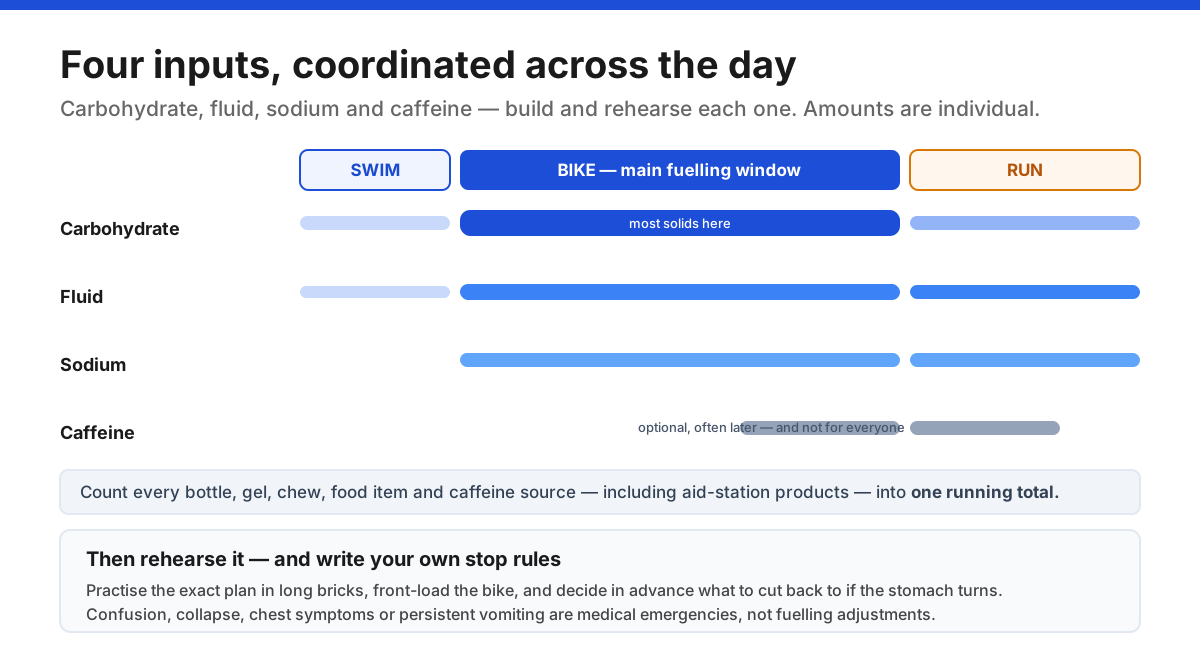
A full-distance (Ironman) nutrition plan is the job of coordinating four separate inputs — carbohydrate, fluid, sodium and caffeine — across a day that can last the better part of a working shift. This guide is about how to build and rehearse that plan rather than a single dose to copy: work out each input from event duration, the on-course products and your own trained tolerance, count every source, and practise the whole thing before race day. Body size alone does not set a safe hourly number, and the detailed how-much of each input lives in the linked nutrition guides.
Key takeaways
- 1Treat full-distance fueling as a plan of four coordinated inputs — carbohydrate, fluid, sodium and caffeine — not a single hourly number to hit.
- 2Start from event duration, the products on course and your current trained tolerance; published ranges are a starting point to test, not a target to force.
- 3Count every bottle, gel, chew, bar, food item and caffeine source toward one running total, including what the aid stations hand you.
- 4Do not convert measured sweat loss into mandatory real-time replacement; both under-drinking and over-drinking carry risk, and overdrinking can cause hyponatraemia.
- 5Rehearse the complete plan in long training sessions, write your own stop rules, and use a qualified sports dietitian for high-stakes or medically complex planning.
In this article
- 1Quick answer: what belongs in a full-distance nutrition plan?
- 2Why it is a planning problem, not a magic number
- 3Carbohydrate: start from ranges, then let training decide
- 4Fluid: avoid both failure modes
- 5Sodium: count it from the whole menu
- 6Caffeine: count every source, and know when to skip it
- 7The bike-to-run problem
- 8Before the race: the days before and race morning
- 9Rehearse the whole plan and write your own stop rules
- 10When to get individual help
- ⚖The four inputs of a full-distance fueling plan
- ?Frequently asked questions
Quick answer: what belongs in a full-distance nutrition plan?
Write down, hour by hour from race-morning breakfast to the finish line, the timing and quantity of four things: carbohydrate, fluid, sodium and caffeine. Note which of them the course supplies and which you must carry, and add a backup for each.
The goal is a plan that supports the effort and stays tolerable for many hours — not the largest number you can force down. A full-distance triathlon is long enough that fueling genuinely behaves like a fourth discipline: strong swim, bike and run fitness can still be undone by a plan the gut cannot handle. But being the fourth discipline means it is trained and rehearsed like the others, not guessed at from a chart. The rest of this page walks through each input, and hands the detailed how-much of each to the guide that owns it.
Why it is a planning problem, not a magic number
The single most common full-distance fueling mistake is looking for one hourly gram figure and treating it as a rule. Real requirements move with the length of your day, the intensity you actually ride and run at, the heat, your body's trained tolerance and what your stomach will still accept in hour eight — and body weight on its own does not settle any of that.
So the useful question is not what is the number, but what plan can I build and rehearse. Start from three anchors: the expected duration of your race, the specific products offered on the course, and the intake you have already practised and tolerated in training. From there you shape each input separately, because carbohydrate, fluid, sodium and caffeine each behave differently and each fails differently. The table below summarises the four; the sections that follow take them one at a time.
Carbohydrate: start from ranges, then let training decide
Carbohydrate is the input that supplies working energy across the day, and it is the one most worth training rather than simply prescribing. Current sports-nutrition guidance gives ranges for long-duration exercise, but treat those as a starting point to test, not a quota — the amount you can actually absorb and tolerate is something you build up, not something you read off a table.
Most athletes end up combining sources — drink mix, gels or chews, and familiar low-bulk real food — because variety helps both tolerance and flavour fatigue over a very long day. The capacity to take on more carbohydrate comfortably is itself trainable, which is the whole point of the gut-training guide; the trade-offs between drinks, gels and solids are covered in energy gels and real food vs gels for Ironman fueling. Whatever you choose, the plan tolerated on the bike is the one that has to survive the run, so rehearse it in that order rather than assuming it transfers.
Fluid: avoid both failure modes
Fluid has two failure modes, and a good plan steers between them. Under-drinking across many hours in heat leads to meaningful dehydration; over-drinking — taking on more fluid than you are losing — can dilute blood sodium and cause hyponatraemia, which is dangerous. Neither extreme is the safe default, so the aim is to limit losses sensibly rather than to match every millilitre in real time.
How much you need is genuinely individual: weather, intensity, clothing, body size, aid-station spacing and your own sweat rate all move it. Estimating your sweat rate in representative conditions gives you a realistic starting point — see how to test your sweat rate — but do not then convert a measured loss into a mandatory real-time replacement target; you also rehydrate after the session, and drinking to a rigid number is how overdrinking happens. The full fluid picture, including electrolytes, is covered in the hydration guide.
Caffeine: count every source, and know when to skip it
Caffeine can support perceived effort and alertness for some athletes late in a long race, but more is not automatically better, and the failure mode is stacking it without realising. Record coffee, caffeinated gels, chews and drinks together as one running total, because it is easy to double up when several products happen to be caffeinated.
Caffeine is also the input most likely to be the wrong choice for a given person. Use a lower-dose or caffeine-free plan when sensitivity, disrupted sleep, pregnancy, certain medications or a cardiovascular concern make that appropriate, and seek professional advice if you are unsure. The performance and practical detail — timing, forms and typical amounts to trial — is in the caffeine guide.
The bike-to-run problem
A plan that feels fine on the bike can fall apart on the run, and full-distance races are where this bites hardest. Cycling in an aerodynamic position, then switching to the jostling and higher core temperature of running, changes what the gut will accept — so the transition itself has to be rehearsed, not assumed.
In practice this means front-loading the bulk of your solid and higher-volume fueling onto the bike, where digestion is easiest, and shifting toward simpler, more easily tolerated sources on the run. It also means your long training bricks — a ride followed immediately by a run — are the most important fueling rehearsals you do, because they are the only place you test the handover before race day.
Before the race: the days before and race morning
The race-day plan sits on top of the days before it. In the final days, the emphasis shifts toward carbohydrate availability so you start with full stores, without adopting a rigid or unfamiliar loading ritual — the practical version for age-groupers is in carb-loading for triathlon. Keep the night-before meal familiar and tolerable rather than a last-minute feast; what to eat the night before covers that specifically.
Race morning is a rehearsed breakfast eaten with enough time to settle, made of foods you have used before. None of this should be improvised on the day. For how the whole race-day fueling sequence fits together across any distance, race fueling is the companion guide; this page stays focused on the specific problem of coordinating it across a full-distance day.
Rehearse the whole plan and write your own stop rules
A full-distance plan is only real once you have completed several representative sessions using the exact bottle concentrations, the exact product sequence and the exact carrying system you intend to race with. Rehearsal is also where you discover flavour fatigue, a bottle that will not stay put, or a gel your stomach turns against at hour six — all far better found in training. Build the volume of what you can tolerate gradually rather than testing a maximal plan once; that gradual build is the point of fuelling during training.
Then write your own stop rules before the race. Decide in advance what you will reduce or switch to after nausea or bloating — typically backing off solids and caffeine and moving to small sips of a tolerated drink until the stomach settles. And separate a nutrition problem from a medical emergency: confusion, collapse, chest symptoms, severe weakness or persistent vomiting are reasons to seek immediate medical attention, not to make another fueling adjustment.
When to get individual help
This framework is deliberately general because safe, effective full-distance fueling is individual. If you are preparing for your first full-distance race, chasing a high-stakes goal, or managing any medical condition — diabetes, a history of gastrointestinal problems, hydration-related issues, pregnancy, or a cardiovascular concern — the highest-value step is to work with a qualified sports dietitian or your clinician, who can build a plan around your physiology rather than a population average.
That is not a disclaimer to skip past. The whole point of treating fueling as a planned, rehearsed and individualised discipline — rather than a number copied from someone else's race — is that it is the part of long-course racing most able to help you, and, done carelessly, most able to harm you.
The four inputs of a full-distance fueling plan
| Input | What it does | Where it comes from | The mistake to avoid |
|---|---|---|---|
| Carbohydrate | Supplies working energy across the day | Drink mix, gels, chews, familiar food | Copying one hourly number instead of training your own tolerance |
| Fluid | Limits dehydration and overheating | Water and drink mix, to thirst and sweat losses | Both under-drinking and over-drinking (which risks hyponatraemia) |
| Sodium | Part of the fluid-balance picture | Drink mix, gels, capsules, salty food | Assuming it alone prevents hyponatraemia or cramp |
| Caffeine | May support perceived effort for some | Coffee, caffeinated gels, chews, drinks | Stacking sources, or using it despite sensitivity |
Sources
Sources are listed so readers can verify consequential claims and dated details.
- Nutrition and Athletic Performance: joint position statement — Academy of Nutrition and Dietetics, Dietitians of Canada and ACSM (accessed September 1, 2026)
- AIS Sports Supplement Framework: Group A sports foods — Australian Institute of Sport (accessed September 1, 2026)
- Sports drinks: how and when to use them — Australian Institute of Sport (accessed September 1, 2026)
- The effect of gut-training and feeding-challenge: systematic review — PubMed (accessed September 1, 2026)
Frequently asked questions
How many calories or carbs do you need during an Ironman?
There is no single correct number, and body weight alone does not set one. Published sports-nutrition ranges are a starting point to test in training, but what you can actually absorb and tolerate over a very long day depends on the event duration, your intensity, the heat and your trained gut tolerance. Build the amount up gradually in training, count every source toward one total, and use a qualified sports dietitian for a high-stakes or first full-distance race.
How do I avoid stomach problems on a full-distance race?
Rehearse your exact plan — the same products, concentrations and timing — in several long sessions, and change nothing on race day. Train your gut to tolerate more carbohydrate gradually rather than testing a maximal plan once, front-load higher-volume fueling onto the bike where digestion is easiest, and practise the bike-to-run transition, because a plan tolerated while cycling can feel different while running. Decide in advance what you will cut back to if nausea starts.
Should I match my sweat losses with fluid during the race?
No. Estimating your sweat rate gives you a realistic starting point, but you should not convert a measured loss into a mandatory real-time replacement target. You also rehydrate after training and racing, and drinking to a rigid number is a common route to overdrinking, which can dilute blood sodium and cause hyponatraemia. Aim to limit losses sensibly and avoid both extremes rather than replacing every millilitre.
Does taking salt prevent cramp or hyponatraemia?
Sodium is a reasonable part of a long, hot race plan, but it is over-claimed. It does not by itself prevent hyponatraemia when too much fluid is consumed — the fluid side governs that — and the evidence that it prevents cramp is much weaker than marketing suggests. Count sodium from your whole menu (drink mix, gels, capsules and salty food together) and treat it as one coordinated input, not an insurance policy.
When should I see a sports dietitian for race nutrition?
Whenever the stakes or the complexity are high: a first full-distance race, a goal you have trained hard for, or any relevant medical condition such as diabetes, a history of gastrointestinal or hydration problems, pregnancy or a cardiovascular concern. A qualified professional can build a plan around your physiology rather than a population average, which is exactly where individualised advice is most valuable.