Triathlon Wetsuit Rules: Water Temperature Limits Explained
When a triathlon wetsuit is mandatory, optional or forbidden, how officials measure the official water temperature, why cold air can change the answer, and what a non-wetsuit swim changes about your kit.
By Lotte
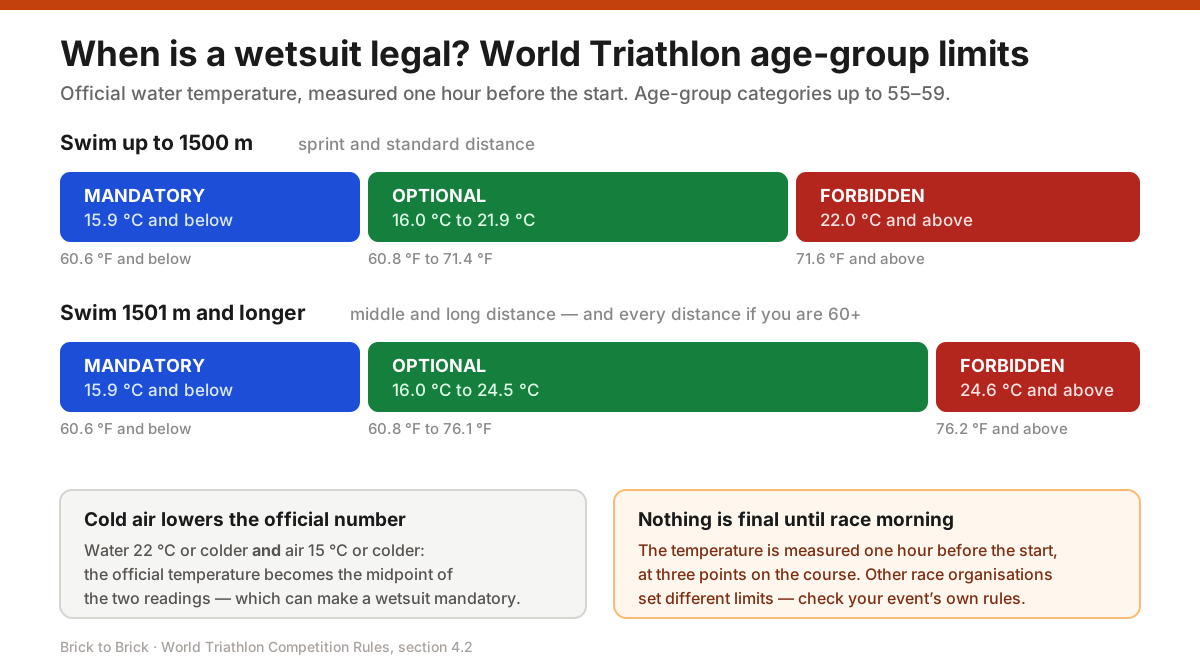
Under the World Triathlon Competition Rules, an age-group athlete up to the 55–59 category must wear a wetsuit at 15.9 °C (60.6 °F) and below, may choose one between 16.0 °C and 21.9 °C for a swim up to 1500 m or between 16.0 °C and 24.5 °C for a swim of 1501 m or longer, and may not wear one at or above 22.0 °C and 24.6 °C respectively. USA Triathlon and IRONMAN publish their own numbers, so the only threshold that binds you is the one in your own event's rules — and it is not final until an official measures the water about an hour before your start.
Key takeaways
- 1There is no single worldwide wetsuit temperature. World Triathlon, USA Triathlon and IRONMAN each publish their own limits, and the one that applies is whichever body sanctions your race
- 2Under World Triathlon rules the age-group cut-off depends on swim length: forbidden at 22.0 °C and above up to 1500 m, and at 24.6 °C and above from 1501 m
- 3Wetsuits become mandatory, not just allowed, at 15.9 °C (60.6 °F) and below under both World Triathlon and USA Triathlon rules
- 4USA Triathlon adds a band most athletes miss: in a normal age-group race you may still wear a wetsuit between about 78 °F and 84 °F, but you forfeit rankings and age-group awards
- 5Cold air can drag the official temperature down. If the water is 22 °C or colder and the air is 15 °C or colder, the official figure becomes roughly the midpoint of the two readings
- 6The official temperature is measured about one hour before the start at three points on the course, so plan for both outcomes and expect the answer on race morning
- 7A non-wetsuit swim changes more than the wetsuit: neoprene caps, neoprene socks, bib numbers and anything covering the arms below the elbow or the legs below the knee can all become illegal
In this article
- 1Is your wetsuit legal? Start with three numbers
- 2How the official water temperature is decided
- 3World Triathlon limits by category and swim distance
- 4USA Triathlon limits — and the band where a wetsuit costs you your award
- 5IRONMAN and other independent organisers
- 6The cold-air adjustment most athletes have never heard of
- 7When the swim gets shortened or cancelled
- 8How long you are allowed to stay in the water
- 9What a non-wetsuit swim actually changes
- 10What counts as a legal wetsuit
- 11Planning when you don't know the temperature yet
- 12Five misunderstandings that cost people their race
- 13Your next step
- ⚖Quick reference: wetsuit temperature limits by rule set
- ?Frequently asked questions
Is your wetsuit legal? Start with three numbers
For most age-group triathletes racing under the World Triathlon Competition Rules, the answer comes down to three numbers and one question about your swim length.
- 15.9 °C (60.6 °F) and below — a wetsuit is mandatory. Not optional. You will not be allowed to start without one.
- 22.0 °C (71.6 °F) and above — forbidden, if your swim is 1500 m or shorter.
- 24.6 °C (76.2 °F) and above — forbidden, if your swim is 1501 m or longer.
Anything in between is your choice. That gives an age-group athlete a legal window of 16.0–21.9 °C for a sprint or standard-distance swim, and 16.0–24.5 °C for a middle- or long-distance swim.
Three things immediately complicate that clean picture, and they are the reason this page exists:
- Your race may not be run under World Triathlon rules at all. USA Triathlon and IRONMAN publish different numbers, and IRONMAN's upper limit for age-groupers is different again from its limit for professionals.
- The number that counts is not the forecast, or last week's reading, or the lake temperature on a swim app. It is an official measurement taken about an hour before the start, using a defined procedure.
- Cold air can lower the official figure, sometimes by several degrees, which occasionally turns an optional-wetsuit day into a mandatory-wetsuit one.
This page sets out what each rule set actually says, where the numbers come from, and — just as importantly — what changes about the rest of your swim kit when the answer comes back "no wetsuit". It is a reference for planning, not a substitute for the athlete guide: your event's own published rules always win, and organisers can and do apply local variations.
How the official water temperature is decided
Athletes argue about wetsuit legality using the wrong numbers all week. The forecast, the lake's public temperature display and the reading from someone's watch during a practice swim are all irrelevant to the decision. Both the World Triathlon and USA Triathlon rulebooks define a specific measurement procedure, and they are almost identical.
When: the water temperature is taken one hour before the start on competition day.
Where: at the middle of the swim course and at two other points on the course, not at the water's edge and not where the water is shallowest.
How deep: World Triathlon specifies 60 cm; USA Triathlon strongly recommends 24 inches, which is the same depth in different units.
Which reading counts: this is the part almost nobody knows, and it is deliberately asymmetric so that the decision errs towards athlete safety.
- If the average of the measurements is 27 °C (80.6 °F) or below, the lowest measurement becomes the official water temperature.
- If the average is above 27 °C, the highest measurement becomes the official temperature.
In other words, in cool water the rules assume the cold spot; in hot water they assume the hot spot. A lake with a cold inflow at one end can therefore be declared colder than the average swimmer will experience, and a warm lagoon can be declared warmer.
Who announces it, and when: under World Triathlon rules the final decision on wetsuit use is made and communicated to athletes one hour before the start. Under USA Triathlon rules, the Head Referee may amend the wetsuit determination — or shorten or cancel the swim — after consulting event management or medical staff, taking account of factors such as water quality, waves, currents, wind, precipitation and humidity.
The practical consequence is simple and worth internalising: there is no way to know for certain in advance. Athletes who travel with only a wetsuit, or only a swimskin, are gambling. The planning section below covers how to avoid that.
World Triathlon limits by category and swim distance
World Triathlon is the sport's international federation, and its Competition Rules are the template most national federations adapt. Section 4.2 governs wetsuit use with three separate tables — one for elite-level racing and two for age-group racing.
Note the two variables that most summaries online flatten out: swim length and age category. Both change the answer.
Elite, U23, Junior and Youth athletes
| Swim length | Forbidden at | Mandatory at |
|---|---|---|
| Up to 1500 m | 20.0 °C (68.0 °F) and above | 15.9 °C (60.6 °F) and below |
| 1501 m and longer | 22.0 °C (71.6 °F) and above | 15.9 °C (60.6 °F) and below |
Age-group athletes, youngest category up to 55–59
| Swim length | Forbidden at | Mandatory at |
|---|---|---|
| Up to 1500 m | 22.0 °C (71.6 °F) and above | 15.9 °C (60.6 °F) and below |
| 1501 m and longer | 24.6 °C (76.2 °F) and above | 15.9 °C (60.6 °F) and below |
Age-group athletes, 60–64 category and older
| Swim length | Forbidden at | Mandatory at |
|---|---|---|
| All distances | 24.6 °C (76.2 °F) and above | 15.9 °C (60.6 °F) and below |
Three observations that matter in practice:
Elites lose the wetsuit sooner than you do. In a 1500 m race at 21 °C, the professional field may be swimming without neoprene while the age-group waves behind them are allowed to wear it. That is not favouritism in either direction; it reflects different exposure times and different medical cover.
The 60+ concession is real and often missed. From the 60–64 category upwards, the more generous 24.6 °C ceiling applies at every distance, including a sprint. If you are in that group, you may be entitled to wear a wetsuit in a sprint race where a 40-year-old in the next wave is not. Check how your event is applying it rather than assuming. Our guide to how triathlon age groups work explains how categories are assigned.
"1501 m and longer" is the boundary, not "70.3 and up". A 1900 m middle-distance swim and a 3800 m long-distance swim sit in the same band. A 1500 m standard-distance swim sits in the stricter one — by a single metre.
USA Triathlon limits — and the band where a wetsuit costs you your award
If you are racing in the United States at a USA Triathlon-sanctioned event, the applicable rules are USA Triathlon's own, and they are structured differently from World Triathlon's. Section 3.4 of the USA Triathlon Multisport Competition Rules sets out three cases.
Elite, U23 and Developmental High Performance races
| Swim length | Prohibited at | Mandatory at |
|---|---|---|
| 1500 m and shorter | 20.0 °C (68.0 °F) and above | 15.9 °C (60.6 °F) and below |
| Longer than 1500 m | 22.0 °C (71.6 °F) and above | 15.9 °C (60.6 °F) and below |
USA Triathlon National Championship and World Triathlon qualifying age-group races
| Swim length | Prohibited at | Mandatory at |
|---|---|---|
| All distances | 24.6 °C (76.2 °F) and above | 15.9 °C (60.6 °F) and below |
All other races and waves — the four-band table
This is the one that applies to most age-group athletes at most American races, and it has a band that does not exist in the World Triathlon rules at all.
| Water temperature | Status |
|---|---|
| 60.6 °F (15.9 °C) and below | Mandatory |
| 60.7–78.0 °F (16.0–25.5 °C) | Permitted — normal racing, full award eligibility |
| 78.1–84.0 °F (25.6–28.8 °C) | Allowed, but you give something up |
| 84.0 °F (28.9 °C) and above | Prohibited |
The third band is the interesting one. In that range you may still choose to wear a wetsuit, but the rulebook is explicit that an athlete who does so in a competitive, non-National age-group race or wave is not eligible to have their results submitted for rankings or age-group awards. Some events additionally run a separate non-competitive wetsuit wave; athletes in a non-competitive wave are not eligible for rankings either.
That turns a safety rule into a genuine strategic decision. If you are a weak swimmer racing for the experience in 80 °F water, wearing a wetsuit may be the right call and the award you are forfeiting was never in play. If you are chasing a podium or a championship qualifying slot, wearing one ends that ambition on the spot — and in water that warm, the overheating risk is real anyway.
Two details worth knowing. First, the table's permitted band ends at 78.0 °F while the footnote describes the forfeiture as applying "at or above 78.0 °F" — at exactly 78 °F, ask the Head Referee rather than assuming. Second, the rulebook allows for variances: a posted variance on USA Triathlon's rules page, or one permitted for a specific event, can change the determination, so an unusual call at a particular race is not necessarily an error.
IRONMAN and other independent organisers
IRONMAN, Challenge Family, T100 and a long list of independent organisers are not bound by World Triathlon's age-group tables. They publish their own competition rules, and an IRONMAN race in the United States is not automatically run under USA Triathlon's numbers either.
IRONMAN's published thresholds, as set out in its own Competition Rules, differ from both federations above:
- Mandatory below 16 °C / 60.8 °F.
- Permitted, with full eligibility, up to and including 24.5 °C / 76.1 °F for age-group athletes.
- Between roughly 76.1 °F and 83.8 °F (24.5–28.8 °C), wetsuit use is handled through a separate non-competitive arrangement at some events; athletes who wear one in that range give up age-group awards and World Championship slots.
- Professional athletes face a lower ceiling than age-groupers, around 21.9 °C / 71.5 °F.
Treat those figures as a planning guide rather than the last word. IRONMAN maintains its Competition Rules on its own site, revises them between seasons, and individual events publish local variations in the athlete guide — a race with a long, exposed sea swim may impose conditions that the general rulebook does not. Confirm the current numbers in IRONMAN's own document and in your specific event's athlete guide before you make a kit decision.
National federations add another layer. British Triathlon, Triathlon Australia, Triathlon Canada and the rest each publish a competition rulebook that closely tracks the World Triathlon structure but can differ in the detail, including on minimum temperatures for a swim to take place at all. If you are racing a domestic event, the national federation's current rules are the ones to read.
The practical rule to carry: identify which body sanctions your race before you look up any number. The registration page, the entry confirmation and the athlete guide all state it. Our guide to reading a triathlon athlete guide explains where the sanctioning body and the local rule variations are usually buried.
The cold-air adjustment most athletes have never heard of
Here is the rule that catches people out on a cold, clear morning in spring or autumn, and it is almost never mentioned in wetsuit buying guides.
When the water is cold and the air is colder, the official water temperature is adjusted downwards. Both the World Triathlon and USA Triathlon rulebooks contain a table for this. The conditions are:
- measured water temperature at or below 22.0 °C (71.6 °F), and
- measured air temperature at or below 15.0 °C (59.0 °F), and
- the air is colder than the water.
When all three apply, the official figure becomes the midpoint of the two readings. USA Triathlon states the arithmetic explicitly: subtract half the difference between the water and air readings from the water reading. In Fahrenheit it is simply half the sum of the two.
World Triathlon publishes the same table, and USA Triathlon publishes it in both units. Here are the adjusted official temperatures in °C, for every combination the rulebooks list:
| Water ↓ / Air → | 15 °C | 14 °C | 13 °C | 12 °C | 11 °C | 10 °C | 9 °C | 8 °C | 7 °C | 6 °C |
|---|---|---|---|---|---|---|---|---|---|---|
| 22 °C | 18.5 | 18.0 | 17.5 | 17.0 | 16.5 | 16.0 | 15.5 | 15.0 | 14.5 | 14.0 |
| 21 °C | 18.0 | 17.5 | 17.0 | 16.5 | 16.0 | 15.5 | 15.0 | 14.5 | 14.0 | 13.5 |
| 20 °C | 17.5 | 17.0 | 16.5 | 16.0 | 15.5 | 15.0 | 14.5 | 14.0 | 13.5 | 13.0 |
| 19 °C | 17.0 | 16.5 | 16.0 | 15.5 | 15.0 | 14.5 | 14.0 | 13.5 | 13.0 | 12.5 |
| 18 °C | 16.5 | 16.0 | 15.5 | 15.0 | 14.5 | 14.0 | 13.5 | 13.0 | 12.5 | 12.0 |
| 17 °C | 16.0 | 15.5 | 15.0 | 14.5 | 14.0 | 13.5 | 13.0 | 12.5 | 12.0 | Cancel |
| 16 °C | 15.5 | 15.0 | 14.5 | 14.0 | 13.5 | 13.0 | 12.5 | 12.0 | Cancel | Cancel |
| 15 °C | 15.0 | 14.5 | 14.0 | 13.5 | 13.0 | 12.5 | 12.0 | Cancel | Cancel | Cancel |
| 14 °C | 14.0 | 14.0 | 13.5 | 13.0 | 12.5 | 12.0 | Cancel | Cancel | Cancel | Cancel |
| 13 °C | 13.0 | 13.0 | 13.0 | 12.5 | 12.0 | Cancel | Cancel | Cancel | Cancel | Cancel |
| 12 °C | 12.0 | 12.0 | 12.0 | 12.0 | Cancel | Cancel | Cancel | Cancel | Cancel | Cancel |
Two things the table encodes that are easy to miss. "Cancel" means the swim does not happen — the adjustment has pushed the official figure below the 12 °C floor. And the adjustment only ever works downwards: where the air is warmer than the water, the water reading stands, which is why the 14 °C row reads 14.0 at both 15 °C and 14 °C of air. At an air temperature below 6 °C, USA Triathlon cancels the swim outright regardless of the water reading, and the World Triathlon table shows the same result across the range.
A worked example. Your lake reads 18 °C at 06:00 — comfortably in the optional band, and you had half decided to swim in a tri suit for a faster transition. But it is a clear morning and the air is 10 °C. The official water temperature becomes 14.0 °C, which is below the 15.9 °C mandatory threshold. A wetsuit is now compulsory, and if you left yours at home you do not start.
A second example, at the other end. Water 16 °C, air 8 °C. The adjusted figure falls to 12.0 °C — still just inside the range where a swim can go ahead, but exactly on the floor. Drop the air one more degree, to 7 °C, and the swim is cancelled.
The pattern to remember: a cold, still morning after a warm week is the classic trap. The water still feels reasonable, but the combination pushes the official number down. Two practical implications:
- If the forecast overnight low is in single figures Celsius and your swim is in the high teens, pack the wetsuit even if you had planned not to use it.
- If you have been training in the same water without a wetsuit, do not assume that experience transfers to race morning. Preparing properly for cold water is its own skill — see the cold water swimming guide and the open-water swim safety checklist.
When the swim gets shortened or cancelled
Wetsuit legality is only half of what water temperature controls. Both rulebooks also set out when the swim distance must be reduced and when the swim cannot take place at all — and those thresholds are the ones that turn a triathlon into a duathlon.
World Triathlon's modification table works from the official water temperature and the original swim distance. Reading across a row gives the distance that may actually be swum:
| Original swim | Above 33.0 °C | 32.9–32.0 °C | 31.9–31.0 °C | 30.9–15.0 °C | 14.9–14.0 °C | 13.9–13.0 °C | 12.9–12.0 °C | 11.9–11.0 °C | Below 11.0 °C |
|---|---|---|---|---|---|---|---|---|---|
| Up to 300 m | Cancel | 300 m | 300 m | 300 m | 300 m | 300 m | 300 m | 300 m | Cancel |
| 750 m | Cancel | Cancel | 750 m | 750 m | 750 m | 750 m | 750 m | Cancel | Cancel |
| 1000 m | Cancel | Cancel | 750 m | 1000 m | 1000 m | 1000 m | 750 m | Cancel | Cancel |
| 1500 m | Cancel | Cancel | 750 m | 1500 m | 1500 m | 1500 m | 750 m | Cancel | Cancel |
| 1900 m | Cancel | Cancel | 750 m | 1900 m | 1900 m | 1500 m | 750 m | Cancel | Cancel |
| 2000 m | Cancel | Cancel | 750 m | 2000 m | 2000 m | 1500 m | 750 m | Cancel | Cancel |
| 2500 m | Cancel | Cancel | 750 m | 2500 m | 2500 m | 1500 m | 750 m | Cancel | Cancel |
| 3000 m | Cancel | Cancel | 750 m | 3000 m | 3000 m | 1500 m | 750 m | Cancel | Cancel |
| 3800 m | Cancel | Cancel | 750 m | 3800 m | 3000 m | 1500 m | 750 m | Cancel | Cancel |
| 4000 m | Cancel | Cancel | 750 m | 4000 m | 3000 m | 1500 m | 750 m | Cancel | Cancel |
Read the 3800 m row carefully if you are racing long: at 14.9–14.0 °C a full-distance swim is already cut to 3000 m, and by 13.9 °C it is 1500 m. Long swims lose distance sooner than short ones, because the exposure time is what matters.
USA Triathlon expresses the same idea as a list of thresholds, applied to the adjusted water temperature where the cold-air rule bites:
- Cancel the swim if the measured air temperature is below 6.0 °C (42.8 °F).
- Cancel if the adjusted water temperature is below 12.0 °C (53.6 °F).
- Cancel if the measured water temperature is at or above 32.0 °C (89.6 °F).
- Keep the original distance if the adjusted water temperature is 15.0–30.9 °C (59.0–87.7 °F).
- Swim no more than 3000 m at 14.0–14.9 °C, no more than 1500 m at 13.0–13.9 °C, and no more than 750 m at 12.0–12.9 °C or 31.0–31.9 °C.
Both systems also give officials discretion beyond the tables. World Triathlon allows the Technical Delegate, in consultation with the Medical Delegate, to adapt the swim length or wetsuit provisions for high winds, heavy rain, changing temperature or current — with the final decision one hour before the start. USA Triathlon gives the Head Referee equivalent authority.
If the swim does get pulled, the race usually continues in another format rather than being abandoned. What that means for your pacing, your fuelling and your expectations is covered in what to do when the swim is cancelled.
How long you are allowed to stay in the water
There is a second, quieter limit that interacts with all of this: a maximum time in the water, after which swimmers are removed from the course. It exists mainly for cold exposure and safety cover, and it is separate from the overall race cut-off.
World Triathlon's table gives different allowances to elite and age-group fields:
| Swim length | Elite, U23, Junior, Youth | Age-group |
|---|---|---|
| Up to 300 m | 10 min | 20 min |
| 301–750 m, below 31 °C | 20 min | 30 min |
| 301–750 m, 31 °C and above | 20 min | 20 min |
| 751–1000 m | 25 min | 50 min |
| 1001–1500 m | 30 min | 1 h 10 min |
| 1501–3000 m | 1 h 15 min | 1 h 40 min |
| 3001–4000 m | 1 h 45 min | 2 h 20 min |
Notice the hot-water row: above 31 °C, the age-group allowance is cut from 30 minutes to 20 for a 750 m swim. Heat, not cold, is the constraint there.
For most age-group athletes these limits are generous — a 1 h 40 min allowance for a 1900 m swim is a long time. But if you are a genuinely slow swimmer at a standard-distance race, 1 h 10 min for a 1500 m swim is roughly 4:40 per 100 m, and that is worth checking against your realistic open-water pace before you enter. Your event may publish a tighter swim cut-off of its own; see triathlon cut-off times for how to compare the two and plan a conservative swim.
What a non-wetsuit swim actually changes
This is the part that turns a rules question into a race-morning problem. "Non-wetsuit swim" does not just mean leaving the neoprene in your bag — it changes what else you are allowed to wear, and the restrictions are stricter than most athletes expect.
Under World Triathlon rules, when wetsuits are forbidden:
- Neoprene swim caps are illegal. They are treated as part of a wetsuit. A neoprene cap is only allowed when wetsuits are allowed.
- Nothing may cover your arms below the elbow or your legs below the knee. That rules out compression sleeves and calf guards on the swim, with narrow exceptions for approved religious and medical cases.
- Bib numbers are forbidden in a non-wetsuit swim for age-group athletes, though they may be worn in a wetsuit swim and are mandatory on the run.
- Your tri suit must be 100% textile — woven, knitted or braided natural or synthetic yarn, with no rubberised polyurethane or neoprene panels.
- Socks are not allowed except when wetsuit use is mandatory. Gloves are never allowed.
- Swimskins remain legal at every water temperature for age-group athletes in all events. They are textile, not neoprene, so they are not affected by the wetsuit determination. Elite, U23, Junior, Youth and Para athletes may not use them at standard distance and shorter. A swimskin must be removed after the swim.
USA Triathlon's equivalents differ in two ways worth knowing, and this is exactly the sort of detail that gets athletes penalised at an unfamiliar race:
- Neoprene boots and socks are allowed whenever wetsuits are permitted, not only when they are mandatory — provided they do not aid propulsion.
- Gloves may be worn when wetsuit use is mandatory, or where the Head Referee has granted a medical exemption, again provided they are not webbed and do not act as paddles.
- When wetsuits are prohibited, swimwear must not cover the neck, extend past the elbow or extend past the knee, and neoprene buoyancy shorts are specifically prohibited.
Both rulebooks prohibit artificial propulsion devices and snorkels outright, and both state that a personal inflatable safety buoy, once deployed, ends your race — you must retire.
The kit consequence is straightforward: if there is any realistic chance of a non-wetsuit swim, bring a legal alternative and know how it feels. For most age-groupers that is a tri suit, or a swimskin if you own one. A swimskin versus tri suit comparison covers where the difference is worth paying for, and the tri suit guide covers fit and chafing considerations for a long non-wetsuit swim.
What counts as a legal wetsuit
Assuming wetsuits are allowed, the suit itself has to comply. The specifications are consistent across the major rule sets and are rarely a problem with a purpose-built triathlon wetsuit — but they do rule out some surf and diving suits, and they matter if you are borrowing.
- Maximum 5 mm thickness anywhere. For a two-piece suit, the combined thickness where the pieces overlap must also stay within 5 mm. World Triathlon allows a manufacturing tolerance of ±0.3 mm.
- Coverage: a wetsuit may cover any part of the body except the face, hands and feet. Where a wetsuit is mandatory, it must cover at least the torso — USA Triathlon adds "and the back".
- Fit: the outermost layer must fit the body tightly while swimming. Loose, baggy suits are not permitted.
- No propulsion aids. Anything creating an advantage — or a risk to other athletes — is prohibited.
- Zips: World Triathlon places no limit on zip length. USA Triathlon requires all components except a zipper cord to fit tightly.
- Official swim cap: you must wear the event's numbered cap. If you wear two, the official cap goes on the outside under World Triathlon rules; USA Triathlon requires the second cap underneath the official one, which amounts to the same thing.
If you are buying, the thickness ceiling is the reason no triathlon-specific suit exceeds 5 mm and why panel thickness is distributed rather than maximised everywhere — the wetsuit thickness and construction guide explains how manufacturers use that budget, and the wetsuit buying guide covers fit, which matters far more than the rules do for how the swim actually goes.
Planning when you don't know the temperature yet
Because the decision lands an hour before your start, the only sensible approach is to prepare for both outcomes. Here is a practical sequence.
Twelve or more weeks out — when you enter. Find out which body sanctions the race and what its wetsuit rules say. Look up the venue's typical water temperature for your race date; organisers of established events often publish previous years' readings, and open-water swimming communities track popular venues. If the historical range straddles a threshold, assume you will need both options.
Six to eight weeks out — decide on owning versus renting. If this is your only open-water race of the year and the water is likely to be marginal, renting is a reasonable way to avoid buying a suit you may not wear; the rent-versus-buy comparison sets out the real costs. If you will race in cold water repeatedly, buy and get the fit right. Either way, swim in it several times before race day — a wetsuit changes your buoyancy, your stroke and your breathing, and race morning is a bad time to discover that. Start with first-time wetsuit swimming tips.
Race week — read the athlete guide properly. Look specifically for: the sanctioning body, any local variation on wetsuit rules, the published swim cut-off, and how the organiser will communicate the wetsuit decision. Many events post a provisional water temperature in the days before the race; treat it as a strong hint, not a commitment. The race briefing is where late changes are announced.
Pack both, always. Wetsuit, plus a legal non-wetsuit option, plus a standard silicone or latex cap in case neoprene is banned. It is a small amount of extra luggage against the risk of a wasted entry.
On race morning, listen for the announcement and then commit. If the swim is declared non-wetsuit, your pacing plan changes: without buoyancy you will swim slightly slower for the same effort and your legs will sit lower, which can cost more than the raw time difference suggests — the wetsuit and swim speed page covers what the difference realistically is. Adjust your expected swim split rather than trying to hold your wetsuit pace.
If it is a hot-water race, think about heat as well as rules. Water above about 25 °C removes most of the cooling benefit of swimming, and you exit into a bike leg already warm. Being legally allowed to wear a wetsuit at 78 °F does not make it a good idea; see racing in the heat for how to manage the whole day. If you want a structured way to work through suit choice, the wetsuit selector walks through the main decisions.
Five misunderstandings that cost people their race
1. "Wetsuit legal" and "wetsuit optional" are the same thing. They are not. Below 15.9 °C a wetsuit is mandatory under both World Triathlon and USA Triathlon rules. Athletes who dislike swimming in neoprene occasionally turn up planning to go without and are refused a start.
2. "The forecast says 22 °C, so I'm fine." Air temperature forecasts are not water temperatures, the official reading is taken at three points and the coldest or hottest may be adopted, and cold air can pull the official figure down. None of the numbers you can look up in advance are the number that decides it.
3. "It's an IRONMAN in the US, so USA Triathlon rules apply." Not necessarily. Independent organisers run under their own competition rules. Identify the sanctioning body from the athlete guide rather than the location.
4. "Non-wetsuit swim just means no wetsuit." It also means no neoprene cap, no neoprene socks, no bib number on the swim under World Triathlon rules, and nothing covering your arms below the elbow or legs below the knee. Athletes get pulled up at the start line for compression sleeves they forgot they were wearing.
5. "I'll decide at the expo." The decision is announced about an hour before the start, long after the expo has closed and long after you have finished packing. Bring both options, or accept that you may have travelled to a race you cannot start.
A related point on fairness: wearing a wetsuit when it is forbidden is not a technicality. It gives a buoyancy advantage over everyone racing legally, and it is grounds for disqualification. The same applies to wearing prohibited equipment in a non-wetsuit swim. Our broader triathlon rules guide and the guide to rules you can break by accident cover the wider set.
Your next step
Do these three things, in this order:
- Open your event's athlete guide and find the sanctioning body. Everything on this page is conditional on that answer. If the guide does not say, ask the organiser — it is a fair question and they will know.
- Look up the venue's historical water temperature for your race date and compare it with the relevant threshold above. If it lands within about 2 °C of a boundary, plan for both outcomes; if the forecast overnight low is in single figures Celsius, plan for the cold-air adjustment as well.
- Make sure you have swum in whatever you will wear. A wetsuit you have never used and a non-wetsuit swim you have never practised are both avoidable problems.
If you still need a suit, start with the wetsuit buying guide for fit and sizing, or the rent-versus-buy comparison if this is a one-race season. If you already own one, the wetsuit care guide will keep it legal and intact for longer — a suit that has split at a seam is a suit you cannot race in.
And whatever the temperature turns out to be: the rules exist because open water is genuinely unforgiving. A decision that goes against your plan on race morning is an inconvenience. Swimming outside the limits is not.
Quick reference: wetsuit temperature limits by rule set
| Rule set and category | Mandatory | Optional | Forbidden | Verify in |
|---|---|---|---|---|
| World Triathlon — age-group up to 55–59, swim up to 1500 m | 15.9 °C / 60.6 °F and below | 16.0–21.9 °C (60.8–71.4 °F) | 22.0 °C / 71.6 °F and above | World Triathlon Competition Rules, section 4.2 |
| World Triathlon — age-group up to 55–59, swim 1501 m and longer | 15.9 °C / 60.6 °F and below | 16.0–24.5 °C (60.8–76.1 °F) | 24.6 °C / 76.2 °F and above | World Triathlon Competition Rules, section 4.2 |
| World Triathlon — age-group 60–64 and older, all distances | 15.9 °C / 60.6 °F and below | 16.0–24.5 °C (60.8–76.1 °F) | 24.6 °C / 76.2 °F and above | World Triathlon Competition Rules, section 4.2 |
| World Triathlon — elite, U23, junior, youth | 15.9 °C / 60.6 °F and below | 16.0–19.9 °C up to 1500 m; 16.0–21.9 °C from 1501 m | 20.0 °C up to 1500 m; 22.0 °C from 1501 m | World Triathlon Competition Rules, section 4.2 |
| USA Triathlon — most age-group races and waves | 60.6 °F / 15.9 °C and below | 60.7–78.0 °F (16.0–25.5 °C) with full award eligibility | 84.0 °F / 28.9 °C and above; 78.1–84.0 °F allowed but forfeits rankings and awards | USA Triathlon Multisport Competition Rules, section 3.4 |
| USA Triathlon — National Championship and World Triathlon qualifying age-group races | 15.9 °C / 60.6 °F and below | 16.0–24.5 °C (60.8–76.1 °F) | 24.6 °C / 76.2 °F and above | USA Triathlon Multisport Competition Rules, section 3.4 |
| IRONMAN — age-group (as published by IRONMAN) | Below 16 °C / 60.8 °F | Up to and including 24.5 °C / 76.1 °F | Above 28.8 °C / 83.8 °F; 24.5–28.8 °C handled as non-competitive at some events | IRONMAN Competition Rules and your event's athlete guide |
Sources
Sources are listed so readers can verify consequential claims and dated details.
- World Triathlon Competition Rules (edition dated 13 December 2025) — sections 4.2 Wetsuit Use, 4.3 Maximum stay in water, 4.4 Modifications, 4.11 Equipment — World Triathlon (accessed September 29, 2026)
- USA Triathlon Multisport Competition Rules (v.2026.01.01) — sections 3.2 Permitted Swimming Equipment, 3.3 Prohibited Swimming Equipment and 3.4 Water Temperatures and Wetsuit Use — USA Triathlon (accessed September 29, 2026)
- IRONMAN Competition Rules — IRONMAN (accessed September 29, 2026)
- British Triathlon Competition Rules — British Triathlon (accessed September 29, 2026)
Frequently asked questions
At what water temperature is a wetsuit legal in a triathlon?
It depends on who sanctions the race and how long the swim is. Under the World Triathlon Competition Rules, an age-group athlete up to the 55–59 category may wear a wetsuit between 16.0 °C and 21.9 °C (60.8–71.4 °F) for a swim of 1500 m or shorter, and between 16.0 °C and 24.5 °C (60.8–76.1 °F) for a swim of 1501 m or longer. Below 15.9 °C (60.6 °F) a wetsuit is mandatory. USA Triathlon and IRONMAN publish different upper limits, so check which body sanctions your event before relying on any single number.
When does a triathlon wetsuit become compulsory?
Under both the World Triathlon and USA Triathlon rules, a wetsuit is mandatory when the official water temperature is 15.9 °C (60.6 °F) or below. IRONMAN publishes a mandatory threshold below 16 °C (60.8 °F). If the water is that cold and you do not have a legal wetsuit, you will not be permitted to start the swim, so a marginal forecast is a reason to travel with one even if you would rather not use it.
How is the official water temperature measured?
About one hour before the start, at the middle of the swim course and at two other points on the course, at a depth of 60 cm (24 inches). If the average of those readings is 27 °C (80.6 °F) or below, the lowest reading becomes the official temperature; if the average is above 27 °C, the highest reading is used. That asymmetry is deliberate: in cool water the rules assume the cold spot, and in hot water the hot spot.
Can cold air make a wetsuit mandatory when the water is warm enough?
Yes. If the measured water temperature is 22 °C (71.6 °F) or below and the air temperature is 15 °C (59.0 °F) or below, with the air colder than the water, the official water temperature is adjusted downwards to roughly the midpoint of the two readings. Water at 18 °C with air at 10 °C gives an official figure of 14.0 °C, which is below the mandatory threshold. A cold, clear morning after a warm week is the classic case.
What can I wear if the swim is declared non-wetsuit?
A tri suit or swimskin made from 100% textile material, and a standard swim cap. Under World Triathlon rules a non-wetsuit swim also bans neoprene caps, neoprene socks, gloves, bib numbers on the swim, and any clothing covering the arms below the elbow or the legs below the knee. Swimskins are legal at every water temperature for age-group athletes and must be removed after the swim. USA Triathlon differs slightly: neoprene socks are allowed whenever wetsuits are permitted, and gloves when wetsuit use is mandatory.
Can I wear a wetsuit and still win my age group?
Under World Triathlon rules, yes — within the permitted band there is no eligibility penalty. Under USA Triathlon rules there is an extra band: in most age-group races, water between about 78 °F and 84 °F (25.6–28.8 °C) still allows a wetsuit, but an athlete who wears one is not eligible to have their result submitted for rankings or age-group awards. IRONMAN applies a comparable arrangement in its warm-water range, where wearing a wetsuit forfeits awards and World Championship slots.
How cold does the water have to be before the swim is cancelled?
Under World Triathlon's modification table, a swim cannot take place below 11.0 °C, and distances are progressively shortened from 14.9 °C downwards — a 3800 m swim is cut to 3000 m at 14.9–14.0 °C and to 1500 m at 13.9–13.0 °C. USA Triathlon cancels the swim if the adjusted water temperature is below 12.0 °C (53.6 °F) or the air temperature is below 6.0 °C (42.8 °F). At the hot end, World Triathlon cancels above 33.0 °C and USA Triathlon at or above 32.0 °C (89.6 °F).
Does the wetsuit rule change if I am over 60?
Under World Triathlon rules, yes. From the 60–64 category upwards, the more generous 24.6 °C (76.2 °F) forbidden threshold applies at every distance, including sprint races where younger age-groupers lose the wetsuit at 22.0 °C. The mandatory threshold of 15.9 °C is the same for everyone. Confirm how your event is applying the category split, because organisers running under other rule sets may not use the same age boundary.
How thick can a triathlon wetsuit be?
A maximum of 5 mm anywhere on the suit, including the combined thickness where the pieces of a two-piece suit overlap. World Triathlon allows a manufacturing tolerance of ±0.3 mm. The suit may cover any part of the body except the face, hands and feet, must fit tightly on its outermost layer, and must not include any device that aids propulsion. Purpose-built triathlon wetsuits are designed within these limits; some surfing and diving suits are not.