Triathlon Race-Day Preparation: Build and Execute a Race Plan
Race day is executed, not improvised. How to build a written race plan, run the countdown from race week to the finish, and plan for what could go wrong.
By Lotte
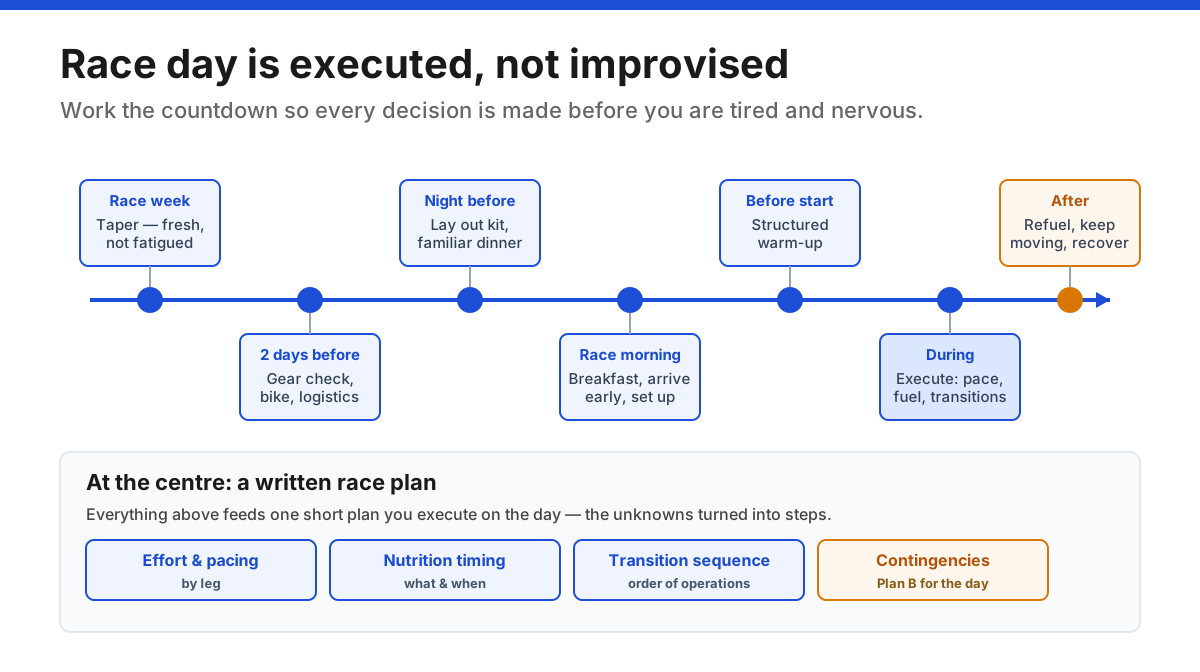
A good race day is not lucky — it is the predictable result of decisions you made in the days before, executed in order. This guide is the orchestration layer: it shows you how to build a written race plan, walks the countdown from race week through the finish line, and helps you plan for what could go wrong — while pointing to the dedicated guides that own each stage, from the taper and the packing checklist to the morning routine, transitions, pacing and recovery. The single organising idea is that race day is executed, not improvised: your job on the day is to run a plan you already wrote, not to make new decisions while tired and nervous.
Key takeaways
- 1Treat race day as execution, not improvisation — every decision made in advance is one you don't have to make while tired and nervous.
- 2Write an actual race plan: effort and pace targets by leg, nutrition and hydration timing, your transition sequence, and contingencies.
- 3Work a countdown — race week and taper, two days before, the night before, race morning, warm-up — so nothing important is decided at the last minute.
- 4Plan for what could go wrong with a Plan B: cold water, a mechanical, a sour stomach, heat or a rough night's sleep should all have a pre-decided response.
- 5This page is the map — use the linked guides for the taper, packing checklist, night-before meal, hour-by-hour morning routine, warm-up, transitions and recovery.
In this article
- 1Race day is executed, not improvised
- 2Build a written race plan
- 3The race-day countdown: what to do and when
- 4The two-days-before gear and logistics check
- 5Plan for what could go wrong (Plan A, B and C)
- 6The mental race plan: control the controllables
- 7How preparation changes with experience
- 8After the finish: the plan doesn't end at the line
- ⚖Your race-day countdown at a glance
- ?Frequently asked questions
Race day is executed, not improvised
The athletes who have smooth, satisfying race days are rarely the ones who wing it and get lucky. They are the ones who arrive with every decision already made, so that on the day itself they are simply executing a plan rather than solving problems in real time. That is the single most useful idea in race-day preparation: your job on race morning is to run a plan you already wrote, not to invent one while tired, nervous and surrounded by strangers in wetsuits.
Preparation is what converts the fitness you built over months into an actual result. A race is a long chain of small decisions — what to eat and when, how hard to start, which shoes go where, what to do if the water is colder than expected — and every one you settle in advance is one that cannot go wrong under pressure. The golden rule that runs through all of it is nothing new on race day: no new kit, no new food, no new pacing experiment. Race day is where you cash in rehearsed habits, not where you test ideas.
This guide is deliberately the map, not every detail. Triathlon race day has a lot of moving parts, and several of them — the taper, the packing list, the morning routine, transitions, pacing, recovery — have their own dedicated guides. This page's job is to show you how they fit together into one plan and one sequence, and to point you to the right guide for each piece.
Build a written race plan
The centrepiece of race-day preparation is an actual, written race plan — the one thing that turns scattered preparation into a single executable document. It does not need to be long; a few lines you can picture and, if useful, jot on your arm or a bike-stem sticker. A good race plan covers four things:
- Effort and pacing by leg. Roughly how hard you intend to swim, ride and run — start controlled, hold something back on the bike, and where you plan to spend it. The reasoning behind those choices lives in race pacing strategy; the plan is simply your decisions written down.
- Nutrition and hydration timing. What you will eat and drink, and when — the breakfast, the fluid on the bike, anything on the run. Build this from race fueling and hydration, then commit the timing to the plan so you are not guessing mid-race.
- The transition sequence. The order of operations in T1 and T2, decided in advance so you never stand in transition wondering what comes next. The trade-offs behind those choices are in transition strategies.
- Contingencies and reminders. Your Plan B for the likely problems (below), plus a couple of anchoring cues — a mantra, a "don't go out too hard" reminder — for when fatigue clouds your thinking.
Writing it down does two jobs: it forces you to actually decide each of these before race morning, and it gives you something external to lean on when your brain is tired and the adrenaline is high.
The race-day countdown: what to do and when
Race preparation is a sequence, and the easiest way to make sure nothing is forgotten is to work a countdown. Each stage below is a job in its own right with its own guide — think of this as the index that ties them together in order:
- Race week — taper. In the final week you reduce training volume while keeping some intensity, so you arrive fresh rather than fatigued. Cutting volume while maintaining a little intensity is the taper approach supported by the research on endurance performance. The day-by-day version is in race-week taper for your first triathlon and the general method in how to taper.
- Two days before — gear and logistics. Prepare and check everything now, not the night before (see the next section).
- The night before — lay out and settle. Kit laid out in order, race number on your belt, devices charged, a familiar dinner. Keep the meal familiar and tolerable rather than a last-minute feast — what to eat the night before covers it.
- Race morning — breakfast, arrive, set up. Your rehearsed breakfast with time to settle, arriving early, and a methodical transition setup. The minute-by-minute version is in the race-morning routine, hour by hour.
- Just before the start — warm up. A short, structured warm-up primes you to start under control instead of red-lining in the first hundred metres; see the pre-race warm-up routine.
- During the race — execute. Run the plan: pace, fuel and move through transitions as rehearsed.
- After the finish — recover. The plan does not end at the line; refuel, move, and begin recovery, covered in recovery after a triathlon.
You do not have to memorise all of it — that is what the countdown table below and the linked guides are for.
The two-days-before gear and logistics check
The most avoidable race-day disasters are logistical, and almost all of them are solved by doing your gear check two days before, not the night before. Giving yourself a buffer means a flat tyre, a dead battery or a missing race belt is a minor errand rather than a midnight crisis.
Two days out, lay out and verify everything against a proper list — the full, categorised version is the race-day packing checklist, so this page will not duplicate it. The essentials to confirm early are your bike's mechanical condition (tyres inflated and holding, brakes and gears working), that all your race kit is present and race-legal, and that your devices are charged. Then handle the logistics: know how you are getting there and parking, when transition opens and closes, where the race briefing is, and — if you can — preview the course or its map so the key turns, hills and aid stations are not a surprise. Confirm the details against the event's own athlete guide, which is the authority on timings, rules and cut-offs; triathlon rules explains the framework those guides sit within. Getting all of this settled early is what lets race morning be calm.
Plan for what could go wrong (Plan A, B and C)
A plan that only works if everything goes perfectly is not a plan. The calmest racers are the ones who have already decided what they will do when something goes sideways — because something usually does, and a pre-made decision beats a panicked one every time.
Think through the likely problems for your race and give each a pre-decided response:
- Cold or rough water. Know your wetsuit decision, your plan to start wide and steady, and that breaststroke or a few backstrokes to compose yourself is always allowed.
- A mechanical on the bike. Carry and know how to use the basics (a tube or plug, inflation, a multitool), and know that outside assistance rules vary — check your event.
- A sour stomach. Decide in advance what you will back off to — smaller sips, simpler fuel, easing the effort until it settles — rather than pushing through blindly.
- Heat. If it is hot, your pacing and fluid plan change; racing a triathlon in heat covers how.
- A bad night's sleep. One poor night before a race is normal and, on its own, will not ruin your day — the training is banked. Do not let it become a mental spiral.
- Falling behind a cut-off, or worse. Know your race's cut-off times, and know that not finishing is a normal part of the sport, not a catastrophe; what happens if you DNF puts it in perspective.
For a fuller picture of how a race actually unfolds so fewer things surprise you at all, what happens on race day walks through the sequence from arrival to finish.
The mental race plan: control the controllables
Nerves before a triathlon are universal and, in moderation, useful — that adrenaline is your body getting ready. The goal of mental preparation is not to eliminate the nerves but to keep them from making decisions for you. And the most powerful calming tool is the one you have already built: a plan. When you know exactly what you are going to do, there is far less to be anxious about, because the unknowns have been converted into steps.
A few practical anchors help on top of that. Rehearse the race in your head in the days before — picture each leg and transition going smoothly, so it feels familiar. Keep your attention on the things you control (your pacing, your fuelling, your effort) and off the things you do not (other athletes, the weather, your time). And carry a simple cue for the hard moments — smooth is fast, one more buoy, I trained for this — something short enough to reach for when you are hurting. If pre-race anxiety is a real obstacle for you rather than ordinary butterflies, managing triathlon anxiety goes deeper on techniques that work.
How preparation changes with experience
The framework is the same for everyone, but how much of it you need to consciously rehearse shifts with experience.
For a first race, preparation is mostly about removing unknowns. You have never done the swim start, the transitions or the run off the bike in a real event, so the highest-value preparation is rehearsing the logistics and simply understanding how the day flows — which is exactly what your first triathlon and how triathlons work are for. Choosing a suitable, low-stress first event matters too; choosing your first race helps. Expect to lean heavily on the written plan, because nothing is yet automatic.
For an experienced athlete, much of the sequence has become habit, and preparation narrows to what is different about this race: a new course, hotter conditions, a longer distance, a specific pacing or nutrition target. The plan gets shorter because more of it is internalised — but the discipline of writing down what is genuinely new, and rehearsing that, is what keeps a familiar process from turning into complacency.
After the finish: the plan doesn't end at the line
It is easy to think of race-day preparation as ending when the gun goes off, but a complete plan includes what happens after you cross the line. In the minutes and hours after finishing you want to keep moving gently rather than collapsing, start replacing fluid and taking on some carbohydrate and protein as your stomach allows, get warm and dry, and collect your gear methodically so nothing is lost in the post-race haze.
Deciding this in advance — where you will meet people, what recovery food you have stashed, how you are getting home — means the end of your race is as calm as the start. The physiology and practice of recovering well, especially after longer events, is covered in recovery after a triathlon. Prepare the whole arc, from race week to the drive home, and race day stops being a thing that happens to you and becomes a plan you calmly execute — which is exactly what turns months of training into the day you hoped for.
Your race-day countdown at a glance
| When | What to lock in | Where to go deep |
|---|---|---|
| Race week | Taper — cut volume, keep some intensity | Race-week taper / how to taper |
| Two days before | Gear check, bike mechanical, logistics | Race-day packing checklist |
| Night before | Kit laid out, familiar dinner, alarms set | What to eat the night before |
| Race morning | Rehearsed breakfast, arrive early, set up | Race-morning routine, hour by hour |
| Before the start | Structured warm-up | Pre-race warm-up routine |
| During the race | Execute the plan: pace, fuel, transitions | Pacing / race fueling / transitions |
| After the finish | Refuel, keep moving, recover | Recovery after a triathlon |
Sources
Sources are listed so readers can verify consequential claims and dated details.
- Effects of tapering on performance in endurance athletes: a systematic review and meta-analysis — PLOS One (2023) (accessed September 18, 2026)
- Mujika & Padilla — Scientific bases for precompetition tapering strategies — Medicine & Science in Sports & Exercise (2003) (accessed September 18, 2026)
Frequently asked questions
What should I do the week before a triathlon?
Taper: reduce your training volume while keeping a little intensity so you arrive fresh rather than fatigued, and avoid drastic diet changes. Do your full gear check and bike service about two days out rather than the night before, preview the course or its map if you can, and write your race plan. The final week is for sharpening and logistics, not for cramming in fitness — the training is already banked.
How early should I arrive at a triathlon on race morning?
At least 90 minutes before your wave start, and more for a bigger or unfamiliar race. That buffer covers parking, body marking, setting up transition methodically, the race briefing, a warm-up and the inevitable bathroom queues. Arriving rushed is a reliable way to make mistakes and start anxious, which is exactly what good preparation is meant to prevent.
What is a triathlon race plan?
A short written plan that captures the decisions you have already made: your effort and pacing for each leg, your nutrition and hydration timing, the order of operations in each transition, and your contingencies for likely problems. Keeping it brief enough to picture — or jot on your arm — means that on race day you are executing a plan rather than improvising while tired and nervous.
Does a bad night's sleep before a race hurt performance?
One poor night's sleep immediately before a race is normal and, on its own, is unlikely to ruin your performance — the fitness you built over months is already banked, and race-eve nerves make broken sleep common. The bigger risk is letting it become a mental spiral. Prioritise consistent sleep in the days leading up to the race, and treat the night before as a bonus rather than a make-or-break requirement.
What should I plan to eat on race morning?
Eat a familiar, rehearsed breakfast a few hours before the start — something you have used successfully in training, not anything new. The specific choices and timing belong to your fuelling plan, so build them from the dedicated race-fueling and night-before-nutrition guides rather than improvising. The rule that matters most is that race morning is for proven habits, never experiments.