Racing a Triathlon in Heat: Adjustments and Stop Decisions
Plan heat-specific pacing, shade, cooling and drink access, with a race-day decision sheet and warning signs that require urgent help.
By Lotte
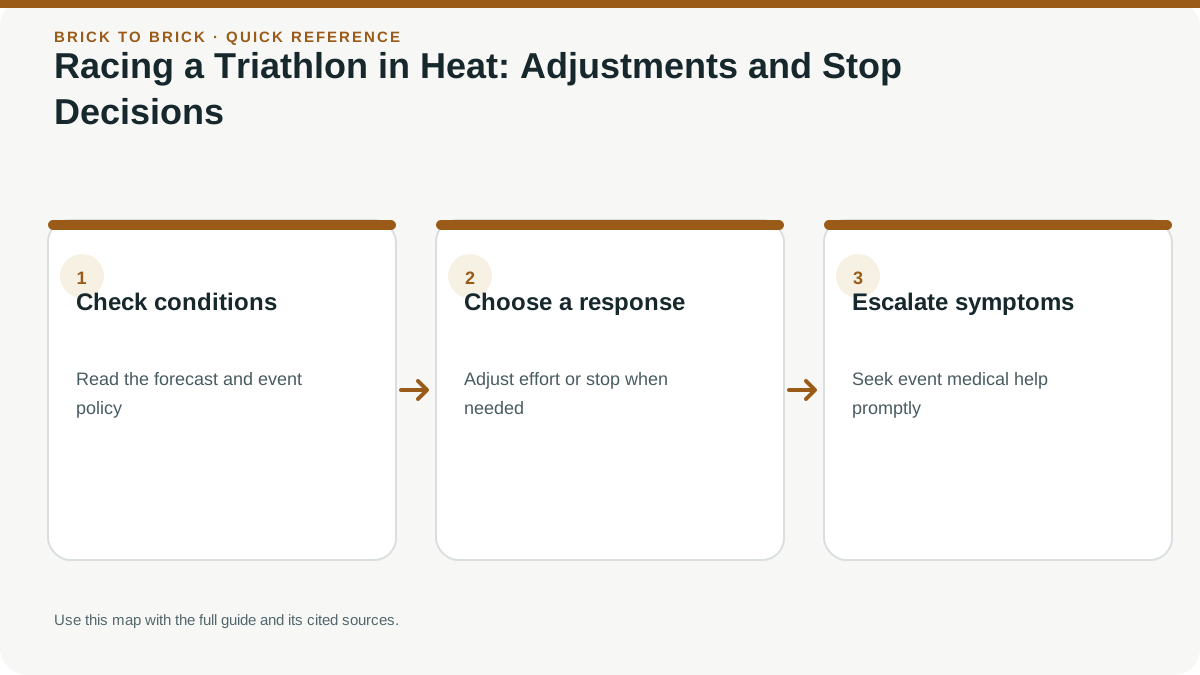
Racing in heat calls for an adaptable effort plan, access to shade and cooling, and clear decisions about when to slow or stop. A cool-weather goal and extra sodium are not substitutes for responding to the conditions.
In this article
- 1Quick answer: what changes in a hot race?
- 2Why heat slows you down
- 3Prepare before race week
- 4Pace and warm up for the conditions
- 5Coordinate drinking and cooling
- 6Verify the live event plan
- 7Know the emergency signs
- 8Build a heat plan from the venue map
- 9Prepare a slower scenario before race morning
- 10Agree a simple response with supporters
- 11Use a checkpoint card for a changed weather forecast
- 12Read the forecast as a set of stresses, not one temperature
- 13Build heat exposure into training without adding a second hard block
- 14Set separate effort guardrails for swim, bike and run
- 15Make a fluid plan that avoids both guessing and forcing
- 16Choose cooling methods that fit the course and your skin
- 17Use a decision ladder for continuing, slowing or stopping
- 18Plan around organizer decisions and course changes
- 19Look after yourself after the finish
- ?Frequently asked questions
Quick answer: what changes in a hot race?
Adjust pace or power downward, limit unnecessary warm-up heat, use shade and cooling opportunities, and follow a rehearsed fluid plan. The size of the adjustment depends on temperature, humidity, sun, wind, course, duration and individual acclimatization; a universal percentage is not defensible.
The short version: plan to go slower than your cool-weather targets, protect yourself from avoidable heat gain, and treat the day as condition-responsive rather than pre-scripted.
Why heat slows you down
In the heat your body has to do two competing jobs at once: power your muscles and shed the heat those muscles produce. To dissipate heat it sends more blood to the skin and sweats heavily, which raises cardiovascular strain — heart rate climbs for the same effort — and can gradually raise core temperature.
Humidity makes it worse, because sweat only cools you when it evaporates; in humid air it drips instead. That's why a moderate temperature with high humidity can feel and perform harder than a hotter, drier day. Understanding this is why the sensible response is to lower the demand (pace) and reduce the heat load (cooling and clothing), rather than to simply drink more.
Prepare before race week
When appropriate, use repeated controlled exercise-heat exposure across roughly one to two weeks. Fit it around the training load and taper rather than adding stress automatically. Review health, medication and prior heat illness with a clinician when relevant, and practise in a controllable setting with access to cooling and help.
The goal of heat preparation is adaptation, not exhaustion: the aim is for the same effort to feel more manageable in warm conditions. Rehearse the specifics you'll rely on race day — your drinking pattern, your cooling steps, your clothing — so nothing is improvised when it's hot.
Pace and warm up for the conditions
Begin conservatively and use effort, symptoms and sustainable output rather than chasing cool-weather targets. Shorten or modify the warm-up when the environment already raises body temperature. Choose light, legal clothing that permits evaporation and use shade before the start.
Starting too fast is costlier in the heat than in the cool, because the extra core-temperature rise is hard to reverse mid-race. Easing off early and reassessing as the race unfolds usually produces a faster, safer result than holding an ambitious pace and fading.
Coordinate drinking and cooling
Start normally hydrated and make fluid available, but do not force intake or aim to replace every measured loss. Count sodium from all products and food without treating it as heat-illness insurance. Use cold drinks, water over the body, ice or other event-provided cooling where practical and permitted.
Practical cooling that athletes commonly use where rules allow: pouring water over the head and neck, ice in a cap or down the suit, cold sponges, and drinking cold fluid. These directly reduce heat load — a different and important lever from drinking volume. Crucially, drinking more than you lose does not prevent heat illness and can cause its own dangerous problem (hyponatremia).
Verify the live event plan
Read the current athlete guide and organizer updates for start changes, aid stations, ice, shade, wetsuit decisions and medical support. Weather and course operations can change late. Build a contingency for reduced pace, missed aid and a decision to stop.
Know before you start where cooling and fluid are available on course, whether the swim is wetsuit-legal for the water temperature, and what the organizer will do if conditions escalate. A plan that assumes the day goes perfectly is not a plan for a hot race.
Know the emergency signs
Confusion, irrational behaviour, slurred speech, staggering, collapse, seizure or unconsciousness during exertion in heat requires emergency action. Call local emergency services and begin rapid whole-body cooling. Do not wait for sweating to stop and do not give oral fluid to a confused, vomiting, seizing or unconscious person. Continue with the exertional heat-stroke emergency guide.
These central-nervous-system signs are what separate a medical emergency from ordinary fatigue. When in doubt, stop and seek help — no age-group result is worth the risk of exertional heat stroke, which is life-threatening but survivable when cooling begins fast.
Build a heat plan from the venue map
Mark exposed queue areas, shaded waiting areas, refill points and the longest gaps between support. Include the walk to the start and the period after finishing, when you may still be hot and far from your bag.
Write who will monitor event announcements and where supporters should meet you if the race is shortened. The organiser's decision about water temperature, distance or start timing takes priority over your original schedule.
Pack permitted sun protection and cooling options you have already used. Check whether they remain accessible after bag drop. A useful item left in a locked transition bag cannot help during a long start delay.
Prepare a slower scenario before race morning
Use the same course distances with a slower bike and run estimate. Look at the resulting time between aid stations and the official checkpoint margins. This shows logistical pressure without pretending that one temperature increase has a universal percentage effect on pace.
Identify what you can change: opening effort, time spent warming up, use of shade, willingness to walk and whether to start at all. Do not treat a slower scenario as a challenge to overcome through willpower.
Review hydration planning separately. Carrying more fluid may help access, but forcing extra intake can create another hazard.
Agree a simple response with supporters
Tell supporters that a confusing answer, unusual behaviour or collapse requires immediate help from event medical staff. They should not assume you are simply tired or need another gel. CDC guidance identifies altered mental status as a serious heat-illness sign.
If you withdraw, inform officials and follow their transport and medical directions. Make sure someone knows where to collect your equipment later.
Afterward, record conditions and decisions alongside the result. A safe withdrawal or pace reduction is meaningful race execution, even when it changes the finish-time goal.
Use a checkpoint card for a changed weather forecast
If the forecast changes, revisit decisions that can still be changed safely. Check reporting and start times, available shade, the permitted equipment list, aid-station locations and the organiser's update channel. Put those facts on one short card before estimating a new finish time.
| Checkpoint | Decision to prepare |
|---|---|
| Before travelling | Can I arrive with appropriate clothing and supplies? |
| At the briefing | Has the course, start or support arrangement changed? |
| Before the start | Do current conditions or symptoms make starting inappropriate? |
| During the event | Where can I slow, stop or reach official medical help? |
A cooler early start does not guarantee a cool run several hours later. Plan for the conditions expected during each discipline, while recognising that a forecast remains uncertain. Cooling supplies also need a practical location: an item in a hotel refrigerator cannot help on the course. Ask supporters to follow event rules and contact official help if needed, rather than giving unpermitted outside assistance.
Read the forecast as a set of stresses, not one temperature
A forecast high is a weak stand-alone race-planning measure. Air temperature matters, but humidity affects how well sweat evaporates, direct sun adds radiant heat, and wind changes both cooling and dehydration. The same air temperature can feel very different on a shaded, breezy bike course and an exposed run beside dark pavement. A start-time forecast can also miss the conditions athletes meet several hours later.
Sports organizers and researchers often use wet-bulb globe temperature (WBGT), which incorporates temperature, humidity, solar radiation and wind. It is more relevant to heat stress than air temperature alone, but it is not a personal safety guarantee. WBGT values are local, can change across a course, and must be interpreted using the event's current policy. Different sports bodies use different action thresholds; there is no single international cutoff that automatically decides every triathlon. Check the organizer's measurement method and response plan rather than applying a number found for another sport.
Review the forecast at several points: before travel, the day before, and race morning. Look for the expected sun exposure and humidity during the run, when accumulated exertion may make conditions harder than they felt during the swim or early bike. If the event publishes WBGT or a heat alert, use the event's explanation of what that level changes. A forecast is a planning input, not a diagnosis or a reason to ignore symptoms.
Build heat exposure into training without adding a second hard block
Heat acclimation is a planned adaptation, not a last-minute test of toughness. Repeated exercise in warmer conditions can change how the body responds to heat, but the preparation itself adds strain. The exact schedule depends on the athlete, climate, training phase and health; research protocols should not be copied as a personal prescription. A coach or clinician can help adapt the plan, especially after prior heat illness or with a condition or medication that affects thermoregulation.
Use familiar, controlled sessions and reduce the normal workload when the heat itself is the new stressor. Do not turn every workout into a pace test, add extra duration to “earn” acclimation, or combine heat exposure with dehydration. Choose a setting where you can stop, cool down and get help. Indoor heat exposure is not automatically safer: ventilation, room temperature, equipment and supervision still matter. If you become unwell, end the session and move to a cooler place rather than trying to complete a target number of days.
Race week is for arriving prepared, not forcing adaptation at any cost. Maintain the taper, keep routines familiar, and prioritize sleep and ordinary recovery. If travel moves you from a cool climate into hot weather shortly before the race, treat that as a real change to the plan. It may mean lowering expectations or reconsidering participation rather than cramming in heat sessions that create fatigue without enough time to adapt.
Set separate effort guardrails for swim, bike and run
A triathlon is not one continuous heat exposure with identical demands. The swim may feel protective because much of the body is in water, yet a wetsuit, a crowded start, warm water or a long wait in direct sun can increase heat load before the bike begins. After exiting, athletes can move quickly from water to sun and wind, so pay attention to how you feel during the first minutes rather than assuming that a cool swim has reset your body.
On the bike, wind can make the effort feel comfortable while heat continues to accumulate. Use a conservative effort cap and avoid surges, especially on climbs or into headwind. On the run, reduced airflow and cumulative fatigue can change the picture again. Decide in advance what a sensible adjustment looks like: shorter stride, easier effort, planned walk breaks if needed, and no attempt to recover lost time with a surge. These are pacing choices, not proof that an athlete is safe to continue.
Choose observable checks that fit your experience, such as whether the planned conversational effort has become unexpectedly hard, whether you can keep a steady rhythm, and whether your thinking remains clear. Heart rate may rise in heat at the same external workload, so a familiar number can be a poor reason to push. Conversely, a normal-looking watch reading cannot rule out illness. Use symptoms, conditions, event support and your ability to make clear decisions together.
Make a fluid plan that avoids both guessing and forcing
There is no single hourly drinking target that is safe for every body size, pace, temperature and race duration. A plan can start with what you have tolerated in training and what aid stations will actually provide. It should also allow you to drink to thirst and adjust to conditions rather than treating a written schedule as an order. If you have a history of kidney, heart or endocrine disease, take medication that affects fluid balance, or have previously had a heat illness, get individualized advice before using a race-day target.
Some athletes estimate sweat rate by comparing body mass before and after a representative session while accounting for fluid consumed and urine produced. This is an approximation: scales, clothing, timing, bathroom breaks and changing conditions introduce error, and one session does not predict every race. A large observed loss is not a reason to drink beyond thirst or to try to replace every gram during the event. Excessive fluid intake can be dangerous too. Exercise-associated hyponatremia can involve low blood sodium, and sodium added to a drink does not make overdrinking safe.
Count fluids and sodium across all products, including sports drink, gels taken with water and food. Follow event instructions at aid stations and do not carry a new bottle mix or supplement you have not tested. If stomach comfort, thirst, conditions or pace differ from training, adapt the plan. Confusion, collapse or repeated vomiting calls for medical help, not another prescribed drink.
Choose cooling methods that fit the course and your skin
Cooling is most useful when it is practical, permitted and does not create a new problem. Shade before the start reduces unnecessary exposure. At aid stations, cold water over the head or body, ice in a cap, or a cold drink may feel helpful when available and allowed. On the bike, secure any item so it cannot obstruct vision, affect handling or fall into traffic. Check the athlete guide for rules about support, litter, containers and equipment; an aid station's layout can make a cooling idea unsafe even when the item itself is harmless.
Test clothing and cooling products in training. Seams, wet fabric, ice and repeated chafing can irritate skin over a long event. A very cold item against bare skin may be uncomfortable, and loose ice can distract a rider. Avoid applying a new topical product on race morning. Do not assume that a cooling sensation means core temperature is controlled or that symptoms have resolved. Cooling can support comfort and heat management, but it does not replace medical assessment when someone is confused, staggering or collapsing.
Before the start, ask what the race will supply and what you may bring. Plan for a station to run out, a cup to be missed or a route to change. A simple option you already know how to use is easier to execute while tired than several products with different instructions. Organizers' cooling resources are part of the safety plan; athletes should not interfere with medical ice or treatment areas to obtain supplies.
Use a decision ladder for continuing, slowing or stopping
Write down the decisions while rested, then share them with a training partner or supporter. A useful ladder has three broad states. In the first, conditions are warmer than expected but you feel normal and can think clearly: lower the effort, use the planned cooling and fluid options, and reassess at the next supported point. In the second, you feel unusually weak, dizzy, nauseated or unable to maintain a familiar effort: stop racing, move to shade or medical support, and tell a volunteer what is happening. Do not restart simply because a brief pause makes you feel a little better.
In the third state, someone is confused, has slurred speech, staggers, collapses, has a seizure or is unconscious. Treat this as an emergency. Alert the nearest marshal or medical team, call local emergency services if needed, and follow the event's emergency procedures. Medical personnel can assess and provide rapid whole-body cooling for suspected exertional heat stroke. A bystander should not delay action to take a temperature, find a watch reading, or wait for a person to stop sweating. Do not give oral fluids to someone whose consciousness or ability to swallow is impaired.
The person experiencing symptoms may not recognize how impaired they are. Agree that a teammate can intervene and that stopping is an acceptable outcome. Race completion, a personal best or a qualification goal never outranks emergency care. This ladder cannot diagnose heat illness and does not replace the event medical team's judgment; it gives athletes and supporters a clear way to summon that help promptly.
Plan around organizer decisions and course changes
Heat policies are event-specific. Organizers may change a start time, shorten a course, add cooling or hydration stations, restrict wetsuits, alter cutoffs, delay the event, or cancel it. Which action is appropriate depends on current conditions, the sport's rules, venue logistics and the local medical plan. A triathlon rule from a previous year or a threshold used in a road race may not apply. Read the current athlete guide and official announcements, including messages sent after packet pickup.
Know how to find updates without relying on a social-media rumor: identify the event's official website, athlete email or text system, briefing, and on-site information point. If an announcement is unclear, ask a marshal or official before entering transition or starting. Do not interpret a wetsuit decision as a complete assessment of overall heat risk; it addresses a specific race rule and water conditions. Likewise, a course modification does not guarantee that the remaining event is safe for every participant.
If an event changes its plan, recalculate only what is useful: travel timing, equipment you are allowed to use, where your supporters will wait, and whether you still want to race. If you withdraw, tell an official rather than leaving the course unaccounted for. Event staff need accurate status information to distinguish a withdrawal from an athlete who may need assistance.
Look after yourself after the finish
The finish line does not instantly remove heat strain. Move out of the sun when practical, follow medical staff instructions and avoid walking away alone if you feel faint or disoriented. Use the recovery area as directed; sit or lie down if symptoms make standing unsafe. Arrange a familiar person to meet you and know where the medical tent is before the race, particularly if the finish area is crowded or far from your bag.
If you develop confusion, collapse, severe weakness, persistent vomiting or another concerning symptom after finishing, tell event medical staff immediately. A person can need assessment even after stopping exercise, and a brief improvement is not a reason to ignore a serious episode. Do not self-diagnose by comparing symptoms with another athlete or by looking at sweat, skin appearance or a wearable's temperature estimate.
For the next training session, make the decision based on how you recovered and whether a clinician has advised follow-up, not on a fixed number of hours after every hot race. A suspected heat illness, fainting episode, or persistent symptoms warrant medical guidance before returning to hard exercise. Record what conditions you encountered and what parts of the plan worked, but avoid treating one race as a precise test of your future heat tolerance. Conditions and personal responses vary.
Sources
Sources are listed so readers can verify consequential claims and dated details.
- IOC consensus statement on recommendations and regulations for sport events in the heat — British Journal of Sports Medicine / PubMed (accessed September 24, 2026)
- Consensus recommendations on training and competing in the heat — PubMed (accessed September 1, 2026)
- National Athletic Trainers' Association position statement: exertional heat illnesses — National Athletic Trainers' Association (accessed September 1, 2026)
- Heat-related illnesses: signs and first aid — CDC / NIOSH (accessed September 15, 2026)
- ACSM Expert Consensus Statement on Exertional Heat Illness: Recognition, Management, and Return to Activity — American College of Sports Medicine / PubMed (accessed September 24, 2026)
- Heat and Athletes — Centers for Disease Control and Prevention (accessed September 24, 2026)
- World Triathlon FAQs — World Triathlon (accessed September 24, 2026)
Frequently asked questions
Does a slower pace eliminate heat risk?
No. Reducing effort can be part of a heat plan, but it does not make every condition or symptom safe. Follow event instructions and respond promptly to confusion, collapse or other emergency signs. Do not delay medical help because a watch shows a lower heart rate or because you have been drinking.