Triathlon Transition Strategy: The Decisions That Save Time in T1 & T2
The strategy behind fast transitions — where time is really lost, the trade-offs behind socks, shoes-on-bike and the flying mount, and how to match your transition plan to the race.
By Lotte
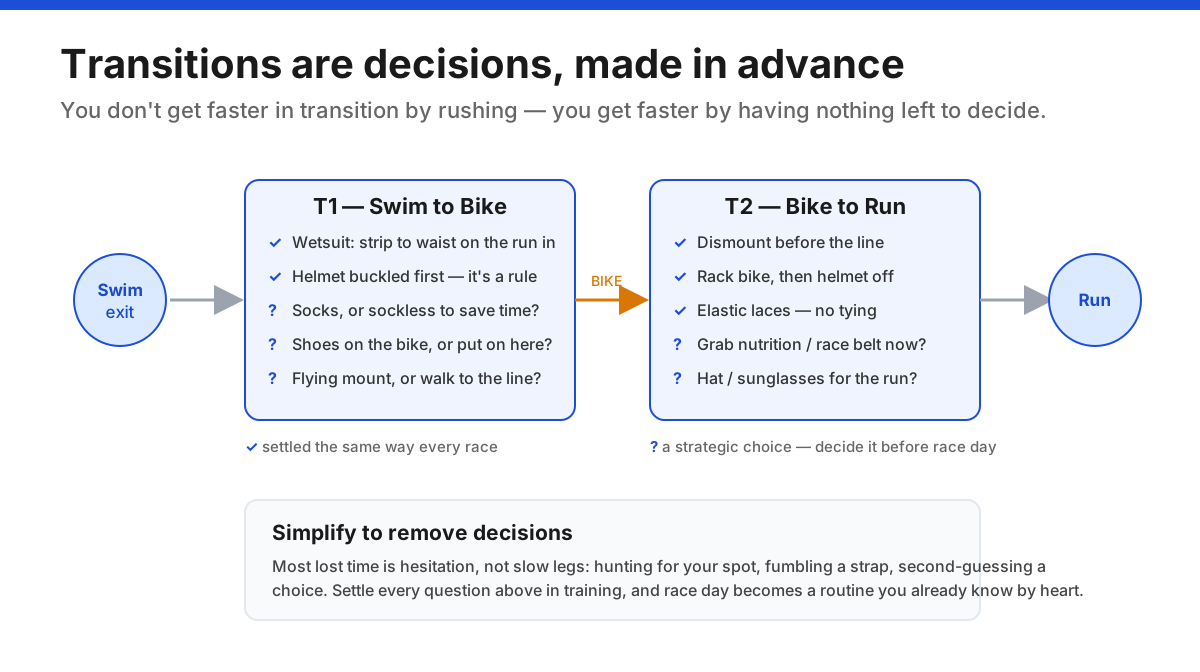
Fast transitions are not about moving frantically — they are about arriving with every choice already made. This is the strategy layer of the 'fourth discipline': where transition time is genuinely lost (hesitation, not slow legs), the real trade-offs behind the big decisions — socks or sockless, shoes clipped to the bike or not, flying mount or a walk to the line — and how the right answers change with race distance and experience. For the step-by-step execution, area layout and mount technique, this pillar links to the guides that own each one.
Key takeaways
- 1Most lost transition time is hesitation, not slow running — the strategy is to remove decisions in advance, not to rush.
- 2The big time-savers (sockless, shoes on the bike, a flying mount) each trade time for risk; the right call depends on the distance, conditions and your skill.
- 3Transition strategy shifts with race distance: in a sprint every second counts, while in an Ironman comfort and nutrition matter more than shaving 20 seconds.
- 4Two things are non-negotiable rules, not choices: buckle your helmet before you touch the bike, and dismount before the line.
- 5Practise transitions as a rehearsed routine so that on race day you are executing a plan, not improvising under stress.
In this article
- 1Transitions are decisions, not sprints
- 2Where transition time actually goes
- 3The strategic decisions to settle before race day
- 4Match your transition strategy to the race
- 5How to practise transitions — and what to rehearse
- 6The mental side: staying calm in the chaos
- 7Common transition-strategy mistakes
- ⚖Transition decisions and their trade-offs
- ?Frequently asked questions
Transitions are decisions, not sprints
Transition is called the fourth discipline, and a slow one can cost several minutes — but the reason most athletes lose that time is rarely that they moved slowly. They lose it by deciding slowly: hunting for their bike, second-guessing whether to put socks on, fumbling a helmet strap, standing over their kit wondering what comes next. Fast transitions come from arriving with every one of those questions already answered.
That reframes the whole skill. Getting good at transitions is less about frantic hands and more about making your choices in advance and rehearsing them until they are automatic. The athlete who looks calm and quick in T1 is not thinking; they are running a routine they have already run a dozen times.
This guide is about that strategy — the decisions and trade-offs. It does not repeat the mechanics, because three companion guides own those:
- The exact step-by-step of T1 and T2 → triathlon transitions mastery
- How to physically lay out your transition spot → how to set up your transition area
- Getting on and off a moving bike → the flying mount and dismount guide
Read this to decide what your plan is; read those to execute it.
Where transition time actually goes
Before optimising anything, understand where the seconds — and sometimes minutes — really disappear. In roughly descending order for most age-group athletes:
- Finding your spot. Wandering a crowded transition looking for your bike is the single biggest avoidable loss, and it is pure hesitation. A memorised location and a visual landmark erase it.
- Indecision. Pausing to choose — socks or not, glasses on now or later — costs more than the action itself. Every choice you settle beforehand is time you never spend.
- Fumbling. Wet hands on a helmet buckle, a wetsuit stuck at the ankles, laces that need tying. Most fumbles are solved by equipment choices (elastic laces, body glide) and practice, not speed.
- Over-complication. Every extra item and step is another thing to do and another thing to go wrong. Simplicity is a strategy, not laziness.
- Actual movement. Running your bike to the line and jogging to your spot is real but small, and it is the last place to look for savings.
The lesson is that transition strategy is mostly about subtraction: fewer decisions, fewer items, fewer things that can snag. You will save far more by removing a moment of doubt than by trying to move your hands faster.
The strategic decisions to settle before race day
These are the choices that actually define your transition plan. None has a single right answer — each trades time for risk or comfort, and the correct call depends on the race and on you. Decide each one in training, not in T1. The table below summarises the trade-offs; the notes add the nuance.
Socks or sockless. Skipping socks saves time, but risks blisters over longer runs and can be a problem in wet or gritty conditions. Common approach: sockless for a sprint, socks for half and full distance.
Shoes on the bike, or put on in T1. Leaving cycling shoes clipped to the pedals and slipping into them once riding saves time, but it demands practice and confidence — done badly it costs more time and risks a fall. It pairs with the flying mount.
Flying mount, or walk to the line. A running mount looks fast and saves seconds, but it is a genuine skill; a calm walk to the mount line and a stationary start is slower by a handful of seconds and far safer. Decide honestly based on your bike handling — see the flying mount guide.
Nutrition and race belt. Whether you grab gels and pin your number in T1, T2 or wear them throughout is a small decision that becomes a fumble if left to the moment.
Two items on the flow are not decisions — they are rules. Your helmet must be buckled before you unrack the bike in T1, and you must dismount before the line in T2. Break either and you take a penalty regardless of how fast the rest was; the governing-body rulebooks below are explicit on both.
Match your transition strategy to the race
The biggest strategic mistake is applying a sprint-racer's every-second-counts mindset to a long-course race, or vice versa. The right transition plan scales with the distance.
- Sprint and super-sprint. Transitions are a large share of a short race, so aggressive time-saving pays off: sockless, minimal kit, a fast mount if you have it. The risk of a small mistake is low because the race is short.
- Olympic. A balance — worth being efficient, but not worth a risky choice you have not nailed in practice. Socks become more defensible as the run lengthens.
- Half distance (70.3). Comfort starts to outweigh raw speed. Twenty seconds putting on socks and applying sunscreen is trivial against a 21 km run done in discomfort. The transition becomes partly a place to set yourself up to race well, not just to leave quickly.
- Full distance (140.6). The change tent is almost a pit stop: many athletes fully change kit, eat, apply chamois cream and sunscreen, and reset mentally. Losing a minute here to feel good for the next several hours is an easy trade.
So the same decisions — socks, mount style, how much to carry — flip their answers as the race gets longer. Fold whichever plan you choose into your wider race-day routine; race day preparation shows how the transition plan sits inside the whole day.
How to practise transitions — and what to rehearse
Transitions are the cheapest skill to improve because they cost nothing but a little time and need no fitness. Yet they are the most neglected, because they are boring to practise and easy to postpone. Treat them as a rehearsed routine.
- Rehearse the sequence, not just the actions. Set up a mock transition in a park or driveway and run the whole flow: jog in as if leaving the swim, execute T1, ride a short loop, execute T2, run out. Doing it in order builds the decision-free automatic routine that holds up under race stress.
- Attach it to your brick sessions. You are already practising running off the bike in brick workouts; add a real T2 to them so the two skills are rehearsed together.
- Rehearse the exact decisions you have chosen. If your plan is sockless with a flying mount, practise that — not a generic version. Race day should contain nothing you have not done before.
- Build the reverse checklist. Lay your kit out in the order you will use it, and mentally walk backwards from "running out" to confirm nothing is missing. Walk your real transition spot before the race and fix your landmark.
A handful of full rehearsals turns transition from a scramble into the calmest part of your race. For the precise step order to rehearse, the transitions mastery guide lays it out; for the physical layout you are rehearsing with, the transition setup guide covers it.
The mental side: staying calm in the chaos
Transition is the most chaotic moment of a triathlon: you arrive dizzy from the swim or with legs full of lactate from the bike, surrounded by other athletes doing the same, heart rate high and adrenaline higher. That state is exactly when good decisions evaporate — which is why pre-made decisions matter so much.
- Run your routine, not the crowd's. The athlete next to you rushing out is not your problem. Chasing someone else's pace in transition is how you skip a step or leave a strap unbuckled.
- Chunk it. Think in two or three simple blocks — "wetsuit and helmet," "shoes and bike," "go" — rather than a long list. The chunks trigger the rehearsed sequence.
- Use one deep breath as a reset. A single breath entering transition slows the panic just enough to let the routine take over.
- Accept that it will feel rough. The heavy, clumsy feeling is normal and shared by everyone around you; it passes within the first minutes of the next discipline.
The calm comes from preparation, not personality. When the plan is rehearsed, the chaos has nothing to disrupt.
Common transition-strategy mistakes
Most transition problems trace back to a few strategic errors rather than clumsy hands:
- Copying pros you cannot match. A flying mount and shoes-on-bike look fast on television, but attempting them untrained costs more time than they save and risks a crash. Earn the advanced techniques in practice first.
- Over-packing the transition spot. More gear means more decisions and more to knock over. Lay out only what you will actually use.
- Optimising the wrong thing. Shaving seconds off your shoe change while losing a minute finding your bike is backwards. Fix the biggest losses — location and indecision — first.
- Forgetting the rules under pressure. The helmet-buckle-first rule and the dismount line are the two most commonly penalised, and both are easy to blow when rushing. Make them the fixed anchors of your routine — and read how triathlon rules work so a penalty never surprises you.
- Never rehearsing. Reading about transitions is not practising them. The athletes who look smooth have simply done it before.
Get the strategy right — remove decisions, match the plan to the race, rehearse it — and the mechanics in the linked guides have something solid to sit on.
Transition decisions and their trade-offs
| Decision | Faster option | The trade-off | Best for |
|---|---|---|---|
| Socks | Go sockless | Blister risk on longer runs | Sprint / short runs |
| Cycling shoes | Leave clipped to bike | Needs skill; risk if rushed | Practised athletes |
| Bike mount | Flying (running) mount | A real skill; fall risk | Confident handlers |
| Race number | Wear belt throughout | Minor comfort on the bike | Most athletes |
| Kit amount | Bare minimum out | Less comfort long-course | Short races |
| Sunscreen / nutrition | Skip or pre-apply | Sunburn / underfuelling | Short races only |
Sources
Sources are listed so readers can verify consequential claims and dated details.
- World Triathlon Competition Rules 2026 — World Triathlon (accessed September 18, 2026)
- Multisport competition rules — USA Triathlon (accessed September 18, 2026)
Frequently asked questions
How much time can good transitions actually save?
A disorganised transition can cost several minutes compared with a smooth one, and most of that gap is hesitation — finding your spot, deciding, and fumbling — rather than slow movement. For beginners, simply eliminating confusion and having a rehearsed routine is worth more than any single advanced technique. The strategic goal is to remove decisions, not to move frantically.
Should I put my cycling shoes on in transition or leave them on the bike?
Both are valid. Leaving shoes clipped to the pedals and slipping into them while riding saves time but is a genuine skill that costs time and risks a fall if it is not well practised. Putting shoes on at your spot is slower by a few seconds but far more reliable. Choose based on how confident you are, and only race the technique you have rehearsed.
Do I need to wear socks in a triathlon?
It is a trade-off, not a rule. Skipping socks saves time and many athletes race sprints sockless with body glide to prevent blisters. As the run gets longer, or in wet and gritty conditions, the blister risk outweighs the seconds saved, so most athletes wear socks for half and full distance. Match the choice to your race distance and skin.
Is a flying mount worth learning?
Only once your bike handling is solid. A running mount saves a handful of seconds and looks fast, but attempted without practice it costs time and risks a crash at the busiest point of the course. For most beginners a calm walk to the mount line and a stationary start is the smarter strategy until the flying mount is rehearsed and reliable.
What transition mistakes get penalised?
The two most common are touching or unracking your bike before your helmet is buckled, and failing to dismount before the dismount line. Both carry time penalties regardless of how fast the rest of your transition was. Make helmet-first and dismount-before-the-line the fixed anchors of your routine, and confirm each event's specifics in its athlete guide and the governing-body rules.