How Triathlons Work: The Sequence, Transitions and Timing
Understand the swim-bike-run sequence, T1 and T2, common start formats and how event timing contributes to your result.
By Lotte
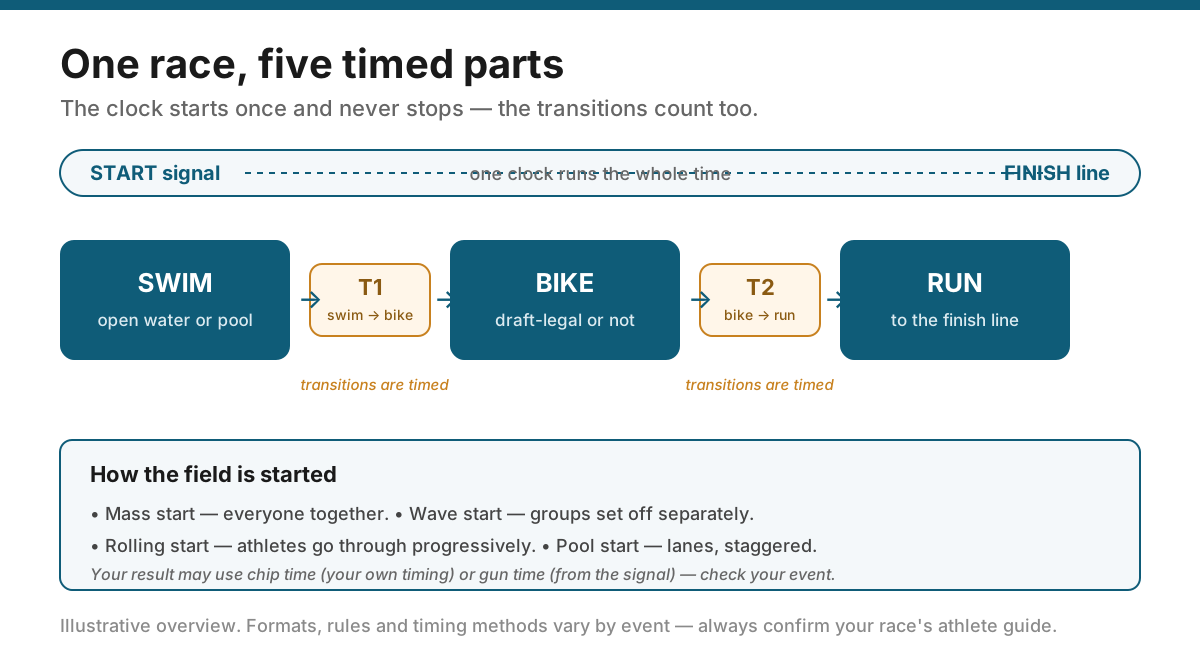
A triathlon is not three separate races — it is one continuous race made of five timed parts: a swim, a first transition, a bike leg, a second transition and a run, all measured by a single clock that never stops. Understanding that shape — the sequence, what the transitions actually are, how the field is started, and how your result is timed and calculated — removes most of the confusion beginners feel. This guide explains the mechanics of how a triathlon works, and points you to the dedicated pages for the day's logistics, the distances and the specific rules.
Key takeaways
- 1A triathlon is one race in five timed parts: swim, T1, bike, T2, run — the clock never stops between them
- 2T1 and T2 are the transitions (swim-to-bike and bike-to-run) and they count toward your total time
- 3Start formats — mass, wave, rolling or pool — change your experience and which clock (chip or gun) counts
- 4Your result is your total elapsed time including transitions, plus any penalties, not the sum of three bests
- 5Rules like drafting, mount/dismount lines and cut-offs vary by event — the athlete guide is the authority
In this article
- 1The short answer: one race, not three
- 2The sequence, part by part
- 3What the transitions actually are
- 4How the field is started
- 5How timing and results work
- 6A worked example: adding up a finish time
- 7The rules that shape the race — and where they vary
- 8Where the mechanics vary: pool, relay and shortened races
- 9Now that you know how it works
- ⚖The five timed parts of a triathlon
- ?Frequently asked questions
The short answer: one race, not three
The single most important thing to understand about triathlon is that it is one continuous race, not three back-to-back events. You swim a set distance, then move through a transition area and get on your bike, then ride, then move through the transition area again and run to the finish. Crucially, a single clock runs the entire time — from the start signal until you cross the finish line — so the minutes you spend changing from one discipline to the next count toward your result just as much as the swimming, cycling and running do.
That continuous-clock idea is what makes a triathlon feel different from doing a swim, a bike ride and a run on the same day. You are not resting between legs; you are racing through the changeovers. Everything else on this page — the sequence, the transitions, the start formats and the timing — follows from that one fact. If you want the identity of the sport (what it is and who does it) rather than the mechanics, start with what is a triathlon; this page is about how the race itself actually operates.
The sequence, part by part
Every standard triathlon runs in the same order, and it helps to see all five parts laid out:
- Swim — usually first, in open water (a lake, sea or river) or sometimes a pool. You exit the water and head for the transition area.
- T1 (first transition) — the swim-to-bike changeover: wetsuit off, helmet on and fastened, shoes on, bike off the rack, and out to the mount line.
- Bike — the longest leg by time in most formats. You ride the marked course and return to the transition area.
- T2 (second transition) — the bike-to-run changeover: rack the bike, helmet off, running shoes on, and out onto the run course.
- Run — the final leg, ending at the finish line.
The swim-bike-run order is near-universal because it moves from the highest-risk discipline (open water, where being tired is dangerous) to the safest (running). A handful of variants exist — duathlons (run-bike-run) and aquabikes (swim-bike) among them — which the what is a triathlon page covers as related formats.
What the transitions actually are
The transition area is a designated zone, usually filled with numbered bike racks, where you leave your bike and gear before the race and return to it during the race. It is the physical hub that connects the three sports, and moving through it well is enough of a skill that many people call transitions the sport's fourth discipline.
Mechanically, three things matter for understanding how it works. First, you follow marked one-way entry and exit routes and rack your bike in your assigned spot — you cannot cut across wherever you like. Second, there is a mount line and a dismount line: you may only get on the bike after the mount line on the way out, and must get off before the dismount line on the way in, so the bike leg has fixed physical boundaries. Third, the helmet must be fastened before you touch the bike and stay fastened until it is racked — a rule so universal it is worth building into muscle memory.
This page explains what transitions are; for how to set them up and move through them quickly, see the transition strategy guide, and for the whole day's flow, what happens on race day.
How the field is started
How everyone begins the swim shapes both your experience and how your time is measured, and events use several formats:
- Mass start — everyone (or a large group) sets off together. Exciting, but crowded and physical at the front of the swim.
- Wave start — athletes are divided into groups (by age, sex or category) that start a few minutes apart, thinning out the swim.
- Rolling start — athletes filter across the start line a few at a time, self-seeding by expected swim speed. Common at larger events for safety.
- Pool start — for pool-based races, swimmers set off individually or in lanes at staggered intervals, often seeded by a predicted swim time.
The format determines a subtle but important point: which clock counts. With a mass or wave start, everyone in a wave shares a start signal. With a rolling or pool start, athletes cross the line at different moments, so your chip time (measured from when you personally start) can differ from gun time (measured from the signal) — which is exactly why you cannot judge your result by who physically finishes ahead of you. The next section unpacks that.
How timing and results work
Your official result is your total elapsed time — swim + T1 + bike + T2 + run — as recorded by the event's timing system, not the sum of your best-ever splits done separately. Timing mats placed around the course detect a chip (usually on an ankle band or your bib) as you pass, producing your segment splits and your finish time.
Two distinctions decide how to read that result. Chip time vs gun time: chip time is your own elapsed time from when you crossed the start; gun time runs from the start signal regardless of when you actually began. Results and cut-offs may use either, so always check which your event applies. Penalties: infringements (a drafting violation, an unfastened helmet, a blocked pass) can add time or a stop-and-go penalty, and results pages differ in whether they show penalties separately or fold them into your total. Because of all this, if your watch disagrees with the official result, compare start and finish points and the timing method before assuming an error — the event's official timing and appeals process, not your watch or another athlete's, is the authority.
A worked example: adding up a finish time
Because the transitions count, the arithmetic of a finish time surprises many first-timers. Take an illustrative result: an 18-minute swim, a 4-minute T1, a 48-minute bike, a 2-minute T2 and a 30-minute run.
Adding only the three sports gives 18 + 48 + 30 = 96 minutes. But the real total includes the transitions: 18 + 4 + 48 + 2 + 30 = 102 minutes, or 1 hour 42 minutes. Those six minutes in transition are part of your race — and for a beginner they can easily be longer, which is why practising transitions is genuinely worthwhile.
These numbers are invented to show the calculation, not a target for a first race. To estimate your own realistic time, put your recent, comparable training paces into the finish-time predictor and remember to leave a generous transition allowance. If you are choosing between event lengths first, the triathlon distances guide shows how the numbers change from a sprint up to a full.
The rules that shape the race — and where they vary
A few rules materially change how a triathlon works, and they are not universal — they depend on the format, the governing body and your category, so the current athlete guide is always the final word:
- Drafting. In most age-group racing, riding closely behind another cyclist to save energy (drafting) is not allowed, and you must keep a set distance and pass within a time limit. Some events and elite races are draft-legal. The drafting rules explained guide covers this in full.
- Cut-off times. Many races set time limits for the swim, for the overall event, or at intermediate points; miss one and your day can end early. See cut-off times.
- Walking and outside help. Walking during the run is usually fine where the course allows it, but receiving certain kinds of assistance, or missing part of the course, can carry consequences.
The theme is consistent: the shape of a triathlon is standard, but the specifics are set by your event. Reading the athlete guide is part of understanding how your particular race works.
Where the mechanics vary: pool, relay and shortened races
Not every triathlon runs exactly like the open-water, individual model above, and knowing the common variations prevents surprises.
Pool-based sprints are a popular first event: the swim happens in a pool with lane and staggered-start rules of their own, which makes the swim far less intimidating. Relay (team) triathlons split the three legs between team members, with the timing chip handed over at the transitions — a great way to try the sport. And on the day, organisers can modify a race for safety: a swim shortened or cancelled for cold or rough water turns it into a duathlon-style event and changes how times compare with previous years.
If a race is altered or you are unable to finish a leg, that is handled by the event's procedures rather than being a personal failure — what happens on race day explains DNFs and modified races. Recording the actual conditions and distance matters before comparing your result to a standard event.
Now that you know how it works
Once the mechanics make sense, the sport stops feeling like a puzzle and becomes a sequence you can prepare for. The nerves most beginners feel come less from fitness than from not knowing how the day is structured — and you now have that structure.
From here, pick the question that matches where you are. To understand the sport's appeal and whether it suits you, read what is a triathlon. To compare event lengths, open the distances guide. To turn understanding into readiness, work through your first triathlon and the step-by-step beginner triathlon guide. And to prepare the day itself, use what happens on race day and the race-morning routine. Understanding how a triathlon works is the foundation; everything else builds on it one concrete step at a time.
The five timed parts of a triathlon
| Part | What happens | Counts toward your time? | Common beginner surprise |
|---|---|---|---|
| Swim | Open water or pool, first leg | Yes | Mass starts are crowded and physical |
| T1 | Swim-to-bike transition | Yes — the clock keeps running | Transitions are timed, not a rest |
| Bike | Longest leg by time; often non-drafting | Yes | You must not draft in most age-group races |
| T2 | Bike-to-run transition | Yes — the clock keeps running | Helmet must stay on until the bike is racked |
| Run | Final leg to the finish | Yes | Legs feel heavy off the bike at first |
Sources
Sources are listed so readers can verify consequential claims and dated details.
- Race-day procedures and athlete information — World Triathlon (accessed September 22, 2026)
- USA Triathlon multisport competitive rules — USA Triathlon (accessed September 22, 2026)
Frequently asked questions
What do T1 and T2 mean in triathlon?
T1 is the first transition, from the swim to the bike; T2 is the second transition, from the bike to the run. Both take place in the transition area where your bike and gear are racked, and both are timed — the race clock keeps running while you change disciplines, so they count toward your total time.
Does the clock stop during transitions?
No. A single clock runs from the start of the swim to the finish of the run, including both transitions. That is why practising fast, organised transitions matters and why your finish time is more than the sum of your swim, bike and run splits.
What is the difference between chip time and gun time?
Chip time is your own elapsed time measured from when you personally crossed the start, using a timing chip. Gun time is measured from the start signal regardless of when you began. With rolling or pool starts the two can differ, so check which your event uses for results and cut-offs.
How is my finish time calculated?
It is your total elapsed time — swim plus T1 plus bike plus T2 plus run — as recorded by the event's timing mats, adjusted for any penalties. It is not the sum of your best individual training times, and it is not decided by your watch; the official timing system is the authority.
Can I walk during a triathlon?
Walking during the run is usually allowed where the course permits, and many beginners use a run-walk approach. You still have to complete the marked course and meet any cut-off times, and certain kinds of outside assistance can carry penalties, so check your event's athlete guide.