Triathlon Pacing by Distance, Terrain and Conditions
Build a flexible triathlon pacing strategy for each leg using effort, terrain, conditions and a plan for difficult race-day changes.
By Lotte
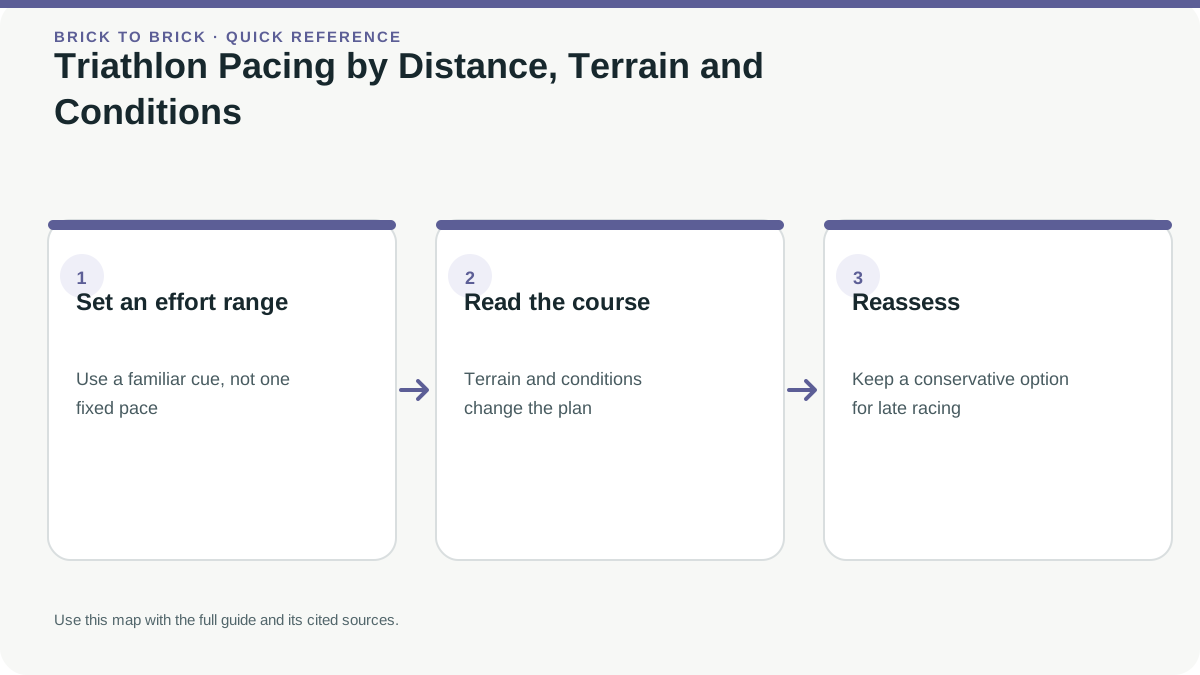
Triathlon pacing means distributing effort across the swim, bike and run so the plan remains usable as terrain, conditions and fatigue change. Set cues from your preparation and adjust when the day differs.
Key takeaways
- 1No fixed pace, heart-rate value or power percentage fits every athlete and course.
- 2Use effort with suitable pace, power or heart-rate context rather than watching one number constantly.
- 3Write a plan for heat, congestion, missed supplies and symptoms before the start.
In this article
- 1Choose the total-race objective first
- 2What changes as the race gets longer
- 3Use more than one effort signal
- 4Adjust to terrain before chasing averages
- 5Write rules for a slow opening or difficult conditions
- 6Review execution with a decision log
- 7Compare two bike strategies without rewarding the faster split automatically
- 8Choose a cue you can use without looking down
- 9Choose a pacing signal that matches the leg
- 10Plan the bike so the run remains possible
- 11Account for hills, wind, heat and course congestion
- 12Use the swim as a controlled entry, not a time trial
- 13Write an opening, middle and finish cue for each race length
- 14Build a stop-or-adjust rule into the plan
- 15Turn pacing ideas into cues you can use under fatigue
- 16Use a pacing review that accounts for uncertainty
- ?Frequently asked questions
Choose the total-race objective first
Decide whether your priority is completing a first event, finishing comfortably inside official cutoffs, improving execution or pursuing a competitive result. Those objectives change how much uncertainty and late-race fatigue you can reasonably accept.
Triathlon pacing research describes influences from event distance, individual fitness and interactions between disciplines. It does not justify taking one athlete's split targets as a universal prescription.
For your first standard-distance event, the Olympic pacing guide provides a worked scenario. This page is the broader framework for choosing and adjusting effort across formats.
What changes as the race gets longer
Distance changes the time an athlete must sustain effort and the number of practical decisions around nutrition, terrain and recovery. It does not create one universal pace multiplier. Use training experience, event conditions and a qualified coach’s guidance to set a conservative starting effort. Treat any target as adjustable when heat, wind, congestion, health or equipment changes the day.
Use more than one effort signal
A useful pacing decision may combine perceived effort with pace, power or heart rate, but their reliability differs by sport and conditions. Pace can fluctuate on hills or from GPS error, power depends on equipment and heart rate lags or shifts with heat, stress, medication and fatigue. Pick a primary cue for each session and use the others as context; stop for concerning symptoms instead of chasing a number.
Adjust to terrain before chasing averages
On a climb, allow speed to fall rather than forcing flat-road speed with a large effort spike. On a descent, use the speed that your handling, visibility and conditions allow. Do not try to repay every slow climbing minute immediately.
A headwind changes speed for a given effort. Holding the original speed can demand much more work; reassess the goal instead. Technical sections may make feeding or looking at data impractical.
Break a complex course into sections and identify where steady effort is possible. Average pace is most useful when the segment being compared has similar demands.
Write rules for a slow opening or difficult conditions
If the swim takes longer than expected, begin the bike under control. A slower first split does not create extra physiological capacity to spend later. Check the implications for cutoffs and supplies, then adjust deliberately.
If heat, illness symptoms or unusually high effort emerge, reduce the demand and seek help when appropriate. Your cool-weather plan is not a contract. Use the heat guide for specific preparation and emergency signs.
A negative split can be a useful goal in some circumstances, but it is not a requirement or a guarantee of the fastest result. Terrain and conditions may make an even-speed finish inappropriate.
Review execution with a decision log
After a rehearsal or race, record where effort changed and why. Compare the opening bike effort, the first run minutes and the final portion of the run. Include weather, fueling, stops and traffic.
Ask whether a decision helped the whole race: did passing require an unnecessary surge, did caution on a descent preserve control, or did a slower opening run prevent an early struggle? These observations are more useful than judging every split against an ideal day.
Choose one change for the next rehearsal. A pacing plan becomes more credible through comparable practice, not through adding more decimal places to an estimated target.
Compare two bike strategies without rewarding the faster split automatically
Consider two fictional rehearsals on comparable routes. In A, the athlete rides 90 km in 3:00 and runs the next 10 km in 1:05. In B, the ride takes 3:05 and the run takes 0:57. Combined moving time is 4:05 for A and 4:02 for B. The slower bike is associated with the faster combined result in this illustration.
That arithmetic does not prove which strategy will work in a race. Weather, terrain, fueling, fatigue and the shortened rehearsal run all limit the comparison. Its purpose is to stop a common accounting error: counting minutes gained on the bike while ignoring minutes lost afterward.
Record effort and comfort as well as time, and compare more than one ordinary session where practical. Use a repeatable route and similar conditions without trying to reproduce a full-distance race in training. The decision is whether an effort strategy leaves you able to execute the next discipline, not whether your bike split looks impressive in isolation.
Choose a cue you can use without looking down
A pacing cue should be available when it matters. On a crowded swim start, a breathing or stroke-control cue may be more usable than a watch split. On a technical bike section, preserving control and choosing an appropriate gear comes before watching average speed. During a run, a familiar effort cue can help when satellite pace fluctuates.
Write one primary cue and one cross-check for each discipline. They should be familiar from training and simple enough to recall when tired. If the two disagree, investigate conditions and symptoms rather than automatically trusting the device. After the race, review where the cue helped you make a better decision. A plan is useful because you can execute it, not because it contains more target numbers than another athlete's plan.
Choose a pacing signal that matches the leg
Pacing means controlling effort over time, not holding one speed or number regardless of conditions. A pace target can be useful on a steady run course; power can help describe cycling effort when wind and gradients change; heart rate gives another response signal but reacts with a delay and can drift with heat, fatigue, hydration and stress. Perceived effort remains available when sensors fail. None of these measurements is a complete race plan by itself.
Before race day, identify the signal you can use reliably for each leg and the conditions that make it less trustworthy. A watch pace from a GPS unit may be noisy around buildings or trees. Bike power can fluctuate on rough roads or fail with a sensor battery. Heart rate may be elevated by heat or anxiety. RPE changes with fatigue but can be hard to interpret when you are inexperienced. Use two signals together—for example, power plus breathing or pace plus perceived effort—so a single number does not force an unsafe decision.
Write one short cue you can remember without looking down. “Comfortable and controlled until the first turn” is more usable in the swim than an exact time target. “Smooth pressure, no surges” can guide a bike on rolling terrain. “Start the run able to speak a short phrase” may help a beginner avoid racing the first kilometre. The cue should reflect a plan rehearsed in training, not an unsupported guarantee.
Plan the bike so the run remains possible
The bike is often the longest leg, but the appropriate effort depends on distance, course, athlete history and weather. A short race may allow a more assertive ride than a long event; a hilly or windy course may demand attention to effort rather than average speed. Do not turn one test result or threshold number into a race target without considering how long you need to sustain it and what follows.
If you use power, evaluate the planned range on terrain similar to the event and practise staying smooth over rises. If you use heart rate, remember it may lag behind a surge and climb over a long session even when power is stable. If you pace by feel, rehearse what “controlled” means on climbs, into a headwind and in heat. In each case, avoid repeated accelerations to respond to other riders or a faster split.
A simple pacing check is to compare how you feel at the end of the bike with the plan you rehearsed: can you settle into an easy opening run, or are you already managing severe fatigue, dizziness or nausea? A harder bike split is not automatically a better race if it undermines the final leg. If serious symptoms appear, seek event medical support rather than treating them as a pacing puzzle. For bike-zone choices, see heart-rate zones, power training and the first Olympic pacing guide.
Account for hills, wind, heat and course congestion
A pace number describes output on a particular surface and day. Hills, wind, turns, gravel, heat and crowded aid stations change how much effort is needed to maintain it. On a climb, holding a flat-road bike speed can require an unsustainable surge. Into a headwind, chasing speed can waste energy. On a technical descent or congested section, safety and control matter more than the target split.
Preview the course and divide it into sections with one instruction each: settle, climb smoothly, fuel at a safe point, descend with control, or conserve before a turn. If heat is likely, expect the same effort to produce a slower pace and discuss hydration and heat management in training. Do not try to “make up” time by forcing a faster pace later. Race conditions are not always predictable, so write down what you will do if the day is warmer, windier or more crowded than expected.
Do not compare splits across different course layouts as if the difference is fitness alone. Aid-station spacing, road closures, start timing and route measurement can affect both elapsed time and recorded pace. Record conditions with your result, and use comparable sessions when evaluating a training change.
Use the swim as a controlled entry, not a time trial
A calm start can protect the rest of the race. Choose a swim position consistent with your ability to navigate and breathe in the event’s start format. The opening strokes may be crowded, and a fast start can raise effort before you have found your rhythm. Use familiar breathing and sighting rather than trying a new stroke pattern to stay with a pack.
If you lose the course line, look for the next marker or a stable landmark, then return to your normal stroke. A few seconds spent reorienting can be safer than swimming a long wrong line. If contact becomes uncomfortable, move toward open water; if you cannot continue safely, signal for help and follow the safety crew. Do not convert pacing into pressure to tolerate distress.
Swimming pace depends on the venue, water, suit, start and navigation. A pool split is useful background but not a reliable direct prediction for an open-water race. Use a range and effort cue rather than promising yourself one exact swim time. The organizer’s course and safety instructions supersede a personal pacing plan.
Write an opening, middle and finish cue for each race length
A compact plan can use three stages without pretending the race is perfectly predictable. In the opening, stay controlled and let breathing and equipment settle. In the middle, return to the planned effort and check fuel, fluid and course position at rehearsed points. In the final section, decide whether you can increase effort based on how you feel, the conditions, and whether doing so remains safe.
For a short race, those stages may be brief and the athlete may choose to race harder after settling. For a middle-distance or full-distance event, the opening restraint and repeated fueling checks matter more because there is more time for small errors to accumulate. These descriptions are frameworks, not distance-specific prescriptions. An athlete with limited preparation, a medical condition or a challenging course may need a more conservative plan.
Write the stage cues in plain language, then test them during a brick session or race rehearsal. If the cue depends on staring at a watch every minute, simplify it. Keep a fallback for sensor failure: a familiar RPE description, route notes and the ability to continue safely without live data. A pacing strategy should remain usable when the device does not.
Build a stop-or-adjust rule into the plan
A pacing plan should include reasons to back off or stop. Slow down if heat, wind, unexpected effort, poor sleep or a missed nutrition opportunity makes the intended target unrealistic. Stop and contact medical support for chest pain, faintness, confusion, severe breathing difficulty, loss of coordination or other alarming symptoms. Do not interpret these as evidence that the athlete lacks toughness.
Before race day, identify the medical tent, how to contact course officials and what to do if you withdraw. Decide how much time margin you need at official cutoffs using the event’s actual athlete guide. Do not accept a plan that only works if every split is perfect. A time estimate is a planning tool, not permission to ignore safety or continue past a closure.
After the event, record the plan, conditions and actual effort. Compare choices rather than judging the result only by finish time. If the bike was within the intended effort but the run was difficult, consider heat, fueling, course, training and health together. One race rarely proves a universal pacing rule. For more, use race heart-rate targets, the race nutrition guide and the distance-specific race pages.
Turn pacing ideas into cues you can use under fatigue
A pacing plan has to work when attention narrows. Before race day, write one cue for each leg that does not require constant screen checking. In the swim, it may be relaxed exhalation and controlled effort through the opening. On the bike, it may be a sustainable pressure on the pedals on flats and a deliberate reduction on climbs. On the run, it may be short relaxed steps and a planned check at each aid station. The cue should describe behavior, not promise a particular split.
Decide what information you will look at and when. A bike computer may show elapsed time, power, heart rate or distance, but frequent glances can distract from traffic. Choose a few safe points to check rather than reacting to every fluctuation. Running pace can vary with terrain, heat and GPS error; treat a brief pace change as information to interpret, not a command to speed up. Heart rate can lag during changes in effort and can be affected by temperature, stress, caffeine, medication or sensor fit.
Write an adjustment rule for common situations. If the first minutes feel unexpectedly hard, settle into a lower effort and assess breathing. If heat rises, reduce effort and seek appropriate cooling and fluids according to your practiced plan. If a mechanical occurs, stop safely and follow the event procedure. If chest pain, confusion, faintness or other severe symptoms appear, stop and seek medical support rather than protecting a pacing target.
After the event, compare the plan with the conditions and your experience. Record where effort drifted, where you made a deliberate choice and what the outcome felt like. Avoid judging the strategy only by finishing time, because course, weather, competition and health vary. The most useful lesson may be that an early restraint kept the final section controlled, even if the split was not the fastest in the field.
Use a pacing review that accounts for uncertainty
A comparison between two race strategies is meaningful only when the comparison accounts for more than split times. Note the course profile, temperature, wind, swim conditions, equipment, fueling, stops, training state and whether the athlete felt healthy. A fast bike split followed by a difficult run does not prove that the bike caused the problem; the swim, heat, nutrition or unrelated illness may have contributed. Treat the record as a clue, not a controlled experiment.
Compare repeated training sessions on similar terrain when practising an effort. Use the same measurement method and note when the conditions differ. A power target from one bicycle position may not feel the same on another setup. A pace from a flat route does not transfer directly to hills or trails. The purpose is to learn a usable range and effort cue, not to make a perfect race prediction.
For a long-course event, build contingencies into the plan. Know what you will do if the event is hotter than expected, if a bottle is lost, if the course is congested or if you need to stop. A conservative plan can include a point where you reassess rather than a promise to hold one number for the entire day. Do not make up a missed fueling portion by taking several at once, and do not use pace to justify ignoring symptoms.
For a short event, pacing still begins with control, but the athlete may be able to sustain higher relative effort after preparation. That does not mean every athlete should start at maximum effort or copy a competitor. Use a coach’s individualized guidance where available, and rehearse the intended effort in training. Your pacing plan is a decision aid that should adapt when conditions change.
Sources
Sources are listed so readers can verify consequential claims and dated details.
- Pacing strategies across sprint, Olympic and half-Ironman triathlons — European Journal of Applied Physiology (accessed September 13, 2026)
- Factors influencing pacing in triathlon — Open Access Journal of Sports Medicine (accessed September 13, 2026)
- IOC consensus on sport in extreme heat — International Olympic Committee (accessed September 24, 2026)
- Training intensity distribution meta-analysis — Peer-reviewed meta-analysis (accessed September 24, 2026)
- Training load and injury risk consensus — IOC consensus (accessed September 24, 2026)
Frequently asked questions
Should I keep the same pace on hills?
Usually, match effort rather than forcing a flat-course speed uphill. Adjust for terrain and preserve control on descents.
How should I pace in heat?
Follow event medical advice, reduce effort when conditions require it and use a practiced hydration plan. Seek help for severe or worsening symptoms.