Aquabike Racing: Distances, Rules and How a Swim-Bike Race Works
An aquabike is a triathlon with the run removed: swim, transition, bike, finish. What the official distances actually are, where the race finishes, which rules apply, and why you pace it differently from a triathlon.
By Lotte
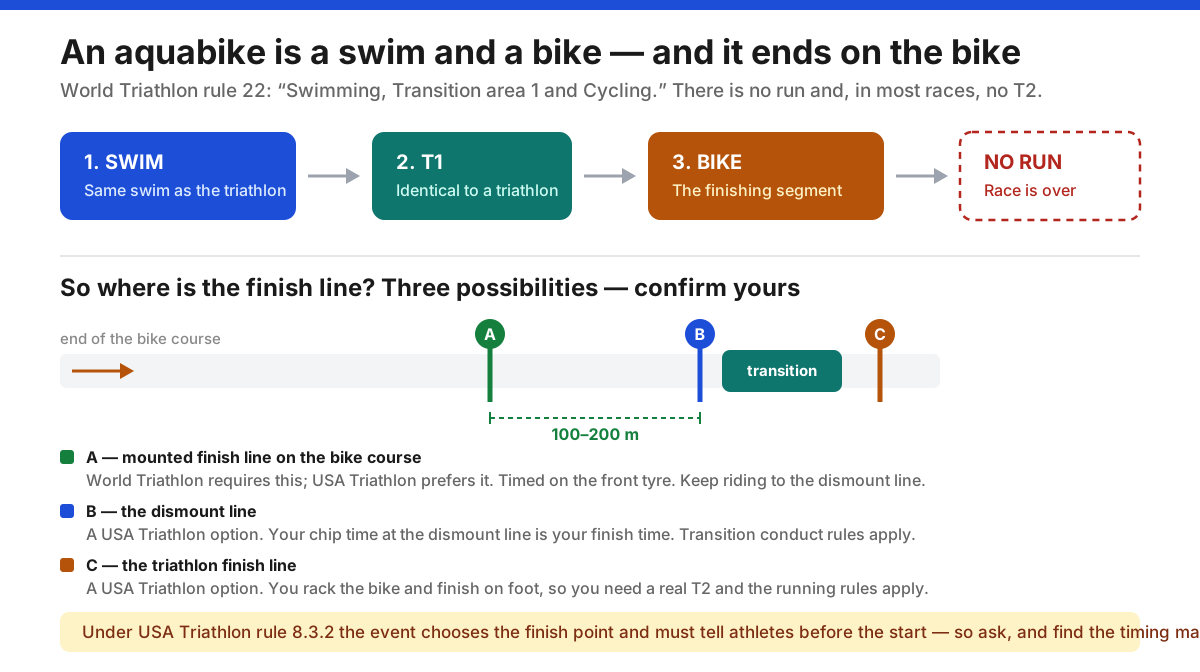
An aquabike is a swim followed by a bike leg, with no run. Under the World Triathlon Competition Rules it runs as an age-group format at three stand-alone distances — 1500 m / 40 km, 1900–3000 m / 80–90 km and 3000–4000 m / 90–200 km — but when it is attached to a triathlon it simply borrows that triathlon's swim and bike distances, which is why published figures disagree so often. The detail that catches people out is the finish: World Triathlon places the line on the bike course 100–200 m before the dismount line and times the front wheel, while USA Triathlon lets each event choose between a mounted finish line, the dismount line and the triathlon's own finish line. Because nothing follows the bike, an aquabike is paced as a time trial rather than as a triathlon bike leg.
Key takeaways
- 1An aquabike is swim, transition area 1, then bike — the run is removed and the race ends on the bike course, not in a finish chute
- 2There is no single aquabike distance. World Triathlon lists three stand-alone formats, USA Triathlon uses four mileage bands, and an aquabike attached to a triathlon takes that triathlon's swim and bike distances
- 3Under World Triathlon rules the finish line sits 100–200 m before the dismount line and your time is taken when your front tyre crosses it, after which you keep riding to the dismount line
- 4USA Triathlon lets event management pick the finish point — the bike course, the dismount line or the triathlon finish line — and it must tell athletes before the start, so confirm it rather than assuming
- 5Every other rule is inherited from the triathlon the aquabike is attached to: same wetsuit determination, same drafting rules, same transition conduct, same penalties
- 6Because there is no run to protect, the bike is paced as a standalone time trial rather than held in reserve — the single biggest change in how you race it
- 7World Triathlon runs aquabike as an age-group-only format with a minimum age of 18, and it is not permitted in relays or individual circuit races under USA Triathlon rules
In this article
- 1An aquabike is a triathlon with the run removed — and it finishes on the bike
- 2Official aquabike distances — and why the numbers online disagree
- 3Where an aquabike race actually finishes
- 4Who races an aquabike, and why
- 5Aquabike, duathlon, aquathlon and relay — which is which
- 6How you race it: you are no longer protecting a run
- 7Fuelling and hydration change shape too
- 8Transition, racking and kit
- 9The rules are the parent triathlon's rules — with a few aquabike-only exceptions
- 10Cut-offs, results and what to confirm before you enter
- 11Championship aquabike racing
- 12How to find and enter an aquabike
- ⚖Which swim-bike-run format fits your situation?
- ?Frequently asked questions
An aquabike is a triathlon with the run removed — and it finishes on the bike
An aquabike is a two-segment multisport race: you swim, you go through transition, you ride, and then you are finished. There is no run.
Both of the rulebooks that govern most of the world's races define it in almost identical words. The World Triathlon Competition Rules state that "Aquabike consists of Swimming, Transition area 1 and Cycling" (section 22.1). The USA Triathlon Multisport Competition Rules call it a "multisport which combines swimming and cycling in two segments. The first segment is swimming, and the finishing segment is cycling" (section 8.3.1).
Read that second sentence again, because it contains the thing that surprises almost every first-time aquabiker: cycling is the finishing segment. You do not rack your bike and jog through an arch. In most aquabike races you cross a finish line while still riding.
That single structural fact ripples through everything else on this page — where the timing mat is, what your recorded time includes, how hard you can ride, what you need to rack in transition, and whether there is a T2 at all.
Two quick points of clarification before we go further:
- This is not the gym "aqua bike." Aquabiking, aqua cycling or hydrospinning — pedalling a stationary bike submerged in a pool — is a completely separate fitness activity that happens to share a name. This page is about the multisport race format.
- Aquabike is a real, sanctioned discipline, not an informal "did not run" category. World Triathlon holds Aquabike World Championships and USA Triathlon holds an Aquabike National Championship. You get a result, a ranking and an age-group placing.
If you are still working out which multisport format you want at all, our guide to choosing your first triathlon covers the wider decision; this page assumes you are specifically interested in the swim-bike version.
Official aquabike distances — and why the numbers online disagree
Search for aquabike distances and you will find confident, contradictory answers. That is not carelessness on the part of the people writing them. The format genuinely has more than one distance framework, and a third rule that overrides both.
What World Triathlon publishes. Appendix A of the World Triathlon Competition Rules lists three stand-alone aquabike formats:
| Aquabike format | Swim | Bike | Minimum age |
|---|---|---|---|
| Standard distance | 1500 m | 40 km | 18 |
| Middle distance | 1900–3000 m | 80–90 km | 18 |
| Long distance | 3000–4000 m | 90–200 km | 18 |
Note that there is no sprint aquabike in that table, and note the minimum age of 18 at every distance — higher than the 15 or 16 permitted for shorter triathlons.
What USA Triathlon publishes. USA Triathlon describes aquabike using four mileage bands rather than named race distances:
| USA Triathlon category | Swim | Bike |
|---|---|---|
| Short | 0.25–0.62 mi | 5–18.6 mi |
| Intermediate | 0.63–1.25 mi | 18.7–31 mi |
| Long | 1.26–1.9 mi | 31.1–62 mi |
| Ultra | 2.0 mi and above | 62 mi and above |
USA Triathlon also names a single most common format, which is also its national championship distance: a 1.2-mile swim and a 56-mile bike — the swim and bike of a middle-distance triathlon.
The rule that overrides both tables. Most aquabike races in the world are not stand-alone events at all. They are a category bolted onto an existing triathlon, and both rulebooks say the same thing about that case. World Triathlon rule 22.1 states that where aquabike is included in the programme of an event that includes a triathlon, "Aquabike will have the same swim and bike distances as the triathlon programmed in the same event." USA Triathlon's section 8.3.1 says aquabike may be combined with triathlon events "with the same swimming and cycling distances as the triathlon(s) programmed into the aquabike race(s)."
So if your local sprint triathlon offers an aquabike option, your aquabike is a 750 m swim and a 20 km bike — even though no sprint aquabike exists in the World Triathlon table. If a middle-distance race offers one, you are swimming 1900 m and riding 90 km.
The practical takeaway: do not plan your training from a distance table you found online, including this one. Find the distance on your specific event's entry page, and confirm it in the athlete guide. Our guide to reading a triathlon athlete guide covers where the segment distances and local variations are usually printed. For a refresher on how the standard triathlon distances themselves are defined, see triathlon distances explained.
Where an aquabike race actually finishes
This is the section that does not exist on most pages about aquabike, and it is the one that changes your race.
In a triathlon, the finish is obvious. In an aquabike, the organiser has to invent one, because the natural end of your race is somewhere out on a bike course that the triathletes are still riding. The two major rulebooks solve that problem differently.
World Triathlon: a moving finish, 100–200 m before the dismount line.
Rule 22.3 is precise. Athletes finish "at the finish line located between 100 meters and 200 meters before the dismount line. The finish occurs at the instant that the tyre of the front wheel meets the vertical plane rising from the starting edge of the finishing line. The time registered in this point is the final time. Finishing athletes will continue cycling till the dismount line."
Three things follow from that:
- Your time stops on the bike, at speed. Your front wheel crossing the line is the moment. Sitting up and soft-pedalling the last 200 m of the bike course costs you real seconds that a triathlete in the same race would not lose, because they are still riding into a transition.
- You then keep riding. Crossing the line does not mean you can stop, dismount or celebrate in the middle of a live bike course. You ride on to the dismount line like everyone else.
- The dismount line rules still apply to you. Your race may be technically over, but you are still on a course under officiating. USA Triathlon's section 6.4 makes an improper dismount a time penalty, and an athlete who makes no attempt to initiate the dismount before crossing the line is disqualified.
USA Triathlon: the event chooses, and must tell you.
USA Triathlon's section 8.3.2 gives event management discretion over the finish point "considering timing and logistics," with an explicit obligation: event management "must inform athletes of the finish point of the race prior to the start of the race." The rulebook then lists the options in order of preference:
- Preferred — a finish line on the cycling course, crossed while mounted. Same mechanics as World Triathlon: the front tyre crossing the vertical plane of the line sets your time.
- The dismount line of the triathlon. Your chip time crossing the dismount line is your finish time. Transition conduct rules apply to the dismount and to entering transition.
- The triathlon's own finish line. In this case all the multisport rules apply to you as they do to a triathlete — including transition conduct and running conduct. In other words, you rack your bike, and the jog or walk out of transition and down the finish chute is part of your race and your recorded time.
USA Triathlon's timing section (14.1) confirms the underlying principle: an aquabike athlete's race time runs from their start signal to the conclusion of the cycling segment.
What to do about it. Ask one question before race day: where does the aquabike finish, and where is the timing mat? Then behave accordingly.
| If the finish is… | Then… |
|---|---|
| A mounted line on the bike course | Ride through it at full effort. Know how far before the dismount line it sits so you do not ease off early |
| The dismount line | Ride hard to the dismount line, then dismount legally. Your time includes nothing after that |
| The triathlon finish line | Budget for a full T2 and a run or walk to the arch, and keep a pair of shoes in transition |
When you preview the course, look for the aquabike finish specifically — it is often a separate arch, gantry or mat that is easy to miss. Our guide to previewing a triathlon race course covers what else to walk before race morning.
Who races an aquabike, and why
Aquabike is usually framed as a consolation prize. It is more useful to think of it as a format that solves several distinct problems.
Athletes who cannot run right now. This is the most common route in, and the epidemiology explains why. A 2022 systematic review of long-distance triathlon musculoskeletal injuries found overuse injuries reported at incidence ranges of 37–91% across the studies reviewed, with acute injuries at 24–27%, and identified running as the discipline predominantly associated with those overuse injuries while cycling was predominantly associated with acute ones. Running is where most of the durability problems in this sport live. Removing it removes the repetitive impact loading without removing the race.
A strong caveat belongs here. "I cannot run, so I will swim and ride instead" is not automatically safe. Some injuries tolerate cycling badly, some tolerate swimming badly, and a few tolerate neither. If you are carrying an injury, get it assessed by an appropriately qualified clinician or physiotherapist and let them tell you what loading is sensible, rather than assuming two disciplines out of three is a soft option. Our guides to common running injuries in triathletes and training when you are unwell both make the same point from different directions.
Athletes with a permanent reason not to run. Joint replacements, chronic conditions, long-term injuries and a variety of other circumstances rule out running for good. Aquabike is not a modified triathlon for these athletes; it is their event, with its own championships and its own rankings.
Strong swimmers and cyclists. If your swim and bike are your strengths and your run is what drags your result down, aquabike is the format where your strengths are the whole race. There is no pretending about this: an aquabike result is not a triathlon result, and it is not supposed to be.
Athletes building towards a first triathlon. Learning open-water swimming, transition and race-day logistics is a lot to absorb at once. Doing all of it without the run leg is a legitimate stepping stone — you get the mass start, the transition, the bike course and the timing chip, and you add the run next season. Our open-water swimming guide covers the part that worries most newcomers.
Long-course athletes who want the day without the cost. A middle- or long-distance aquabike is a genuinely hard day out that leaves far less damage than the same event with a marathon on the end. Some athletes use one as a training race, or as a way to experience a famous course in a season where a full build is not realistic.
Who it is not for. If your goal is a triathlon, do the triathlon. Aquabike will not teach you to run off the bike, and the bike-to-run transition is a skill that only develops by practising it.
Aquabike, duathlon, aquathlon and relay — which is which
Multisport has a naming problem. Four formats sit around triathlon, and the names give very little away. Here is the whole family in one place, defined from the rulebooks rather than from common usage.
| Format | Order of disciplines | Defined by |
|---|---|---|
| Triathlon | Swim → bike → run | Both rulebooks |
| Aquabike | Swim → bike | World Triathlon 22.1; USA Triathlon 8.3.1 |
| Duathlon | Run → bike → run | World Triathlon; USA Triathlon 8.2.1 |
| Aquathlon | Swim → run, or run → swim → run | World Triathlon Appendix D; USA Triathlon 8.4.1 |
| Relay | A team splits the disciplines between its members | Both rulebooks |
Two of those need a note.
Aquathlon changes shape depending on the water. USA Triathlon's section 8.4.1 makes the switch explicit: when wetsuits would be permitted, aquathlon is a two-segment swim-then-run event; when wetsuits would be prohibited, it may be either two-segment or the three-segment run-swim-run version. World Triathlon's definition describes the three-segment form as standard. So "aquathlon" does not tell you the running order — the athlete guide does.
Duathlon is the one people confuse with aquabike. Both drop a discipline, but they drop opposite ones: aquabike removes the run, duathlon removes the swim. If your problem is the water rather than your legs, duathlon is your format, and our duathlon versus triathlon comparison goes into it properly. If your swim is cancelled on the day, a triathlon can be converted into a duathlon mid-event — see what happens when the swim is cancelled.
For the team option, how triathlon relays work explains exchanges and timing. And if the barrier is open water rather than swimming itself, an indoor triathlon uses a pool.
How you race it: you are no longer protecting a run
This is the part that generic "what is an aquabike" articles skip, and it is the difference between a good aquabike and a triathlon bike leg with the run cancelled.
In a triathlon, the bike leg is deliberately under-ridden. Not because triathletes are timid, but because effort spent on the bike is withdrawn from the run. The measurement literature is unambiguous that prior cycling degrades running. In a 2019 study in Sports, triathletes completing a 12-minute run immediately after 20 minutes of cycling covered 195 m less than in an isolated 12-minute run, and their stride length dropped by about 0.1 m, despite similar heart rates — the authors attributed it to accumulated muscular fatigue and an altered neuromotor pattern rather than to cardiovascular limitation. That is the tax every triathlete is pacing around.
In an aquabike, there is nothing to pay the tax for. The bike is the last thing you do. The constraint changes from "how hard can I ride and still run well" to "how hard can I ride and still reach the line." That is the definition of a time trial.
The effect is worth being precise about, because it is easy to overstate. Even in a full triathlon, riding conservatively is not automatically optimal: a 2010 study in the European Journal of Applied Physiology by Suriano and Bishop reported that combined cycle-and-run performance was maximised when the cycle was completed at the highest sustainable intensity. The word doing the work in that sentence is sustainable. What an aquabike changes is not that you abandon pacing — it is that the ceiling on "sustainable" is set by the bike alone.
What that means in practice:
- Pace the bike as a standalone time trial of that duration. If you know what you can hold for a 40 km or a 90 km effort on its own, that is now the relevant number, not your triathlon bike target.
- You can finish emptier. A negative-split ride that builds into the final third is available to you in a way it is not in a triathlon, where the last 20 minutes of the bike are usually spent deliberately getting ready to run.
- The swim still needs discipline. Swim fatigue carries straight into the bike. Going out hard in the water to gain 40 seconds and then riding worse for two hours is as bad an idea here as it is in a triathlon. Our pacing strategy guide covers the general principle.
- Aerodynamic position matters more, not less. You are spending a greater share of your race on the bike, and you no longer have to leave your hip flexors in a state fit for running. How long you can hold a position becomes a bike-specific question.
- Brick workouts become less central to your build. Brick sessions exist to train the bike-to-run transition, and you are not doing one. Replace that training time with longer or harder riding, and with finishing rides hard rather than easing down.
- Do not experiment on race day. If this is your first aquabike, ride it roughly as you would a triathlon bike leg and use the last quarter to push. Learning a new intensity ceiling in a race you have never done is how people get walked back to transition.
Test all of this in training first. A long ride finished at genuine effort — rather than the usual soft-pedal home — is the specific session an aquabike build needs and a triathlon build usually avoids.
Fuelling and hydration change shape too
An aquabike is a shorter day than the triathlon it is attached to, and the segment you drop is the one that causes most of the fuelling problems. That has some practical consequences.
Everything can live on the bike. In a triathlon you have to think about what you will carry on the run, what you will grab at run aid stations and what you can stomach while running. In an aquabike, the bike is the last segment, so every calorie and every millilitre you need can be on the frame at the start or picked up from bike aid stations. Carrying capacity stops being a constraint in the way it is in a long triathlon.
Gut tolerance is usually easier. Running is the discipline that most reliably provokes gastrointestinal problems — the mechanical jostling, the more upright posture and the higher perceived effort at the end of a race all contribute. Riding is gentler on the gut. Many athletes find they can take on more on an aquabike than they could in the same event with a run attached.
But you are in an aero position for a bigger share of the day. A deep aerobar position compresses the abdomen and can make drinking and eating harder, and it is the position you will now be in for the closing, hardest part of your race rather than for the settled middle of it. Practise fuelling at aquabike race effort, not at endurance-ride effort.
Do not fuel for a run you are not doing. A common error is to carry a full triathlon fuelling plan into an aquabike and arrive at the finish with an hour of unused calories on board and a heavy stomach. Work out your plan from the actual duration of your event.
The underlying principles do not change, and we cover them properly elsewhere: start with race fuelling for the plan, and hydration for fluid and sodium. Individual tolerances vary a lot, and anyone with a relevant medical condition, a history of gut problems or a diagnosed eating disorder should get individual advice from a qualified sports dietitian rather than following a general plan.
Transition, racking and kit
Your T1 is identical to a triathlete's. Same rack, same helmet-before-you-touch-the-bike rule, same mount line, same conduct rules. Both rulebooks are explicit that transition conduct applies to the corresponding segments of an aquabike.
What differs is everything after the bike, and it depends on the finish point covered above.
- If the finish is on the bike course, you have no T2 in a competitive sense. You will still be directed back into transition to rack your bike and collect your things afterwards, but nothing you do there is timed.
- If the finish is the dismount line, the same applies, but the dismount itself is your finish and needs to be clean and legal.
- If the finish is the triathlon finish line, you have a real, timed T2. You need running shoes racked, and the running conduct rules apply to you.
What to rack. Set up T1 exactly as you would for a triathlon. Whether you also lay out run shoes depends on the finish point — which is another reason to establish it in advance. If in doubt, rack them; a spare pair of shoes costs you nothing and the alternative is finishing barefoot on hot tarmac.
Bike check-in and racking rules are unchanged. Aquabike athletes go through the same equipment checks and the same racking process. Our guide to bike check-in and racking applies without modification.
Wetsuit rules are also unchanged. The wetsuit determination for your aquabike is the determination made for the triathlon it is attached to, based on the official water temperature measured on race morning. Our reference on triathlon wetsuit rules by water temperature sets out the thresholds each governing body publishes.
One uniform detail. World Triathlon's uniform rules treat aquabike as part of the "all other multisport" grouping alongside aquathlon, duathlon, long-distance triathlon, cross triathlon and winter triathlon, which affects the zip and sleeve specifications that apply. If you are racing a championship event where uniform is scrutinised, read that section rather than assuming your standard tri suit qualifies. For everyday racing, see what to wear for a triathlon.
The rules are the parent triathlon's rules — with a few aquabike-only exceptions
The single most useful thing to know about aquabike rules is that there are almost no aquabike rules. Both governing bodies handle it by inheritance.
World Triathlon's rule 22.2 states that the general rules, specific rules and rule exceptions applicable to the triathlon the aquabike is attached to apply to the aquabike as well, and that where the aquabike is a stand-alone event, the triathlon rules apply. USA Triathlon's section 8.3.2 does the same thing, applying the General Athlete Conduct, Swimming Conduct, Cycling Conduct and Transition Conduct rules to the corresponding segments.
So: drafting rules, helmet rules, equipment rules, littering rules, outside-assistance rules and penalty procedures are all exactly what they would be in the triathlon. If the parent race is non-drafting, your aquabike is non-drafting, and the draft zone is the same. Our drafting rules guide and the broader triathlon rules pillar both apply to you unchanged.
The genuine aquabike-specific provisions are short:
- Age-group only, under World Triathlon. Rule 22.1 states that aquabike events "will be organised only for Age-Group categories." There is no elite aquabike at World Triathlon level, and Appendix J lists Aquabike World Championships with Age-Group as the only category.
- Minimum age 18, at every World Triathlon aquabike distance. Standard, middle and long-distance aquabike all carry an 18 minimum in Appendix A, where sprint and super-sprint triathlon allow 16 and 15 respectively. If you are looking for a format for a younger athlete, see our triathlon for kids and teens guide; USA Triathlon does publish youth aquabike distances, so check your national federation rather than assuming the World Triathlon minimum applies domestically.
- Not allowed in relays or circuit races, under USA Triathlon. Section 8.10.1 states that aquabike is not authorised for individual circuit races or multisport relays, and section 9.2 repeats the exclusion for multisport relays specifically.
- The finish provisions in World Triathlon 22.3 and USA Triathlon 8.3.2, covered in detail above.
Age-group categories themselves work the same way as in triathlon; how triathlon age groups are assigned explains the calculation.
Cut-offs, results and what to confirm before you enter
Cut-offs are set by the event, not by the rulebook. Neither World Triathlon nor USA Triathlon publishes a universal aquabike time limit. Where an aquabike is attached to a triathlon, the swim cut-off and the intermediate bike cut-offs are usually the triathlon's, but the final cut-off is a question the organiser has to answer separately, because your race ends earlier on the course than a triathlete's does. Some events publish an explicit aquabike cut-off; some simply apply the bike cut-off. Our guide to triathlon cut-off times explains how to read and plan around a cut-off structure; the numbers themselves must come from your event.
Results are a separate category. You are ranked against other aquabike athletes, in your age group, with your own podium. USA Triathlon's timing rules confirm that your race time ends at the conclusion of the cycling segment, and its results rules set out how finishers, non-classified athletes and incomplete finishes are listed. If the results you receive look wrong — a missing split, a time that clearly includes a chunk of transition you did not expect — the timing chip and results guide explains how corrections work.
A DNF works the same way it does in a triathlon. Missing a cut-off, withdrawing or being removed from the course produces the same outcome and the same paperwork. See what happens if you DNF.
Before you enter, get answers to these:
- What are the exact swim and bike distances for the aquabike category, in the units the organiser uses?
- Where is the finish line, and is it on the bike course, at the dismount line, or in the main finish chute?
- Is there a separate aquabike cut-off, or does the bike cut-off apply?
- Do aquabike athletes start with the triathletes, in a separate wave, or in a rolling start?
- Which body sanctions the race, and therefore which rulebook applies?
- Are aquabike athletes eligible for the same awards structure and any championship qualification on offer?
- Is there a T2 at all, and do you need to rack running shoes?
- Does the entry include a licence or day membership, as it would for the triathlon?
Most of those are answered in the athlete guide. Our guides to registering for a triathlon and reading an athlete guide cover where to find the rest.
Championship aquabike racing
Aquabike is not a participation-only category. Both of the bodies referenced throughout this page run championship racing in it.
World Triathlon holds Aquabike World Championships. Appendix J of the Competition Rules lists "World Championships. Aquabike" with Age-Group as the category — consistent with rule 22.1's restriction of the format to age-group racing. Aquabike world championship races are scheduled both within the World Triathlon Championship Finals week and alongside the long-distance multisport championships.
USA Triathlon holds an Aquabike National Championship, contested at the 1.2-mile swim and 56-mile bike distance that USA Triathlon describes as the format's most common.
Qualification runs through your national federation, and the criteria change. Slots, qualifying races, rolldown procedures and team-entry deadlines are published by each federation for each season, and they are not the same from one country to the next. Do not rely on a general article — including this one — for the criteria that apply to you. Start at your national federation's age-group or team pages and work from the current season's published document.
It is worth flagging that this is a different system from the one most readers have heard about. The Kona and 70.3 World Championship slots that dominate the conversation in long-course triathlon are awarded by an independent race series with its own qualification structure, explained in our guide to how Kona and 70.3 Worlds qualification works. Federation age-group world championships, including aquabike, work on an entirely separate pathway.
How to find and enter an aquabike
The most common reason athletes think there are no aquabikes near them is that they are searching for the wrong thing. Most aquabikes are not separate events. They are a category in the entry dropdown of a triathlon you have already scrolled past.
So the method is:
- Find triathlons in your area first, using the approach in our guide to finding a triathlon near you — your national federation's race finder is usually the best-maintained list.
- Open the entry page and read the category list, not just the event name. Look for "Aquabike," "Aqua Bike," "Swim-Bike" or occasionally "Aquabike (no run)."
- Check the federation's own discipline listing. USA Triathlon, British Triathlon, Triathlon Australia, Triathlon Canada and others maintain pages for the format and sanction dedicated aquabike races.
- Read the athlete guide before you pay, specifically for the finish point and the cut-off, using the eight questions in the previous section.
A final word on how to think about the format. Aquabike is often described as a triathlon you failed to complete, and athletes entering one sometimes feel they need to explain themselves. That framing does not survive contact with the rulebooks: it is a defined discipline with its own world championship, its own national championships, its own age-group rankings and its own tactical demands. Ridden properly — as a time trial rather than as a held-back triathlon bike leg — it is a genuinely hard race in its own right.
If, having read all this, what you actually want is the run leg as well, start with choosing your first triathlon instead.
Which swim-bike-run format fits your situation?
| Format | Disciplines, in order | Choose it when | Where your race ends |
|---|---|---|---|
| Triathlon | Swim, bike, run | You want the standard event and can run | The finish chute, on foot |
| Aquabike | Swim, bike | You cannot run, do not want to run, or want the day without the run cost | Usually on the bike course before the dismount line; check your event |
| Duathlon | Run, bike, run | The swim is the barrier, or the swim has been cancelled on the day | The finish chute, on foot |
| Aquathlon | Swim then run, or run, swim, run | You want a short multisport race without a bike or the cost of one | The finish chute, on foot |
| Relay | Split between team members | You want one discipline, or want to race with friends | The finish chute, with your last team member |
Sources
Sources are listed so readers can verify consequential claims and dated details.
- World Triathlon Competition Rules (edition dated 13 December 2025) — section 22 Aquabike, Appendix A Competition Distances and Age Requirements, Appendix D Definitions, Appendix I Related Multisports, Appendix J Events and Event Categories — World Triathlon (accessed September 29, 2026)
- USA Triathlon Multisport Competition Rules (v.2026.01.01) — sections 6.4 Bicycle Mounting and Dismounting, 8.3 Aquabike, 8.4 Aquathlon, 8.10 Individual Multisport Circuit Race, 9.2 Multisport Relays and 14 Timing and Results — USA Triathlon (accessed September 29, 2026)
- Aquabike — discipline overview and distance categories — USA Triathlon (accessed September 29, 2026)
- Olcina G, Perez-Sousa MÁ, Escobar-Alvarez JA, Timón R. Effects of Cycling on Subsequent Running Performance, Stride Length, and Muscle Oxygen Saturation in Triathletes. Sports (Basel). 2019;7(5):115 — Sports (Basel), MDPI (accessed September 29, 2026)
- Suriano R, Bishop D. Combined cycle and run performance is maximised when the cycle is completed at the highest sustainable intensity. Eur J Appl Physiol. 2010;110(4):753–760 — European Journal of Applied Physiology (accessed September 29, 2026)
- Rhind JH, Dass D, Barnett A, Carmont M. A Systematic Review of Long-Distance Triathlon Musculoskeletal Injuries. J Hum Kinet. 2022;81:123–134 — Journal of Human Kinetics (accessed September 29, 2026)
Frequently asked questions
What is an aquabike race?
An aquabike is a two-segment multisport race consisting of a swim, a transition and a bike leg, with no run. The World Triathlon Competition Rules define it as "Swimming, Transition area 1 and Cycling"; USA Triathlon defines it as a race in which "the first segment is swimming, and the finishing segment is cycling." It is a sanctioned discipline with its own world and national championships, not an informal category.
How long is an aquabike race?
It depends on the event. World Triathlon lists three stand-alone distances: standard (1500 m swim, 40 km bike), middle (1900–3000 m, 80–90 km) and long (3000–4000 m, 90–200 km). USA Triathlon uses four mileage bands from short to ultra, and names 1.2 miles swim and 56 miles bike as the most common format and its national championship distance. Crucially, when an aquabike is attached to a triathlon it takes that triathlon's swim and bike distances, so your local sprint triathlon's aquabike is a 750 m swim and a 20 km bike. Confirm the distance on your event's entry page.
Where does an aquabike race finish?
Under World Triathlon rules, on the bike course, at a finish line between 100 m and 200 m before the dismount line, timed when your front tyre crosses it — and you then keep riding to the dismount line. Under USA Triathlon rules, event management chooses between a mounted finish line on the bike course (preferred), the dismount line, or the triathlon's own finish line, and must tell athletes before the start. It changes how you pace the last few hundred metres and whether you need a T2, so confirm it.
Is an aquabike easier than a triathlon?
It is shorter and it removes the discipline most associated with overuse injury, but it is not a soft option. Because nothing follows the bike, you ride at a genuine time-trial intensity rather than holding something back for a run, so the bike leg itself is usually raced considerably harder than the same distance would be in a triathlon.
Can I wear a wetsuit in an aquabike?
The wetsuit determination is inherited from the triathlon your aquabike is attached to, and is made on race morning from the official measured water temperature under whichever rulebook governs your event. There is no separate aquabike wetsuit rule.
Do I need a triathlon bike for an aquabike?
No. The equipment rules are the parent triathlon's equipment rules, so any bike legal for that race is legal for the aquabike. That said, you spend a larger share of your race riding and you no longer need to protect your legs for a run, so aerodynamic position and the ability to hold it comfortably matter more than they would in a triathlon of the same distance.
Is there an aquabike world championship?
Yes. World Triathlon lists Aquabike World Championships in Appendix J of its Competition Rules, with Age-Group as the only category, consistent with rule 22.1's restriction of the format to age-group racing. USA Triathlon also holds an Aquabike National Championship. Qualification runs through national federations and the criteria differ by country and season, so check your federation's current published document.
Can I switch from the triathlon to the aquabike if I get injured before the race?
Often, but it is entirely at the organiser's discretion and subject to their transfer policy and deadline. Ask early rather than assuming you can change category at packet pickup. Also get the injury assessed: swimming and cycling are not automatically safe with every running injury, and an appropriately qualified clinician should be the one to tell you what loading is sensible.
Does an aquabike count as a triathlon?
No, and it is not meant to. It is a separate discipline with separate results, separate rankings and separate championships. If you want a triathlon finish, do a triathlon; the run off the bike is a distinct skill that only develops through brick training.