How to Find a Triathlon Near You: Search, Verify and Shortlist
Find a triathlon near you the reliable way: search official race directories, decide your distance and radius, filter for a beginner-friendly event, verify every listing, and shortlist before you register.
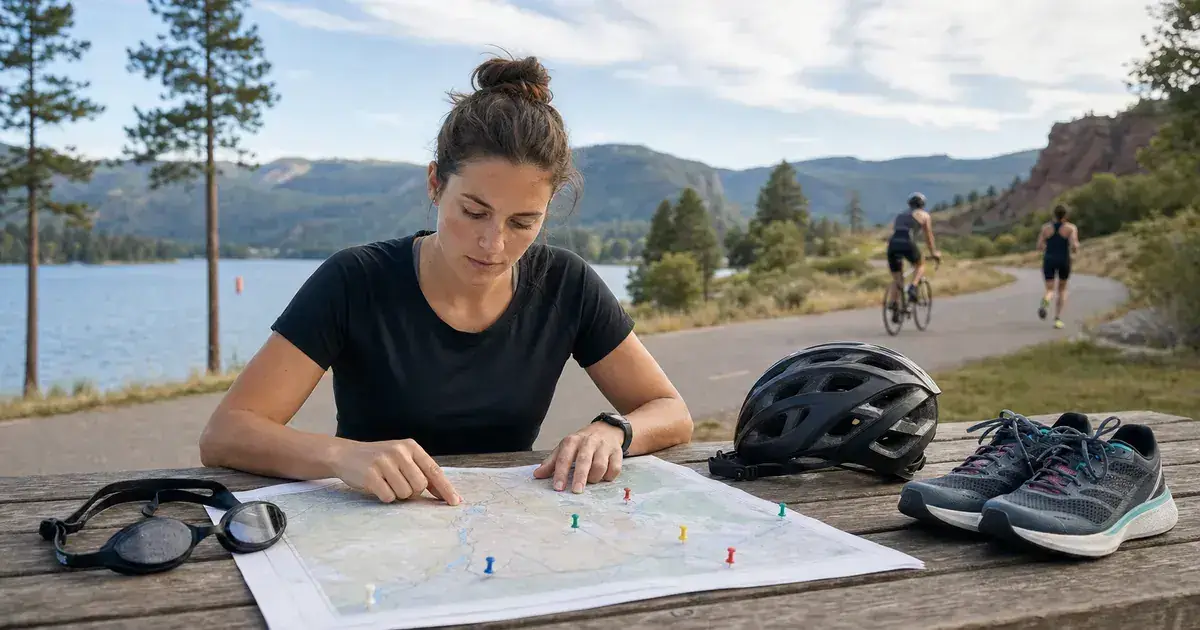
Finding a triathlon near you is less about a single search box and more about a short, reliable process: start with the official event directory of your national triathlon federation, add World Triathlon and the major series, and decide your distance and travel radius before you filter. Treat every listing as a lead rather than a fact — the organizer's current page is the only source of truth for the swim type, distances, cutoffs, course, date and refund terms. Filter for a genuinely beginner-friendly event, build a shortlist of two or three, check the true total cost including travel, and register only after a final look at the official entry page. This guide walks through each step so a nearby race turns out to be a suitable one.
Key takeaways
- 1Start with your national federation's directory, then World Triathlon and the major series — these surface sanctioned, insured events first
- 2A directory listing is a lead, not the final word; always verify the details on the organizer's current page
- 3Decide your distance and a realistic travel radius before searching, and include pool, indoor and duathlon options
- 4Filter for a beginner-friendly event — calm swim, simple bike course, generous cutoffs, clear support — not just the closest one
- 5Shortlist two or three races and check the true total cost before you register
In this article
- 1Quick answer: search official directories first
- 2Where to actually look: the source hierarchy
- 3Decide your distance and format first
- 4Turn 'near me' into a sensible radius
- 5What a good first-race listing looks like
- 6Verify the race, not just the listing
- 7Read the signals of a well-run event
- 8Build a two-or-three-race shortlist
- 9Check the true total cost and logistics
- 10Register only after the final checks
- 11If nothing nearby fits
- ⚖Race-finder source hierarchy
- ?Frequently asked questions
Quick answer: search official directories first
The most reliable place to start is your national triathlon federation's event search, because it surfaces sanctioned, insured local races and flags any licence or day-membership requirements. From there, widen out to World Triathlon's event calendar, the IRONMAN race finder and reputable regional series.
Search by location and date, but treat what you find as a shortlist of leads, not a decision — you will open each organizer's own current page before committing. And do one thing before you filter at all: if you are not yet sure which distance you are training for, settle that first with the distance selector and the triathlon distances overview, because it changes which events are even worth looking at. The rest of this guide turns that quick answer into a dependable process.
Where to actually look: the source hierarchy
Not all race listings are equal, so search them in order of reliability.
- National federation directories (USA Triathlon's race search, British Triathlon's event search, AusTriathlon's calendar, Triathlon Canada's listings, and the equivalent in your country — most are linked through World Triathlon) are the best first filter, since they list sanctioned events that carry insurance and follow a rulebook.
- World Triathlon and the major series (IRONMAN, Challenge and large regional brands) cover international and long-course events.
- Regional race series and local clubs often run the friendliest beginner events, some of which never reach the big directories.
- Community and general endurance calendars (and race-registration platforms) can surface smaller local races, but coverage is patchy and status is not always current.
Coverage genuinely differs between these: unsanctioned community races may not appear in a federation directory, while cancelled or rescheduled events can linger on a general calendar. For every candidate, record the organizer name, the official URL and the date you last checked it, so you can tell a live listing from a stale one.
Decide your distance and format first
It is far easier to find the right race when you know what you are looking for, so narrow the search before you widen the map.
Settle on a distance — a sprint is the usual first-race choice — using the distance selector. Then consider format, because 'triathlon near me' is broader than it looks. A pool-swim sprint removes open-water worries; an indoor triathlon removes weather and open water entirely and often runs in the off-season; a relay lets you race just one discipline with teammates; and a duathlon (run-bike-run) drops the swim if water access is your barrier. Deciding these first means you can filter directories by the format that actually suits you rather than scrolling past events that were never right — and it often reveals suitable options much closer to home than a standard open-water triathlon would.
Turn 'near me' into a sensible radius
A useful search radius is the one you can travel without wrecking your sleep or your pre-race logistics, not simply the nearest dot on a map.
For a first sprint, 50-100 km (30-60 mi) often allows a calm same-day trip, while a 200 km (125 mi) journey usually justifies staying over the night before so you are not driving at dawn on tired legs. Geography and road access matter more than straight-line distance — a race across a city at rush hour can be a bigger logistical ask than one twice as far down an open motorway. Search your own town, the surrounding cities and a couple of neighbouring regions, and vary the date window rather than hammering one keyword; the perfect event might be six weeks later than your first search assumed. Remember, too, that pool and indoor events can extend the season at both ends, so a quiet local winter does not mean no racing until summer.
What a good first-race listing looks like
When you are new, the closest race is not automatically the best one — the friendliest one usually is. As you scan candidates, favour events whose listing (and athlete guide) point to:
- A calm, contained swim — a pool, or a sheltered lake or bay rather than an exposed sea start.
- A simple bike course — relatively flat, non-technical, and ideally on closed or traffic-managed roads.
- Generous cutoffs and an explicitly beginner-welcoming tone, often signalled by a 'first-timers' or 'try-a-tri' category.
- Clear, current information and visible support — marshals, medical cover, a briefing.
A slightly farther event with a pool swim and strong beginner support will almost always give you a better first experience than a nearer one with a cold open-water start and a hilly course. The choosing your first race guide expands on these trade-offs, and your first triathlon sets the wider context.
Verify the race, not just the listing
This is the step that separates a good day from a nasty surprise: a directory entry is a lead, and the organizer's current page is the only authority. Before a race earns a place on your shortlist, confirm from official sources:
- exact swim, bike and run distances, and whether the swim is pool or open water;
- draft-legal or non-drafting, the course elevation and surfaces, and whether transition and the finish are in different places;
- cutoff times, minimum age, para access, and any licence or day-membership requirement;
- the current date and the refund, transfer and deferral policy;
- the latest athlete guide, which supersedes everything else.
Do not rely on an old calendar, a social-media post or a third-party ticket page for safety-critical details, and if two official pages disagree, contact the organizer directly. Checking cutoff times against realistic prepared paces is especially worth doing early, so you know the event's window comfortably fits you before you fall for the location.
Read the signals of a well-run event
Beyond the hard facts, a few softer signals tell you whether an event is organised and beginner-friendly, which matters more than a scenic photo.
Look for an up-to-date athlete guide and a website that clearly states this year's date, course and policies — vagueness or last year's information is a warning sign. A visible safety setup (water safety cover for the swim, marshalled or closed roads, medical support, a proper briefing) signals a serious organiser. Reviews or reports from previous participants, and an active club or community around the race, suggest it is well run and welcoming. Timing and results provided by a recognised timing company, and a sensible field size for your comfort, round out the picture. None of these is a dealbreaker on its own, but an event that scores well across them is a safer bet for a first race than one that leaves you guessing.
Build a two-or-three-race shortlist
Rather than fixating on one event, shortlist two or three and score them honestly against what matters to you: travel and logistics, swim confidence, course fit, the training time you will realistically have before the date, total cost, and how clear and supportive the organiser seems.
Keeping a backup or two is genuinely useful, because entries sell out, dates clash, and weather or life can force a change of plan. A shortlist also protects you from the common trap of talking yourself into the nearest race despite an intimidating swim or an awkward date. If none of your standard-triathlon candidates feels right, that is exactly the moment to compare a relay, an indoor triathlon or a duathlon, any of which might be the better entry point into the sport.
Check the true total cost and logistics
The entry fee is rarely the whole cost, so work out the real number before you commit. Add processing and checkout fees, any required licence or day membership, travel and fuel or transport, accommodation if it is not a same-day trip, and the practicalities of getting your bike there safely.
A nearer race with a modest entry can easily end up cheaper than a 'bargain' event two regions away once you add a hotel and a long drive — and for a first race, that simplicity is worth paying attention to. The cost calculator helps you compare candidates on their full cost rather than the headline entry, and is triathlon expensive? puts the wider numbers in perspective. Factoring logistics in now also means fewer stressful surprises in race week.
Register only after the final checks
Once a race tops your shortlist, do a last verification before you pay. Reopen the official entry page, confirm the total checkout cost including any fees, and read the cancellation, transfer and deferral terms so you know your options if training or life changes. If the race needs travel, check the accommodation cancellation policy too, and book flexible where you can. Save a copy of the listing and the policy version alongside your receipt, so you have a record if anything is disputed later.
Then you are ready to commit. Use choosing your first race for the final go/no-go decision and how to register for a triathlon for a field-by-field walkthrough of the entry form. Popular events do sell out, so once a race has passed every check, entering promptly is sensible — just never let urgency replace the verification steps above.
If nothing nearby fits
Sometimes the honest conclusion is that no suitable race is close right now — and there are good options rather than giving up.
Widen the radius and the date window; a great first race a season away often beats a poor one next month. Switch format — a pool sprint, an indoor triathlon, a relay or a duathlon may exist locally even when a standard open-water triathlon does not. Ask a local triathlon club or coach, who usually know grassroots events that never reach the big directories — the finding a coach guide is a starting point. Consider making a slightly farther race a small, enjoyable destination trip. Or simply set a target for next season and use the extra time to build your swim and bike confidence, for example through open-water practice. A little patience usually turns up a race worth doing.
Race-finder source hierarchy
| Source | Best use | Still verify |
|---|---|---|
| National federation | Sanctioned local events | Organizer page and licence |
| World Triathlon | International federation events | Eligibility and travel |
| Major series (IRONMAN, Challenge) | Branded long-course events | Regional rules and policies |
| Regional series & clubs | Friendly beginner events | Current date and support |
| Organizer website | Current operational details | Latest athlete guide |
| Community calendar | Discover smaller events | Sanctioning and current status |
Sources
Sources are listed so readers can verify consequential claims and dated details.
- World Triathlon events and official results — World Triathlon (accessed August 2, 2026)
- USA Triathlon: Get Racing — USA Triathlon (accessed August 2, 2026)
- IRONMAN race finder — IRONMAN (accessed August 2, 2026)
- British Triathlon event search — British Triathlon (accessed August 2, 2026)
- AusTriathlon events — AusTriathlon (accessed August 2, 2026)
Frequently asked questions
What is the best way to find a local triathlon?
Start with your national triathlon federation's official event search, which lists sanctioned, insured races, then add World Triathlon and the major series. Decide your distance and format first, and verify every promising result on the organizer's own current website before shortlisting it.
How far should I travel for a first triathlon?
Choose a distance that preserves your sleep and lets you arrive calm. Around 50-100 km often allows a same-day trip for a first sprint, while roughly 200 km usually justifies staying over the night before. A simple nearby course generally beats a destination race for event one.
Are all triathlons listed in federation directories?
No. Unsanctioned and small community events may be absent, and directory coverage varies by country and platform. Federation listings are the most reliable first filter, but you may find local grassroots races through clubs, regional series or word of mouth — just verify safety, insurance and organizer details directly.
How do I know if a race is beginner-friendly?
Look for a calm or pool swim, a flat and non-technical bike course, generous cutoff times, an explicit first-timer or try-a-tri category, and clear, current information with visible safety and support. A slightly farther race with these features usually beats a nearer one with a cold open-water start and a hilly course.
When should I register for a triathlon?
Once you have enough training runway before the date and have read the refund, transfer and deferral terms. Popular events can sell out, so entering promptly after a race passes your checks is sensible — but urgency should never replace verifying the course, cutoffs and total cost first.