Training When You're Sick: A Triathlete's Decision Guide
A symptom-by-symptom guide to deciding whether to train, modify or rest when you are ill — including which triathlon discipline is safest to keep, how to return in stages, and what to do if you get sick in race week.
By Lotte
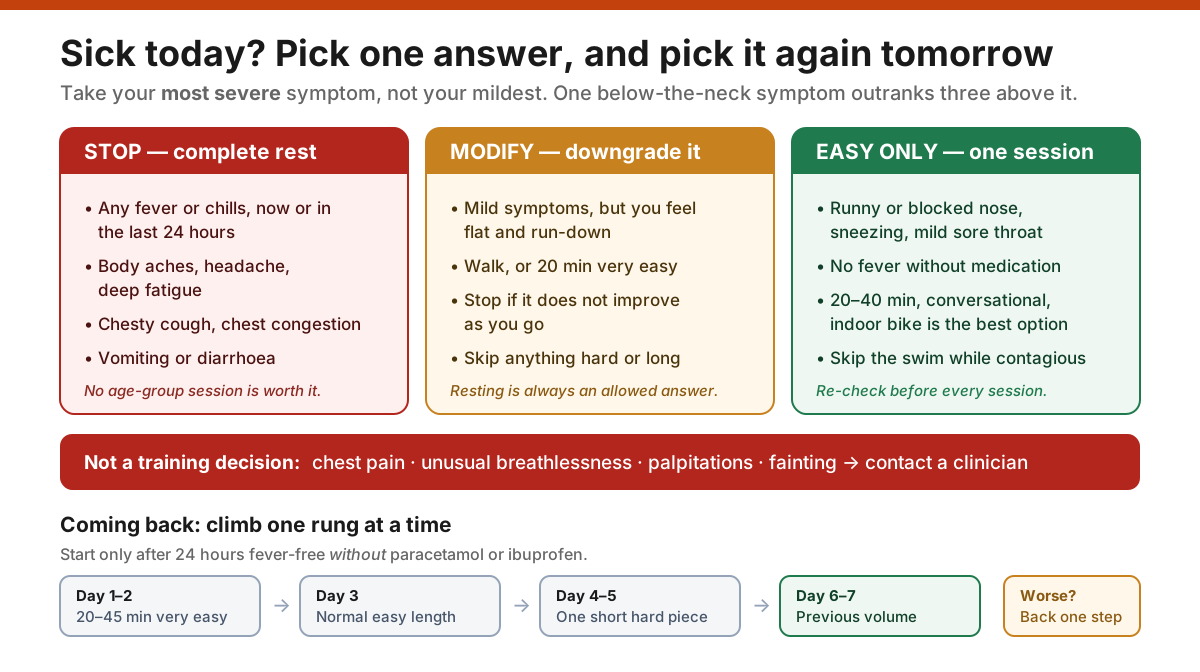
Use the neck check as a starting point, not a rule. With mild symptoms above the neck and no fever, an easy 20–40 minute session is usually reasonable. With a fever, chest symptoms, body aches, a productive cough or stomach upset, stop training completely until you have been fever-free for at least 24 hours without medication, then rebuild over four to seven days. Three to seven easy days costs you almost no fitness; training through a systemic illness can cost you weeks.
Key takeaways
- 1Symptoms above the neck only (runny nose, sneezing, mild sore throat) with no fever: short, easy training is usually reasonable — this is the position USA Triathlon and most sports-medicine guidance takes
- 2Fever, chills, body aches, chest tightness, a chesty cough, vomiting or diarrhoea are a hard stop, whatever the training plan says
- 3The neck check is a clinical rule of thumb, not a validated safety test — re-run it every single day, because a head cold can move into the chest
- 4Wait until you have been fever-free for 24 hours without paracetamol or ibuprofen, then rebuild in stages rather than rejoining your plan mid-week
- 5A week off is not detraining: measurable VO2max losses of roughly 4–7% are reported after around 12–14 days of complete cessation, not after three easy days
- 6Never make up missed sessions — sharp increases in training load are themselves associated with higher illness risk
- 7Chest pain, breathlessness out of proportion to the effort, palpitations or fainting during or after an illness need medical assessment, not a rest day
In this article
- 1The short answer: train easy, modify, or stop
- 2The neck check — and the three things it gets wrong
- 3Symptom by symptom: what to do today
- 4Why fever is the hard stop
- 5What the evidence actually supports — and what it doesn't
- 6Which triathlon discipline is safest to keep?
- 7How much fitness do you actually lose?
- 8The return-to-training ladder
- 9Getting sick in race week
- 10Afterwards: fix the plan, not the week
- 11When to get medical advice
- 12Your next step
- ⚖If you keep one session while mildly ill, which discipline?
- ?Frequently asked questions
The short answer: train easy, modify, or stop
Every illness decision in triathlon collapses into one of three answers, and you should pick one today rather than for the whole week:
- Train easy — mild symptoms above the neck, no fever, no body aches. Do one short, genuinely easy session, and no more.
- Modify — mild symptoms but you feel flat, or the session you had planned is hard. Swap it for something easy, indoors and low-risk, or make it a walk.
- Stop — any fever, chills, body aches, chest tightness, a chesty cough, vomiting or diarrhoea. Rest completely.
The single most useful sentence to hold onto: there is no session in an age-group training plan worth extending an illness for. The upside of training through a bad week is a few hours of low-quality work. The downside is a longer illness, a worse block afterwards, and — rarely but seriously — a complication that ends your season.
This page is a decision aid for healthy adult recreational triathletes, not medical advice. It cannot tell you which infection you have, and nothing here replaces a clinician who can actually examine you. If you have a diagnosed condition, are pregnant, take regular medication, or your symptoms are getting worse, get individual advice before you make the call.
The neck check — and the three things it gets wrong
The best-known rule of thumb is the neck check, and it is the right place to start. USA Triathlon's guidance puts it simply: symptoms above the neck — a runny or blocked nose, sneezing, a mild sore throat — generally mean light exercise is acceptable. Symptoms below the neck — chest congestion, a persistent cough, fever, body aches, deep fatigue — mean rest.
It is a good heuristic. It is not a complete one, and three gaps cause most of the bad decisions triathletes make:
1. It was never validated as a safety test. The neck check is a clinical rule of thumb popularised by sports physicians and adopted widely because it is memorable and errs on the safe side — not because a trial established a safe symptom threshold. Treat it as a prompt to think, not as permission.
2. It is a daily check, not a weekly verdict. Infections move. A head cold on Tuesday can be a chest infection by Thursday. Athletes get into trouble by running the neck check once, deciding "above the neck, I'm fine to train", and then not re-running it as the illness develops. Check again before every session, and treat any new below-the-neck symptom as a stop signal even if you felt fine yesterday.
3. It says nothing about intensity or duration. This is the big one. The neck check answers whether, but almost every triathlete who makes things worse does so by getting how hard and how long wrong. "Above the neck, so I trained" and "above the neck, so I did my threshold set" are completely different decisions. When you are ill, the only honest session is conversational, short, and one you can abandon halfway through without it mattering.
A practical version for triathletes: above the neck and no fever → one easy session, under 45 minutes, at an effort you could hold while talking in full sentences. Anything else → rest.
Symptom by symptom: what to do today
Run down this list honestly, taking the most severe symptom you have rather than the mildest. One below-the-neck symptom outranks three above-the-neck ones.
Two points before the table. First, "no fever" means no fever without medication — if you took ibuprofen or paracetamol four hours ago, you do not currently know your temperature story. Second, "usually reasonable" is not "recommended": resting is always an acceptable answer, and if you feel awful despite mild symptoms, that feeling is data.
| What you have today | Today's answer | What that means in practice |
|---|---|---|
| Runny or blocked nose, sneezing — no fever | Easy only | 20–40 min easy spin or walk, conversational throughout |
| Mild sore throat, no fever, no body aches | Easy only | Easy indoor ride; skip the pool while you are contagious |
| Mild symptoms but you feel flat and run-down | Modify | Walk, or 20 min very easy — and stop if it does not improve as you go |
| Any fever or chills, now or in the last 24 hours | Stop | Complete rest. Re-check after 24 h fever-free without medication |
| Body aches, headache, deep fatigue | Stop | Complete rest; give it 24–48 h after symptoms resolve |
| Chesty or productive cough, chest congestion | Stop | Rest, then rebuild in stages. Get advice if a cough lasts beyond ~3 weeks |
| Vomiting or diarrhoea | Stop | Rest and rehydrate; wait 24–48 h after it stops |
| Swollen glands, wiped out for more than a few days | Stop | Rest and arrange an appointment rather than self-managing |
| Chest pain, breathlessness out of proportion, palpitations, fainting | Stop — get medical advice | Contact a clinician; urgent care if severe. This is not a training decision |
If you are between two rows, take the more cautious one. The cost of an unnecessary rest day is close to zero.
Why fever is the hard stop
Of all the symptoms, a fever is the one where the answer is never "see how you feel on the warm-up". Three reasons stack up:
You are already running hot. Exercise adds a large metabolic heat load to a body whose core temperature is elevated and whose thermoregulation is disturbed. On a warm day, or in a wetsuit, or on an indoor trainer, that is a poor combination — and fever usually comes with reduced appetite and fluid intake, so you are likely starting dehydrated too.
Your effort-to-output relationship is broken. Resting heart rate rises with fever, so heart-rate zones read high for a given effort and power or pace read low. Every metric you would normally use to keep a session easy is unreliable at exactly the moment you need it most.
The rare risk is the serious one. Several of the common viruses that cause respiratory and flu-like illness can also inflame heart muscle. Myocarditis is uncommon, but athletes appear to be a group in which it matters more, and hard exercise during an active systemic viral illness is the setting sports cardiologists specifically caution about; published return-to-play reviews describe restriction periods measured in months, not days, after a confirmed diagnosis (Return-to-play post-myocarditis review, 2024). That asymmetry — a small chance of a season-ending problem against the gain of one easy ride — is the whole argument for resting.
So: no training with a fever, and no training within 24 hours of the last fever. And if you get chest pain, unusual breathlessness, palpitations or light-headedness either during an illness or in the weeks after one, that is a reason to contact a clinician rather than to schedule another rest day.
What the evidence actually supports — and what it doesn't
The honest position is that the evidence base here is thinner than the confidence of most advice about it, so it is worth knowing what actually exists.
The most directly relevant study is a controlled trial in which 50 moderately fit young adults were deliberately inoculated with a common cold virus (rhinovirus 16). The exercise group completed 40 minutes of supervised exercise every other day at 70% of heart rate reserve for ten days while both groups logged symptoms every 12 hours. Moderate exercise during the illness did not change the severity or the duration of the cold (Weidner et al., Medicine & Science in Sports & Exercise, 1998).
That is a genuinely useful result, and it is also narrow. It used one specific virus, in young moderately fit people, at a moderate intensity, in a supervised setting. It says nothing about influenza, COVID-19, chest infections or gastrointestinal illness, and it certainly does not license a threshold session or a four-hour ride. Read it as: moderate exercise with a mild head cold probably does not make the cold worse — not as training through illness is fine.
On the wider question of whether exercise helps at all, a Cochrane systematic review found that exercise programmes did not reduce the number of acute respiratory infections people experienced, with some evidence of reduced symptom severity, and the authors flagged small studies and risk of bias as limits on certainty (Grande et al., Cochrane Database of Systematic Reviews, 2020).
What is better established is the other direction: how you manage load affects how often you get ill. The International Olympic Committee consensus statement on load and illness concluded that rapid changes in training and competition load, congested calendars, psychological stress and travel are all associated with illness risk, and recommended small load increments — the frequently quoted figure is weekly increases under about 10% (Schwellnus et al., British Journal of Sports Medicine, 2016;50:1043–1052).
That last finding is the one that should change your behaviour most, and it applies after you recover: the week you come back is exactly the wrong week to spike your training.
Which triathlon discipline is safest to keep?
Most illness advice is written for single-sport athletes, which leaves the specifically triathlon question unanswered: if you are keeping one easy session, which one should it be? The three disciplines are not equally forgiving.
Bike, indoors, easy — usually the best option. The turbo or smart trainer is the safest place to be mildly unwell. The temperature is controlled, there is no impact, you can stop the instant you feel worse, you are not exposing anyone else, and — importantly — power or heart rate gives you an objective ceiling so "easy" does not quietly drift. Set a hard cap before you start (for example 30 minutes in the low aerobic range) and end the session there even if you feel fine. If you use structured workouts, pick the flattest, dullest endurance ride in the library rather than anything with intervals. See the indoor cycling workouts guide for easy options.
Run — the hardest to keep honest. Easy running drifts upward almost automatically, the impact load is higher, and a blocked nose forces mouth breathing, which dries the airway. Cold or dry air compounds that and can turn a mild throat irritation into a cough that lasts a fortnight. If you are ill and you want the run, take the walk instead, or move it to the bike. Running is also the discipline where people most often "just test how it feels" and end up doing thirty minutes at tempo by accident.
Swim — the first thing to drop. Two separate reasons, and the second is the important one.
- In the pool, you are sharing a confined body of water and a changing room while you are contagious. That is a courtesy issue more than a personal-risk one, and it is worth taking seriously — see pool and lane etiquette. Chlorine by-products can also aggravate an already irritated airway, which is why a mild post-cold cough so often flares after the first swim back.
- In open water, it is a safety decision, not a physiology one. Illness blunts exactly the judgement you rely on to notice that you are struggling, and open water gives you nowhere to stop. Add cold water and the risk rises further. Do not open-water swim while unwell, and certainly not alone. The open-water swim safety checklist and the cold water swimming guide both apply with extra force here.
Strength work. Drop the loaded lifting — you are more likely to lose form, and heavy strength work is a real systemic stressor. Gentle mobility work is usually fine and often feels better than doing nothing.
How much fitness do you actually lose?
Most bad illness decisions are driven by fear of losing the block. That fear is almost always out of proportion.
A review of detraining in endurance athletes reports that meaningful declines in VO2max appear over weeks, not days: roughly a 4–7% reduction after around 12–14 days of complete training cessation, growing to around 10% after five weeks, with blood and plasma volume falling 9–12% within two to four weeks and resting heart rate climbing a few beats (Barbieri et al., Frontiers in Physiology, 2024).
Read the timeline carefully, because it reframes the decision:
- Three to seven easy days is not detraining. It is a deload. Athletes deliberately schedule weeks like that — see the recovery week and deload guide.
- The awful feeling in your first session back is mostly not lost aerobic fitness. Reduced plasma volume, a few days of neuromuscular rustiness and the tail of the illness itself explain it far better, and most of that reverses within a couple of sessions.
- Two weeks off starts to matter, and even then it is measured in single-digit percentages — recoverable in a few weeks of consistent training, and far cheaper than a month of half-training through a chest infection.
The figures above come from studies of complete cessation in trained athletes and are averages, not a prediction for you — training history, age and what you manage to do during the layoff all change the picture. But the direction is not in doubt: the cost of resting is small and the cost of dragging out an illness is large.
The return-to-training ladder
Rejoining your plan on the day the plan says so is the second most common mistake, after training too hard while ill. Use a ladder instead. Each rung is a test, and you only climb if the previous rung produced no setback the next morning.
Gate to start: 24 hours with no fever without paracetamol or ibuprofen, symptoms clearly improving rather than plateauing, and you are eating and drinking normally.
| Step | Session | Only move on if |
|---|---|---|
| Day 1 | 20–30 minutes very easy — a walk or an easy spin. Conversational throughout. | You wake up no worse |
| Day 2 | Repeat, up to 45 minutes, still entirely easy | Sleep and resting heart rate are settling |
| Day 3 | Normal easy session length, still zero intensity | No cough or fatigue rebound |
| Day 4–5 | Reintroduce one short controlled hard piece — e.g. 4 × 2 minutes at a moderately hard effort with full recoveries | You recover from it normally |
| Day 6–7 | Resume the plan at the volume you were doing before you got ill | — |
The stop rule matters more than the schedule. If any step leaves you worse the next morning — heavier legs, a resting heart rate that stays elevated, a cough returning, disturbed sleep, or that specific hollow fatigue that is not normal training tiredness — go back one rung and repeat it. Do not climb two rungs in a day because you feel good on the bike; how you feel the next morning is the test, not how you feel during the session.
Scaling for longer illnesses. A widely used rule of thumb is roughly one to two easy days for every day you were ill, and longer after influenza or anything that kept you in bed. A three-day head cold might need three easy days. A week of flu reasonably needs one to two weeks of rebuilding, and there is no version of that week that includes a race-pace session.
Be clear about what this ladder is: a planning framework built from general graded return-to-activity principles and the load-management evidence above, not a validated clinical protocol. Anyone who had chest symptoms, a diagnosed infection, symptoms lasting more than two weeks, or any cardiac or respiratory symptom should get individual clearance rather than following a table on a website.
Getting sick in race week
Race week changes the question. It is no longer "can I train?" — it is "should I start?" — and those have different answers.
The training part is easy. Race week is the cheapest week of the year to lose. Taper volume is small and its purpose is to shed fatigue, which is exactly what rest does; the race-week taper guide explains why cutting sessions in that week costs you very little. Missing three taper sessions because you are ill is close to costless. Do not try to "top up" with a hard session once you feel better — that has real downside and no upside.
The starting decision needs honesty, in this order:
- Any fever within 48 hours of the start? Do not race. This is the one that should not be negotiated, for the reasons in the fever section above. A triathlon is hours of sustained effort, often in heat, frequently far from help.
- Any chest symptoms — tightness, a chesty cough, breathlessness? Do not race, and get them checked if they persist.
- Head-cold symptoms only, no fever, and you can complete an easy 20 minutes without feeling worse afterwards? Starting is usually reasonable if you go in with an explicit plan: race conservatively, drop your target, and agree with yourself in advance that you will stop if things deteriorate.
- Is it a hot race? Raise your threshold. Illness, reduced fluid intake and heat interact badly, and your usual pacing feel will be unreliable. If the forecast is hot, read racing in the heat and be more conservative than you would be on a cool day.
Check the deferral rules early in the week, not on race morning. Most events publish transfer, deferral and withdrawal policies with cut-off dates, and those dates often fall days before the race — the athlete guide is where they live. Knowing your actual options on Wednesday makes Saturday's decision far less emotional than discovering on Sunday that the window closed.
And retire the sunk-cost argument. The entry fee is spent whether you start or not, so it cannot be a reason to start. If you do start and it goes badly, not finishing is a normal part of the sport — but it is a much better outcome to have skipped a start than to have collected a bad DNF and a longer illness.
Afterwards: fix the plan, not the week
Once you are back, resist the urge to repay the missed sessions. The IOC load-and-illness consensus is unambiguous that sharp jumps in training load are associated with higher illness risk — so cramming a missed week into the next one is, quite literally, a way to get ill again.
The better process is to re-plan forwards:
- Count what the race still needs, not what the plan originally contained. With eight weeks left, losing one week changes very little. With two weeks left, the answer is usually to accept a lower target rather than compress anything.
- Delete, do not compress. Drop the sessions that provided the least specific stimulus and keep the ones closest to race demands.
- Rebuild volume before intensity. Get the easy hours back first; the hard work needs a foundation to sit on.
- Use the missed workout adjuster if you want a structured way to decide what to move and what to let go.
If this keeps happening, treat it as a signal. Repeated respiratory infections through a season, illnesses that keep recurring, or a pattern where every hard block ends in a cold is worth taking seriously as a load, sleep, stress or under-fuelling problem rather than a discipline problem. The sleep and recovery guide covers the most common contributor. Tracking tools such as heart rate variability may help you spot a pattern over weeks, but no wearable metric can diagnose why you keep getting ill — and a good readiness score never overrides symptoms. If the pattern persists, ask a clinician to look for a cause.
When to get medical advice
Some situations are not training decisions at all. Nothing on this page is a substitute for assessment by a clinician who can examine you, and the lists below are general prompts, not a diagnostic tool.
Seek urgent care for chest pain or pressure, severe or rapidly worsening breathlessness, fainting or near-fainting, a racing or irregular heartbeat at rest, confusion, a severe headache with neck stiffness or a rash that does not fade when pressed. Contact your local emergency service rather than waiting.
Arrange an appointment if you have a fever lasting more than about three days or one that returns after improving, symptoms that worsen after an initial recovery, a cough persisting beyond about three weeks, breathlessness or chest tightness on exertion in the weeks after an infection, or if you are unusually exhausted for more than a week or two after the other symptoms resolve.
Get individual advice before applying any of this if you are pregnant, immunosuppressed, or living with asthma, another chronic lung condition, heart disease, diabetes or another long-term condition, or if you take regular medication. Standard advice about training through mild illness is written for otherwise healthy adults and may not apply to you.
One practical note on medication: do not take painkillers or decongestants in order to train. Masking a fever removes the single most important piece of information in the decision, and it makes it easy to push through something you should not. There is also a competition angle — pseudoephedrine, a common ingredient in multi-symptom cold and flu remedies, is a specified stimulant prohibited in competition above a urinary threshold on the WADA Prohibited List, and athletes are advised to stop taking it at least 24 hours before the in-competition period. If you race under anti-doping rules, check any cold remedy against the current list or your national federation's medication-checking service before you take it.
Your next step
If you are ill right now, the action is simple: run the symptom table above for today only, pick train-easy, modify or stop, and re-run it tomorrow. Write nothing else into the calendar until you are 24 hours fever-free.
Once you are on the way back, the recovery week and deload guide is the closest thing to what your first week back should look like, and the missed workout adjuster will help you reshape the rest of the block without cramming. If the illness landed in race week, read the race-week taper guide before you decide to add anything back.
And if you want to reduce how often this happens at all, the highest-return changes are not supplements — they are the ones in the load-and-illness evidence: gradual load progression, protected sleep, adequate fuelling, and treating a heavy life week as a reason to train less rather than more.
If you keep one session while mildly ill, which discipline?
| Discipline | Verdict with a mild head cold | Why | Do this instead |
|---|---|---|---|
| Bike — indoors | Best option | Controlled temperature, no impact, you can stop instantly, and power or heart rate gives an objective ceiling so easy stays easy | Cap it before you start: 20–40 min, low aerobic, no intervals |
| Bike — outdoors | Acceptable in mild weather | Same low-impact benefits, but you are committed to getting home and easy effort drifts on hills and into wind | Flat, short loop close to home; take the indoor option in cold or wet weather |
| Run | Drop or downgrade | Easy running drifts upward, impact load is higher, and a blocked nose forces drying mouth-breathing that can turn throat irritation into a lasting cough | Walk, or move the session to the trainer |
| Swim — pool | Drop | You are sharing confined water and a changing room while contagious, and chlorine by-products can aggravate an irritated airway | Return once symptoms have cleared, starting with a short easy swim |
| Swim — open water | Do not | A safety decision, not a physiological one: illness blunts your ability to notice you are struggling, and there is nowhere to stop | Wait until fully recovered, and never swim alone on the way back |
| Strength — heavy lifting | Drop | A real systemic stressor, and form degrades when you are tired and congested | Gentle mobility work if you want to move at all |
Sources
Sources are listed so readers can verify consequential claims and dated details.
- The Neck Rule — USA Triathlon (accessed September 26, 2026)
- How much is too much? (Part 2) International Olympic Committee consensus statement on load in sport and risk of illness (Br J Sports Med 2016;50:1043–1052) — British Journal of Sports Medicine (accessed September 26, 2026)
- Weidner et al. — The effect of exercise training on the severity and duration of a viral upper respiratory illness (Med Sci Sports Exerc, 1998) — Medicine & Science in Sports & Exercise (accessed September 26, 2026)
- Grande et al. — Exercise versus no exercise for the occurrence, severity, and duration of acute respiratory infections (Cochrane Database of Systematic Reviews, 2020) — Cochrane Database of Systematic Reviews (accessed September 26, 2026)
- Cardiorespiratory and metabolic consequences of detraining in endurance athletes (2024) — Frontiers in Physiology (accessed September 26, 2026)
- Return-to-play post-myocarditis for athletes: to play or not to play? (2024) — Diagnostics (accessed September 26, 2026)
- The Prohibited List — World Anti-Doping Agency (accessed September 26, 2026)
Frequently asked questions
Can I train with a cold?
If your symptoms are limited to above the neck — a runny or blocked nose, sneezing, a mild sore throat — and you have no fever, one short easy session is usually reasonable. Keep it conversational and under about 45 minutes, and choose an easy indoor ride or a walk rather than a run or a swim. Stop training entirely if you develop a fever, body aches, a chesty cough or chest tightness, and re-check your symptoms before every session rather than deciding once for the week.
How long should I wait after a fever before training again?
Wait until you have been fever-free for at least 24 hours without paracetamol or ibuprofen, and until your symptoms are clearly improving rather than plateauing. Then rebuild in stages — 20–30 minutes very easy on day one, longer easy sessions over the following days, and no intensity until around day four or five. A useful rule of thumb is one to two easy days for every day you were ill, and longer after influenza or anything that kept you in bed.
Will I lose fitness if I take a week off sick?
Very little. Reviews of detraining in endurance athletes report VO2max losses of roughly 4–7% after around 12–14 days of complete training cessation, so three to seven easy days behaves much more like a deload week than like detraining. Most of the heaviness you feel in your first session back is reduced plasma volume and a few days of neuromuscular rustiness, and it typically resolves within a couple of sessions.
Should I race with a cold?
If you have had a fever within 48 hours of the start, or any chest symptoms, do not race. With head-cold symptoms only, no fever, and the ability to complete an easy 20 minutes without feeling worse afterwards, starting is usually reasonable — provided you lower your target, race conservatively and agree in advance to stop if things deteriorate. Raise your threshold further if the race is hot. Check your event's deferral and transfer cut-off dates early in race week, because they often fall days before the race.
Is it okay to swim in the pool with a cold?
It is the discipline to drop first. You are sharing a confined body of water and a changing room while you are contagious, which is a courtesy issue worth taking seriously, and chlorine by-products can aggravate an already irritated airway — which is why a lingering cough often flares after the first swim back. Open-water swimming while unwell is a safety decision rather than a physiological one: illness blunts the judgement you rely on to notice you are struggling, and open water gives you nowhere to stop. Do not open-water swim while ill, and never alone.
Can I take a decongestant or painkiller so I can train?
Do not medicate in order to train. Masking a fever removes the single most important input to the decision and makes it easy to push through something you should not. There is also an anti-doping consideration: pseudoephedrine, a common ingredient in multi-symptom cold and flu remedies, is a specified stimulant prohibited in competition above a urinary threshold on the WADA Prohibited List, and athletes are advised to stop taking it at least 24 hours before the in-competition period. Check any remedy against the current list or your national federation's medication-checking service before racing.
Why do I keep getting ill during hard training blocks?
Treat it as a load and lifestyle signal rather than a discipline problem. The International Olympic Committee consensus statement on load and illness links rapid increases in training and competition load, congested calendars, psychological stress and travel to higher illness risk, and recommends small weekly load increments. Protected sleep, adequate fuelling and treating a heavy life week as a reason to train less are the highest-return changes. If the pattern continues, ask a clinician to look for an underlying cause rather than assuming it is inevitable.