Kona vs 70.3 Worlds Qualification: How Slots Work
Understand how full-distance Kona and the IRONMAN 70.3 World Championship differ, how 2026 age-group slots work, and what to verify before a qualifier.
By Lotte
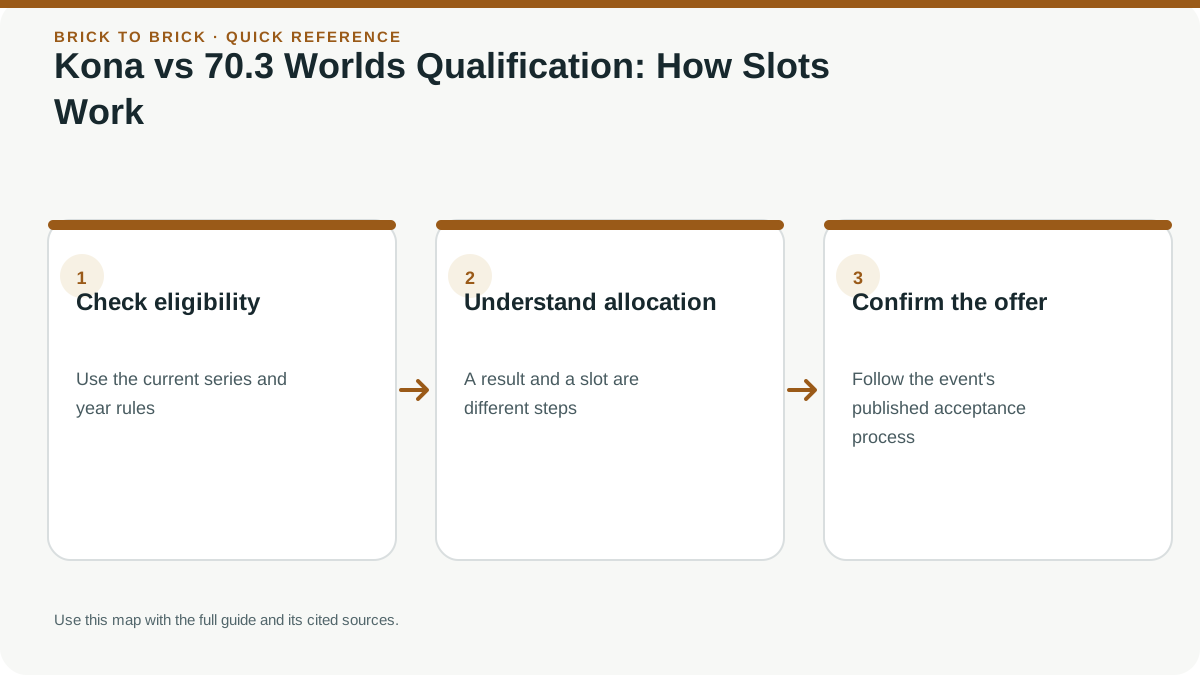
Kona is the full-distance IRONMAN World Championship; the 70.3 World Championship is a separate event. Their qualifying races, standards and 2026 slot processes differ, so check the exact championship cycle and event guide.
Key takeaways
- 1Kona is shorthand for the full-distance IRONMAN World Championship; the 70.3 World Championship is a separate event.
- 2Each championship has its own qualifying races and performance standard.
- 3For the 2026 cycle, age-group winner offers and performance pools follow published, event-specific allocation and roll-down rules.
- 4An age-graded benchmark is not a guaranteed qualifying time; slot count, field, eligibility and acceptance all matter.
- 5Verify the championship year, qualifier, category and acceptance steps in the current official race guide.
In this article
- 1Quick answer: Kona and 70.3 Worlds are separate championships
- 2The two qualification routes at a glance
- 3How automatic offers and performance pools work
- 4What age grading means in the 2026 system
- 5Verify the correct race, year and category before entering
- 6Plan to accept an offer, not just to finish
- 7Why there is no reliable qualifying time to target
- 8Scope and source date
- ?Frequently asked questions
Quick answer: Kona and 70.3 Worlds are separate championships
“Kona” means the full-distance IRONMAN World Championship. The IRONMAN 70.3 World Championship is a separate half-distance event with a host location that can change. A qualifying result at a 70.3 event is not a Kona slot; a full-distance qualifying race is not a 70.3 slot.
Both championships use designated IRONMAN qualifying events and age-group slot offers, but their performance standards and allocation details differ. This page explains the published 2026 cycle. For another year, check IRONMAN's current Age Group Qualification System, the 2026 qualification update and the athlete guide for the exact race.
The two qualification routes at a glance
| Full-distance IRONMAN World Championship (Kona) | IRONMAN 70.3 World Championship | |
|---|---|---|
| Qualifier | An official full-distance qualifying event | An official IRONMAN 70.3 qualifying event |
| Championship standard | Kona Standard, based on full-distance championship results | IRONMAN 70.3 Standard, based on 70.3 championship results |
| 2026 allocation summary | Age-group winner offers, followed by gender-specific performance pools; pool allocation reflects eligible age-group starters at that event | Age-group winner offers, followed by performance-pool offers under the 2026 event guide; the 2026 guide describes equal male and female slot totals |
| What determines an offer | Eligibility, event slot count, the current age-graded ranking and roll-down | Eligibility, event slot count, the current age-graded ranking and roll-down |
The table summarizes the 2026 materials, not a promise that future cycles will use the same system. The published event guide and live allocation page take precedence for a specific race.
How automatic offers and performance pools work
For the 2026 cycle, qualifying event materials describe an initial automatic slot offer for an eligible age-group winner. If the offer is declined or cannot be accepted, it may move to the next eligible finisher under the event's process. Slots that remain unclaimed can move into that event's performance pool.
The performance pool compares eligible finishers using the relevant championship standard and age-graded results. The pool is tied to the qualifying event and its published allocation; it is not one live ranking across every qualifier. The number of available places, eligible starters, results and accepted offers affect who receives an offer. Read the specific event guide for the exact order and ceremony process.
What age grading means in the 2026 system
IRONMAN's published 2026 method uses a separate standard for the full-distance and 70.3 championships. An athlete's finish time is multiplied by the applicable age-group standard ratio to create an age-graded time; a lower adjusted time ranks ahead within the relevant pool.
For arithmetic only, if a fictional athlete finishes in 10:00:00 and the applicable published ratio is 0.90, the adjusted time is 9:00:00. This example does not use a real athlete's result, standard or slot cutoff. The ratios and pool rules are cycle-specific, so do not reuse one from a past year or from the other championship.
Verify the correct race, year and category before entering
A race calendar entry does not by itself tell you whether your exact division can claim an age-group place. Before paying, confirm on the official event page and current athlete guide:
- The championship name and year the event qualifies for.
- That the specific race is an official qualifier for that championship.
- The age-group division and any eligibility restrictions that apply to you.
- The event's slot count, how it is divided and where the current allocation is published.
- How the published age-group standard and performance pool apply in this cycle.
- When and where slots are offered, whether you must attend in person, and the acceptance deadline.
- The registration fee, accepted payment method and information you need if an offer is made.
Save the guide and allocation details with the date you checked. If a rule or eligibility detail is unclear, ask the event organizer before committing to travel or treating a result as qualification.
Plan to accept an offer, not just to finish
Many event guides require athletes to attend an in-person awards or slot-allocation ceremony, but the exact procedure can vary. If you would accept a slot, plan to stay for the posted ceremony and have the required account details, identification and payment method available. Confirm the actual requirements in that event's guide; do not rely on last year's process or another athlete's report.
An offer is not complete until you follow the organizer's acceptance and registration steps. If you cannot attend or are unsure about the cost, check the event's policy in advance and decide what you would do if your name is called.
Why there is no reliable qualifying time to target
A past athlete's finish time cannot guarantee that a future athlete will qualify. Slot totals, course and weather, the field, age-group standards, eligibility and acceptance decisions differ by race and cycle. Age grading helps compare results under the published method; it does not create a universal cutoff.
Treat old race results as historical context only when the event, championship year, course and allocation process match. Choose a qualifier that is worthwhile for you even if no slot is offered, and avoid spending or training beyond what makes sense for your health, time and budget.
Scope and source date
This explainer was checked on October 7, 2026 against IRONMAN's published age-group qualification system, its 2026 qualification update and 2026 athlete-guide material for the 70.3 championship. It describes the 2026 cycle only. Slot allocations, standards, eligibility and acceptance procedures can change; verify the official materials before entering a future qualifier. No individual qualification probability or finish-time prediction is provided.
Sources
Sources are listed so readers can verify consequential claims and dated details.
- Age Group Qualification System — IRONMAN (accessed October 7, 2026)
- 2026 Qualification Update — IRONMAN (accessed October 7, 2026)
- 2025 Athlete Guide: Qualifying for the 2026 IRONMAN 70.3 World Championship — IRONMAN (accessed October 7, 2026)
Frequently asked questions
Is there a Kona 70.3 World Championship?
No. Kona is shorthand for the full-distance IRONMAN World Championship. The IRONMAN 70.3 World Championship is a separate event with its own qualifying races and a host location that can change.
Does an IRONMAN 70.3 race qualify me for Kona?
No. A 70.3 race can offer places to the separate 70.3 World Championship if it is an official qualifier. Check the specific event's official qualification information.
Is there a qualifying time for Kona or 70.3 Worlds?
There is no universal guaranteed time. Slot availability, the field, the current standard, eligibility and acceptance decisions vary by qualifying race and cycle.
Does winning an age group guarantee a championship entry?
An eligible age-group winner may receive the first slot offer, but they must meet the event's rules and complete the required acceptance and registration steps. Check the current athlete guide for roll-down and ceremony details.
Can I accept a slot later or transfer it?
Do not assume a slot can be accepted later or transferred. Follow the deadline and terms in the current qualifying event and championship materials.