Women in Triathlon: Participation Barriers and Useful Actions
Examine access, time, cost, representation and support without inventing a global participation rate, and identify practical changes for clubs and athletes.
By Lotte
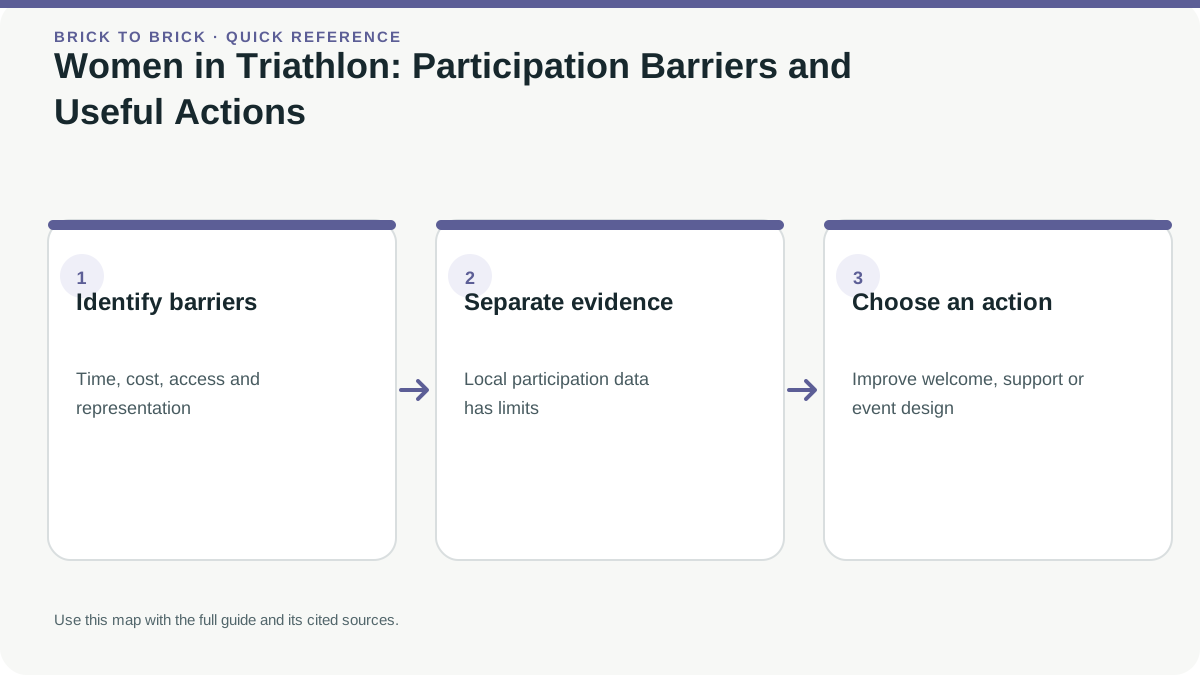
Women’s participation in triathlon varies by country, event format and the population being counted. To understand a gap, distinguish entries, finishers, members and coaches, then examine practical barriers rather than assuming a lack of interest or ability.
In this article
- 1Start by defining the participation measure
- 2Separate documented findings from possible local barriers
- 3Audit the first-contact experience
- 4Design changes around the barrier identified
- 5Support different health and life circumstances appropriately
- 6Measure whether the change helped
- 7Measure the first-contact pathway with useful denominators
- 8Ask about inclusion without asking for unnecessary personal data
- 9Read participation research with its limits in view
- 10Lower the cost of trying the sport
- 11Make the first club session understandable before arrival
- 12Treat time and caregiving as event-design questions
- 13Check facilities and kit against the event promise
- 14Handle pregnancy and return-to-training questions individually
- 15Discuss menstrual health without prescribing around it
- 16Set a usable safety and reporting process
- 17Make representation useful rather than performative
- 18Put women in the role of decision-makers
- 19Use a first-season checklist for individual athletes
- 20What a credible improvement looks like over time
- ?Frequently asked questions
Start by defining the participation measure
An event's female finisher share is not the same as a federation's female membership share or the proportion of coaches who are women. Different age groups and distances can also produce different patterns.
A useful statistic needs a date, location, population and denominator. This page does not publish one global female-participation percentage because a comparable current global dataset has not been established here.
Avoid using elite medal equality or one successful local event as proof that access is equal throughout the sport. They answer different questions.
Separate documented findings from possible local barriers
World Triathlon's recent women-in-coaching work identifies issues involving access to opportunities, leadership and perceptions of female coaches. Those findings concern coaching and should not be presented as a direct measurement of why every recreational athlete participates or leaves.
At club or event level, investigate practical questions: session times, cost, transport, changing facilities, safety, equipment fit and whether newcomers receive useful instruction. These are areas to assess, not assumptions about all women.
Ask participants and people who stopped attending. A programme can look successful among current members while failing people who never reached the start line.
Audit the first-contact experience
Review the website, joining process and first session. Can a newcomer see the pace expectations, equipment needed, cost and whom to contact? Are photographs and examples varied without making unsupported claims about inclusion?
Offer a clear explanation of what happens at the session and whether anyone can attend to observe first. Avoid requiring expensive equipment before a beginner has tried the activity.
A named contact and predictable welcome process can reduce uncertainty. Evaluate whether those arrangements are actually used rather than treating a slogan as evidence.
Design changes around the barrier identified
If timing is the problem, test an alternative session and measure attendance and repeat participation. If cost is the problem, examine loan equipment or transparent lower-cost entry options. If confidence in a skill is the issue, provide instruction at an appropriate level.
Do not assume a women-only session solves every barrier or suits every participant. It may be useful in some settings, alongside other options and clear eligibility arrangements.
For individual beginners, the first-triathlon guide helps turn practical gaps into actions without attributing them to gender.
Support different health and life circumstances appropriately
Pregnancy, postpartum recovery, menopause, disability and chronic conditions can affect participation needs, but there is no single women's training prescription. Refer individual health questions to appropriately qualified professionals.
Ask what accommodations are useful and protect privacy. Do not require public disclosure of a health history to access basic information or a welcoming session.
Coaches and organisers should know their safeguarding and referral boundaries. Representation matters, but a female coach should not be expected to provide medical expertise simply because of gender.
Measure whether the change helped
Track the relevant stages: enquiries, first attendance, repeat attendance, entries and completion, using appropriate consent and privacy protections. Compare similar periods and recognise seasonal or event-calendar changes.
Collect reasons for leaving in a respectful way and report neutral results as well as successes. A small pilot can generate useful questions without proving a universal solution.
The practical goal is more people finding a safe, workable route into the sport. Keep the evidence specific and the improvements responsive to the people affected.
Measure the first-contact pathway with useful denominators
A club can learn more from a simple participation pathway than from an unsupported national percentage. Count enquiries, trial-session attendance, registrations and continued attendance over a defined period. State the population and how categories were recorded, and protect privacy when groups are small.
For a fictional example, 20 enquiries followed by 5 trial visits raises a different question from 20 trial visits followed by 5 returning participants. The first may involve information, timing or the sign-up process; the second may involve the session experience. These are hypotheses to investigate with appropriate feedback, not proof of a cause.
Ask potential participants what would make access easier without assuming everyone shares the same barrier. Trial a specific change, such as clearer ability descriptions or a different session time, and compare equivalent periods. Report limitations, including seasonality and small samples. The aim is to understand who can enter and stay in the sport, not to produce a flattering headline.
Ask about inclusion without asking for unnecessary personal data
A practical feedback question can focus on the service: was the session description clear, could you reach the venue, did you understand the ability expectation, and did you know whom to ask for help? You do not need a detailed health or family history to investigate every access problem.
Give people a way to decline questions and avoid presenting one person's experience as the explanation for all women. If feedback concerns pregnancy, disability, safety, changing facilities or harassment, handle it through appropriate support and safeguarding arrangements rather than treating it merely as a marketing insight.
When reporting findings, distinguish what participants said from what the club inferred. For example, a request for clearer ability descriptions supports changing those descriptions; it does not prove that confidence is the universal barrier. Review whether the change helped the people it was intended to help, and preserve privacy when the group is small. Transparent limits make a local improvement more useful to other organisers than an exaggerated claim of solving the whole participation gap.
Read participation research with its limits in view
Participation numbers answer different questions. The percentage of entrants who are women at one event does not tell you the number of women who tried a local club, the share of a federation's members, or who felt welcome enough to return. A survey can reveal experiences that timing data cannot, but a voluntary survey may overrepresent people motivated to respond. Always retain the population, place, date, question wording and denominator when sharing a finding.
A 2025 narrative review of triathlon research noted that contemporary, comparable participation data remain limited. Separately, SheRACES and Women in Tri UK reported responses from more than 900 women about race experiences; those responses are valuable evidence about barriers, but they are not a census of all triathletes. The distinction protects both sides: do not dismiss reported problems because a survey is not representative, and do not turn one sample into a global rate.
Lower the cost of trying the sport
A first triathlon can involve entry fees, travel, a bicycle, a wetsuit, clothing and time away from work or caregiving. The total can become discouraging before an athlete learns which items are mandatory. Clubs and organisers can make the real cost visible early: state the required equipment, identify what can be borrowed, list transport and parking costs, and explain refund or deferral rules before payment.
Try-out sessions with loan equipment, beginner relays, local pool events and low-cost club memberships can reduce the cost of testing interest. Borrowing works only when fit, condition and event rules are checked. Avoid presenting an expensive specialist bike or a full brand-matched kit as the default. The first triathlon gear essentials guide separates core requirements from optional purchases and offers a more practical starting point.
Make the first club session understandable before arrival
An invitation that says “all abilities welcome” may still leave a beginner unsure what to bring, where to go or whether they will be able to keep up. A useful first-contact page explains the session format, expected pace, swim ability required, route, changing arrangements, accessibility, cost and contact person. It can say explicitly whether a participant may leave early or observe first.
Offer a named person who can answer practical questions without requiring someone to disclose why they are nervous. Share location pins and a simple arrival photo when a venue is confusing. A first session does not need to become a test, selection workout or sales pitch. Clubs can ask whether the visitor wants an introduction, a buddy or quiet observation, then let them choose. Those small details make “beginner-friendly” verifiable rather than a slogan.
Treat time and caregiving as event-design questions
Training availability depends on paid work, unpaid care, transport, shift patterns and access to a pool or safe route. It is not enough to tell athletes to “make time” or to assume early mornings work for everyone. Clubs can rotate session times, publish dates well ahead, avoid making attendance a condition of belonging, and offer a clearly described shorter option when coaching capacity allows.
Race organisers can publish expected arrival and finish windows, family access rules, volunteer commitments and travel logistics. Parents and caregivers should not have to guess whether children can wait in a permitted area or whether a course closes before a realistic finish. These choices cannot remove every constraint, but they can prevent avoidable surprises and let people decide whether an event fits their lives.
Check facilities and kit against the event promise
Before opening entries, organisers can walk through the athlete journey: registration, toilets, changing, swim start, transition, aid stations and finish. Check whether toilets are open when athletes need them, whether privacy is available, whether changing areas are accessible and whether uniforms and sizes are offered in usable ranges. State where facilities are limited rather than leaving participants to discover that on race morning.
Equipment rules should be clear and contactable. Athletes may have questions about swimwear, head coverings, adaptive equipment, pregnancy-related participation or an accommodation. Provide a person or channel that can respond privately and early. Do not promise an exception until the governing rules and safety needs are checked. A predictable answer helps an athlete plan; a vague “ask us on the day” shifts uncertainty onto the person who already has less information.
Handle pregnancy and return-to-training questions individually
Pregnancy, birth and postpartum recovery vary. A race policy can set out deferral, refund and transfer options without claiming that every athlete should train or return on a particular timetable. Athletes should follow advice from their own maternity-care clinician, especially when they have symptoms, complications or questions about intensity. Coaches can support the plan the athlete and clinician agree on; they should not diagnose or make assumptions about capacity.
Organisers can state how to request a confidential deferral and what documentation, if any, is required. Policies should cover more than a single deadline when possible, since circumstances may change. Avoid making an athlete explain private health information to a public club chat or volunteer at check-in. Clear procedures protect privacy and make participation options visible before someone pays an entry fee.
Discuss menstrual health without prescribing around it
Menstrual symptoms, bleeding patterns and contraception experiences differ widely. Some athletes notice that symptoms affect comfort or planning; others do not. A coach should not assign training phases from a calendar, assume a cycle predicts performance, or ask for tracking data as a condition of coaching. If symptoms are severe, new or disruptive, a clinician is the right person to assess them.
Practical event support can include accessible toilets, disposal facilities, water and a private way to ask for help. Coaches can let an athlete describe what feels useful, then adapt training based on symptoms, recovery and their own goals. No one needs to share intimate health information with teammates. Keep the focus on the individual's experience rather than a universal claim about how women train.
Set a usable safety and reporting process
A zero-tolerance statement matters only if participants know what to do when behaviour crosses a line. Publish a reporting channel, identify who receives it, explain how urgent safety concerns are handled and say what confidentiality can and cannot be promised. At events, marshal briefings should cover harassment, unsafe overtaking, unwanted contact and respectful intervention as well as course logistics.
Clubs can set a code of conduct and explain how reports are reviewed. Avoid asking a person who reports harm to confront the other participant or repeat details to multiple volunteers. If there is immediate danger, use the event's emergency response and local authorities. A report should be recorded and followed up by someone with the role and training to handle it; social-media replies are not a substitute for a safeguarding process.
Make representation useful rather than performative
Images and language shape who can picture themselves taking part. A race page can show athletes across ages, body sizes, abilities and experience levels while accurately depicting the event and equipment. Avoid using a single image as evidence that the event has solved access barriers. Explain the actual format, course demands, cutoffs, support and facilities so that the invitation is backed by facts.
Clubs can feature beginner stories with consent and without presenting one person as a spokesperson for every woman. Ask athletes whether they want their names, images or results shared. Representation also includes who coaches, leads sessions, makes decisions and appears in event communications. The goal is not a photo quota that displaces substance; it is an environment where more people can see a credible route from curiosity to participation.
Put women in the role of decision-makers
Feedback is stronger when it arrives before a decision is final. Include women and other affected participants in course planning, facility reviews, safeguarding, kit selection and club scheduling. Pay or otherwise recognize substantial advisory work where practical; repeated unpaid consultation can itself become a barrier. Ask for views through more than one channel so that people who cannot attend a meeting can still contribute.
The person giving feedback should be told what changed, what could not change and why. Avoid asking a single athlete to represent all women or to design the response to a safety issue they experienced. A small, diverse working group with a clear remit is more useful than an annual listening session with no owner or follow-up.
Use a first-season checklist for individual athletes
If you are considering a first race, make a list of what you need to know rather than assuming you must solve every barrier alone. Confirm the entry cost and refund policy, course and cutoff details, swim format, equipment rules, toilets and changing, transport, accessibility and who to contact privately. Ask a club whether a supported beginner session or loan equipment is available. It is reasonable to compare events on how clearly they answer those questions.
You can set a goal that fits your own reason for entering: learning transitions, finishing comfortably, racing a relay or simply trying a local event. You do not owe anyone a performance target, a particular body type or a story about why you participate. If the information is missing, ask the organizer before committing; a clear answer is part of deciding whether the event is right for you.
What a credible improvement looks like over time
An intervention is promising when it changes a barrier that participants identified and the change can be observed. For example, a new loan-bike program should track whether equipment was available in the right sizes and whether beginners could use it safely. A revised cutoff explanation should make the time calculation and support policy easier to find, not just add the word “inclusive” to the page.
Participation can take time to shift and is influenced by cost, location, event mix and broader social conditions. A rise in entries alone does not show why people joined or whether their experience was good. Combine appropriately scoped participation data with anonymous feedback, facility checks, return rates and reports of safety problems. Publish what was measured and what remains unknown. This is more trustworthy than claiming that one campaign “solved” underrepresentation.
Sources
Sources are listed so readers can verify consequential claims and dated details.
- Global updates in the study of women coaching in triathlon — World Triathlon (accessed September 24, 2026)
- SheLovesTri: turning awareness into action — World Triathlon (accessed September 24, 2026)
- Women in the triathlon—the differences between female and male triathletes: a narrative review — Frontiers in Sports and Active Living (accessed September 24, 2026)
- Triathlon Research Report — SheRACES and Women in Tri UK (accessed September 24, 2026)
Frequently asked questions
Can one women-only session solve a participation gap?
It may help some people, but one format cannot address every barrier. Ask who the session serves, whether timing and cost are accessible, how newcomers progress and what feedback shows. Offer clear choices and evaluate continued participation rather than assuming attendance at a launch event proves lasting impact.