Periods and Triathlon: Training, Racing and Race-Day Practicalities
A practical, evidence-based guide to the menstrual cycle and triathlon: what research says about performance across the cycle, whether to cycle-sync training, managing symptoms, heavy periods and iron, period products for swimming and long races, hormonal contraception, missed periods as a warning sign, and perimenopause.
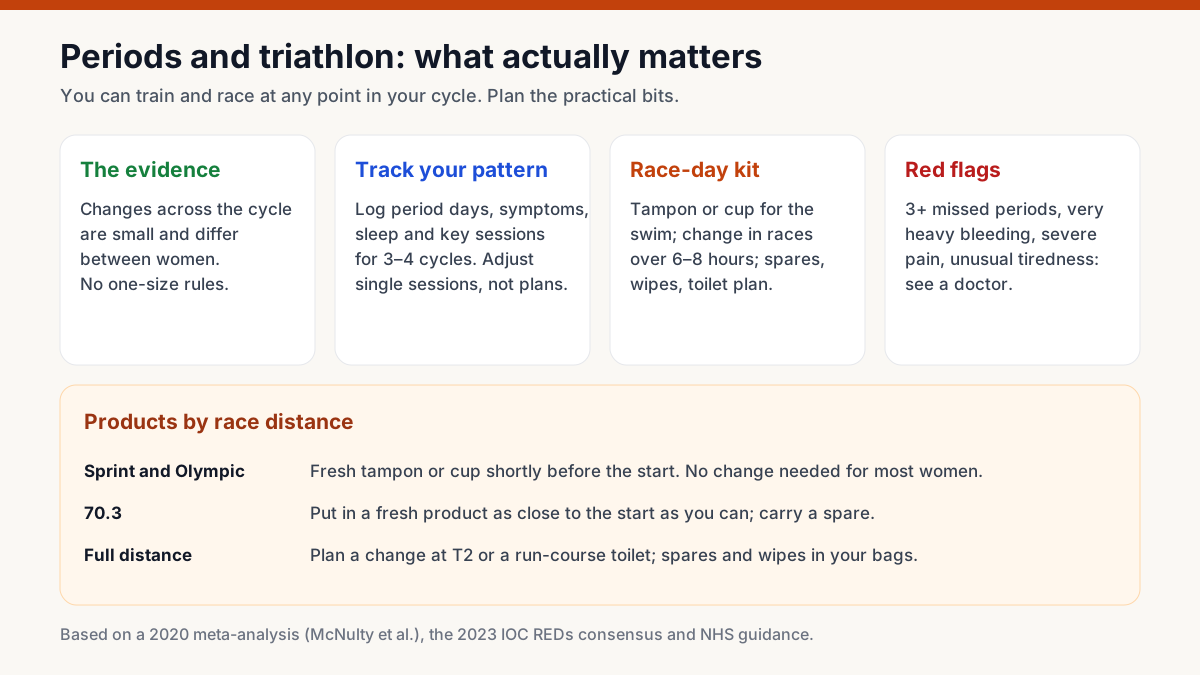
You can train and race at any point in your menstrual cycle. The best research to date, a 2020 meta-analysis, found that performance may be trivially lower around the start of a period, but the evidence is low quality and individual responses vary widely, so rigid 'cycle syncing' is not supported. Track your own symptoms and adjust if you see a pattern. On race day, tampons and menstrual cups both work for swimming; plan a change in long races and pack spares. Heavy periods raise the risk of iron deficiency, so ask for a ferritin check if you are tired. Missing periods for three months or more is not a sign of fitness: it can signal low energy availability and needs a doctor.
Key takeaways
- 1Performance changes across the cycle are small and individual; there is no evidence that everyone should train by phase
- 2Track symptoms, sleep and how sessions feel for three or four cycles before changing your training
- 3Tampons and menstrual cups both work for swimming; in races over about 6 to 8 hours, plan a change
- 4Heavy periods increase iron loss; tiredness and poor training response are reasons to ask for a ferritin test
- 5Missed or stopped periods can be a sign of low energy availability (REDs) and need medical advice, not more training
- 6Hormonal contraception can be used to move or skip a bleed around a race, but discuss it with a doctor well in advance
- 7Perimenopause brings its own changes, such as sleep disruption and hot flushes; strength training and medical support help
Quick answer: can you race a triathlon on your period?
Yes. Women set personal bests and win world titles at every point of the menstrual cycle. The research shows that, on average, any effect of cycle phase on performance is small, and it varies a lot from person to person. What matters more is how you feel, how you manage symptoms, and having a practical plan for products and toilets on race day.
| Question | Short answer |
|---|---|
| Does my cycle change my performance? | For most women, only slightly, if at all; some notice a clear pattern |
| Should I plan training around my phases? | Not by fixed rules; track your own pattern and adjust if you see one |
| Can I swim on my period? | Yes, with a tampon or menstrual cup |
| What about a long race? | Plan a change of product, pack spares and know where the toilets are |
| When should I see a doctor? | Missed periods, very heavy bleeding, severe pain or sudden changes |
The menstrual cycle in one minute
A typical cycle lasts about 21 to 35 days. It is often described in phases:
- Menstruation (the period), days 1 to about 5: oestrogen and progesterone are both low.
- Follicular phase, from day 1 until ovulation: oestrogen rises.
- Ovulation, around the middle of the cycle.
- Luteal phase, from ovulation to the next period: progesterone rises, then both hormones fall before the next period.
Cycle length and the timing of each phase vary between women and from month to month. Apps estimate phases from your period dates, but they cannot see ovulation unless you use additional tracking, so predictions are only approximate.
What the research says about performance
The best summary of the evidence is a 2020 systematic review and meta-analysis in Sports Medicine by McNulty and colleagues, which pooled 78 studies of women with regular cycles. It found that exercise performance might be trivially reduced in the early follicular phase, the days around the start of a period, compared with other phases. The authors judged the quality of the evidence as low, found large differences between individuals, and concluded that general guidelines on adjusting training by phase could not be recommended. They suggested a personalised approach instead.
That fits what many athletes report: some feel flat or heavy in the days before or during a period, while others notice no difference or feel strongest then. Neither experience is wrong.
Other changes across the cycle
- Body temperature. Core temperature is slightly higher in the luteal phase, typically by a few tenths of a degree. Some women feel the heat more in that phase, which can matter in a hot race. Our racing in heat guide covers heat preparation.
- Breathing and heart rate. Resting heart rate and breathing rate can be slightly higher in the luteal phase. If you use heart-rate zones or HRV, small changes in that phase may be normal for you rather than a sign of fatigue.
- Fluid and weight. Some women retain fluid before a period, which can add a kilogram or more on the scales. It is not fat gain.
- Appetite. Energy needs and appetite can be slightly higher in the luteal phase. Listen to hunger rather than restricting it.
Should you "cycle sync" your training?
Cycle syncing means planning hard and easy sessions by phase, for example doing high-intensity work in the follicular phase and easier work in the luteal phase. Apps and social media often promote it.
The evidence does not support fixed rules that apply to everyone. Training studies that compared phase-based plans with normal plans are few, small and inconsistent. What does make sense is a personal approach:
- Track for three or four cycles. Note your period days, symptoms, sleep, energy and how key sessions felt. A simple note in your training log is enough.
- Look for a pattern. If you consistently struggle on certain days, you have useful information. If you do not, there is nothing to change.
- Adjust flexibly. If hard sessions regularly go badly on the first two days of your period, swap them with an easier day in that week. Do not rebuild your whole plan around predicted phases.
- Keep racing as planned. You cannot choose your race date to match your cycle, and you do not need to.
Our women's training planner treats cycle phase as optional context for daily choices rather than a rule.
A worked example: three months of tracking
Here is what a simple log might look like for an athlete who suspects her period affects her running. She notes, for each key session, the cycle day, a symptom score from 0 (none) to 3 (severe), sleep and how the session went compared with plan.
| Cycle day | Session | Symptoms (0–3) | Sleep | Session vs plan |
|---|---|---|---|---|
| 2 | 6 × 3 min threshold run | 2 (cramps) | Poor | Slower, felt heavy |
| 9 | 6 × 3 min threshold run | 0 | Good | On target |
| 16 | Long ride, 3 h | 0 | Good | On target |
| 24 | Long run, 80 min | 1 (bloating) | Fair | On target |
| 1 | 2 × 20 min bike threshold | 2 (cramps) | Poor | Stopped after the first set |
| 2 | Easy swim | 1 | Fair | Fine |
After three cycles, she sees that hard sessions on days 1 and 2 often go badly, mostly when she has slept poorly, while long easy sessions are fine at any point. Her change is small: she moves hard sessions away from the first two days of her period when she can, keeps easy and long sessions as planned, and takes pain relief earlier on those days. She does not change anything else.
Another athlete keeping the same log might find no pattern at all. That is useful too: it means she can stop worrying about it.
Managing symptoms
Cramps, back pain, headaches, bloating, fatigue, mood changes and sleep disruption are common. Practical options:
- Gentle movement. Many women find easy exercise reduces cramps. You do not have to stop training.
- Heat on the lower abdomen or back, for example a hot water bottle after a session.
- Pain relief. Paracetamol or anti-inflammatory painkillers such as ibuprofen help many women with period pain. Avoid anti-inflammatories during long races and hot sessions, where they can increase the risk of kidney problems, and follow the label and your pharmacist's advice.
- Sleep and food. Prioritise sleep, eat enough and do not cut carbohydrate when your appetite rises.
- Medical treatment. If symptoms regularly stop you training or working, see a doctor. Conditions such as endometriosis and adenomyosis are common, under-diagnosed and treatable.
Heavy periods and iron
Heavy menstrual bleeding is common in active women, and it increases iron loss. Endurance training adds to iron needs through sweat, gut losses and red blood cell turnover. Together, they make low iron one of the most common reasons women triathletes feel tired and stop improving.
The NHS describes heavy periods as bleeding that affects your daily life: for example, needing to change products every one to two hours, passing large clots, or bleeding through clothes. If that sounds familiar:
- See a doctor. Heavy periods have treatable causes, and treatment can make a big difference to training.
- Ask for a ferritin test (your iron stores) and a full blood count if you are unusually tired, breathless or not improving. Low ferritin can reduce performance before anaemia appears.
- Eat iron-rich food regularly, and combine plant sources with vitamin C. Our plant-based nutrition guide covers iron in detail.
- Take iron supplements only if a test shows you need them, and follow your doctor's dose. The supplements guide explains timing for better absorption.
Missed periods are a warning sign, not a badge of fitness
Periods that stop, or become very irregular, are not a normal consequence of training hard. The most common cause in athletes is low energy availability: eating too little for the energy you use in training. The International Olympic Committee calls the resulting condition relative energy deficiency in sport (REDs). Its effects include:
- Lower bone density and a higher risk of stress fractures.
- Reduced training response, more illness and injury.
- Mood changes and poorer concentration.
- Longer-term effects on fertility and heart health.
See a doctor if you have missed three or more periods in a row (and you are not pregnant, breastfeeding or using contraception that stops bleeding), or if your periods become much less frequent. Mention your training and how much you eat. Treatment usually starts with eating more, not training less, and the earlier it starts the better.
Hormonal contraception can hide the problem: a monthly bleed on the pill is a withdrawal bleed, not a natural period. If you use it, watch for other signs of underfuelling, such as constant tiredness, frequent illness, stress fractures or a fall in performance.
Hormonal contraception and training
Many women triathletes use hormonal contraception. Research suggests any effect on performance is small and inconsistent. The best choice is the one that suits your health and life; discuss it with your doctor or a sexual health clinic.
Some women use contraception to control the timing of bleeding. With some combined pills, it is possible to take packs back to back to skip a withdrawal bleed around a key race. Not every pill is suitable for this, and breakthrough bleeding can still happen, so talk to your doctor or pharmacist months before the race, not the week before.
Contraception options at a glance
Each method has different effects on bleeding, and a few have points that matter for athletes. This is a summary to discuss with a doctor or sexual health clinic, not a recommendation.
| Method | Effect on bleeding | Points for athletes |
|---|---|---|
| Combined pill | Regular withdrawal bleeds, or fewer if packs are taken back to back | Some pills allow bleeds to be skipped around races; a monthly bleed does not show that natural cycles are healthy |
| Progestogen-only pill | Bleeding may be irregular, lighter or stop | Must be taken at a similar time each day, which needs planning on race mornings and when travelling across time zones |
| Implant | Often irregular or no bleeding | Long-acting; irregular bleeding can be unpredictable on race day |
| Hormonal coil (IUS) | Often much lighter periods, sometimes none | Can help heavy periods and so iron loss |
| Copper coil (IUD) | Periods may become heavier or more painful | Worth considering iron status if periods become heavier |
| Injection | Often irregular or no bleeding | The NHS notes it can reduce bone density, which matters for athletes at risk of stress fractures |
Whatever you use, the warning signs of under-fuelling still apply, and a lack of bleeding on hormonal contraception does not tell you whether your energy intake is enough.
Race-day practicalities
A period on race day is common, and a little planning removes most of the worry.
Products for the swim
- Tampons work well for swimming. Insert a fresh one shortly before the start.
- Menstrual cups also work, and many hold more than a tampon. Practise inserting and removing one in training first.
- Period swimwear is designed for lighter flow and usually for swimming only. It is not designed to be worn under a tri suit for a whole race, so test it carefully if you want to use it.
- Pads do not work in water.
Products for long races
Tampons and cups should not be left in for too long, because of the small risk of toxic shock syndrome. The NHS advises changing tampons as often as the packet instructions say, usually every 4 to 8 hours, and following the manufacturer's guidance for cups. That means:
- Sprint and Olympic races: no change needed for most women. Put in a fresh product before the start.
- 70.3: most women can race without changing, but put in a fresh product as close to the start as you can.
- Full distance: plan a change. Common options are a portaloo near T2 or on the run course. Pack a spare in your bike-to-run bag and in your run special-needs bag, with hand wipes and a small bag for disposal.
Kit and logistics
- Dark tri suit or shorts can reduce anxiety about leaks.
- Two-piece tri suits make toilet stops much faster. Our women's kit fit guide compares suits and covers bras and saddles.
- Know where the toilets are before the start, around transition and on the run course. The athlete guide usually shows them.
- Pack a small kit: spare products, wipes, a disposal bag, pain relief if you use it, and spare underwear for after the race.
- Fuel and hydrate as planned. Some women feel more bloated around their period; rehearse your race nutrition in training at different points in your cycle if you can.
If your period starts during a race
It happens, and it is rarely a reason to stop. In a short race, most women simply carry on; a dark tri suit hides most leaks and nobody on the course will notice. In a long race, use the next toilet, change or insert a product from your spare kit, and keep going. Aid stations and medical tents usually have basic supplies and staff are used to being asked. If you feel faint, have unusual pain or are bleeding much more heavily than normal, stop at the medical tent.
Talking to your coach, club or training partners
Many women find periods awkward to mention, especially to a male coach or in a mixed training group. A few simple habits help:
- Share what is useful, not everything. "I am having a rough day, can we swap the intervals to Thursday?" is enough.
- Use your training log. Many training platforms let you note symptoms or cycle days; your coach can see patterns without a conversation every month.
- Ask clubs for practical changes: sanitary bins and toilets near the pool or start of group rides, and darker club kit for women who prefer it.
- Expect a professional response. A good coach treats periods like any other factor in training, such as sleep or work stress. If yours does not, that tells you something about the coach.
Racing abroad and travelling
Travel can change your cycle: long flights, time zone changes, stress and a different routine can bring a period early, delay it or change symptoms. For destination races:
- Pack more products than you think you need, because your usual brand or type may be hard to find, and some countries sell mainly pads rather than tampons.
- Ask your doctor or pharmacist how to time a daily pill when you cross time zones, because some progestogen-only pills have a short window for a missed dose.
- Carry pain relief you know, in its original packaging, and check it is allowed in your destination country.
- Plan toilets around the course using the athlete guide; long queues at portaloos are common at big races.
Planning training across the year
You do not have to plan your season around your cycle, but a few habits help:
- Log your cycle in the same place as your training, so patterns are easy to see.
- Move a hard session by a day if symptoms are bad, as you would for illness or poor sleep.
- Do not judge fitness on one test. If a threshold test falls on a day you feel rough, repeat it later rather than lowering your zones.
- Expect a little extra weight on the scales before a period and do not let it change how you eat.
- Rehearse race nutrition and kit in different weeks of your cycle, so you know what works on any day.
Perimenopause and menopause
Perimenopause, the years before periods stop, usually starts in the 40s and can bring irregular periods, heavier bleeding, hot flushes, night sweats, sleep problems, joint aches and mood changes. Many masters triathletes train and race through it successfully.
Things that help:
- Strength training helps protect muscle and bone, which decline faster after menopause. Our strength training guide has a programme for triathletes.
- Enough protein and calcium, and vitamin D in winter.
- Cooling strategies for hot flushes in training and racing: lighter layers, cold drinks and early-morning sessions in hot weather.
- Sleep support: a cool bedroom, regular times and limiting alcohol.
- Medical advice. Hormone replacement therapy (HRT) and other treatments can help symptoms; a doctor can explain the benefits and risks for you. Heavy or irregular bleeding during perimenopause should still be checked.
When to see a doctor
See a doctor or sexual health professional if you have:
- Missed three or more periods in a row, or periods that have become much less frequent.
- Very heavy periods, bleeding between periods, or bleeding after sex or after menopause.
- Severe pain that stops you training, working or sleeping.
- Unusual tiredness, breathlessness or a sudden drop in performance.
- Symptoms of toxic shock syndrome while using a tampon or cup, such as a sudden high temperature, a rash, vomiting or feeling faint. Remove the product and seek urgent medical help.
Sources
Sources are listed so readers can verify consequential claims and dated details.
- The effects of menstrual cycle phase on exercise performance in eumenorrheic women: a systematic review and meta-analysis (McNulty et al., 2020) — Sports Medicine (accessed November 21, 2026)
- 2023 IOC consensus statement on relative energy deficiency in sport (REDs) — British Journal of Sports Medicine (accessed November 21, 2026)
- Periods — NHS (accessed November 21, 2026)
- Heavy periods — NHS (accessed November 21, 2026)
- Toxic shock syndrome — NHS (accessed November 21, 2026)
- Menopause — NHS (accessed November 21, 2026)
- Iron fact sheet for health professionals — NIH Office of Dietary Supplements (accessed November 21, 2026)
Frequently asked questions
Will my period make me slower in a race?
Probably not by much. Research suggests any average effect is trivial, and many women race their best on their period. Symptoms, sleep and how you manage them matter more than the phase itself.
Can I swim in a triathlon on my period?
Yes. A tampon or menstrual cup works in the water. Put in a fresh one shortly before the start.
How do I manage my period during an IRONMAN?
Plan a change of tampon or cup, usually at T2 or a portaloo on the run, and pack spares and wipes in your transition and special-needs bags.
Should I train differently in each phase of my cycle?
Not by fixed rules. Track your own symptoms and performance, and adjust individual sessions if you see a consistent pattern.
Is it normal for periods to stop when training hard?
No. It can be a sign of low energy availability, which affects bone health, performance and long-term health. See a doctor if you miss three or more periods in a row.
Can I delay my period for a race?
Some combined contraceptive pills can be taken back to back to skip a withdrawal bleed. Talk to a doctor or pharmacist well before the race, because it is not suitable for everyone.