Women's Triathlon Kit Fit Guide: Tri Suits, Sports Bras, Saddles and Wetsuits
How to get triathlon kit that fits a woman's body: one-piece vs two-piece tri suits, choosing a sports bra that works wet and under a suit, saddle choice and set-up for soft-tissue comfort in the aero position, chamois and saddle sores, wetsuit cuts and sizing, bike fit for smaller riders, plus a fit-test plan and what to do when something still hurts.
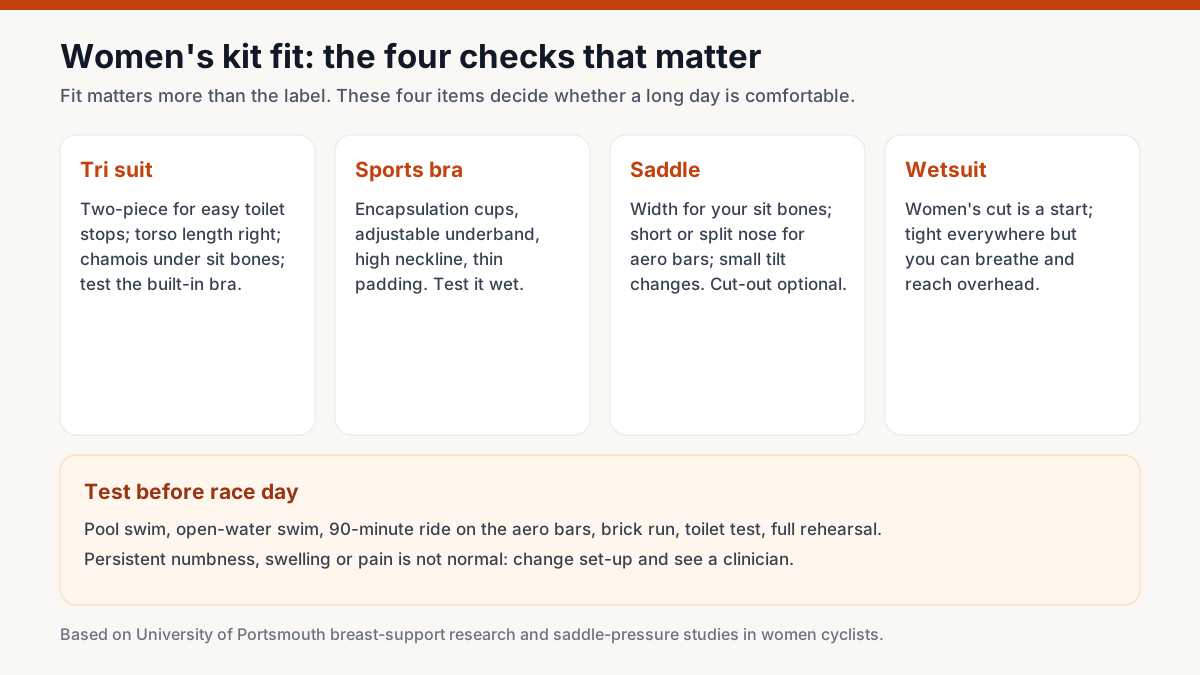
Kit that fits is one of the most common practical problems women raise about triathlon. Four items matter most. A tri suit should fit your torso length and leave you able to use the toilet; two-piece suits make that far easier. A sports bra should hold you still when wet and under a suit: University of Portsmouth researchers found encapsulation cups, padding, an adjustable underband, nylon fabric and a high neckline explain over a third of how well a sports bra performs. A saddle should support your sit bones and keep pressure off soft tissue in the aero position; width, nose shape and small tilt changes matter more than labels, and a cut-out is not automatically better. A wetsuit in a women's cut should feel tight everywhere without restricting breathing or reach. Test everything in training, and see a doctor about saddle pain, numbness or swelling that persists.
Key takeaways
- 1A two-piece tri suit or a suit with a rear or front access design makes toilet stops much easier; one-pieces are more streamlined but need pulling down to the waist
- 2Many built-in tri suit bras offer little support; most women with larger busts wear a separate sports bra underneath and test the pair wet
- 3Encapsulation cups, padding, an adjustable underband, nylon fabric and a high neckline are the bra features most linked to reduced breast movement
- 4In the aero position the pelvis rolls forward onto soft tissue; a saddle with a short or split nose and the right width usually helps more than a women's label
- 5A cut-out saddle is not automatically better: one study found the highest pressure at the edges of the cut-out
- 6Women's wetsuits are cut shorter in the torso and differently at chest and hips; fit matters more than brand
- 7Persistent saddle soreness, numbness or labial swelling is not something to put up with: change set-up, and see a doctor or women's health physiotherapist
Quick answer: the four fit checks that matter most
Most triathlon kit is designed and sized around an average body that many women do not have. You do not need special kit for a first race, but four items decide whether a long training day or a race is comfortable:
| Item | What to get right | How to test it |
|---|---|---|
| Tri suit | Torso length, chamois position, easy toilet access, a bra you trust | Swim, ride 90 minutes and run in it, then try a toilet stop |
| Sports bra | Encapsulation cups, adjustable underband, high neckline, quick-drying fabric | Jump and run in it wet, under your tri suit |
| Saddle | Width for your sit bones, a nose that suits your riding position, small tilt adjustments | Ride 2 hours in your race position, including the aero bars |
| Wetsuit | A women's cut that is tight everywhere but lets you breathe and reach | Swim 20 minutes in open water before race day |
The rest of this guide covers each item in turn, then bike fit, shoes, hair and helmets, periods on race day, pregnancy and a simple test plan.
Why fit matters more than it should
When women are asked what stops them starting or continuing triathlon, kit that fits and saddle discomfort come up again and again. Our article on why fewer women do triathlon covers the wider picture. A Cyclingnews survey of 278 active women cyclists, published in 2025, found that nearly all had experienced saddle sores and 68% named a poorly fitted saddle as a cause. Phil Burt, the former head physiotherapist at British Cycling, told Cycling Weekly that every woman in the Team GB squad he surveyed between the London and Rio Olympics reported saddle sores as a problem.
These are not problems you have to accept as part of the sport. Most are fixed by better-fitting kit and small set-up changes.
Tri suits
A tri suit is worn for the whole race: under the wetsuit, on the bike and on the run. It has a thin chamois (pad) for the bike that dries quickly and does not feel like a nappy when you run. Our tri suit guide covers fabrics and features; these are the fit points that matter most for women.
One-piece or two-piece?
| One-piece | Two-piece (top and shorts) | |
|---|---|---|
| Toilet stops | Must be unzipped and pulled down to the waist | Pull the shorts down only |
| Streamlining | Smoother; no riding-up top | Top can ride up in the aero position |
| Fit across body shapes | Torso length must be right | Mix sizes for top and bottom |
| Price | Usually one purchase | Two items, but each can be replaced |
For a long race, toilet access often decides it. Many women choose a two-piece for 70.3 and full-distance racing, where toilet stops are likely, and a one-piece for sprints. Some one-piece designs make stops easier with a front zip that opens to the waist or a rear access panel; check how it works before you buy.
Getting the size right
- Torso length. If a one-piece pulls down on your shoulders when you stand up straight, the torso is too short; it will be worse in the aero position. If it bags at the stomach, it is too long.
- Between sizes? Tri suits are meant to be snug, but a suit that is too small creates pressure points at the shoulders, chest and leg grippers. A two-piece lets you choose a different size top and bottom.
- Leg grippers should hold the leg without digging in. Wide, silicone-dotted grippers are usually more comfortable than narrow elastic.
- Chamois. Women's tri suits use a chamois shaped for women's anatomy. Sit on a chair in the suit: the pad should sit under your sit bones and soft tissue, not ride forward or back.
- Size ranges. Some brands make women's suits only in a narrow range of sizes. If standard sizes do not fit, look for brands with wider size ranges or a unisex suit in a size that fits your torso.
The built-in bra
Many women's tri suits have a built-in shelf bra. It is usually light support, which suits some smaller-busted athletes and almost nobody else for the run. Most women wear a separate sports bra underneath. If you do, make sure the suit's chest is cut to allow it, and test both together when wet.
Sports bras: the item most often overlooked
A sports bra has to do more in triathlon than in most sports. It is worn wet from the swim, under a tight suit and possibly a wetsuit, for several hours, and it has to control movement on the run when you are tired.
What the research says
The University of Portsmouth's Research Group in Breast Health has studied breast movement and sports bras for more than two decades. Its published findings include:
- Poor support changes how you run. In its research, inadequate breast support led to a 4 cm reduction in stride length, along with higher perceived effort and more upper-body muscle activity.
- Five design features matter most. Encapsulation-style cups (each breast supported separately), padded cups, an adjustable underband, nylon fabric content and a high neckline together explained over a third of how well a sports bra performed.
- Many women wear the wrong size. The group reports that most women wear a bra size that does not fit them; a professional fitting or careful self-check is worth the time.
Choosing a bra for triathlon
- Encapsulation or combination styles give better support than compression-only crop tops for most women, especially with a larger bust.
- An adjustable underband lets you get a firm fit; most of the support comes from the band, not the straps.
- Thin, quick-drying fabric and light padding. Thick foam soaks up water and stays heavy; thin, closed-cell or perforated padding dries faster.
- Flat seams and a smooth back. A clasp or seam where your tri suit zip or wetsuit sits will rub for hours.
- Front or back zip? A front-zip or front-close bra is easier to get on, but the zip can rub under a tight suit. Check where it sits.
- Racerback straps stay in place under a tri suit and leave the shoulders free for swimming.
Fitting a sports bra
- The underband should be snug and level all the way round. You should be able to fit about two fingers under it, and it should not ride up when you lift your arms.
- The cups should hold all the breast tissue without gaps or spilling over the top or sides.
- The straps should not dig in. If they do, the band is probably too loose.
- Do the jump test: jump and jog on the spot in front of a mirror. Movement should be small and comfortable.
- Test it wet. Swim, then run in it under your tri suit. Some bras that are fine dry stretch when wet.
Anti-chafe balm under the band and at the armpits prevents most bra chafing. Our chafing guide lists the common hot spots and how to protect them.
Saddles: comfort in the aero position
Saddle discomfort is the problem women triathletes raise most often, and triathlon makes it harder than road cycling. In the aero position, the pelvis rolls forward, so weight moves from the sit bones onto the soft tissue at the front. A saddle that is comfortable on a road bike can be painful on aero bars.
What the research says
Research on women cyclists and saddles is limited, but one study shows why simple rules do not work. Guess and colleagues (Journal of Sexual Medicine, 2011) measured saddle pressure in 48 competitive women cyclists riding their own bikes. They found:
- Cut-outs were not automatically better. Riders on cut-out saddles had higher pressure in the perineal area, and for most of them the highest pressure sat on the edges of the cut-out.
- Wider saddles were linked to lower pressure, both in the perineal area and overall.
- The study did not test noseless or split-nose saddles, which are common in triathlon, or the aero position.
Reporting by Cycling Weekly describes manufacturer research with transparent saddles that found swollen soft tissue pushing into a cut-out, which the designers had not expected. Cut-outs help some riders and make things worse for others.
Choosing a saddle
- Width. Your sit bones should be supported. Many bike shops measure sit-bone width with a gel pad or a simple card. Women's sit bones are, on average, slightly wider than men's, but the range overlaps a lot, so measure rather than guess.
- Nose shape. For riding on aero bars, a short-nosed or split-nose (noseless) saddle lets you sit further forward with the pelvis rotated without pressure on soft tissue. Our triathlon saddle guide compares the main styles.
- Padding. More padding is not always better. Thick soft padding can press into soft tissue. A firm saddle shape with a good chamois often feels better after two hours than a soft one.
- Women's-specific saddles can be a good starting point, but the right saddle is the one that fits your anatomy and position, not one with a women's label. Many women ride unisex saddles, and many men ride saddles marketed to women.
- Test before you buy. Many shops and brands offer test saddles. Ride each one for at least a week, including a long ride on the aero bars.
Setting it up
- Tilt. A level saddle is the usual starting point. Phil Burt advises that a nose angled down by a couple of degrees can relieve persistent vulval discomfort. Too much tilt makes you slide forward and puts more weight on your hands and arms, so change it by small amounts.
- Height and fore-aft position. A saddle that is too high makes you rock, which causes friction and sores. Moving the saddle forward on the rails is common for triathlon positions, so the hips sit over the cranks.
- Front end. Aero bars that are too low or too far forward force more forward rotation. Raising the aero bars a little is often the single most effective change. Our bike fit guide for beginners and aero bar guide explain how.
- Change one thing at a time and ride at least two or three sessions before judging it.
Saddle sores, numbness and swelling
- Saddle sores (inflamed hair follicles, boils or abrasions) come from pressure, friction and moisture. Wear a clean chamois for every ride, use chamois cream, change out of wet kit straight after training, and do not wear underwear under cycling shorts or a tri suit.
- Numbness means pressure on nerves. It is a sign to change your set-up, not something to ride through.
- Labial swelling (lymphoedema) can develop with years of saddle pressure. If you notice persistent swelling, asymmetry or pain, see a doctor or a women's health physiotherapist early; it is a recognised problem in cycling, and earlier changes give better results.
Tri shorts and cycling shorts for training
For long training rides, cycling shorts or bibs with a thicker chamois are more comfortable than a tri suit. Women's bibs with a drop-tail, zip or clip system let you use the toilet without taking off your jersey, which matters on long rides. Our comparison of tri shorts and cycling bib shorts explains when to use each.
Chamois shapes differ between brands. If one brand always rubs, try another rather than changing saddles first.
Wetsuits
Women's wetsuits are cut for a typical women's shape: generally shorter in the torso, narrower at the shoulders and shaped at the chest and hips. As with everything else, the cut that fits your body matters more than the label; some women fit a men's suit better.
Fit checks
- Tight everywhere, but you can breathe. A new wetsuit feels tight on land. You should still be able to take a full breath and lift your arms above your head.
- No water pockets. Gaps at the lower back, chest or armpits fill with water and drag. If you have a large bust relative to your torso, check the chest and the lower back carefully.
- Neck. The collar should seal without choking. Chafing at the back of the neck is common; balm helps.
- Crotch. Pull the suit up the legs so the crotch sits high; that frees the shoulders.
- Size charts. Brands size wetsuits by height, weight and sometimes chest. If you sit between sizes, try both, and prioritise shoulder freedom.
Our wetsuit buying guide covers thickness and features, the wetsuit selector narrows options by your measurements, and renting is a good way to try fits before buying.
Wetsuit with a sports bra
Wear the sports bra and tri suit you will race in when trying a wetsuit. A bulky bra or a strap clasp can create pressure points under the neoprene. Test the whole combination for at least 20 minutes in open water.
The bike: frame size and contact points
Many women ride standard bikes very happily. Large bike-fit datasets from manufacturers suggest the average differences between men's and women's proportions are smaller than often assumed, which is why several brands now make unisex frames in a wide range of sizes. The points that matter most for women are often about size rather than sex:
- Frame size and reach. Smaller riders need small frames with short reach. Very small frames sometimes use smaller wheels for better handling and toe clearance.
- Handlebar width. Narrower shoulders usually suit narrower bars.
- Brake reach. Smaller hands need levers adjusted closer to the bar. Most modern levers have a reach adjustment.
- Crank length. Shorter riders often benefit from shorter cranks, which also make it easier to rotate the hips forward in the aero position.
- Aero bar fit. Pads and extensions that are too wide or too far forward are common on clip-on bars. Our aero bar guide covers shapes and fit.
A professional bike fit is worth considering if you have pain you cannot solve with small changes.
Running shoes and the rest
Running shoes. Women's running shoes are typically built on a last with a narrower heel and different volume. Fit matters far more than the label; some women with wider feet run in men's or wide models. Our running shoe fit guide covers heel lock and lacing for transitions.
Helmet and hair. A helmet must sit level and stable. Long hair works best in a low braid or ponytail that does not push the helmet up; our race-day hairstyle guide shows options.
Goggles and swim caps. Smaller faces often suit smaller-fitting goggles. Our goggle guide explains how to test the seal.
Periods on race day
A period on race day is common and manageable with preparation. Tampons and menstrual cups both work during swimming and for the rest of the race. Period-proof underwear is not designed to be worn under a tri suit for a full race, so test anything new in training. Pack spares in your transition bag and know where the toilets are near transition and on the run. Our menstrual cycle and triathlon guide covers training, race-day products and when to see a doctor.
Pregnancy and after birth
During pregnancy your bra size, saddle comfort and running support needs change, sometimes month by month. Supportive maternity sports bras and a looser tri top or swimsuit help. Wetsuits are a fit problem in later pregnancy; follow your midwife's advice on open-water swimming.
After birth, return gradually, and consider a women's health physiotherapist check before running or racing. Pelvic floor symptoms, such as leaking when you run, are common and treatable, and they are a reason to get help, not to stop. Our women's training guide covers pregnancy and postpartum training in more detail.
A fit-test plan before race day
Test everything you will race in, in the same order, before your race:
- Pool session: swim 20 to 30 minutes in your tri suit and bra. Check straps, seams and the chest.
- Open-water session: add the wetsuit. Check the neck, armpits and whether the bra creates pressure.
- Long ride: at least 90 minutes in your tri suit, mostly in the aero position. Note any numbness, pressure or rubbing.
- Brick session: ride, then run 20 to 30 minutes off the bike in the same kit. Check bra movement and chafing.
- Toilet test: practise using the toilet in your suit. It is far easier to discover a problem at home than in a portaloo mid-race.
- Race rehearsal: a long brick a few weeks before your race, in full race kit, including balm and nutrition.
Write down what you change after each session, so you know what worked.
When kit is not the problem
If pain or discomfort continues after you have changed kit and set-up, the cause may be something else: pelvic floor dysfunction, a skin condition, a previous injury or a bike fit issue you cannot see yourself. A women's health physiotherapist, a doctor or a professional bike fitter can help. Saddle-related pain, numbness, swelling and leaking are all common in endurance sport, and none of them is something you just have to put up with.
Sources
Sources are listed so readers can verify consequential claims and dated details.
- Research Group in Breast Health — University of Portsmouth (accessed November 21, 2026)
- Women's bike seats: a pressing matter for competitive female cyclists (Guess et al., 2011) — Journal of Sexual Medicine (via CDC Stacks) (accessed November 21, 2026)
- The science of sitting comfortably: how can the cycling industry help more women ride bikes without pain? — Cycling Weekly (accessed November 21, 2026)
- Cycling's most sensitive issue: why saddle discomfort is a silent barrier for female cyclists — Cyclingnews (accessed November 21, 2026)
Frequently asked questions
Do women need women's-specific triathlon kit?
Not always. Women's-specific tri suits, bras and wetsuits are cut for a typical women's shape and are a good starting point, but fit matters more than the label. Some women fit unisex or men's wetsuits, saddles and shoes better.
Should I wear a bra under my tri suit?
Most women do, unless they have a small bust and find the suit's built-in shelf bra supportive enough for running. Test the bra and suit together when wet before race day.
Is a one-piece or two-piece tri suit better for women?
A one-piece is more streamlined; a two-piece makes toilet stops much easier and lets you choose different sizes for the top and shorts. Many women choose a two-piece for long races.
Why does my saddle hurt more on aero bars?
In the aero position the pelvis rolls forward, putting more weight on soft tissue. A short-nosed or split-nose saddle, a small tilt change, moving the saddle forward or raising the aero bars usually helps.
Are cut-out saddles better for women?
Not necessarily. One study of competitive women cyclists found higher pressure at the edges of cut-outs. Some women find them more comfortable and some do not, so test before you buy.
What should I do about labial swelling or numbness?
Do not ride through it. Change your set-up, and see a doctor or women's health physiotherapist if it persists.