Women in Triathlon: Your Start-Here Hub for a First Race and Beyond
The Brick to Brick hub for women starting or returning to triathlon: how to choose a women-friendly race, a first training plan, kit that fits, periods and iron, pregnancy and the return to running after birth (with the postnatal load and impact tests), race deferral policies, perimenopause, safety, and where to find your people.
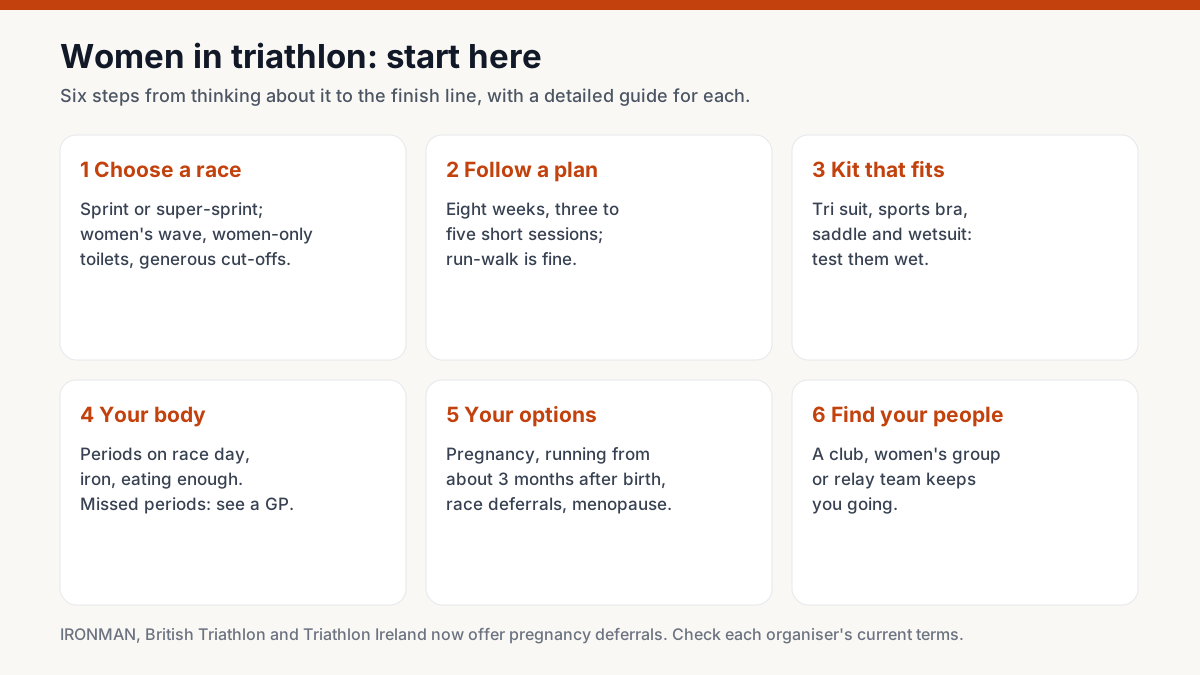
Women are a growing share of triathletes, and most of what you need for a first race is the same as for anyone: a realistic race, a simple plan and kit that works. A few questions are specific to women, and this hub answers them in one place. Choose a race with a women-friendly set-up, such as a women's series event or a race with female-only waves and women-only toilets. Follow a gradual eight-week sprint plan. Get a tri suit, sports bra, saddle and wetsuit that fit. Plan for periods on race day and keep an eye on iron. If you are pregnant or have had a baby, exercise is encouraged with medical guidance, running usually restarts no earlier than about three months after birth once simple load and impact tests are comfortable, and IRONMAN and several federations now let you defer race entries. Then find a club or group: it is the single best predictor of sticking with the sport.
Key takeaways
- 1Start with a sprint or super-sprint; women's series races and events with female-only waves are designed for first-timers
- 2An eight-week plan with three to five short sessions a week is enough for most women to finish a first sprint
- 3Kit fit matters most for four items: tri suit, sports bra, saddle and wetsuit
- 4You can race at any point in your cycle; plan products for race day and get ferritin checked if you are tired
- 5Exercise in an uncomplicated pregnancy is recommended; ask your midwife or doctor about racing and open water
- 6UK postnatal guidance advises against running before about three months after birth, and suggests load and impact tests and a pelvic health check first
- 7IRONMAN lets pregnant athletes defer to the same race for up to two years; British Triathlon and Triathlon Ireland have similar policies for age-group team slots
Start here: the path from thinking about it to the finish line
If you are a woman thinking about a first triathlon, or coming back after a break, this page is the map. Each step links to a detailed guide, and the sections below answer the questions women ask most.
| Step | What to do | The detailed guide |
|---|---|---|
| 1. Choose a race | A sprint or super-sprint with a women-friendly set-up | Choosing your first race |
| 2. Follow a plan | Eight weeks, three to five short sessions a week | Women's first triathlon training plan |
| 3. Get kit that fits | Tri suit, sports bra, saddle, wetsuit | Women's kit fit guide |
| 4. Plan for your body | Periods on race day, iron, fuelling enough | Periods and triathlon |
| 5. Know your options | Pregnancy, the postnatal return, race deferrals, menopause | The sections below |
| 6. Find your people | A club, women's group or relay team | Why fewer women do triathlon |
You do not need to be fast, slim, young or a strong swimmer to start. Most first-time finishers are none of those. What helps most is a realistic race, a gradual plan and a few practical answers in advance.
Why this hub exists
Women make up a minority of triathletes, and the share falls as race distances get longer. When women are asked why, the answers are practical: cost, time, kit that does not fit, toilet and changing facilities, safety, and uncertainty about periods, pregnancy and returning after birth. Our article on why fewer women do triathlon looks at the evidence.
Most of these barriers have answers. They are just scattered. This page gathers them.
Step 1: choose a women-friendly first race
The best first race is short, close to home and run by an organiser that makes beginners welcome. For many women, a few extra features make a big difference:
- Women's series and women-only races. USA Triathlon runs a Women's Series of women-focused races across the US season, including sprint and Olympic triathlons, aquabikes, aquathlons, duathlons and relays. It states that no qualification or experience is required, and its race finder has a women's-only filter. In 2024 the series featured 27 events, supported by a free eight-week Olympic-distance training plan.
- Female-only start waves. A wave of women only means a calmer swim start with swimmers of similar size and speed. Many UK and European organisers offer them for sprint races.
- Women-only toilets and changing areas. These matter more than they sound, especially in long races.
- Generous cut-off times, so you can finish without racing the clock.
- Women in Tri partner events (UK). Women in Tri recognises events that commit to women-friendly policies. Castle Race Series, for example, became a Gold Partner for 2025 and 2026, listing a pregnancy deferral policy, women-only toilets at every event, female-fit kit options, flexible race transfers, female-only start waves for sprint races and equal prizes. It reported that 42% of participants at a recent Belvoir Castle Triathlon were women.
- Local initiatives. Groups such as ForTheGirls, a support network founded by two age-group athletes in north-west England, run course recces and beginner sessions. It is aiming for a 50:50 gender split on the start line at IRONMAN 70.3 Bolton in June 2027, with IRONMAN's support.
When you look at a race, check the swim type (pool swims are easiest for a first race), the cut-offs, whether wetsuits are likely and whether there is a novice or women's wave. Our guide to choosing your first race explains each factor, and the registration guide explains licences and refund policies.
Step 2: follow a gradual plan
A first sprint triathlon (usually 750 m swim, 20 km bike, 5 km run, or shorter in a super-sprint or pool race) needs less training than most people think. Our eight-week women's first triathlon plan uses three to five sessions a week, most of them under an hour, with run-walk options and a gentle introduction to open water. It comes with a printable PDF and a calendar export.
A few principles apply to everyone, but women raise them often:
- Swimming is the most common worry. Lessons, a masters group or a pool-based race take most of the fear away. Our open-water anxiety guide helps with the step outside.
- Run-walk is a legitimate strategy, in training and in races.
- Strength training twice a week helps prevent injury and supports bones, especially from your 40s.
- Fit training around life. If you are juggling work and caregiving, our guide to training while working full time shows how to build a realistic week.
Step 3: get kit that fits
You need very little kit for a first sprint, but four items decide whether you are comfortable: a tri suit (two-piece suits make toilet stops much easier), a sports bra that works wet and under a suit, a saddle that suits your anatomy and riding position, and a wetsuit cut for your shape. Our women's kit fit guide covers each one, including what research says about sports bras and saddle pressure, and a test plan before race day.
Two other practical guides: race-day hairstyles that work with caps, goggles and helmets, and how to prevent chafing.
Step 4: periods, iron and fuelling
Periods. You can train and race at any point in your cycle. Research suggests any average effect of cycle phase on performance is small, and it varies between women, so track your own pattern rather than following fixed rules. Tampons and menstrual cups both work for swimming; plan a change in long races. Our periods and triathlon guide covers products, symptoms and contraception.
Iron. Periods, especially heavy ones, and endurance training both increase iron needs. If you are unusually tired, breathless or not improving, ask your doctor for a ferritin test and a full blood count.
Eat enough. Training uses a lot of energy, and eating too little affects hormones, bones and performance. Missed or stopped periods are a warning sign of low energy availability, not a sign of fitness, and need medical advice. If you eat a plant-based diet, our plant-based nutrition guide covers iron, B12 and protein.
Step 5a: training and racing during pregnancy
For most women with an uncomplicated pregnancy, exercise is safe and encouraged. The American College of Obstetricians and Gynecologists (ACOG) recommends regular physical activity during pregnancy, including at least 150 minutes a week of moderate-intensity activity for those who were not already very active, and says women who were already doing vigorous exercise can generally continue with guidance from their healthcare provider.
Practical points for triathletes:
- Talk to your midwife or doctor about your current training and any racing plans. Some conditions mean exercise should be limited.
- Expect to adapt as the pregnancy progresses. Many women keep swimming throughout; cycling often moves indoors as balance changes and the risk of falls matters more; running is very individual.
- Avoid activities with a high risk of falls or abdominal impact, overheating, and exercising to exhaustion. Hot races and sessions in heat deserve particular caution.
- Stop and seek medical advice if you have warning signs such as vaginal bleeding, fluid leaking, regular painful contractions, chest pain, dizziness, calf pain or swelling, or reduced baby movements.
- Racing while pregnant is a personal and medical decision. Most organisers' insurance and rules still apply; check with the organiser and your healthcare provider.
Our women's training guide covers pregnancy and postpartum in more detail, and the kit fit guide covers maternity sports bras and wetsuits.
Step 5b: returning to training after birth
The return after birth is where clear guidance is most useful and hardest to find. In the UK, physiotherapists Tom Goom, Grainne Donnelly and Emma Brockwell published a postnatal return-to-running guideline in 2019, now widely used by health professionals. Its key recommendations are:
- Low-impact exercise first. Walking, pelvic floor exercises, and then gradual low-impact strength work in the first three months.
- Running no earlier than about three months after birth, with a return between three and six months at the earliest, regardless of whether you had a vaginal birth or a caesarean section.
- A pelvic health assessment with a specialist physiotherapist, offered to every mother from six weeks after birth.
- Load and impact tests before running. You should be able to do all of the following without pain, heaviness, dragging or leaking:
| Test | Target |
|---|---|
| Walking | 30 minutes |
| Single-leg balance | 10 seconds each leg |
| Single-leg squat | 10 repetitions each side |
| Jogging on the spot | 1 minute |
| Forward bounds | 10 repetitions |
| Hopping on the spot | 10 repetitions each leg |
| Single-leg "running man" (opposite arm and leg drive) | 10 repetitions each side |
- Strength tests. The guideline also suggests aiming for about 20 repetitions of single-leg calf raises, single-leg bridges, single-leg sit-to-stands and side-lying leg raises before running.
- Warning signs to stop and get help: heaviness or dragging in the pelvic area, leaking urine or difficulty controlling the bowels, a bulge or doming along the midline of the stomach, pelvic or lower back pain, and bleeding beyond about eight weeks after birth that is not a period.
These are guidelines, not a timetable: some women are ready to run at three months and others need longer, and both are normal. Leaking, heaviness and pain are common and treatable; they are reasons to see a women's health physiotherapist, not to give up.
Swimming can usually restart once bleeding has stopped and any wounds have healed, often around six weeks, but check with your doctor or midwife, especially after a caesarean section. Cycling outdoors depends on comfort, perineal healing and core strength; an indoor trainer is a good first step. Breastfeeding athletes need extra energy and fluid; a well-fitting, supportive sports bra and feeding or expressing before sessions help.
Step 5c: race entries, deferrals and qualifying slots
Losing a race entry because you became pregnant is a real cost. A UK survey by SheRACES and Fund Her Tri, cited by TRI247, found that 79% of triathletes who became pregnant while preparing for a race lost at least one entry. Policies are improving:
| Organisation | What the policy offers (as published) |
|---|---|
| IRONMAN and IRONMAN 70.3 | Athletes who register and then become pregnant can defer to the same event for up to two years (updated July 2024 from one year). Partners whose baby is due near race day, and parents through adoption or surrogacy, can defer to the following year with proof. |
| British Triathlon (age-group team) | Women who qualify for an age-group championship race can defer their Great Britain team place for up to two years, including after pregnancy loss. |
| Triathlon Ireland | Age-group team slots can be deferred for up to two years after birth or pregnancy loss, partners and medically assisted reproduction are covered, and membership can be paused for up to two years (April 2026 policy). |
| Castle Race Series (UK) | Pregnancy deferral policy listed among its Women in Tri commitments. |
Many other organisers have no formal policy but will help if you ask. Before you enter, read the transfer and deferral rules; if you are planning a pregnancy, choose races with flexible policies. Always check the organiser's current terms and how to apply, because policies change.
Step 5d: perimenopause and menopause
Many women start or return to triathlon in their 40s and 50s, and many race well through perimenopause and beyond. Changes to expect include irregular periods, hot flushes, poorer sleep, joint aches and a faster loss of muscle and bone. What helps:
- Strength training two or three times a week, with progressively heavier loads. See our strength training guide.
- Enough protein, spread across the day, and calcium and vitamin D.
- Recovery and sleep. You may need more easy days between hard sessions than you used to.
- Heat management, because hot flushes and heat in races can combine.
- Medical support. Hormone replacement therapy and other treatments help many women; a doctor can explain the options.
Questions to ask a race organiser before you enter
Race websites rarely answer everything a first-time woman wants to know. A short email to the organiser usually does. Useful questions:
- Is there a women's or novice wave, and how are swim waves seeded?
- Where are the toilets, how many are there near transition and on the run, and are any women-only?
- Is there a changing area, or is changing in transition not allowed?
- What are the cut-off times for the swim, bike and finish?
- Can I use a bike I already have, such as a hybrid or mountain bike? (For most sprints the answer is yes.)
- What is the transfer and deferral policy, including for pregnancy, injury or illness?
- Is there a beginners' briefing, a course recce or a transition walk-through before the race?
- Are relays available, if you would like to try the race with friends first?
An organiser who answers quickly and clearly is usually one who runs a well-organised, welcoming race.
Pelvic floor: leaking is common, and treatable
Leaking urine while running, jumping or lifting is common among women who exercise, not only after childbirth. It is also one of the reasons women give for stopping running. It is not something you have to accept.
- See a women's health (pelvic health) physiotherapist if you leak, feel heaviness or dragging, or have pain. Many health systems let you self-refer.
- Pelvic floor training works. A physiotherapist can check that you are doing the exercises correctly and build them into your strength routine.
- Training changes help. Building up running gradually, strengthening the hips and core, and avoiding running when very fatigued can reduce symptoms while you work on them.
- Do not cut fluids to avoid leaking. Dehydration makes training harder and can irritate the bladder.
A first-race checklist for women
On top of the usual race-day packing checklist, women often find these useful:
- Sports bra you have tested wet, and a spare for after the race.
- Period products and wipes, even if you do not expect your period.
- Hair ties and a cap that fits over your hairstyle.
- Anti-chafe balm for the bra band, neck and inner thighs.
- A long top or changing robe for getting into and out of the wetsuit.
- Sunscreen applied before the wetsuit goes on, where the suit will not cover.
- Something warm for after the finish; you will cool down quickly.
- A friend or supporter with your phone, keys and a plan for where to meet.
What it costs, and how to keep it down
Cost is the most common barrier women name. A first sprint can be done on a small budget: a borrowed or second-hand bike that works, a swimsuit and cycling shorts or a basic tri suit, a helmet, running shoes and a rented wetsuit if the swim needs one. Our triathlon cost guide gives example budgets, and the licence fees by country page shows the extra federation fee non-members pay. Many women's groups run kit swaps, and some race organisers offer discounted first-race entries.
Coaching and groups: what to look for
A coach or structured group is not necessary for a first sprint, but many women find it makes the difference between starting and sticking with the sport. What to look for:
- Experience with beginners, and with women at your stage of life, whether that is fitting training around young children, returning after pregnancy or training through perimenopause.
- Flexibility. A good plan adapts to missed sessions, illness, your cycle if you want it to, and a busy week, rather than making you feel you have failed.
- Open conversation about women's health. You should feel able to mention periods, pelvic floor symptoms, pregnancy plans or menopause without embarrassment. A coach who brushes these off is not the right coach.
- Sensible attitudes to food and weight. Be wary of anyone who sets weight-loss targets for performance or praises missed periods. Fuelling well is part of training.
- Swim support. Lessons or a coached swim group are worth paying for even if everything else is self-coached.
Our guide to finding a triathlon coach explains costs, qualifications and the questions to ask. Club sessions are usually the cheapest way to get coached swims and group rides, and many clubs now run women's beginner groups or "couch to tri" courses each spring.
Returning after a break
If you raced before and are coming back after a break for children, illness, injury or life, start lower than you think. Fitness returns faster than it was built, but tendons, bones and the pelvic floor take longer than the heart and lungs. Use the first four weeks of the eight-week plan as a re-entry block, keep running in run-walk form at first, and choose a short, friendly race as your comeback goal.
Safety, confidence and community
Safety. Ride routes you know, tell someone where you are going, carry a phone and lights, and consider riding with a group, especially in winter. Report harassment on course to race officials; many organisers now have clear codes of conduct. Our reflective gear and bike lights guide covers visibility.
Confidence. Nerves before a first race are universal. A rehearsal of the race-morning routine, a visit to the venue and a plan for the swim start help. Our guide to triathlon anxiety has techniques to practise.
Community. Joining a club, a women's group or a beginner programme is the single biggest help for many women. It gives you training partners, advice on local races, kit swaps and someone to share transition with. Relays are a low-pressure way to try a race with friends. If you cannot find a group, ask the race organiser or your national federation: many run women's beginner sessions.
Sources
Sources are listed so readers can verify consequential claims and dated details.
- Women's Series — USA Triathlon (accessed November 21, 2026)
- Two-year event deferral option in updated IRONMAN Pregnancy & Parenthood Policy (July 2024) — Endurance Business (accessed November 21, 2026)
- British Triathlon announce pregnancy deferral policy for Age Group team — TRI247 (accessed November 21, 2026)
- Pregnancy, Parental and Family Policy (April 2026) — Triathlon Ireland (accessed November 21, 2026)
- Returning to running postnatal: guideline for medical, health and fitness professionals (Goom, Donnelly and Brockwell, 2019) — Athletics Northern Ireland (hosted copy) (accessed November 21, 2026)
- Physical activity and exercise during pregnancy and the postpartum period (Committee Opinion 804) — American College of Obstetricians and Gynecologists (accessed November 21, 2026)
- Women in Tri gold partnership 2025–2026 — Castle Race Series (accessed November 21, 2026)
- ForTheGirls targets 50:50 gender split at IRONMAN 70.3 Bolton — TRI247 (accessed November 21, 2026)
Frequently asked questions
Do I need to be fit to start?
No. A first sprint suits beginners who can walk briskly for 30 minutes. An eight-week plan builds from there.
What if I am the slowest?
Someone has to be, and at most races the people at the back get the biggest cheers. Choose a race with generous cut-offs, and remember that finishing your first triathlon puts you ahead of everyone who did not start.
What do I wear?
A tri suit or swimsuit with cycling shorts, plus a sports bra, works for a first sprint. See the kit fit guide.
Can I race on my period?
Yes. Use a tampon or menstrual cup for the swim, and plan a change in long races. See the periods guide.
Can I keep training while pregnant?
Usually yes, with your healthcare provider's guidance and adaptations as your pregnancy progresses. Avoid falls, overheating and exhaustion.
When can I run after having a baby?
UK guidance advises against running before about three months after birth, and recommends a pelvic health assessment and simple load and impact tests first.
Is it too late to start in my 50s or 60s?
No. Age-group racing has categories up to 80 and above, and strength training helps you stay strong and healthy as you train.