FTP Test Explained: How to Find Your Threshold Power for Triathlon
Learn what FTP estimates, how common tests differ and how to interpret cycling zones without treating one result as fixed.
By Lotte
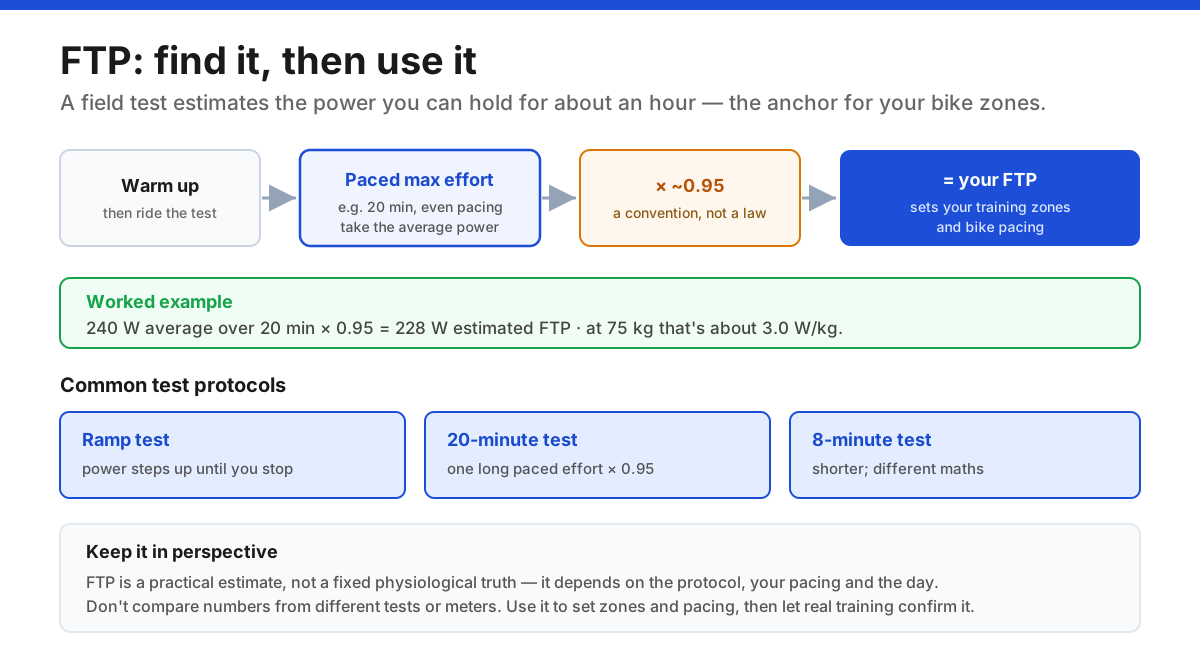
Functional threshold power (FTP) is the roughly one-hour cycling power used to anchor your training zones and bike pacing. A common 20-minute field test estimates it as about 95% of your average power, but FTP is an estimate that depends on the protocol, your pacing and the day — not an exact physiological threshold. Pick a repeatable test, do the maths correctly, turn the number into zones, and let ordinary training confirm whether it's right.
Key takeaways
- 1FTP is the power you can hold for about an hour — the anchor for your cycling training zones and bike pacing.
- 2It's a practical estimate, not a measured physiological threshold; it shifts with protocol, pacing and the day.
- 3Pick one repeatable protocol (ramp, 20-minute or 8-minute) and don't compare numbers across different tests or meters.
- 4The 20-minute maths: FTP ≈ average power × 0.95 (e.g. 240 W → 228 W); use the interval average, not peak or whole-ride power.
- 5Turn FTP into zones, validate it through ordinary training, and retest only when a decision needs it — not to chase a bigger number.
In this article
- 1What FTP is — and what it isn't
- 2Why FTP matters for triathletes
- 3You need a power meter — or a sensible alternative
- 4The test protocols, and how to choose one
- 5How to run a 20-minute test properly
- 6The maths: turning the effort into a number
- 7Turning FTP into training zones
- 8Control the factors that skew comparisons
- 9Validate the number through ordinary training
- 10When (and how often) to retest
- 11The bottom line
- ⚖FTP test protocols compared
- ?Frequently asked questions
What FTP is — and what it isn't
Functional threshold power (FTP) is the power, in watts, that you can hold for roughly an hour of hard cycling. It's the single most useful number in power-based bike training because almost everything else — your training zones, your workout targets, your race pacing — is expressed as a percentage of it.
But it's just as important to be clear about what FTP isn't. It is a practical estimate, not a directly measured physiological threshold, and research comparing field-test FTP with laboratory threshold measures shows they shouldn't be treated as interchangeable. How long you can actually hold your "FTP" varies from person to person, and the number moves with your pacing, the protocol and even the day.
So treat FTP as a working anchor that starts a training conversation, not a verdict on your worth or a figure to force every session and race to obey. If you're new to power altogether, read cycling watts explained first for what power actually measures — this page is about finding and using your threshold number.
Why FTP matters for triathletes
For a triathlete, FTP earns its keep in two places:
- It sets your training zones. Once you have an FTP, your easy, tempo, threshold and harder efforts all fall out of it as power ranges — so your sessions have concrete, repeatable targets instead of vague "ride hard" instructions. How those zones translate into actual workouts is the job of threshold vs sweet-spot training.
- It helps you pace the bike so you can run. The classic triathlon mistake is riding the bike too hard and destroying the run. Knowing your threshold lets you hold a sensible, sub-threshold percentage on the bike and arrive at T2 able to run — which is what pacing strategy and the broader bike-training design are built around.
Keep it in perspective, though: FTP is one useful input, not the whole picture. Consistency, easy volume, durability and fuelling matter more than chasing a bigger threshold number — the point of testing is better decisions, not a trophy.
You need a power meter — or a sensible alternative
An FTP test measures power, so you need a device that reports it: a power meter on the bike (crank, pedals or hub) or a smart trainer that measures power indoors. If you're deciding whether that's a worthwhile purchase, power meters for triathlon covers what they do and whether you need one.
No power meter? You can still train effectively. Heart rate and perceived effort organise training well for most age-groupers — see heart-rate zones explained — they just respond more slowly and drift with heat and fatigue, so they pace differently from power. And if you want a more physiological picture than a field test gives, lactate threshold testing at home is a different (and more involved) approach.
Whatever the source, use the same one when you compare results over time. A number from your pedals and a number from a trainer aren't the same measurement.
The test protocols, and how to choose one
There's no single "correct" FTP test — several protocols estimate the same number in different ways, each with its own assumptions:
- Ramp test — power steps up steadily until you can't continue; software estimates FTP from your final effort. Short and repeatable, but the estimate can suit some riders better than others.
- 20-minute test — one long, evenly paced maximal effort; FTP is estimated as about 95% of your average (more on the maths below). The most common field test.
- 8-minute test — a shorter effort (often two of them) for athletes who struggle to pace a full 20 minutes; it uses different maths.
- Longer efforts or platform estimates — a full ~60-minute test, or a modelled estimate from your recent rides on a training platform.
The golden rule: don't compare results across protocols or platforms as if the difference must be a fitness change. Pick one method you can repeat, follow its complete protocol (warm-up, effort and cool-down included), and stick with it for tracking. The comparison table below summarises the trade-offs.
How to run a 20-minute test properly
The 20-minute test is the most common, so here's how to give it a fair shot:
- Warm up thoroughly — 15–20 minutes with a few short openers so the first minutes of the test aren't wasted easing in.
- Pace it evenly. The classic error is starting too hard and fading; aim for a hard but sustainable effort you could just about hold to the end, and keep it steady. A big negative split usually means you left time on the table with a timid start.
- Choose a controlled setting. Indoors on a trainer removes traffic, junctions and descents; outdoors needs a long, uninterrupted, safe stretch. Never do a maximal effort somewhere handling hazards can bite.
- Be honest about readiness. A maximal test is inappropriate when you're ill, injured, very fatigued or not prepared for hard exercise, and any concerning symptoms during exertion mean stop and seek appropriate medical advice.
A good test is a repeatable one — same protocol, similar conditions — because the goal is a number you can trust and compare to later, not a one-off hero effort.
The maths: turning the effort into a number
For the 20-minute test, the convention is:
FTP ≈ average power for the 20 minutes × 0.95
So if you average 240 W across the 20 minutes, your estimated FTP is 240 × 0.95 = 228 W. The ~5% reduction is a rough allowance for the fact that you can hold 20 minutes at a higher power than you could hold for a full hour. Treat 0.95 as a useful convention, not a law — it fits some riders better than others.
Two details that trip people up:
- Use the right input. It is the average power for the defined 20-minute interval — not peak power, not normalized power, and not the average of your whole ride including warm-up.
- Power-to-weight (W/kg) is an FTP estimate divided by body mass: 228 ÷ 75 kg ≈ 3.04 W/kg. This is arithmetic, not a grade of ability. Effort duration, test method and course matter; the triathlon power-to-weight guide explains how to interpret the ratio.
The FTP calculator does this arithmetic for you — but remember it can only do the sum; it cannot tell whether your test was well paced or your meter was calibrated. A ramp or 8-minute test uses different maths, so always label which protocol produced a number.
Turning FTP into training zones
The payoff for testing is a set of training zones: percentage bands of FTP that give each session a concrete target. Roughly, easy/endurance work sits well below FTP, tempo and sweet-spot just under it, threshold work around it, and VO2/anaerobic efforts above — though the exact boundaries differ between zone systems.
Two honest cautions:
- Zones are organisational ranges, not sharp biological walls. Nothing magic happens at 76% versus 75%. They're a tool for structuring effort, so don't agonise over a single watt.
- Label which system you're using. "Zone 2" or "sweet spot" means different things in different models, so a number is only useful alongside its definition.
The training-zone calculator will lay out bands from your FTP, and threshold vs sweet-spot training explains what to actually do in the most useful ones. Setting zones is where FTP stops being a test score and becomes a training tool.
Control the factors that skew comparisons
If you want an FTP number you can track, you have to control the things that quietly change it:
- Same power source, calibrated. Follow the zero-offset/calibration steps, and don't switch power meters and test protocols at the same time — you won't know which caused the change.
- Note the conditions. Indoor vs outdoor, cooling (a fan matters a lot indoors), heat, fatigue, motivation and pacing all move the result. A hot, un-cooled indoor test can read low for reasons that have nothing to do with fitness.
- Sanity-check surprising results. Before you re-zone your whole training around a shock number, inspect the file for dropouts, a wrong interval selection or a sensor glitch.
And resist the temptation to "fix" a disappointing test by quietly applying a friendlier multiplier until the number you wanted appears. That's measuring your hopes, not your threshold.
Validate the number through ordinary training
A test result is a hypothesis; your training confirms or corrects it. Use a new FTP conservatively at first and watch how the sessions feel:
- If work that should be manageable at your zones repeatedly feels unsustainable, your FTP is probably set too high (or you're fatigued) — adjust it down rather than grinding yourself into a hole.
- If everything feels far too easy, the estimate may be low, or your test was under-paced.
Let perceived effort and recovery be part of the verdict, not just the watts. And don't force a long-race power target from a single short test — a full-distance bike is ridden well below threshold, and duration, position, terrain, heat, fuelling and the run afterward all change the right number. FTP informs race pacing; it doesn't dictate it. The pacing framework and data-driven training cover how to hold that perspective.
When (and how often) to retest
Retest when a decision needs it — after a solid training block, a clear change in fitness, or an equipment change that requires a fresh baseline. Testing constantly is counter-productive: a maximal effort costs recovery, and week-to-week noise will have you chasing numbers rather than training.
When you do retest, keep the old result, protocol and conditions rather than overwriting them. A short log — date, protocol, warm-up, power source, indoor/outdoor, cooling, recent fatigue, plus both the raw average and the calculated FTP — lets you tell a real trend from one unusually good or bad day, and stops an "improvement" that's really just a changed method from fooling you.
Your next step after a test is always a sensible training adjustment, not a bigger number at any cost. If your FTP supports repeatable sessions and pacing that sets up a good run, it's doing its job — however modest it looks.
The bottom line
FTP is the practical anchor of power-based cycling: the roughly one-hour power that sets your zones and helps you pace the bike so you can run. Find it with a protocol you can repeat — most often a well-paced 20-minute test, estimated at about 95% of your average — record the method alongside the number, and turn it into zones you actually use.
Then hold it lightly. It's an estimate that depends on the protocol, your pacing and the day, so let real training confirm it, retest only when a decision needs it, and never chase a bigger number for its own sake.
Where to go next: cycling watts explained for the fundamentals, threshold vs sweet-spot training for what to do with your zones, heart-rate zones if you train without power, and training basics for how it all fits into a plan.
FTP test protocols compared
| Protocol | How it works | Good for | Watch out for |
|---|---|---|---|
| Ramp test | Power steps up until you stop | Quick, repeatable, low pacing skill | Estimate suits some riders more than others |
| 20-minute test | One paced effort × ~0.95 | A solid, widely used field standard | Needs even pacing; hard to pace well |
| 8-minute test | Shorter effort, different maths | Riders who can't pace 20 min | Different calculation — don't mix with 20-min |
| Longer / platform estimate | ~60-min test or modelled from rides | Least correction; passive tracking | Long test is brutal; models are approximate |
Sources
Sources are listed so readers can verify consequential claims and dated details.
- Reliability of functional threshold power in competitive cyclists — Journal of Strength and Conditioning Research (accessed September 20, 2026)
- Functional threshold power: validity and physiological responses — Journal of Strength and Conditioning Research (accessed September 20, 2026)
Frequently asked questions
What is FTP in cycling?
Functional threshold power is the power in watts you can sustain for roughly an hour of hard cycling. It's used as the anchor for your training zones and bike pacing. Importantly, it's a practical estimate rather than a directly measured physiological threshold, and how long you can actually hold it varies with your pacing, the protocol and the day.
How do I test my FTP?
Pick one repeatable protocol — a ramp test, a 20-minute test, or an 8-minute test — and follow its full procedure including a proper warm-up. The most common is the 20-minute test: warm up, ride one hard but evenly paced 20-minute effort on a power meter or smart trainer, and estimate FTP as about 95% of your average power for that interval. Only test when you're healthy and ready for a maximal effort.
Why is FTP 95% of a 20-minute test?
The ~5% reduction roughly accounts for the fact that you can hold a higher power for 20 minutes than for a full hour, which FTP represents. So a 240 W 20-minute average estimates an FTP of about 228 W. Treat 0.95 as a useful convention rather than an exact law — it fits some riders better than others, and other protocols use different maths.
Do I need a power meter to find my FTP?
Yes — FTP is a power measurement, so you need a power meter or a smart trainer that reports watts. Without one you can still train effectively using heart-rate zones and perceived effort; they pace more slowly and drift with heat and fatigue, but they organise training well for most age-group triathletes.
How often should I retest my FTP?
Only when a decision needs it — typically after a solid training block, a clear fitness change, or an equipment change that needs a new baseline. Testing too often just costs recovery and has you chasing week-to-week noise. Keep a log of each test's protocol and conditions so you can tell a real trend from one good or bad day.
Should I repeat a failed FTP test the next day?
No, don't automatically repeat a maximal effort while fatigued or unwell. First work out why it failed — an interruption, poor pacing, an equipment issue, conditions, or symptoms. Retest once you've recovered and when the result will actually inform a decision. Any concerning symptoms during hard exertion warrant appropriate medical advice.