VO2 Max for Triathlon: Measurement, Estimates and Meaning
Understand VO2 max units, laboratory tests and watch estimates, and learn why one aerobic-fitness number cannot predict your triathlon result.
By Lotte
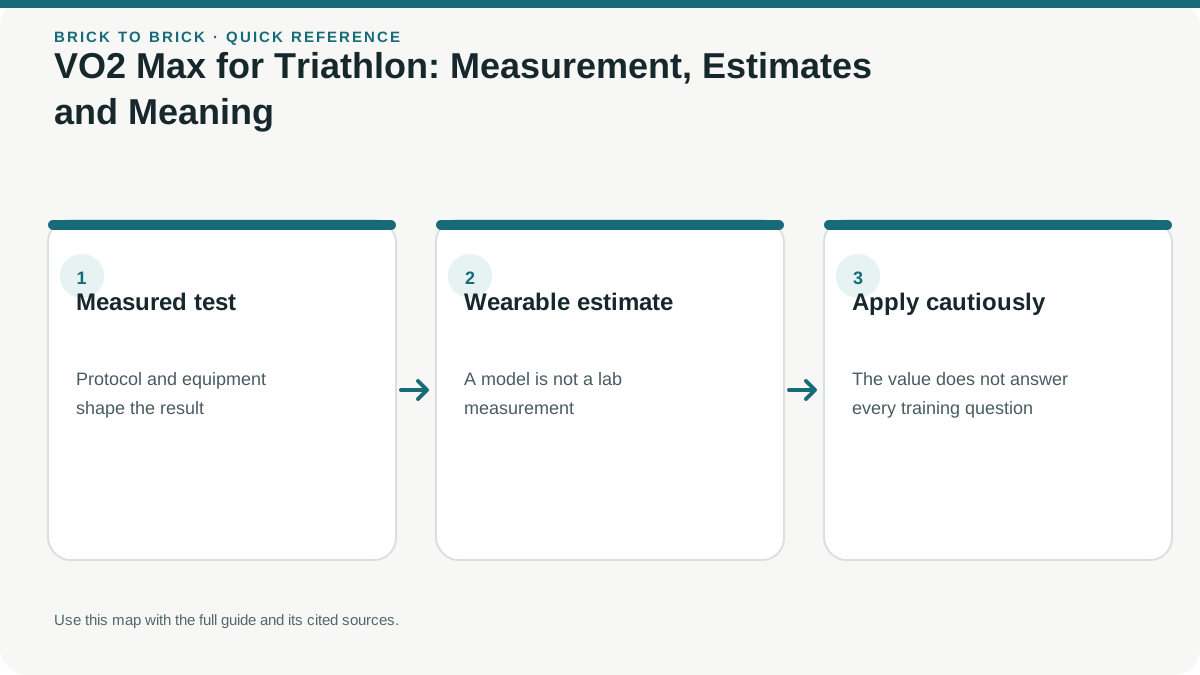
VO2 max describes the highest rate of oxygen uptake measured during a suitable maximal exercise test. It is one aspect of aerobic fitness; a watch estimate, a laboratory result and a triathlon finish-time prediction are different things.
In this article
- 1Read the units correctly
- 2Distinguish a test from an estimate
- 3Why the number does not determine race time
- 4Use trends only when the context is comparable
- 5Train for the athlete, not the metric
- 6Decide whether additional testing is useful
- 7Understand why relative VO₂ max can change without a faster race
- 8Choose a performance question that VO₂ max cannot answer alone
- 9Understand what the laboratory actually measures
- 10Know when an estimate is only an estimate
- 11Do not compare running and cycling values as if they were identical
- 12Separate aerobic ceiling from sustainable race performance
- 13Interpret change without overreacting to body mass or one test
- 14Use ventilatory and lactate thresholds carefully
- 15Choose training based on the limitation you can address
- 16Know what age, sex and population comparisons leave out
- 17Decide whether paying for a test solves a real problem
- 18A worked interpretation example
- 19Keep VO₂ max in a healthy place in your training dashboard
- ?Frequently asked questions
Read the units correctly
Absolute oxygen uptake is commonly expressed in litres per minute. Relative VO2 max is expressed in millilitres per kilogram per minute, which divides by body mass.
For an illustrative absolute value of 3.5 L/min at 70 kg, the relative value is 3,500 ÷ 70 = 50 mL/kg/min. If mass changes, the relative number can change even if absolute oxygen uptake does not.
That arithmetic is a reason to interpret the number carefully, not a recommendation to lose weight. Adequate energy intake and health remain more important than improving a ratio on a display.
Distinguish a test from an estimate
A laboratory assessment measures respiratory gases during a defined exercise protocol. The modality, protocol and whether maximal criteria are reached affect interpretation. A cycling result and a running result need not be identical.
A wearable estimates aerobic fitness using the inputs and algorithm supported by that device. Garmin, for example, specifies conditions and sensor requirements for its running and cycling estimates. It is not directly measuring respiratory gas at the wrist.
Check the exact device manual before interpreting missing or changing values. A new sensor, activity type or firmware can alter the available estimate.
Why the number does not determine race time
Triathlon performance also depends on technique, sustainable fraction of capacity, economy, pacing, equipment, conditions and the ability to continue across disciplines. Two athletes with the same VO2 max can have different swim skills and very different race execution.
A population comparison may provide context, but it is not a personal ceiling or a required entry standard. Avoid treating a device's category label as a verdict on whether you belong in the sport.
Use finish-time scenarios built from relevant training when planning an event. Do not substitute a VO2 max ranking for actual discipline-specific evidence.
Use trends only when the context is comparable
Record activity type, conditions, sensor setup and recent fatigue when a number changes substantially. Heat or a difficult route can affect the relationship between pace and heart rate used by an estimate.
Look for a sustained pattern rather than reacting to one update. Compare it with ordinary training observations: can you complete familiar sessions more comfortably, recover predictably and improve the skills that limit you?
If the number and your experience disagree, investigate rather than obeying the display. Persistent unusual symptoms require assessment regardless of what the device says.
Train for the athlete, not the metric
A consistent aerobic programme and appropriately selected harder work can improve fitness, but a universal VO2-focused interval prescription is not suitable for every beginner. Establish manageable training first.
Do not add maximal sessions simply because a watch reports a lower estimate. Consider existing workload, recovery and the actual race goal. A swim lesson or more consistent easy training may address the relevant limitation better.
The training basics guide helps organise progression. Qualified coaching can help select testing or intensity when a specific performance question warrants it.
Decide whether additional testing is useful
A laboratory test may be worthwhile when a qualified professional needs the information for a defined assessment or performance plan. It is not automatically necessary for a first triathlon.
Before paying, ask what the test measures, which modality is used, how the result will change training and what limitations apply. Clinical exercise testing for symptoms is a different service from recreational performance testing.
Keep the final interpretation modest: VO2 max can inform one part of the picture. Your training choices should still reflect the whole athlete and the event you are preparing for.
Understand why relative VO₂ max can change without a faster race
Relative VO₂ max is commonly expressed in millilitres of oxygen per kilogram of body mass per minute. A hypothetical absolute value of 3.0 L/min at 75 kg corresponds to 40 mL/kg/min: 3,000 ÷ 75 = 40.
Because body mass appears in the denominator, the relative number can change when mass changes even if absolute oxygen uptake does not. This is a units explanation, not a recommendation to lose weight. Nutrition, health and performance cannot be reduced to improving a ratio.
A device estimate also depends on its algorithm and the activities or sensors it accepts. Annotate changes in device, settings, measurement source and training conditions before comparing months. Use the metric alongside actual sustainable sessions, skills and recovery. Pursuing a higher display value at the expense of appropriate fueling or consistent training misses the purpose of measuring fitness.
Choose a performance question that VO₂ max cannot answer alone
If you want to know whether your swim is becoming more repeatable, use a suitable swim comparison and technique feedback. If you want to understand a difficult run after cycling, review the bike effort, conditions and transition. A higher whole-body fitness estimate does not explain those specific tasks.
Similarly, two athletes with the same relative VO₂ max can have different skills, sustainable efforts, equipment, pacing and endurance backgrounds. The shared number does not produce a shared race prediction. Use a finish-time scenario only with explicit discipline assumptions, and keep its arithmetic separate from the physiological measurement.
If you are considering a laboratory test, ask what protocol is used, who interprets the result and how it would change a decision. A test may be valuable when it answers a defined question, but more measurement is not automatically better preparation. Bring the report to a qualified professional if you need help interpreting health-related findings or designing individual training around them.
Understand what the laboratory actually measures
A direct maximal oxygen-uptake test measures oxygen entering and leaving the lungs while exercise intensity rises under a defined protocol. The result depends on the equipment, calibration, exercise mode, test duration, effort, criteria for a maximal test and the athlete's state that day. A lab report may also include ventilatory thresholds and other information that can be more useful for setting training than the peak number alone.
Ask which exercise mode was used, what units are reported, how the test was performed and whether it was judged maximal. A treadmill test and a cycle-ergometer test are not interchangeable for every triathlete. Research in triathletes shows that test mode can affect physiological values and the transfer of training zones. A qualified exercise professional can explain what the particular result does and does not support.
Know when an estimate is only an estimate
A watch or training platform can estimate VO₂ max from speed, heart rate, power or other recorded inputs. The algorithm is proprietary and may depend on activity type, sensor quality, GPS conditions, training history and whether the device has enough representative data. An estimate is not a gas-analysis result and may be unavailable or inaccurate for a new user, unusual terrain or a workout with stops.
Check the manufacturer's current documentation for supported activities and data requirements. Keep device, sensor and activity conditions similar if you look at a trend. A watch's number should not decide whether you are healthy enough to race or whether a session is safe. If an estimate shifts suddenly, verify sensor contact, settings, illness and context before drawing a conclusion.
Do not compare running and cycling values as if they were identical
The muscles used, body position and familiarity of the test can change a maximal result. Some triathletes record a higher VO₂ max in a treadmill test than on a cycle ergometer; others may differ in the opposite direction or show little difference. A running number is therefore not automatically the best description of cycling capacity, or vice versa.
Use sport-specific testing when the practical question is sport-specific, particularly when setting threshold or training zones. Even then, interpret the result with pace or power, effort and the test protocol. A swim does not use the same convenient gas-analysis setup as land exercise, so the watch's swim metrics should not be presented as a directly measured swim VO₂ max unless the method explicitly supports that claim.
Separate aerobic ceiling from sustainable race performance
VO₂ max describes a maximal rate of oxygen use under the test conditions. Triathlon performance also depends on how much of that capacity can be sustained, movement economy, pacing, skill, fatigue resistance, fueling, equipment, conditions and transitions. Someone with a lower test result can outperform a person with a higher result through better economy, experience and execution.
For long-course events, the pace or power you can maintain and how well you run after cycling may be more actionable than the peak value. A laboratory assessment may offer useful threshold and ventilatory information, but no single metric predicts an individual finish time. For race-day effort, use a tested plan and the heart-rate target guide alongside relevant pace or power data.
Interpret change without overreacting to body mass or one test
Relative VO₂ max divides absolute oxygen uptake by body mass. A change in body mass can alter the relative result even if absolute oxygen uptake stays the same. That arithmetic is descriptive; it is not a reason to pursue weight loss. Body composition, measurement error and health all matter, and the number can create harmful pressure if treated as a goal on its own.
Repeated tests should use similar equipment, protocol, exercise mode, preparation and evaluator when possible. Compare changes that exceed the method's expected noise and fit other evidence such as training tolerance or performance. A single drop after illness, heat, sleep loss or a different protocol may not indicate a lasting fitness change. Seek clinical advice for an unexplained decline accompanied by symptoms.
Use ventilatory and lactate thresholds carefully
Thresholds can help describe transitions in exercise intensity, but laboratories and coaches use several definitions and test methods. One label may refer to the first ventilatory threshold, a blood-lactate breakpoint, a critical speed or a device-derived zone. These are related concepts, not synonyms. A number from one protocol may not map directly to a zone chart from another.
Ask what threshold was measured and how it relates to your training. Avoid applying a heart-rate value from one discipline to another without evidence. If using a field test, follow a coach's protocol and do not turn an all-out trial into routine training. The heart-rate drift guide explains one submaximal observation and its limits.
Choose training based on the limitation you can address
If a test identifies a possible aerobic limitation, a coach can decide whether the next block should emphasize easy volume, intervals, technique or recovery. A high-intensity workout is not automatically the best way to raise VO₂ max, and a popular online interval recipe may not fit your experience or current workload. Training adaptations depend on repeatability, gradual progression, recovery and the overall plan.
For a beginner, learning swim technique or riding safely may matter more to event performance than changing a lab value. For an experienced athlete, sport-specific intervals may be useful within a structured plan. Any training that triggers concerning symptoms should stop and be reviewed. This article does not prescribe a weekly interval set or promise a particular increase in VO₂ max.
Know what age, sex and population comparisons leave out
Reference values depend on age, sex, training background, health, body size, test mode and the population used to create the reference. A chart for elite runners is not a standard for a recreational triathlete. Research samples have historically underrepresented women in some areas, and findings from small or specific cohorts should not be generalized without qualification.
The useful comparison is usually your own repeatable measurement and the performance question it can answer. Do not treat a ranking, age-adjusted score or watch percentile as a measure of worth or readiness. If the number is part of a clinical evaluation, let the qualified clinician interpret it in that context rather than relying on a sport app label.
Decide whether paying for a test solves a real problem
Testing may be useful when you have a clear question: whether a training block changed a measured variable, how to set individualized zones, or whether symptoms need clinical assessment. Before booking, ask what is included, who administers the test, what safety screening occurs, how results are explained and whether the protocol matches your sport. A low-cost watch estimate may be enough for curiosity, while a lab test may not change your training choices.
Do not purchase testing as a promise of faster racing. If you have health concerns, choose a clinical service with appropriate qualifications and referral pathways. For most beginners, consistent practice, coaching feedback and sensible progression can be more useful than collecting another number.
A worked interpretation example
Imagine an athlete's watch estimate rises by several points after a month, but easy-run pace and perceived effort are unchanged. The athlete should first check whether the same device, activity type and sensor were used and whether the month included more steady outdoor running. The change may reflect algorithm inputs or improved data quality as well as physiology.
Now imagine a laboratory test shows a similar peak oxygen uptake but a different ventilatory threshold. That could matter more for pacing, depending on the test quality and the athlete's goal. Neither example proves a race result. Use the number to raise a focused question for a coach or exercise physiologist, then look for a pattern across multiple observations.
Keep VO₂ max in a healthy place in your training dashboard
If you track the metric, place it alongside practical indicators: sessions completed, pace or power at a familiar effort, recovery, sleep, technique and enjoyment. Turn off a notification if it encourages compulsive checking or unhealthy changes in food or training. A value that is not actionable does not need to guide every decision.
If testing creates worry about body mass, ability or whether you belong in the sport, speak with a coach or health professional you trust. A metric can be useful without defining an athlete. The purpose of measurement is to make a better-informed decision, not to create another standard to chase.
Sources
Sources are listed so readers can verify consequential claims and dated details.
- Garmin VO2 max estimates — Garmin (accessed September 24, 2026)
- Factors influencing pacing and performance in triathlon — Open Access Journal of Sports Medicine (accessed September 24, 2026)
- Ventilatory threshold and maximal oxygen uptake during cycling and running in triathletes — Medicine & Science in Sports & Exercise (accessed September 24, 2026)
- Transferability of running and cycling training zones in triathletes — Journal of Strength and Conditioning Research (accessed September 24, 2026)
Frequently asked questions
Can I compare my cycling and running VO₂ max numbers directly?
Check how each was obtained. Different exercise modes, sensors and estimation methods can produce values that are not interchangeable. Label the mode and method, then follow comparable trends rather than treating the larger number as the more accurate description of your entire triathlon fitness.