Strength Training for Triathlon Cycling: Plan the Gym Work
An evidence-aware guide to strength training for triathlon cycling, including exercise selection, progression, scheduling, fatigue and realistic performance expectations.
By Lotte
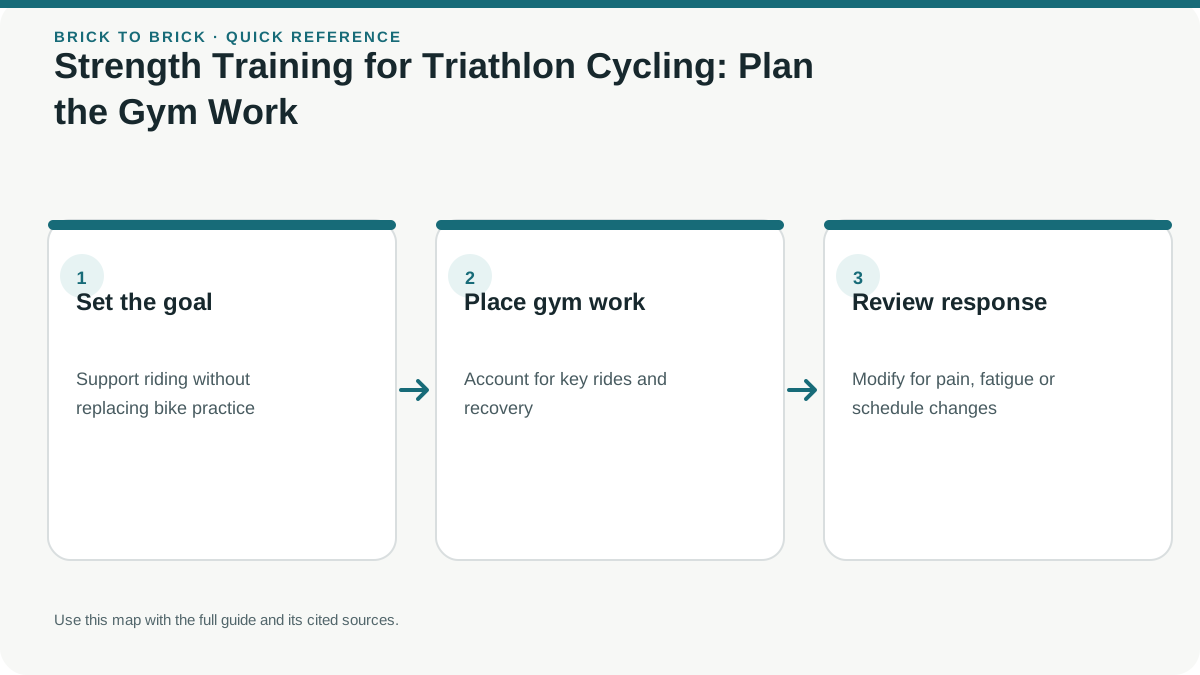
Strength training can be one part of cycling preparation, but it is not mandatory and a gym gain does not translate into a guaranteed watt increase. Learn how to choose manageable movements, progress without fixed rules, coordinate lifting with key rides and recognize when symptoms or health concerns call for individualized advice.
Key takeaways
- 1Heavy strength training may help some endurance-cycling outcomes, but current evidence is low certainty and does not define an optimal prescription.
- 2Choose exercises for a clear goal, your experience and available instruction rather than copying another athlete.
- 3Progress one manageable element at a time and observe effects on subsequent riding and running.
- 4Low-cadence cycling, gym strength and plyometrics are distinct training methods.
- 5Pain, new symptoms, health conditions or medication questions may require individualized professional advice.
In this article
- 1Distinguish strength from a hard cycling workout
- 2Select movements that fit your experience
- 3Build a session around quality rather than circuits to exhaustion
- 4Schedule around the rides that matter
- 5Do not diagnose asymmetry from a power display
- 6Look for transfer without inventing a conversion formula
- 7Place strength work against the actual bike calendar
- 8Separate load, repetitions and effort in the gym record
- 9Use equipment availability to simplify the session
- 10Read cycling-strength research as evidence, not a personal prescription
- 11Decide what strength training is meant to support
- 12Choose movement patterns you can learn and repeat
- 13Use technique and control as the first progression
- 14Progress strength without changing the whole training week
- 15Coordinate gym work with the ride that matters most
- 16Choose whether to build, maintain or pause in race season
- 17Keep cycling strength distinct from low-cadence riding and plyometrics
- 18Interpret soreness and side-to-side differences carefully
- 19Adapt the approach to experience, access and health
- ⚖
- ?Frequently asked questions
Distinguish strength from a hard cycling workout
A heavy gear can make pedalling feel forceful, but that does not make every low-cadence ride equivalent to resistance training. Gym exercises and cycling sessions differ in movement, load and fatigue.
A 2025 systematic review examined heavy strength work alongside endurance cycling and found potential performance benefits, with limitations in the evidence and athlete populations. It does not prescribe one heavy routine for every triathlete.
Start by deciding whether you need to learn basic lifting, maintain existing strength or address a specific coaching objective. Those goals require different entry points.
Select movements that fit your experience
A squat pattern, a hip hinge and a controlled single-leg or split-stance exercise can form the lower-body core of a session. Add suitable trunk work if it helps you maintain control under load.
Use machines, free weights or supported versions according to experience, access and instruction. The best option is one you can perform consistently with sound technique. Do not chase a particular barbell lift if it is painful or impractical.
Ask a qualified instructor to check unfamiliar movements. Past injuries, bone-health concerns or other conditions may require individual advice before loading.
Build a session around quality rather than circuits to exhaustion
An illustrative structure is a warm-up, technique practice, then a small number of controlled sets of two or three main movements. Rest enough that each set remains deliberate. Select loads that leave good repetitions available rather than attempting a maximum.
Record exercise, load, repetitions and response. If the session is new, keep the first exposure modest and observe the following days before adding more.
A fast circuit can be useful for other goals, but turning every lift into breathless endurance work may miss the reason you added strength training. Keep the session's purpose visible.
Schedule around the rides that matter
Identify the key ride and any demanding brick before placing gym work. Avoid introducing a new leg-strength session immediately before a technically difficult ride or a crucial long rehearsal.
If combining gym and endurance work on one day, consider which session has priority and whether fatigue affects movement quality or road safety. There is no single order that suits every athlete and schedule.
During a heavy race-specific block, maintaining a familiar modest dose may be more useful than chasing new lifting records. Use the periodization guide to place the emphasis in the season.
Do not diagnose asymmetry from a power display
Left-right power balance can vary with effort, fatigue, measurement system and technique. A number that differs from 50:50 does not automatically identify a weak muscle or an injury.
If you have pain, marked functional difficulty or a persistent concern, seek an assessment. Do not prescribe extra work to one leg solely to make a sensor display symmetrical.
Use single-leg exercises for a clear training purpose and with controlled movement, not as a promise to correct every pedalling difference.
Look for transfer without inventing a conversion formula
Compare familiar rides using similar conditions, equipment and effort, and note whether you can maintain position and finish the planned work. Gym progress and bike progress can occur at different rates.
A claim that adding a certain amount to a squat guarantees a specific FTP increase is not justified. The FTP testing guide explains how to interpret changes in a field estimate.
Keep the strength work when it supports the whole programme. If it repeatedly compromises riding or running, reduce the dose and review the plan with qualified support.
Place strength work against the actual bike calendar
Draw the week and mark the rides that require the most freshness: a technical outdoor ride, a demanding interval session or a long course rehearsal. Then place a modest strength session where you can observe its effect without compromising safe handling.
For the first few exposures, keep the following ride familiar and controlled. Record whether fatigue changed pedalling comfort, concentration or your ability to hold the planned position. If the cost is larger than expected, reduce the strength dose or change the spacing before adding another session.
Do not judge success by converting a heavier squat into an assumed FTP gain. The useful outcomes are whether you tolerate the programme, can progress it appropriately and continue the bike work that matters. A strength coach can help select and teach movements; a bike fitter or clinician may be more relevant when discomfort is position-related or persistent.
Separate load, repetitions and effort in the gym record
Load is the external resistance, repetitions are the completed movements, and perceived effort describes how demanding the set felt. These are related but different. The same dumbbell can produce a very different session when you change movement range, repetition count or rest.
Record each main movement with enough detail to repeat it: the variation, support or machine setting, resistance, repetitions and the quality of the final repetitions. If you cannot maintain the intended position or continue breathing normally, stop the set and reassess the dose or technique.
A useful progression does not require a heavier weight every visit. You might first make the same movement more consistent, then add an appropriate increment when recovery allows. Keep the change distinct from a simultaneous increase in hard bike intervals or long-ride duration.
Heavy-strength research in cyclists concerns structured programmes and defined study populations. It should not be translated into a claim that a new lifter needs maximal attempts or that a particular gym gain adds a fixed number of watts. The practical aim is an appropriate, repeatable strength stimulus alongside the cycling that prepares you for your event.
Use equipment availability to simplify the session
Choose a version you can repeat with the equipment you actually have. A session depending on several busy gym stations may be difficult to complete in a short visit. A simpler set of familiar movements can make the recording and progression easier.
If you substitute an exercise, note the change instead of assuming the same weight or repetition count produces an identical demand. Machines differ in setup and leverage; a number on a weight stack is not necessarily comparable with a free weight or another machine.
Keep time for an appropriate warm-up and enough rest to maintain deliberate movement. Rushing the final sets because the session ran late can change its purpose. If the gym visit repeatedly conflicts with an important ride, revise the session design or timing rather than treating every listed exercise as mandatory. The programme should support your cycling preparation in a way you can maintain.
Read cycling-strength research as evidence, not a personal prescription
A 2026 systematic review and meta-analysis examined 17 studies with 262 adult endurance cyclists; only 60 participants were female, interventions lasted five to 25 weeks, and programmes used one to three strength sessions per week. The review found low-certainty evidence that heavy strength work may improve some cycling performance outcomes, while it did not show significant changes in several other measured outcomes. The authors state that the evidence does not support robust recommendations about the best implementation. Read the review and its methods.
That is a reason to consider strength training, not proof that every triathlete needs heavy lifting or will become faster. Research groups, event demands, training history and programme support differ. The study's range of frequencies is not a menu from which to prescribe yourself a dose. A triathlete also has swimming, running, work, sleep and recovery to consider.
The American College of Sports Medicine's 2026 resistance-training position stand summarizes research in generally healthy adults, not a triathlon-specific prescription. Its broad point that consistency and individualization matter can inform a general approach, but it does not determine how to combine a gym programme with your bike sessions. See the ACSM overview and work with a qualified professional if your health or training history needs individual consideration.
Decide what strength training is meant to support
Before selecting exercises, name the reason for adding gym work. You might want to learn safe lifting technique, build general lower-body strength, maintain familiar strength during a race-specific phase, or address a coach-identified need. These are different goals. A list of popular exercises is not a diagnosis of what your cycling lacks.
A practical question is: what would change if this work is useful? Possible observations include completing a planned programme consistently, tolerating training without repeated disruption, or progressing an exercise with good control. Do not define success as a particular squat score automatically adding a set number of watts. Gym measures and cycling outcomes are related in complex ways and can change at different rates.
If the main issue is discomfort in a riding position, assess bike fit and symptoms before adding strength exercises. If you cannot control the bicycle or hold the planned posture, technique instruction may be more relevant. If you already train strength, the need might be to coordinate existing sessions rather than add more. A clear purpose makes it easier to retain, adapt or remove the work later.
Choose movement patterns you can learn and repeat
Many lower-body strength programmes use some combination of knee-dominant movement (such as a squat or step-up variation), hip-hinge movement, and supported single-leg work. A trunk exercise may be included when it serves a defined goal. These are categories, not a required triathlon circuit. A machine, dumbbell, barbell or body-weight version can be appropriate depending on your experience, access and coaching.
Select a version that allows a comfortable range and consistent technique. An exercise does not need to mimic the exact pedal stroke to be useful, and you do not need to train only muscles that feel tired after a ride. Good movement selection considers load tolerance, training background and what the full programme already contains. If one movement is unfamiliar, learn it with light or otherwise manageable resistance and qualified instruction before adding load.
Avoid testing every variation in one session. Pick a small group of repeatable movements and record how they are set up. If you have pain or an injury history that affects exercise selection, get individualized guidance. The broader strength-training guide covers general exercise decisions, while this guide focuses on fitting them around bike preparation.
Use technique and control as the first progression
For a newer lifter, learning to set up, move through a comfortable range and stop a repetition deliberately is already meaningful progress. Use an exercise version you can control and breathe through. A stable machine or supported movement may be easier to learn than a complex free-weight variation; this is a practical choice, not evidence that one equipment type is inherently superior for all athletes.
Keep the movement purposeful rather than rushing between stations. Use a range that is comfortable and appropriate to the exercise, and do not force depth or speed to match a video. If you cannot maintain the intended position, reduce the challenge or ask for instruction. Stop if the exercise causes sharp pain, dizziness, unexpected weakness or other concerning symptoms.
Once the technique is repeatable, progression might involve a small change in resistance, range, repetitions or exercise variation. Change one factor at a time so you can interpret the response. There is no requirement to lift to momentary failure, test a one-repetition maximum or make every set exhausting to obtain a useful training effect. A qualified strength professional can adapt technique and loading to your experience and available equipment.
Progress strength without changing the whole training week
Strength progression takes place alongside swim, bike and run workloads. If you add a new movement, more sets and an extra interval ride at the same time, you will not know which change affected recovery. Begin with a manageable, familiar session and observe how you respond before increasing the demand. Keep the following day predictable enough that you can distinguish ordinary training fatigue from a problem.
Record exercise version, resistance, repetitions, how controlled the last repetitions felt, and any effect on subsequent training. A heavier load is not the only kind of progress: more consistent technique, a more comfortable range or completing the planned session without disrupting key work may be relevant. Avoid making a change because a training app labels the session easy or because another athlete follows a different plan.
There is no universally correct weekly increase or number of weeks before changing a programme. Progress depends on prior lifting experience, other training, recovery, equipment and health. If soreness repeatedly changes your pedalling, running gait or ability to handle the bike, reduce the challenge and seek coaching advice instead of pushing through to meet a generic progression rule.
Coordinate gym work with the ride that matters most
Mark the week’s most important bike sessions first: perhaps a technical outdoor ride, a key interval workout or a long ride with a planned race-specific objective. Place new strength work where you have room to notice its effects and where fatigue is less likely to compromise road safety. Avoid learning a demanding lift immediately before a ride that requires fresh concentration or precise handling.
Some athletes combine strength and endurance work on the same day to preserve easier days; others separate them. Research on exercise order does not establish one schedule for every age-group triathlete, and the cycling-strength meta-analysis found too little certainty to define an optimal programme. Prioritize the session whose quality matters most and allow enough recovery for movement and cycling technique to remain sound.
If a combined day is necessary, consider doing the priority session when you are fresher, but treat that as a planning decision rather than a universal rule. Keep a record of how the next ride feels. If strength work repeatedly reduces a key session's quality, increase spacing, lower the lifting dose, or remove an exercise with a coach. A plan should not depend on pretending fatigue has no cost.
Choose whether to build, maintain or pause in race season
Strength emphasis can change with the training calendar. An athlete with time before a goal event may choose to develop a new lifting skill or gradually build a programme. Closer to an event, it may be more appropriate to retain only familiar work, reduce demands or pause an exercise that creates soreness. These are options for discussion with a coach, not a mandatory seasonal formula.
Do not introduce heavy or complex lifting for the first time during a taper, travel week or race week. Familiarity matters: even a session that looks brief can cause soreness when it is new or unusually demanding. If an event is approaching and your regular strength routine is already tolerated, follow the plan that accounts for both endurance and gym work.
During a high-volume block, protecting the quality of swim, bike and run sessions may take priority over adding new strength goals. During a lighter period, you may have more opportunity to learn. Review how each choice affects your total training load and life outside training. The triathlon periodization guide covers changes in emphasis over a season, while the workout split guide addresses coordination across disciplines.
Keep cycling strength distinct from low-cadence riding and plyometrics
Pedalling a large gear at low cadence is still cycling. It loads the legs and cardiovascular system in a cycling-specific way, but it is not a direct substitute for resistance training in the gym. Whether low-cadence work belongs in your plan depends on the cycling goal, technique and experience; adding it on top of strength and hard rides may simply increase total stress.
Plyometric exercise is different again: it involves rapid stretch-shortening actions and impact. It has separate skill, readiness and progression considerations. Do not add jumps because you heard they make cyclists powerful or because a strength session feels too easy. Use the triathlon plyometric guide if you are considering that specific type of training.
Keep each session's purpose clear. A gym lift, a low-cadence interval and a jump exercise are not interchangeable ways to reach a single “strong legs” target. If your schedule already contains several demanding sessions, ask a coach which one supports your goal before adding another. A smaller programme you can repeat may be more useful than a collection of modalities competing for recovery.
Interpret soreness and side-to-side differences carefully
New strength work can feel unfamiliar, but soreness is not a score of programme quality. Severe or persistent pain, swelling, numbness, unusual weakness or symptoms that alter how you walk or ride are reasons to stop and seek suitable advice. Do not add a stretch, roller or extra single-leg exercise simply to self-treat a symptom you have not assessed.
A left-right difference on a cycling power display does not by itself prove a strength deficit or injury. Readings depend on the device, calibration, effort, cadence, fatigue and measurement method. The display can be a prompt to check the equipment or ask a coach, but it cannot diagnose a muscle imbalance. A clinician can assess symptoms; a coach can review training; a bike fitter can consider position-related issues.
Use unilateral exercises when they fit a training goal and you can perform them safely, not to force a perfectly symmetrical number. Human movement is not always identical side to side, and an arbitrary symmetry target may create unnecessary work. If a difference is new, marked, painful or affects function, seek an appropriate assessment.
Adapt the approach to experience, access and health
Someone who has never lifted needs time to learn exercises and should not copy an experienced cyclist's weights or programme. Someone with a background in resistance training may need to coordinate a familiar routine with triathlon rather than start again from a beginner template. Available equipment, coaching access, work schedule and other activities all affect what is realistic.
If you have a chronic condition, recent surgery, osteoporosis or another health concern, are pregnant or postpartum, take medication that affects exercise, or have been advised to modify activity, consult a qualified clinician about the relevant limits. This article cannot clear you for heavy lifting or select rehabilitation exercises. Work with a coach or exercise professional who understands your training and can adapt the plan to clinical advice.
A simple session done with control and enough recovery can be a reasonable starting conversation; it is not a universally safe prescription. Stop when something feels wrong, and do not interpret a missed workout as a reason to double the next session. Sustainable strength work has to fit the whole athlete, not only the bike leg.
| Training method | Main distinction | Planning question |
|---|---|---|
| Gym strength exercise | External resistance and deliberate movement practice | Can I perform this version with control and a clear purpose? |
| Low-cadence cycling | Cycling-specific work with force and endurance demands | Does it belong in the bike plan, and can I ride it safely? |
| Plyometric exercise | Rapid force production and impact demands | Do I have the skill and progression support for this? |
| Bike-fit adjustment | Changes rider position and bicycle contact points | Is the problem specific to the riding position or equipment? |
Sources
Sources are listed so readers can verify consequential claims and dated details.
- Heavy strength training effects on endurance cyclist performance: systematic review and meta-analysis — European Journal of Applied Physiology / PubMed (accessed September 24, 2026)
- How to improve strength and flexibility — NHS (accessed September 24, 2026)
- ACSM 2026 resistance training guidelines for healthy adults — American College of Sports Medicine (accessed September 24, 2026)
Frequently asked questions
Does strength training make you faster on the bike?
It may improve some cycling performance outcomes for some endurance cyclists. A 2026 systematic review reported low-certainty evidence and could not establish an optimal programme; no specific watt or time gain can be promised.
Can low-cadence cycling replace gym strength training?
No. Both can load the legs, but they are different training methods with different demands. Use low-cadence work only for a clear cycling purpose and account for total training load.
How many strength sessions should a triathlete do each week?
There is no universal schedule for every triathlete. Frequency depends on experience, endurance training, recovery, health and goals. Start from the whole weekly plan and adjust with a qualified coach if needed.
Should I lift before or after cycling?
Prioritize the session whose quality matters most and avoid placing unfamiliar or fatiguing work where it compromises safe handling or a key ride. The evidence does not establish one order for all age-group triathletes.
Should I train one leg more if my power balance is uneven?
Not based on a power-display number alone. Measurement, effort, fatigue and equipment affect the reading. Use unilateral exercises for a clear purpose, and seek assessment for a new or symptomatic difference.