Stability Training for Triathlon: Control and Progression
Learn how triathletes can practise balance and trunk control, progress safely and distinguish useful drills from unsupported injury or performance claims.
By Lotte
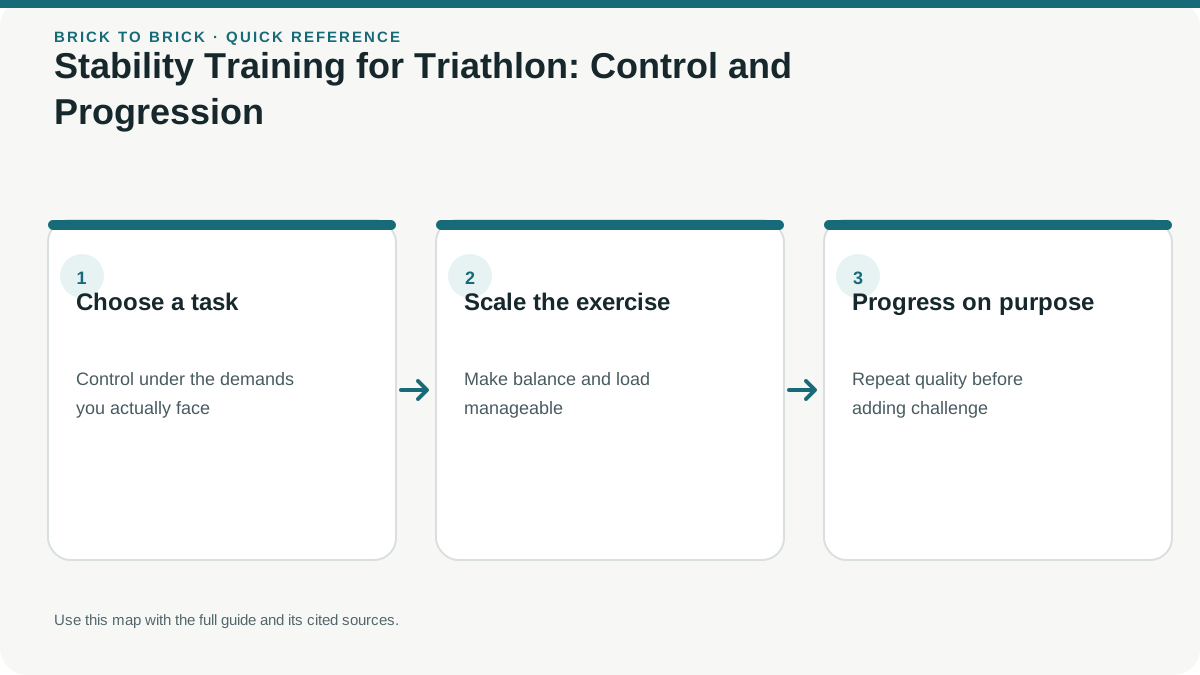
Stability training can practise controlling a position or movement, but it is not a diagnosis, injury guarantee or replacement for swim, bike and run skills. Choose a clear task, use manageable support and progress only when the movement remains comfortable and controlled.
Key takeaways
- 1Balance, trunk control, strength and mobility overlap but describe different training goals.
- 2Research on core and stability training uses mixed sports and tests; it does not establish a universal triathlon routine or guarantee faster racing.
- 3A stable surface and nearby support can make early practice easier to control; wobble equipment is optional.
- 4Change one task demand at a time and stop when control declines or symptoms arise.
- 5Persistent pain, dizziness, unexplained falls or new weakness warrant appropriate professional advice.
In this article
- 1Define the movement you want to control
- 2Start with support and a predictable surface
- 3Build a small practice circuit
- 4Progress the task rather than collecting equipment
- 5Connect the drill to an everyday or sporting observation
- 6Keep the dose compatible with the week
- 7Make a balance drill measurable without making it risky
- 8Describe the task so you can repeat the same test
- 9Choose one control cue per attempt
- 10Separate balance, trunk control, strength and mobility
- 11What research on core and stability training can tell a triathlete
- 12Connect a stability task to the demands of each sport
- 13Use a flexible progression instead of a fixed stability plan
- 14Fit stability work around swim, bike, run and strength training
- 15Make a home setup accessible and easy to stop
- 16Decide whether this kind of training belongs in your plan
- ⚖Choose a stability-related exercise by its purpose
- ?Frequently asked questions
Define the movement you want to control
Choose a specific task: keeping the trunk steady during a reach, controlling a supported single-leg stance, or maintaining shoulder control during an easy pushing movement. A clear task makes progress observable.
“Activate the core” is too vague to guide a session. Name the position, the movement and the sign that control is being lost. For example, a supported single-leg reach can stop when you can no longer return smoothly without stepping.
Use mobility training when the issue is access to movement range, and strength work when the goal is producing more force. These overlap but are not interchangeable.
Start with support and a predictable surface
Stand near a wall or sturdy support for balance practice. Use a stable floor and remove trip hazards. External support lets you practise a controlled movement without making a fall the main challenge.
For trunk work, an easy bird-dog, dead-bug variation or supported side-plank variation can provide a clear movement task. Choose a range where you can breathe normally and maintain control.
These are exercise examples, not a rehabilitation prescription. Pain, dizziness or a history of falls can require an individual assessment before progressing.
Build a small practice circuit
Choose one standing balance task, one trunk-control task and one shoulder-control task you can perform comfortably. Use a few short, deliberate attempts with rests, stopping when quality declines.
An illustrative circuit might include a supported single-leg reach, a slow dead-bug variation and a wall push-up with controlled shoulder movement. Record the version and what made it difficult.
Do not turn the circuit into a timed competition. A longer hold achieved through breath-holding or an awkward position does not necessarily represent better control.
Progress the task rather than collecting equipment
Reduce hand support, increase a comfortable reach, or add a small controlled load only after the original task is repeatable. Change one variable so you can tell what caused a loss of control.
Unstable boards and balls are optional tools, not automatic upgrades. A more unstable exercise can reduce the force you can produce and may not resemble the sporting task you want to improve.
Keep enough stability to practise the intended movement safely. You do not need to close your eyes or stand on a soft object to make every exercise worthwhile.
Connect the drill to an everyday or sporting observation
Ask whether you can step down more smoothly, carry equipment comfortably or maintain a useful position without excessive effort. These are observations, not proof of injury prevention.
If a bike fit causes persistent pain, a stability routine should not be used to force you to tolerate it. Review the fit. If swimming hurts, technique and clinical assessment may matter more than adding shoulder drills.
Treat a drill result as information about that drill. It cannot independently diagnose tendon damage, joint instability or neurological problems.
Keep the dose compatible with the week
A short practice session can fit after an easy workout or in a separate brief slot. Stop before fatigue makes the next task unsafe. The aim is controlled repetition, not soreness.
Review after a few consistent exposures. Retain the tasks with a clear purpose and progress only when control is reliable. If symptoms appear or balance concerns persist, ask a qualified professional for advice.
Use the training-week guide to place the work without displacing the swim, bike and run practice needed for your race.
Make a balance drill measurable without making it risky
“Stability” is an umbrella term, so choose a task before choosing a score. Static balance means maintaining a position with little movement. Dynamic balance means controlling the body while reaching, stepping or changing direction. Trunk control describes how the torso and hips coordinate during movement or force. These abilities can overlap, but a single wobble-board test does not measure all of them.
Use an exercise that resembles the task you care about and write down its setup. For a supported single-leg stance, note the foot, hand support, surface and whether the position remains comfortable. For a reach, note direction and return control. For a step-down, choose a safe height and observe whether you can lower and rise smoothly. Do not make the test harder by closing your eyes, standing on foam or adding a load unless that progression has a clear purpose and is safe for you.
Repeat under similar conditions if you want to notice change. Better performance on the chosen drill means you have improved that drill under those conditions; it does not establish that you are less likely to be injured, ready for a race or stronger in every sport. Balance tests can be affected by fatigue, footwear, surface, attention and familiarity. The comparison is useful for practice planning, not diagnosis or athlete ranking.
Describe the task so you can repeat the same test
A short log can make your practice clearer without turning it into a daily test. Record the exercise version, support, range, number of controlled repetitions or attempts, rest, and how it felt. Add context only when it could change the result, such as whether you trained beforehand, slept poorly or used a different surface. You do not need to record every sensation or chase an increasing score.
Change one demand at a time. If you reduce hand support, keep the surface and movement the same; if you increase the reach, keep the support. This helps you see which change mattered and makes it easier to step back if control declines. A longer hold is not automatically progress if you are holding your breath, twisting or bracing through discomfort.
Use practice observations alongside what matters in ordinary training: can you repeat the drill comfortably, does it take too much time, and is it relevant to the movement you want to practise? Do not infer weakness, asymmetry or injury risk from a left-right difference in a home test. If a symptom, unexplained fall or new coordination problem prompted the exercise, record that concern and discuss it with a qualified clinician rather than building a self-made diagnostic score.
Choose one control cue per attempt
A cue is a short piece of information that helps direct movement. Use one at a time, such as “move slowly,” “keep the range comfortable,” or “return to the starting position under control.” A cue should help you notice the task; it is not a command to lock every muscle or hold the body perfectly still. Normal movement includes small adjustments.
External cues can be clearer than anatomy instructions. For a reach, you might aim toward a visible point; for a step, move toward a floor marker. Try the simplest cue that helps you complete the movement comfortably. If the cue creates tension, breath-holding or more instability, change it. You do not need to brace maximally or maintain an identical posture in swimming, cycling and running.
Feedback from a coach or physiotherapist can help when a movement is confusing, but choose someone qualified for the question. Describe what task you want to control and what you notice. A cue or drill should be adapted to the athlete, not used to tell a person with pain or dizziness to “stabilize harder.” Stop if a movement produces concerning symptoms and seek suitable assessment.
Separate balance, trunk control, strength and mobility
These terms describe related but different qualities. Balance is managing the body's position relative to its base of support. Trunk control describes coordinating the torso and hips while the body moves or resists a force. Strength is the capacity to produce force. Mobility concerns comfortable, controlled access to movement range. An exercise can challenge more than one quality, but labelling every drill “core stability” makes the purpose hard to see.
For example, a supported single-leg reach challenges balance and coordination; a loaded carry combines trunk control with strength and grip; a dead-bug variation practises coordinating limbs while the trunk remains comfortable; and a hip mobility drill explores movement range. None is a substitute for the others. You do not need a wobble board to train balance, or a long plank to develop useful trunk strength.
Pick one primary goal for each movement. If the goal is maintaining a position while reaching, use a balance task with enough support to move deliberately. If the goal is tolerating force, choose a strength exercise that can be loaded and progressed safely. If the goal is comfortable range, practise the range rather than adding instability. This vocabulary also makes it easier to ask a coach or clinician a specific question.
The distinction avoids the idea that a single weak “core” explains pain or poor performance. Symptoms, technique, mobility, training load and equipment can all matter. A stability exercise can be one useful part of training, but it does not diagnose or fix a problem by itself.
What research on core and stability training can tell a triathlete
Research uses different definitions of core training, stability, balance and athletic performance. One systematic review of 24 studies found mixed results and difficulty isolating the effect of core stability work because it was often combined with broader exercise. A later meta-analysis examined outcomes such as balance and jumping in healthy participants; those tests are not the same as swim speed, cycling economy, triathlon time or injury prevention. More recent reviews include varied athlete groups and protocols, which still do not establish a standard triathlon prescription.
The reasonable conclusion is narrow: practising a task can improve performance on that task, and structured exercise can improve some general physical capacities. It does not follow that a balance drill automatically transfers to faster swimming, steadier cycling, better running or fewer injuries. Transfer depends on the movement, training history, dose, coaching and how closely the exercise relates to the sport demand.
Use stability work for a clear purpose such as learning controlled single-leg movement, building confidence with a supported reach or adding variety to a strength routine. If your main goal is swim propulsion, bicycle power or run endurance, prioritize the relevant sport practice and strength work. A general trunk drill should complement that work rather than crowd it out.
Treat claims like “fixes imbalances,” “prevents injuries” or “activates the deep core” with care. A sensation or score during one exercise does not reveal a tissue problem or predict future injury. The evidence base is not specific enough to promise an outcome to an individual triathlete, especially if pain or a medical concern is involved.
Connect a stability task to the demands of each sport
Triathlon combines distinct tasks, so a single generic drill is unlikely to reproduce all three sports. A swim requires a streamlined body position, breathing and coordinated force through the water. Cycling involves holding a position while producing force and steering on a moving bicycle. Running asks the athlete to control repeated single-leg landings and move over changing surfaces. These descriptions can help choose a relevant practice goal, but they do not prove that a particular drill improves the sport.
For swimming, a land-based exercise may let you practise comfortable shoulder and trunk coordination, but it cannot replace swimming or coaching on stroke mechanics. For cycling, a controlled hip hinge or carry may build general strength, but a balance disc does not simulate safe bicycle handling. For running, a supported step-down can practise lowering under control, but it does not reproduce thousands of running contacts. Add the sport-specific skill in the sport environment when it can be practised safely.
Use a transfer question: “What exact movement or position do I want to practise, and how will this exercise contribute?” If you cannot answer it, select a basic strength or mobility exercise instead, or spend the time on swim, bike or run technique. A drill may still be enjoyable even when its transfer is uncertain; enjoyment can justify a place in a program as long as it is safe and does not displace a higher priority.
If the movement is painful or a fit issue appears during a sport, address that directly. Do not use extra single-leg or plank work to force yourself to tolerate an uncomfortable saddle, restricted shoulder movement or changing gait. A coach, bike fitter or clinician may be more appropriate, depending on the issue.
Use a flexible progression instead of a fixed stability plan
A progression can be organized by control and support rather than by a mandatory week number. The following sequence is an example for a generally healthy athlete, not an individual rehabilitation plan:
| Stage | Example task | What to notice before changing it |
|---|---|---|
| Learn | Supported stance, wall push-up or easy dead-bug variation | Can you set up, breathe and stop comfortably? |
| Repeat | Same task with a consistent range and setup | Does control stay similar across attempts? |
| Adjust one demand | Slightly less support, a small reach or a light external load | Does the movement remain deliberate and comfortable? |
| Apply | Choose a related strength or sport-skill task | Is the practice useful for your goal and schedule? |
There is no requirement to pass every stage or move forward each week. Repeating an easy task may be useful when it serves a purpose. If you add a new demand, keep other conditions steady so you can interpret the response. Do not combine eyes-closed work, a soft surface, a heavy load and a fast movement simply to make the drill look advanced.
Allow enough time to learn the setup. Brief sets with rest can be easier to control than long fatigue-based holds. Stop before movement quality becomes a contest. If pain, dizziness, unusual weakness or a fall risk is present, do not use this example as a self-progression; ask an appropriately qualified professional for individualized guidance.
Keep the progression in perspective: improvement here means better control of this drill. To build swim, bike or run capacity, continue the specific training appropriate to your event and experience.
Fit stability work around swim, bike, run and strength training
Stability practice can be brief, but it still uses attention and physical capacity. Decide where it fits only after considering the swim, bike and run sessions that support your event. A new balance drill that leaves your legs tired before a technical ride or run may be poorly placed even if the drill itself feels manageable. Keep early practice away from situations where fatigue could compromise handling or safety.
If you already perform resistance training, some trunk and balance demands may already appear in squats, hinges, carries, step-ups and other movements. You do not need a separate “core day” simply because a schedule template includes one. A coach can help identify overlap and prioritize exercises so extra work does not expand total training without a clear reason.
For a self-guided athlete, treat the first few sessions as skill practice. Use a stable surface and a version that allows controlled movement, then see whether it interferes with the next planned workout. Consider perceived effort, soreness, schedule and whether the exercise has a defined goal. If you are in a taper, returning from illness or managing injury, adding a novel balance circuit is rarely necessary; follow your existing plan and professional advice.
The useful amount depends on the task, experience and wider training. There is no evidence-based universal number of sets, weekly sessions or seconds per hold for every triathlete. A short and repeatable practice that fits well can be more useful than a long circuit that crowds out sport-specific training. Use the triathlon strength guides to choose broader strength work, and ask a coach where any added drills belong.
Make a home setup accessible and easy to stop
A useful practice space does not require specialist equipment. Choose a clear, non-slip area with enough room to step in every direction. Keep a chair, rail or wall within reach for standing tasks. Wear footwear that matches the exercise and surface; barefoot work is not automatically safer or more effective. Remove pets, loose mats, cables and other trip hazards before beginning.
Select the setup that lets you control the movement. A wall push-up is a legitimate way to practise pushing mechanics; a supported stance is a legitimate balance task; a folded towel is not a required replacement for a wobble board. If getting down to and up from the floor is difficult, use a standing or chair-supported variation or choose another exercise. Do not force a position to match a video.
Equipment can introduce extra costs and risks. A wobble board, exercise ball or suspension strap needs suitable space, storage and instruction. Inspect it for damage and follow the manufacturer's use directions. Use a stable support point; a door handle or wheeled chair may move unexpectedly. A tool is worthwhile only if it supports a task you can practise safely and consistently.
People with a history of falls, dizziness, fainting, neurological symptoms, significant joint or bone conditions, or a clinician's movement restrictions may need individualized advice before unsupported balance work. This list is not a complete medical screen. If a new or worrying symptom appears, stop and seek suitable assessment rather than changing the surface or making the drill harder.
Decide whether this kind of training belongs in your plan
Before adding an exercise, answer three questions. What is the goal? Name a movement or physical quality rather than using a general label such as “activation.” Why this drill? Explain how its task fits that goal and what it does not train. What will you do with the observation? Decide how you will repeat, adjust or stop it.
If the goal is general strength, a progressive resistance exercise may be a clearer choice. If you want to feel steadier while stepping or reaching, a supported balance practice may suit. If your limitation is access to a range, mobility practice may be more relevant. If you want better race performance, keep the main time for sport-specific training and ask whether the proposed drill has evidence for that outcome. It is fine to include a drill because you enjoy it, but do not mislabel enjoyment as a proven performance gain.
Review after a few repeatable exposures, not after a single attempt. Ask whether the task feels manageable, whether it takes time from a higher priority, and whether there is an observable reason to keep it. If the only result is fatigue or soreness, the dose or exercise may not be serving your goal. More instability is not automatically better.
Stop and seek appropriate help for persistent pain, unexplained falls, sudden weakness, numbness, fainting or dizziness. A general training guide cannot assess a personal medical problem. Stability training can be a small, useful part of a broader program, but it is optional and should remain tied to a clear and safe purpose.
Choose a stability-related exercise by its purpose
| Training goal | Example task | What it does not establish |
|---|---|---|
| Balance and coordination | Supported stance with a controlled reach | That every sport movement or injury risk has improved |
| Trunk coordination | Comfortable dead-bug or wall-push-up variation | A diagnosis of a weak core or back problem |
| Strength | Progressive resistance exercise with stable setup | Immediate pain relief or guaranteed race performance |
| Mobility | Controlled movement through a comfortable range | Strength or control under every training load |
| Sport skill | Swim, bike or run technique practice | That a generic drill transfers automatically to racing |
Sources
Sources are listed so readers can verify consequential claims and dated details.
- Improving strength and flexibility — NHS (accessed September 14, 2026)
- Physical activity guidance for older adults: balance and strength — NHS (accessed September 14, 2026)
- The effects of isolated and integrated core stability training on athletic performance measures: a systematic review — Sports Medicine / PubMed (accessed September 24, 2026)
- Core training and performance: a systematic review with meta-analysis — Biology of Sport / PubMed (accessed September 24, 2026)
- Exploring the role of the core in sports performance: a systematic review of the effects of core muscle training — PubMed (accessed September 24, 2026)
Frequently asked questions
Do triathletes need stability training?
It is optional. A balance or trunk-control exercise may be useful when it has a clear purpose and fits your program, but it does not replace sport-specific practice or progressive strength work.
Does core stability training make triathletes faster?
Research reports mixed results across different sports and tests, and it does not establish a guaranteed triathlon performance gain. Choose an exercise for a defined goal and keep expectations specific to the task.
Are wobble boards necessary for balance training?
No. A supported stance, reach or step on a stable surface can be a useful practice task. Unstable equipment is optional and should only be used when it is safe and relevant.
Can stability exercises fix pain or prevent injury?
A general stability exercise cannot diagnose or treat an individual's pain or guarantee injury prevention. Persistent or worsening symptoms, dizziness or unexplained falls should be discussed with an appropriately qualified professional.
How should a beginner progress a stability exercise?
Start with support and a predictable surface. Repeat a comfortable movement, then change one demand at a time only if control remains. There is no universal progression schedule for every triathlete.