Strength Training for Triathlon Running: A Practical Start
Add running-support strength work to triathlon training with controlled movement, sensible scheduling and realistic evidence limits.
By Lotte
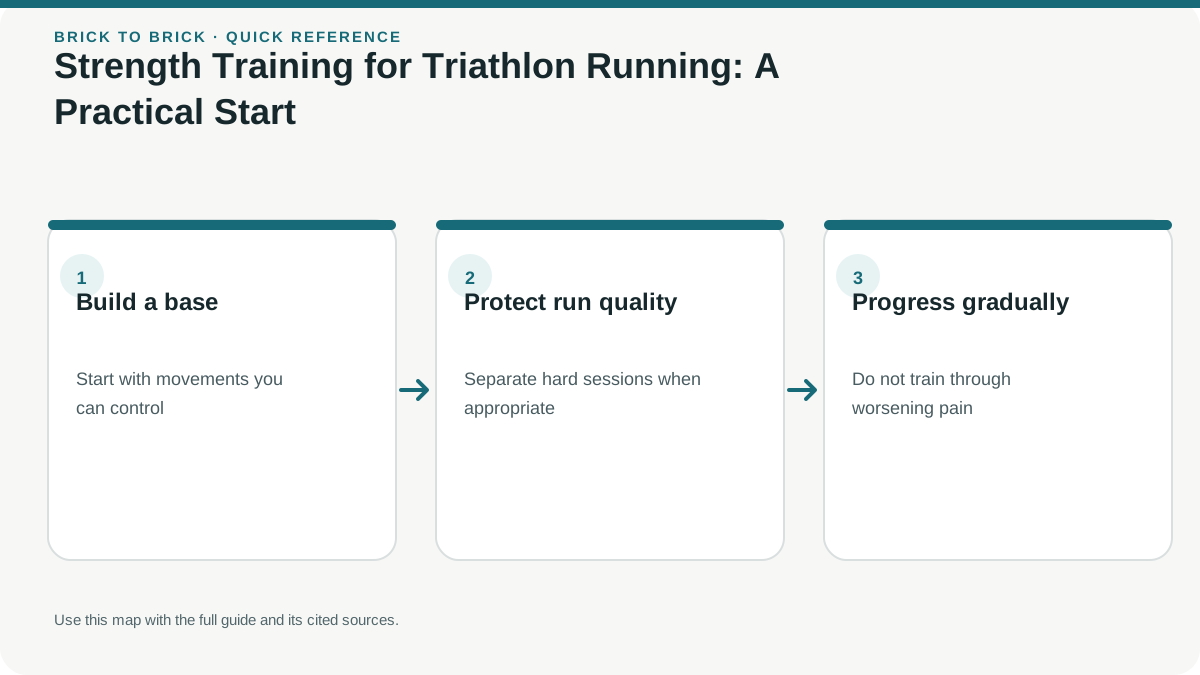
Strength training can support running performance in studied distance runners, but findings do not prescribe a program for every triathlete or guarantee injury prevention. Choose controlled movements, fit the session around priority runs and review the whole week’s response.
Key takeaways
- 1Most cited strength-training performance evidence is from distance runners, not triathletes across all distances.
- 2Choose a session you can perform with control and recover from alongside swim, bike and run training.
- 3Strength work does not diagnose, rehabilitate or guarantee prevention of a running injury.
In this article
- 1Give the session a running-specific purpose
- 2Choose an entry version you can control
- 3An illustrative short session
- 4Progress one variable and check the next run
- 5Know when more specialised work belongs elsewhere
- 6Review the block using useful evidence
- 7Choose exercise versions by control rather than labels
- 8Understand what the movement patterns ask you to do
- 9Review strength work across a training block
- 10How much of the research applies to triathlon running?
- 11Place the gym session where it does not distort your key runs
- 12Understand what higher-load and combined strength research does not prescribe
- 13Use a short review cycle to decide whether the session belongs
- 14What to do when race preparation leaves less room for the gym
- 15A worked example: fit a new session around an existing run week
- 16Strength work does not require a specialised gym setup
- ?Frequently asked questions
Give the session a running-specific purpose
Running asks you to support and move your body repeatedly on one leg. A useful strength session develops force and control through movements such as a squat, hinge, step or split stance and calf raise. It does not need to imitate running with a weight in each hand.
A systematic review of distance runners found that strength-training methods can improve performance, but the studies do not establish one programme for every triathlete. Training history and the rest of your workload matter.
Use this page for the running-support session. Cycling strength addresses a different emphasis, while the injury-risk guide covers broader load decisions.
Choose an entry version you can control
Try a chair squat or light goblet squat, a hip hinge taught with a dowel or light load, a supported split squat, and a controlled calf raise. Use a stable support where balance would otherwise prevent good movement.
The exercise name is less important than the quality of the version you can perform. If a movement causes pain, stop and seek appropriate guidance rather than forcing the range. A rehabilitation plan may require different choices.
Learn unfamiliar lifts with a qualified instructor. Do not use a heavy-load research protocol as your first gym session merely because it produced an average benefit in trained runners.
An illustrative short session
For an athlete already comfortable with these movements, an example is two easy-to-moderate sets each of a squat, hinge, split squat and calf raise, using a small number of controlled repetitions and enough rest to repeat them well. Choose repetitions and load that leave several good repetitions in reserve.
Record the actual exercise, load, repetitions and how it felt. The example is a structure to adapt, not a universal starting dose. Someone new to strength work may need fewer exercises or only technique practice.
Stop before fatigue changes the movement. The aim is a repeatable session that supports training, not exhaustion that makes the next run awkward.
Progress one variable and check the next run
When a version becomes consistently comfortable, change one element: a little more load, another controlled repetition, or less external support. Do not increase all of them while also extending your longest run.
Review how you feel during daily movement and the next easy run. Unusual soreness, altered gait or persistent pain means the plan needs adjustment. Do not treat soreness as a required sign of success.
Keep the key run session in view when scheduling. A gym session that repeatedly leaves you unable to run as intended is too costly for its current place in the week.
Know when more specialised work belongs elsewhere
Jumping and hopping introduce faster loading and deserve a separate progression. Use the plyometric guide only when the entry criteria and your health context make sense.
Balance drills can support control, but standing on an unstable surface is not automatically a better way to develop strength. Use stable conditions when the objective is producing controlled force.
If you are returning from injury, follow the clinician's return-to-running and loading advice. A general strength article cannot determine whether a tendon, joint or bone is ready for a particular exercise.
Review the block using useful evidence
After several consistent weeks, compare the loads you can control, session tolerance and whether running remains manageable. Do not infer a percentage improvement in running economy from a stronger squat alone.
Retain exercises that serve a clear purpose and simplify those that consume time without a useful result. During demanding race preparation, reducing gym volume may help maintain the work without overwhelming recovery.
The outcome to seek is a sustainable strength habit alongside running. Keep notes so a coach or clinician can see what you actually did if problems arise.
Choose exercise versions by control rather than labels
For a running-focused session, compare a supported split squat, a step-up and a calf raise by what you can perform smoothly. The exercise name alone does not establish the right load, depth or number of repetitions.
Choose an entry version that lets you finish with controlled movement and some capacity remaining. Record support used, range of motion, load and the response during the next ordinary run. If you change all four at once, you will struggle to identify why the session became harder.
A practical progression might improve control through the same range before adding load. Another athlete may need a lower step or more support first. Neither path can be chosen from race distance alone. If pain or a recent injury affects the movement, obtain appropriate assessment instead of using the exercise as a self-prescribed rehabilitation test.
Understand what the movement patterns ask you to do
A squat pattern practises bending and extending through the hips and knees while controlling the trunk. A supported split stance changes the task by putting the feet in different positions. A hip hinge emphasises movement at the hips, while a calf raise uses controlled ankle movement. These descriptions explain exercise families; they do not diagnose which muscle is responsible for a running problem.
For a first session, learn the setup before choosing the resistance. A sturdy chair can provide a reference for a sit-to-stand, while a stable support can reduce the balance demand of a calf raise. Keep the floor clear and breathe normally. A wall, chair or rail must be strong enough for its intended support role.
In your log, distinguish completing the movement from increasing its difficulty. “Two controlled sets using the same chair height” is a more reproducible note than “legs workout.” Add repetitions, resistance or complexity only when the existing version is manageable and the rest of the running week remains recoverable.
The research on strength work and running performance supports considering it within a programme; it does not supply an exercise prescription for every reader or promise protection from injury. Use qualified instruction when technique, symptoms or progression are uncertain.
Review strength work across a training block
Choose a small number of movements and keep them recognisable long enough to learn from the log. Constantly changing exercises makes it difficult to distinguish adaptation from simply becoming familiar with a new task. Record any change in range, equipment or support alongside the resistance.
At the block review, consider the running week as well as the gym record. Are you completing suitable runs consistently? Does strength work fit the calendar? Are symptoms or unusual fatigue accumulating? A heavier lift is interesting, but it should not be the only result you use to judge the programme.
During a race-focused period, the useful decision may be to maintain a familiar dose rather than increase it. When training priorities change, reassess the strength session's place and purpose. General examples can help you organise the review, while individual technique, loading and rehabilitation questions need appropriately qualified input.
How much of the research applies to triathlon running?
The most direct evidence cited here comes from distance-running studies, not from trials that test every kind of triathlete. A 2024 systematic review and meta-analysis included middle- and long-distance runners aged over 16 and found that selected high-load and combined strength programs could improve measured running performance in those study groups. The authors rated certainty from very low to moderate and reported little change in several physiological measures. That is a reason to consider strength work, not a promise that a triathlete will run faster or avoid injury.
A triathlete differs from a standalone runner because the run follows swimming and cycling, and strength sessions compete with time for three sports. The evidence does not establish the best lift, load, weekly frequency or placement for someone preparing for a sprint, Olympic, middle or full-distance event. A protocol used in a study may also require equipment, instruction or recovery capacity that a beginner does not have.
Use this distinction when interpreting claims: “strength training can support distance-running performance in studied runners” is narrower and more defensible than “this exercise fixes your triathlon run.” See the general triathlon strength guide for a wider view of strength across the sport, and use this page for how to include running-support work without overloading the run schedule.
Place the gym session where it does not distort your key runs
Strength work adds a second kind of load to a week already containing swim, bike and run sessions. A hard lower-body gym session immediately before a long run, a demanding interval run or a race-specific brick can leave you unable to perform the session as intended. The best calendar placement depends on your experience, session dose, work and sleep schedule, and how your body responds. There is no single number of hours between strength and running that fits everyone.
When possible, identify the most important run sessions first and protect them. Place new or demanding strength work where you have recovery time before the next priority. If two sessions must happen on one day, discuss their order and spacing with your coach; do not assume that combining them is automatically more efficient. A beginner may benefit more from a short technique-focused gym visit than from turning an easy run day into a double day.
After each session, record what you did and how the next run felt. If soreness repeatedly changes your gait, causes you to shorten a planned run or creates focal pain, reduce or move the strength work and seek advice if symptoms persist. The goal is a useful support session that fits the endurance plan, not a second competition inside the week.
Understand what higher-load and combined strength research does not prescribe
The 2024 runner meta-analysis grouped interventions such as high-load, submaximal-load, plyometric and combined methods. In the included studies, high-load and combined programs showed performance benefits on selected running tests, but that does not mean an unsupervised athlete should begin with heavy lifts. The study participants were runners, the interventions lasted at least several weeks, and the evidence certainty ranged from very low to moderate.
A “high-load” research category is a description of a study intervention, not a beginner recommendation. Safe use requires appropriate technique, equipment, loading, rest and individual readiness. Do not estimate a one-repetition maximum or copy a percentage from a paper if you have not learned the lift. Ask a qualified instructor to teach unfamiliar movements. If you have a medical condition, recent surgery, pain or a history of injury, talk with an appropriately qualified clinician before changing your training.
Combined methods can mean more than one strength approach in a program; they do not require a long list of exercises in every session. Keep the purpose clear and the total program manageable. Plyometric jumps or hops add fast loading and are a separate progression, not a casual add-on after a tiring run. The linked triathlon plyometric guide covers that distinct training choice.
Use a short review cycle to decide whether the session belongs
At the start of a block, write down the reason for adding strength: learning basic movements, improving confidence with a single-leg task, building general capacity, or following a qualified coach’s plan. Then choose a small set of familiar exercises and keep the rest of the week stable long enough to understand the response. This does not prove that one movement caused a performance change; it makes your notes more useful.
Review several weeks of actual training, not only a single gym result. Did you complete the planned runs? Did the important run feel controlled? Was soreness brief and manageable, or did it repeatedly alter normal movement? Did you have to cut swim or bike training to fit the gym? Did a new pain appear? If a session consistently takes more recovery than you can afford, reduce the load, volume or complexity, or move it.
A stronger lift is only one possible measure. Running consistency, comfort, skill and recovery matter too. Do not assume that a new squat number means your running economy improved, or that no personal best means the strength work failed. Lab measures and race results respond to many factors. If the decision affects injury rehabilitation or a persistent symptom, use qualified clinical advice rather than a self-made test.
What to do when race preparation leaves less room for the gym
As a race approaches, the schedule may shift toward course-specific rides, bricks, open-water practice or longer runs. The useful strength decision might be to maintain a familiar, tolerable session or reduce its volume rather than trying to build strength and endurance at once. This is not a universal taper rule: the timing depends on the athlete, the event and the plan. Avoid adding a new exercise or unfamiliar heavy session close to race day.
If you have been consistent and the gym work is not affecting key sessions, discuss how to retain it with your coach. If the training week is already crowded, protect the discipline or recovery session that addresses your largest need. A race-specific block does not make strength mandatory, and missing one gym visit does not erase prior work.
After the race, return to strength training when ordinary movement and recovery allow, and rebuild the previous workload rather than compensating for missed sessions. If pain, unusual fatigue or a change in gait persists, get appropriate assessment before resuming. This page cannot determine readiness to train after an injury or race complication.
A worked example: fit a new session around an existing run week
Suppose a triathlete already has one easy run, one interval run and one longer run, plus bike and swim sessions. They want to add lower-body strength but have not lifted consistently. First, they keep the key run days visible and choose a day that allows easy movement afterward. They arrange qualified instruction for unfamiliar lifts, use simple controlled versions and stop well before technique deteriorates. This is an example of planning, not a prescribed weekly schedule.
For the first few visits, the athlete records exercise variation, support, resistance, repetitions, perceived effort and how the following run feels. If the interval session is repeatedly compromised, the gym session may be too demanding or too close to that run. The athlete can reduce one variable, move the session or ask a coach to review the full week. If the next run remains normal and the movements are controlled, they can continue observing before progressing.
This approach makes room for work, family and three sports without treating missed training as a debt. The objective is not to reach an arbitrary number of gym days. It is to find a repeatable amount that serves a purpose and does not crowd out the endurance work, technique practice and recovery that the athlete can actually sustain.
Strength work does not require a specialised gym setup
A triathlete can learn movement patterns with a stable chair, a clear floor area and light or no external resistance. A resistance band or adjustable dumbbell can add options, but only if it is intact, securely anchored and appropriate for the movement. You do not need a balance board, unstable surface or wearable weight to make a session useful. Prioritize a safe space, shoes that do not slip, and equipment that cannot tip or roll unexpectedly.
Home equipment changes how resistance is progressed. If a bodyweight version becomes easy, a qualified instructor can help select a modest increase in range, repetitions, external load or exercise difficulty. Change one feature at a time so that movement remains controlled and the next run remains manageable. A heavier backpack or household object is not automatically a safe weight; check its grip, closure and stability before using it.
If cost or access is a barrier, ask a local club, community gym or qualified coach about introductory instruction and basic equipment. The aim is to learn a few reliable movements that fit your circumstances, not to copy a professional athlete’s gym. If you have balance concerns, pain, a medical condition or uncertainty about equipment setup, seek in-person guidance before progressing.
Sources
Sources are listed so readers can verify consequential claims and dated details.
- Strength training methods and distance-running performance: systematic review and meta-analysis — Sports Medicine / PubMed (accessed September 24, 2026)
- Improving strength and flexibility — NHS (accessed September 14, 2026)
- Acute responses after strength training in runners: systematic review and meta-analysis — Sports Medicine - Open (accessed September 24, 2026)
- Resistance training prescription for muscle function, hypertrophy and physical performance in healthy adults — American College of Sports Medicine (accessed September 24, 2026)
Frequently asked questions
Does strength training make triathletes faster runners?
Some strength-training methods improved performance in studies of distance runners, but the evidence does not guarantee a faster triathlon run. Results depend on the athlete, program and the rest of training.
How many strength sessions should a triathlete do each week?
There is no universal number for every triathlete. Consider experience, current swim-bike-run load, recovery and coaching advice. Begin with an amount you can perform safely and review how it affects key sessions.
Should I lift heavily to improve running?
Do not copy a high-load study protocol without appropriate experience and instruction. Learn the movement, use suitable equipment and seek qualified advice when technique, symptoms or health concerns are uncertain.
Can strength training prevent running injuries?
This article cannot promise injury prevention. Strength may be one part of a broader training approach, but injury risk has many causes. Persistent or worsening pain needs appropriate assessment.
When should I schedule strength around an interval run?
Protect priority sessions and consider your response to gym work. There is no single spacing rule for everyone. If strength work repeatedly disrupts the next run, adjust its dose or timing and review the wider plan.