Strength Training for Triathlon Swimming: Evidence and Practice
Use an evidence-aware approach to dryland strength for triathlon swimming, with exercise ideas, scheduling guidance and clear shoulder-pain limits.
By Lotte
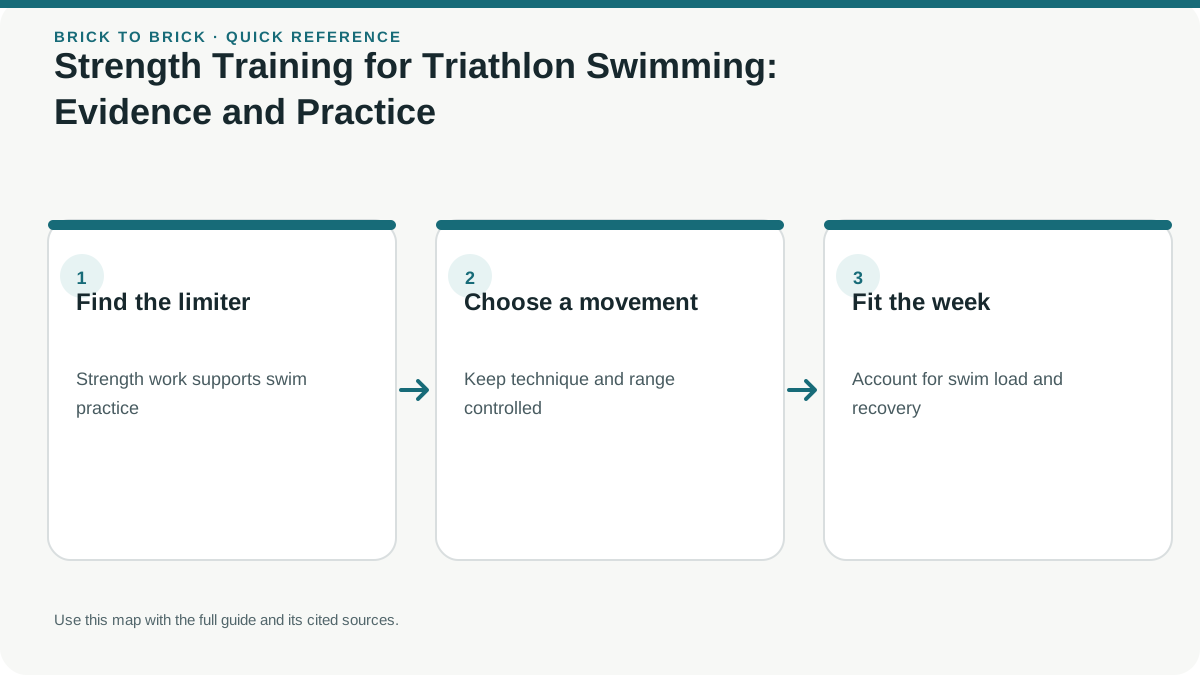
Dryland strength can be one optional part of triathlon swim preparation, but it does not replace time in the water, stroke coaching or an individualized programme. Reviews of competitive swimmers find no single best strength method and limited certainty about shoulder-pain risk factors. Use the exercise examples as a menu, coordinate added load with the swim week, and seek qualified guidance for pain or health concerns.
Key takeaways
- 1Strength work may support general capacity, but gains in gym exercises do not automatically transfer to a faster triathlon swim.
- 2Swimmer-specific reviews do not establish one best dryland method or universal weekly schedule.
- 3No band routine or exercise list can guarantee prevention of shoulder injury.
- 4Choose controllable movements for a clear purpose and fit them around swimming, cycling, running and recovery.
- 5Persistent or worsening shoulder pain needs qualified assessment; do not diagnose it or prescribe extra prehab from a generic checklist.
In this article
- 1Why swimmers need strength training
- 2Key muscle groups for swimming
- 3Dryland vs gym training
- 4Shoulder injury prevention
- 5Example swim strength workouts
- 6Beginner to intermediate progression
- 7How swim strength fits the bigger picture
- 8What the research says about strength work for swimmers
- 9Decide what you want a strength session to support
- 10Match exercises to a controllable movement, not a swim myth
- 11Build a session blueprint you can adapt
- 12Schedule strength around the pool without fixed phase rules
- 13Track useful responses instead of chasing a gym number
- 14Adapt the plan to equipment, experience and accessibility
- 15Respond to shoulder symptoms with assessment, not extra prehab
- 16Review the strength habit at the end of a training block
- ⚖What swim-focused strength work can and cannot provide
- ?Frequently asked questions
Why swimmers need strength training
Dryland resistance exercise can be one part of a swimmer's preparation, especially when the aim is general strength, load tolerance or a quality selected with a coach. It is not a replacement for time in the water, technical instruction or appropriately planned swim training. Strength exercises and swimming use different movement speeds, positions and resistance patterns, so gains in a gym movement do not automatically become a faster stroke.
Research on competitive swimmers has examined several types of strength work, but reviews do not identify one approach as best for every swimmer. The studies vary in age, experience, intervention, swim distance and testing. Many participants train and compete at a higher swim volume than an age-group triathlete. Their results should not be translated into a guaranteed time improvement for an adult learning freestyle or balancing three sports.
Consider adding strength work only after checking what your current programme needs and what you can recover from. For a beginner, safe technique, regular swim access and feedback on the stroke may matter more than a complex gym routine. A coach can help coordinate strength work with key pool sessions; a clinician or qualified rehabilitation professional should guide exercise where an injury or health condition affects movement.
Key muscle groups for swimming
Swimming uses the shoulder complex, trunk and lower body together, but listing muscles is not a diagnosis or a map from one weak muscle to one stroke fault. The arm's pull, shoulder-blade movement, body rotation, kick and breathing all depend on timing and technique as well as physical capacity. The stroke also changes with speed, fatigue, body position and whether the swimmer uses freestyle, backstroke or another style.
For general strength programming, a qualified coach might select movements that train a controlled pull, push, trunk bracing or rotation, hip and leg strength, and shoulder-blade control. Those are exercise categories, not a claim that every triathlete has an imbalance or must isolate the rotator cuff. Heavy or high-volume pulling is not automatically more swim-specific; it can add fatigue to the same upper body that is already working in the pool.
If a stroke feels inefficient, seek poolside or video feedback from a qualified swim coach. A band exercise cannot correct breathing timing, catch path, body alignment or a mobility limitation by itself. Use strength work to support a plan with a clear purpose, and revisit the purpose if it does not fit the swim sessions you are trying to protect.
Dryland vs gym training
Home and gym training are both ways to add resistance; neither setting is inherently superior. A band, bodyweight movement, cable, free weight or machine can be useful if its resistance is appropriate, the setup is stable and you can perform it with control. Choose by access, cost, space, confidence, the exercise goal and whether someone can teach you the movement safely.
At home, inspect bands for wear and secure them to an anchor designed to hold the load. Keep the path clear and avoid anchoring to a loose door handle or furniture. At a gym, learn how to adjust a machine, select a manageable load and stop a set before technique breaks down. A beginner can start with no load or a light load while learning; heavier equipment is not a requirement for “real” strength training.
The original claim that a fixed eight-week home phase should be followed by heavier gym work is not a universal progression rule. A swimmer may stay with simple movements, seek coaching or use a different plan based on experience, access and pool schedule. If a product is not necessary for a suitable exercise, do not buy it solely because it is marketed as swim-specific.
Shoulder injury prevention
No short band routine can promise to prevent shoulder injury. Shoulder pain in swimmers is multifactorial, and systematic reviews have found that evidence for many individual risk factors remains limited or inconsistent. Training exposure, previous symptoms, technique, strength, mobility, recovery and personal health may all be relevant. Findings in competitive squad swimmers also do not map directly to every recreational triathlete.
External rotations, rows and shoulder-blade control exercises are examples sometimes used in general strength or rehabilitation programmes. They are not mandatory “prehab,” and a specific set-and-repetition prescription has not been shown to protect every swimmer. Choose them with a coach or clinician if they suit your needs, and progress load and range only as tolerated. Stop an exercise that causes new or worsening pain rather than adding more repetitions to push through it.
If shoulder pain persists, interferes with sleep or daily tasks, limits stroke or worsens during training, reduce or pause the aggravating activity and seek assessment from a qualified health professional. Do not diagnose “impingement” from a symptom list or treat pain by abruptly increasing prehab while keeping the same swim load. The clinician can help determine what changes are appropriate.
Example swim strength workouts
The routines below were previously presented as fixed prescriptions; they should instead be treated as a menu of movement ideas to discuss with a qualified coach. They have not been validated as a complete programme or as injury-prevention routines. A beginner might practise a supported row, an incline push-up, a controlled squat or hinge, and a simple trunk-control exercise with light resistance, choosing versions that feel comfortable and stable.
Start by learning setup and movement quality. Use a load you can control throughout the range without breath-holding, joint pain or compensating with the trunk. Leave time between exercises and stop a set while you can still move smoothly. The right amount depends on strength experience, health, equipment, the rest of your week and the reason for doing the session; this page does not assign a universal number of sets, repetitions or weekly sessions.
If a coach has already prescribed gym work, follow that plan rather than duplicating it with a second “swim strength” circuit. Make changes one at a time and note their effect on the next swim and the rest of your training. In-water drills, paddles, bands or resisted swimming also change the load on the shoulder; use them under appropriate guidance rather than treating them as automatically safer or more specific.
Beginner to intermediate progression
Progression should reflect what you can perform and recover from, not a calendar that automatically increases weight by a fixed percentage each week. First learn the setup and movement, then repeat it until the version feels consistent. If appropriate, change one variable at a time—such as resistance, range or exercise complexity—and keep the change small enough to assess. A coach can help make those decisions, especially when gym work is new or swimming volume is increasing.
There is no universal rule that all triathletes need two strength sessions in a base phase and one in race season. A useful schedule depends on training history, priority events, swimming frequency, work and sleep, pool sessions, other sport training and individual recovery. Some athletes may benefit from a modest maintenance routine; others may need instruction before adding load, or may need to pause and address a health issue.
Avoid increasing gym intensity at the same time as a large increase in swimming volume. A training log can help you see when fatigue or symptoms appeared, but it cannot diagnose an injury. If a schedule repeatedly leaves your shoulders sore or your key swim sessions compromised, adjust the total load and get qualified advice rather than insisting on the original plan.
How swim strength fits the bigger picture
Strength training for swimming is one optional part of a broader triathlon week. Its value depends on how it fits around swimming, cycling, running, rest and life outside sport. Adding a separate session because it appears on a checklist can make the week busier without serving a clear need. For many athletes, the first task is to organise the existing programme and learn the basic skills, not to add more training categories.
If you include strength work, ask what it is meant to support, how you will recognize whether it fits, and what you will reduce if total load becomes excessive. A strength session should not displace swim technique practice when technique is the main goal, and it should not be placed where soreness repeatedly undermines an important session. A coach can help distribute work; a clinician can advise when symptoms or medical history change what exercise is appropriate.
The related cycling strength guide, running strength guide, stability training guide, mobility guide and plyometric training guide address other topics. They are not a required checklist: select only the work that fits your experience and plan. See the triathlon workout split guide when coordinating sessions across all three sports.
What the research says about strength work for swimmers
The evidence is more cautious than a promise that dryland work will make every triathlete swim faster. A systematic review of strength-training methods in competitive swimmers included 27 studies and found no clear consensus about which method was most beneficial. The research compared different ages, training histories, exercise types and swim outcomes; it does not define one routine for recreational triathletes.
A 2023 systematic review of shoulder-pain risk factors found no strong evidence for or against many of the variables assessed, reflecting limits in the underlying studies. A separate review of swim-training volume and shoulder pain found an association in adolescent competitive swimmers and called for better research to establish decision thresholds. These findings support measured training and qualified assessment; they do not prove that one band routine prevents pain.
Treat a paper as evidence about a group, not an individualized prescription. Ask who was studied, what intervention was tested, how long it lasted and what outcome was measured. Sprint-swim performance in competitive specialists, shoulder pain in a youth squad and sustainable preparation for an adult's first triathlon are different questions. The review authors themselves describe uncertainty; this guide does too.
Decide what you want a strength session to support
Before choosing exercises, state the reason for adding them. It might be learning basic resistance-training skills, developing general strength, supporting a coach's plan or maintaining a familiar routine when pool access changes. “Prevent shoulder injury” and “get a faster stroke” are not precise enough to justify a particular exercise by themselves. A clear purpose helps you tell whether the session belongs in the week.
For a swimmer who is new to lifting, a coach or qualified strength professional can help set up familiar movements with low complexity and equipment that is available. For an experienced lifter, the useful question may be whether the current gym plan already covers the intended goal; a second swim-specific circuit may simply duplicate work. If the main limitation is breathing, alignment or catch timing, a swim coach can give feedback that a land exercise cannot provide.
Write down what would count as a useful result: consistent attendance, better confidence with a movement, a manageable response during the following swim, or completion of a coach-prescribed plan. Do not use an unsupported percentage time target. If the training adds fatigue without a benefit you can identify, reconsider its dose and placement with appropriate support.
Match exercises to a controllable movement, not a swim myth
A broad exercise menu can use pulling, pushing, leg strength and trunk-control patterns. For example, a supported cable or band row and an incline push-up train the upper body in different directions; a sit-to-stand or light hinge practises a lower-body pattern; a simple carry or controlled trunk movement challenges bracing. These are examples of general resistance exercise, not a mechanical copy of the freestyle stroke.
Choose the version you can set up safely. A band needs an anchor that will not release unexpectedly. A cable station needs a clear path. Dumbbells need secure handling and enough space. A machine can make the path more guided but still requires correct adjustment. Keep movements comfortable and stop if a joint hurts. A movement that looks like pulling underwater may create a different shoulder position or speed on land, so “swim specific” on a product label is not proof of transfer.
The pool remains the place to practise water feel, timing, body position and breathing. If you change stroke mechanics, ask a qualified swim coach to assess the actual movement in water. A gym exercise can contribute to general capacity, but it cannot show whether the hand enters in the right place or the body rolls effectively.
Build a session blueprint you can adapt
A practical session can be organized into four parts: check readiness, warm up, practise a small number of familiar strength movements, then note how you responded. The number of exercises, sets, repetitions and rest depends on experience, health, load elsewhere in the programme and the professional plan you follow; there is no universal swim-strength dose. Someone learning the movements may spend the entire visit on technique with light resistance.
One illustrative menu is a row, a push variation, a lower-body movement and a trunk-control option. Use a version that allows smooth movement and normal breathing. Finish a set before fatigue makes you swing, shrug or lose control. Rest until you can repeat the movement comfortably. Add load only after the current version feels consistent and does not disrupt your swim or other training. Do not treat a hard session or muscle soreness as proof it worked.
Keep the first session deliberately simple and leave time to learn equipment. Avoid combining unfamiliar heavy lifting, high-volume swim paddles and a hard swim on the same day just to “maximize” specificity. If a coach has already provided a session, use that rather than layering this example on top. Seek qualified instruction for complex lifts or any movement made uncertain by pain, surgery or another health concern.
Schedule strength around the pool without fixed phase rules
There is no race-calendar formula that requires exactly two strength sessions in a base block and one in race season. Training phases, event distance, pool access, previous resistance experience and recovery differ. Put the strength work on a calendar only after reviewing the swim sessions it sits beside, as well as cycling, running, work and sleep. The same session may be manageable in one week and poorly timed in another.
Some athletes prefer to combine strength and an easier swim on one day to preserve a separate recovery window; others need to keep them apart because the schedule or fatigue demands it. Those are planning choices, not universal rules. Protect the session whose purpose matters most, and do not schedule unfamiliar upper-body loading immediately before a key swim without seeing how you respond.
During a race-specific block, it may be reasonable to maintain a familiar routine, reduce the amount of gym work or pause it temporarily. Make the change with your coach if you have one. If the routine makes technique worse, affects daily tasks or leaves persistent fatigue, reassess the total training load rather than trying to solve everything by changing the strength session alone.
Track useful responses instead of chasing a gym number
A concise log can make strength work easier to evaluate. Record the exercise version, equipment, resistance, how controlled it felt, any discomfort and the next swim's general response. Add relevant context such as a harder run, poor sleep, a change in pool volume or a travel week. A short note is usually more useful than a long list of unrelated metrics.
Look for repeatable patterns across several sessions. Can you set up the movement with confidence? Is the chosen resistance manageable? Does the session coexist with the planned swim? Is a symptom appearing or getting worse? One difficult day can reflect sleep, work stress, illness or other training, so avoid making a large programme change based on a single observation.
Strength numbers do not automatically measure stroke efficiency or injury risk. A stronger row does not prove that the catch improved, and a pain-free week does not prove that an exercise prevented an injury. If swim performance is the goal, track comparable in-water sessions and ask a coach about technique and pacing. If pain is the concern, keep clinical decisions with a qualified health professional.
Adapt the plan to equipment, experience and accessibility
The best programme is one you can access and perform safely. A person who cannot get to a gym might use a light band or bodyweight movement after learning a stable setup. Someone who has trouble standing may use a seated variation selected with a qualified professional. Limited grip, balance, shoulder range or a past injury can change which movement is suitable; a general article cannot assess those constraints.
If equipment is limited, do not assume that buying a suspension trainer, medicine ball or expensive band set will make the programme more effective. Ask whether a safe, accessible alternative can meet the same broad purpose. If you train at a public gym, confirm that equipment adjustment and access fit your needs, and request instruction where available. Keep walkways clear and use a spotter or support when an exercise requires it.
Adaptive exercise is individual. An athlete returning after surgery, managing a chronic condition, pregnant or taking medication that affects exertion should follow advice from an appropriately qualified clinician or exercise professional. There is no need to copy a competitive swimmer's programme to be a triathlete. A modest, accessible plan is preferable to a complicated one that cannot be repeated.
Respond to shoulder symptoms with assessment, not extra prehab
A shoulder that hurts during swimming or daily activity deserves attention. Do not interpret the pain as proof of weak rotator-cuff muscles, and do not add more band work while continuing the same painful load without assessment. Symptoms can have different causes, and a strength exercise that is suitable for one swimmer may aggravate another person's shoulder.
If an exercise produces pain, stop that exercise and note what movement and load were involved. If swimming itself triggers symptoms, discuss whether to modify the session with a coach and seek a clinician or physiotherapist qualified to assess shoulder problems in sport. Prompt medical care is important for severe pain, sudden loss of function, traumatic injury or symptoms that are rapidly worsening. A clinician can help determine whether examination, rehabilitation or a gradual return plan is appropriate.
The aim is not to avoid all effort or to self-diagnose from a checklist. It is to avoid worsening a problem while you seek the right input. Do not return to an event or increase training based only on a generic exercise list. When symptoms settle, the next strength and swim steps should be based on how you respond and any professional guidance you received.
Review the strength habit at the end of a training block
At the end of a block, review whether the work served its original purpose. Did you learn a movement, complete the plan consistently, or find a manageable way to support the swim programme? Did it fit the week without repeatedly compromising a key pool session, sleep or recovery? What changed when your swim volume, race proximity or access changed?
Use those observations to choose a next step with your coach or qualified professional. You might keep the same simple exercises, change the schedule, reduce the load, take a break during a demanding period or seek instruction before progressing. The result does not need to be a larger weight or a new product. If the only observed change is more soreness or disrupted swimming, that is a reason to reassess.
Training is iterative: keep notes about the plan and update one major variable at a time when possible. Do not attribute a better race time to a single strength exercise without considering technique practice, swim volume, pacing, course conditions and the rest of your programme. Treat the session as one part of preparation, then make the next decision from the complete picture.
What swim-focused strength work can and cannot provide
| Training element | May help with | Does not replace |
|---|---|---|
| General resistance exercise | Practising and developing strength on land | Pool time, swim technique or a personalized plan |
| Rows, pushes and trunk control | Training broad movement patterns with manageable resistance | A diagnosis of a stroke fault or shoulder weakness |
| Band or bodyweight options | Accessible ways to practise selected movements | Proof that a routine prevents shoulder pain |
| A training log | Noticing repeatable tolerance and scheduling patterns | Clinical assessment or a measure of swim efficiency |
| Coach or clinician input | Adapting technique, load and exercises to the swimmer | The event's rules or individualized medical care when needed |
Sources
Sources are listed so readers can verify consequential claims and dated details.
- Effect of Different Types of Strength Training on Swimming Performance in Competitive Swimmers: A Systematic Review — Journal of Strength and Conditioning Research / PubMed (accessed September 24, 2026)
- Shoulder pain and injury risk factors in competitive swimmers: A systematic review — Scandinavian Journal of Medicine & Science in Sports / PubMed (accessed September 24, 2026)
- Swim-Training Volume and Shoulder Pain Across the Life Span of the Competitive Swimmer: A Systematic Review — Journal of Athletic Training / PubMed (accessed September 24, 2026)
Frequently asked questions
Does strength training make a triathlete swim faster?
It may support general strength, but performance transfer varies. A systematic review of competitive swimmers found no clear consensus on the best strength method. Strength work does not replace swim practice or technical feedback.
How many days per week should a triathlete do swim strength training?
There is no universal frequency. Consider training experience, current swim and triathlon load, recovery, health and event timing. A coach can help decide whether a session belongs in your plan.
Can band exercises prevent swimmer's shoulder?
No band routine can guarantee injury prevention. Shoulder pain has multiple possible contributors and evidence for individual risk factors is limited. Get qualified assessment if pain persists or worsens.
What is a good beginner exercise for swimming strength?
Choose a controllable movement that fits your equipment and experience, such as a light supported row or incline push-up, after learning safe setup. These examples are not a personalized programme or treatment for pain.
Should strength work replace a swim session?
Strength and pool sessions have different purposes. If swim technique or water practice is the priority, dryland work is not a direct replacement. Review the whole schedule with a coach before adding or substituting training.