Plyometrics for Triathletes: Readiness, Landing and Progression
An evidence-aware guide to plyometrics for triathletes: exercise choices, coaching, readiness, impact planning, performance limits and when to leave jumps out.
By Lotte
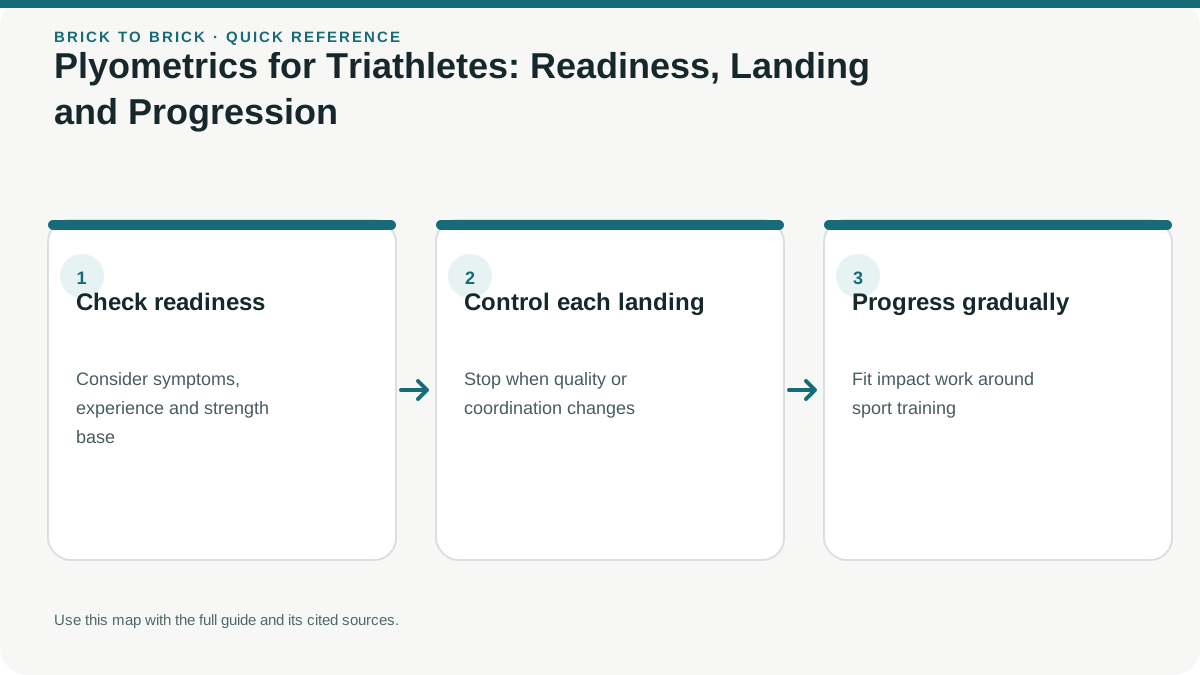
Plyometric training is optional impact work, not a required extra for triathletes. Running studies suggest possible performance effects but do not provide a universal safe dose or prove a triathlon benefit for every athlete. Learn how to weigh the evidence, choose a clear goal, plan around other impact and recognise when coaching or clinical advice is needed.
Key takeaways
- 1Plyometrics are optional and should have a clear purpose in the training plan.
- 2Running research does not provide an individualized triathlon prescription or promise an injury or performance outcome.
- 3Jump complexity changes with height, speed, direction, support leg and recovery, so contact count alone is incomplete.
- 4Consider all running and other impact in the week before adding jumps.
- 5Pause and seek individualized advice for persistent symptoms, recent injury or health concerns that affect impact exercise.
In this article
- 1Know the purpose and the limits of the evidence
- 2Check readiness before adding impact
- 3Learn landing before repeated rebound
- 4Use a progression ladder with clear exit points
- 5Place jumps where fatigue will not obscure technique
- 6Evaluate tolerance before claiming performance gains
- 7Count landing quality before counting a larger session
- 8Recognise how one progression changes several loads
- 9Ask an instructor to observe the part you cannot judge
- 10Decide what job a plyometric exercise would do
- 11Read running research without turning it into a triathlon recipe
- 12Choose between jumping, lifting and running strides
- 13Use a movement category, not a copied workout
- 14Adjust expectations for your training background
- 15Make a one-page impact audit before changing the plan
- 16Know when skipping impact is the right training choice
- 17Avoid common mistakes that make progress hard to interpret
- 18Frequently asked questions about plyometrics for triathletes
- ⚖Choose a method that matches the training goal
- ?Frequently asked questions
Know the purpose and the limits of the evidence
Plyometrics challenge the stretch-shortening cycle: a rapid loading action followed by force production. The practical examples range from low, controlled jumps to demanding bounds and drop jumps, so the category covers very different loads.
Research in runners suggests potential performance benefits, but average study results do not establish an injury-free progression for a particular triathlete. Running history, strength, age, health and current impact load matter.
Use running strength for the foundational gym work. This page focuses on deciding whether and how faster impact exercises belong in the programme.
Check readiness before adding impact
You should be comfortable with ordinary training and basic controlled strength movements before experimenting with jumps. Current pain, a recent bone or tendon injury, significant balance difficulty or an uncertain return-to-sport status calls for professional advice.
Being able to complete a long bike ride does not establish readiness for repeated landings. Cycling fitness and impact tolerance are different capacities.
A qualified coach can observe landing and progression. Do not use a high box or a large contact count as a self-administered readiness test.
Learn landing before repeated rebound
Begin with a low-demand task on a stable, uncluttered surface and learn to stop under control. If you have not done impact training before, ask a qualified coach or physiotherapist to show an appropriate starting version and observe your movement.
Aim for a balanced landing that you can hold briefly, rather than trying to make it silent or spring back as fast as possible. A sound cue can help a coach notice a change, but quietness by itself does not tell you whether an exercise is suitable.
Keep each attempt separate enough to reset your balance and attention. Stop when you cannot land where intended, need an unplanned step to recover, or feel pain. Those observations are more useful than finishing a preselected number of contacts.
Use a progression ladder with clear exit points
Plyometrics are a family of movements, not one exercise. The demands can change with jump height, direction, one-leg support, speed, repeated contacts, surface and recovery between efforts. A progression is therefore a deliberate change in task demand, not simply a calendar moving forward.
One reasonable teaching order is controlled landing, a small two-leg jump with a pause, and only later a more continuous or directional action if the earlier version is comfortable and controlled. It is an example of increasing complexity, not a required programme. Some athletes will have no reason to progress beyond landing practice.
Change one meaningful feature at a time and keep the rest of the training week familiar enough to interpret. Return to the earlier task when technique or comfort changes. Drop jumps and aggressive bounding are advanced options, not milestones every triathlete needs to reach.
Place jumps where fatigue will not obscure technique
Plan an unfamiliar impact session for a time when you are alert and can focus on the movement. Do not attach first-time jumps to the end of a long run, hard brick or demanding strength session. Fatigue can make it harder to judge how the task feels and to keep the movement deliberate.
A short practice still belongs in the training calendar. Look at the surrounding run, hills, faster intervals and strength work before adding contacts. If one of those sessions is already new or unusually demanding, postpone the plyometric experiment instead of stacking several changes.
Near a race, protect familiar training and recovery. There is no need to introduce a novel jumping drill during taper to gain a last-minute benefit. See the triathlon periodization guide for the broader logic of organising a season; a coach can help adapt that logic to your event and training history.
Evaluate tolerance before claiming performance gains
Record the exercise, contact count, surface and response during the following days. Ask whether the task is becoming more controlled and whether regular running remains comfortable.
Do not infer a percentage improvement in economy or injury risk from a higher jump. Those outcomes require different measurements. A routine that repeatedly interrupts running is not serving its purpose.
If you want specialised performance work, use qualified coaching. The useful first outcome is a modest, tolerable impact progression, with permission to omit plyometrics when they do not fit your circumstances.
Count landing quality before counting a larger session
Choose a clear area with enough room to jump and land without approaching a wall, equipment or another person. Check for loose objects, wet patches, uneven edges and any surface change that could catch your foot. A predictable, non-slip surface makes the task easier to observe; a soft surface is not automatically safer if it shifts underfoot.
Use footwear that fits and feels secure for the task. There is no single shoe model required for plyometrics. Avoid testing a new shoe, surface and exercise in the same session because you will not know which change affected comfort or control.
Keep the practice area and task simple enough that you can stop immediately. Do not use a box, curb, bench, stairs or improvised platform unless a qualified instructor has selected it for you and explained how to use it. Most introductory landing practice does not require equipment.
Recognise how one progression changes several loads
Before adding jumps, scan the whole week for impact rather than looking only at the plyometric session. Note run frequency and duration, hills, intervals, brick runs, races, court sports, strength training and any recent return from a break. This is a planning inventory, not a formula that converts unlike activities into one precise load score.
Mark which items are established and which are new. If a new run workout and a jump progression are both being considered, introduce only one change at a time so the response is easier to interpret. A week with fewer total minutes can still feel harder if its sessions contain more speed, hills or landings.
Review the next several days for pain, altered walking or running, and recovery that is unusually disrupted for you. Do not treat soreness as a success target. Persistent or worsening symptoms call for stopping the exercise and getting individual assessment, especially after a known injury or bone stress problem.
Ask an instructor to observe the part you cannot judge
A video demonstration cannot tell whether your own landing, balance and response suit the proposed progression. When seeking instruction, describe your recent running and strength exposure, the task you have tried and any relevant symptoms or injury history. Ask what the instructor wants you to observe and what should end a set.
Learn how to return to an easier version. If a directional jump becomes uncontrolled, the answer may be a simpler straight-line task or a pause between attempts, rather than another cue delivered at higher speed. Keep enough recovery between attempts to practise the intended movement.
Record the session in the same calendar as the rest of your training. New impact work is still training load even if it occupies only a few minutes and does not generate a long watch activity. Review how it fits with running, hills and other demanding work.
Do not introduce a complicated progression immediately before an important race to chase a theoretical benefit. Familiar, tolerated work and appropriate recovery are more useful than proving you can complete an advanced drill once. The appropriate next step depends on your actual preparation and response.
Decide what job a plyometric exercise would do
Start with a concrete reason before adding jumps. You may want coaching in how to land, be curious about a performance method used by runners, or have a qualified coach identify a specific need. These goals do not all require the same exercise, progression or amount of impact. If you cannot name what the drill is intended to help, it may be unnecessary extra work.
Do not treat plyometrics as a shortcut for improving all three triathlon disciplines. The research is mainly about running, not swimming or cycling, and it does not show that jumping transfers automatically to a faster triathlon run. Technique practice, consistent aerobic training, appropriate strength work, sleep and event-specific preparation may be more relevant to a particular athlete.
Keep a simple test for usefulness: can you perform the chosen task with control, continue the key sessions in your plan, and recover without a recurring problem? If the answer is no, simplify, pause or remove the drill. There is no requirement for every age-group athlete to use plyometrics.
Read running research without turning it into a triathlon recipe
A 2022 systematic review and meta-analysis compared heavy resistance and plyometric training added to running training in long-distance runners. It included 22 studies overall, but its pooled running-economy effect for plyometrics was small and uncertain. Its comparison does not establish that a particular jump improves an individual triathlete’s race time, nor does it provide a universal safe starting dose. See the review and its methods.
A separate review examined different strength-training methods and running economy in middle- and long-distance runners. Its findings depended in part on the method and running speed being studied. Those participants were runners under research conditions; a triathlete has to fit any additional work around swimming, cycling, running, work and recovery. Read the systematic review.
Research averages describe groups. They cannot tell you whether you personally need a jump drill, whether your joints and tissues are ready, or how it fits with an injury history. Use the evidence to frame a question for a coach, not to copy a study protocol without supervision.
Choose between jumping, lifting and running strides
Plyometric jumps, resistance exercises and relaxed running strides all ask the body to do different things. A jump concentrates on a take-off and landing or rebound. A strength exercise uses resistance to practise producing force through a chosen movement. A stride is a brief run at a quicker but controlled pace, with running mechanics and ground contacts that resemble the discipline itself. None is a universal replacement for the others.
If your main goal is basic strength or confidence with resistance, the triathlon strength guide for running is a better starting point than adding jumps. If your goal is to practise a relaxed change of running pace, use suitable run coaching and familiar strides rather than a box jump. If impact is not appropriate, cycling and swimming can maintain sport-specific work without repeated landings.
Choose the least complex method that matches the goal and your current capacity. More explosive-looking exercise does not automatically make a better endurance plan. A coach can help decide which quality is missing and how to train it without displacing the sessions that matter most.
Use a movement category, not a copied workout
There are many kinds of jumping task: a controlled landing from a very small hop, a two-foot jump with a reset, repeated low bounces, a lateral action, or a single-leg bound. They differ in balance, direction, speed and loading. Listing them does not make them a beginner workout. The more complex versions need more preparation and clearer coaching.
For a first discussion with an instructor, describe the intended goal and ask which simplest movement could teach it. Ask what a successful repetition looks like, what would end the set, and which version should replace it if you are tired or uncomfortable. Learn how to step back from a progression before you attempt to move forward.
Do not choose an exercise because a video labels it “triathlon-specific.” Running involves one-leg support, but that does not mean a new athlete should begin with high single-leg bounds. A stable, repeatable task is often more useful for learning than a complicated movement performed once.
Adjust expectations for your training background
A triathlete who has years of regular running may have a different movement history from someone who has just started running after mostly swimming and cycling. Neither background proves readiness. Recent training consistency, injury history, current symptoms, strength experience and the exact jump all matter.
If running is new, protect the gradual development of ordinary running tolerance first. Adding jumps at the same time as a new run frequency, longer distance or speed session makes it difficult to learn which change caused a problem. If you are returning after injury, follow the clinician’s or rehabilitation professional’s return-to-impact plan rather than using this article as clearance.
If you already do coached jumps in another sport, tell your triathlon coach. Those contacts still contribute to your week even if they do not appear in a triathlon app. Older athletes, people with bone-health concerns, and those managing a medical condition should seek individualized guidance about impact; age alone is not a readiness test, and a generic web routine cannot assess these factors.
Make a one-page impact audit before changing the plan
A small training note can prevent an accidental pile-up. Before the week starts, write down each run and label it easy, long, hilly, fast, race-specific or a brick. Add other impact activities, recent races, strength sessions and any jump work. Mark the one item that is new. This simple map is more honest than pretending different activities can be reduced to a universal contact score.
After a practice, record the exact movement, whether you paused between repetitions, how control felt, and any symptoms during the next run or ordinary walking. Include context such as a hard bike session, poor sleep or a change in shoes. The note is meant to help you notice patterns and communicate with a coach or clinician; it is not a diagnostic chart.
If familiar running becomes less comfortable, the next decision is not automatically to add more strength or stretch harder. Pause the new impact exercise, return to a comfortable training level, and seek professional assessment if pain is persistent, worsening or changes normal movement.
Know when skipping impact is the right training choice
Plyometrics may be a poor fit during an active injury, an unresolved return-to-running process, pain with ordinary walking, or a period when key endurance sessions already exceed your recovery capacity. A coach may also leave them out because the athlete’s goal, available time or event calendar does not justify the extra complexity. This can be a sound plan, not a missed requirement.
Seek clinical advice before jumping if you have a current or recent bone stress injury, unexplained focal bone pain, a significant tendon problem, balance or neurological symptoms, or a health condition that changes exercise risk. Sudden severe pain, inability to bear weight, or acute injury deserves prompt medical attention. Do not use a jump test to decide whether an injury has healed.
A professional can help select a suitable alternative and decide when impact is appropriate. Keep the article’s examples educational: they cannot examine you, diagnose symptoms or replace an individualized rehabilitation plan.
Avoid common mistakes that make progress hard to interpret
One common error is copying the number of jumps from a study, video or elite athlete without copying its population, coaching, exercise selection and surrounding training. A contact count alone hides height, direction, pace, support leg and recovery. A second error is changing all of those features together, then attributing any soreness or improvement to one part of the session.
Another is using fatigue as proof that the workout worked. Plyometric practice is about a defined movement, not reaching exhaustion. Repeated sloppy landings, chasing height, adding a weighted vest, or jumping from furniture can increase complexity without making the exercise more useful.
Finally, do not make a claim of better running economy from how springy you felt in one session. A worthwhile training decision is based on a longer view of consistent, comfortable running and a clear reason for the exercise. Performance changes have many possible causes, and personal impressions are not a controlled measurement.
Frequently asked questions about plyometrics for triathletes
Do all triathletes need plyometric training? No. It is optional. A training plan can be complete without it, particularly when impact is unsuitable or when it would interfere with higher-priority sessions.
Can I do jumps after cycling because the bike is low impact? Cycling is low impact, but your legs may still be fatigued after a hard or long ride. Do not assume that a bike session is a good warm-up for unfamiliar jumping. Start fresh enough to control the task and follow a coach’s advice.
Are plyometrics a way to prevent running injuries? This page does not promise injury prevention. Strength and jump training research asks different questions, and evidence about group performance outcomes cannot guarantee an individual injury result.
How many contacts should I do? There is no contact quota that is safe or useful for everyone. Exercise type, prior exposure, health and the rest of your impact week matter. Choose a starting task with qualified guidance and stop when control or comfort changes.
Choose a method that matches the training goal
| Method | Main task | Useful when | Key limitation |
|---|---|---|---|
| Plyometric exercise | Practise a take-off, landing or rebound | A coach has identified a suitable impact skill or performance goal | Adds impact and requires appropriate readiness and progression |
| Resistance training | Practise force production against a resistance | Building general or task-specific strength is the priority | Technique, load and scheduling need suitable instruction |
| Running strides | Practise brief, controlled faster running | A runner wants familiar running-specific speed or rhythm work | Still adds running load and should fit current preparation |
| No added drill | Protect existing sport-specific sessions and recovery | Impact is unsuitable, symptoms are present or the schedule is already demanding | May be the best choice; it does not mean training is incomplete |
Sources
Sources are listed so readers can verify consequential claims and dated details.
- Heavy resistance training versus plyometric training for running economy and time-trial performance: systematic review and meta-analysis — Sports Medicine - Open / PubMed (accessed September 24, 2026)
- Strength training methods and distance-running performance: systematic review — Sports Medicine (accessed September 14, 2026)
- Strength training methods and running economy in middle- and long-distance runners: systematic review and meta-analysis — PubMed (accessed September 24, 2026)
Frequently asked questions
Do triathletes need plyometric training?
No. It is an optional method. The appropriate choice depends on the athlete’s goal, impact tolerance, current training and recovery; a well-built triathlon plan does not require jumps.
Can plyometric training make me faster at triathlon?
Some research in distance runners reports potential running-performance effects, but results do not guarantee an individual benefit or automatically transfer to triathlon. The evidence should inform a discussion with a qualified coach, not a promise.
How should a beginner start plyometrics?
There is no universal beginner dose. First establish suitable running and movement experience, choose a simple task with qualified guidance, and stop if control or comfort changes. People with symptoms or relevant injury history should seek individualized advice.
Can plyometrics prevent injuries?
This article does not claim that they prevent injuries. A performance study or review cannot establish an injury-prevention result for each athlete.