How to Test Your Sweat Rate for Triathlon: A Step-by-Step Protocol
A step-by-step pre/post body-mass protocol to estimate your sweat rate, work through the maths, and turn the result into a rehearsed, safe triathlon hydration plan.
By Lotte
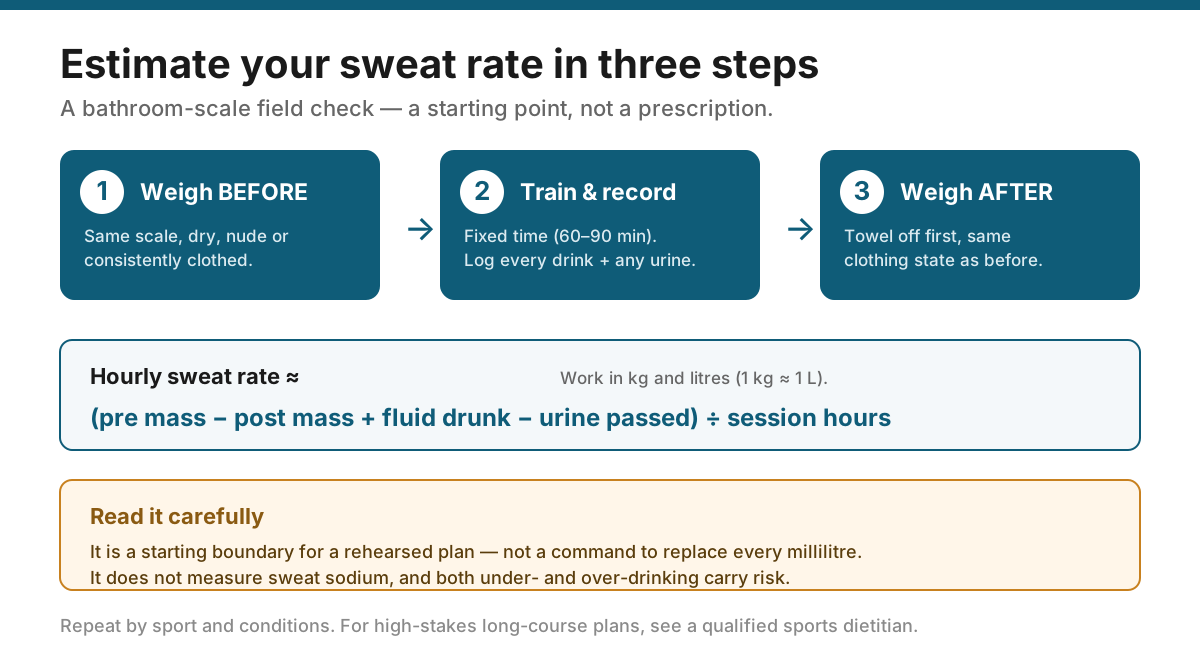
The simplest way to estimate how much fluid you lose while training is a pre/post body-mass check: weigh yourself before and after a session, account for what you drank and any urine you passed, and divide by the hours. That number is a useful, personal starting point — but it is only an estimate for those conditions, it does not measure sweat sodium, and it should never become a command to replace every millilitre during a race. This guide walks through the protocol step by step, works through the maths, and shows how to turn the result into a rehearsed drinking plan without drifting toward the real danger at the other end: overdrinking.
Key takeaways
- 1Estimate sweat rate from the change in body mass across a session, correcting for drinks and urine
- 2Sweat rate is specific to the sport, intensity, clothing and weather you tested in — repeat it in representative conditions
- 3About 1 kg of acute body-mass change equals roughly 1 litre of fluid for this field estimate
- 4The scale test does not measure sweat sodium and cannot diagnose dehydration
- 5Use the number as an upper boundary for a rehearsed plan; never drink to the point of gaining weight, which risks hyponatraemia
In this article
- 1Quick answer: how do you estimate sweat rate?
- 2Why bother — and what sweat rate actually is
- 3The protocol, step by step
- 4Test in representative conditions — and repeat
- 5Interpret the result carefully — it is a boundary, not a target
- 6What the scale test cannot tell you
- 7Turn the estimate into a rehearsed plan
- 8Common mistakes that ruin the test
- ⚖What a sweat-rate scale test can and can't answer
- ?Frequently asked questions
Quick answer: how do you estimate sweat rate?
Weigh yourself just before a steady session and again straight after, keep track of everything you drink, and note any urine you pass. Then estimate your hourly loss with:
Hourly sweat rate ≈ (pre-exercise mass − post-exercise mass + fluid consumed − urine passed) ÷ session hours
Work in kilograms and litres, and use the handy approximation that 1 kg of acute mass change ≈ 1 litre of fluid. For example, if you start at 70.0 kg, finish at 69.0 kg, drank 0.5 L and passed no urine during a one-hour ride, your estimate is (70.0 − 69.0 + 0.5 − 0) ÷ 1 = about 1.5 L per hour for those conditions. That is a starting figure to rehearse against, not a target to force down on race day — the rest of this guide explains why, and how to run the test properly.
Why bother — and what sweat rate actually is
Fluid need is one of the most individual variables in endurance sport: two athletes side by side in the same race can lose very different amounts, because weather, intensity, clothing, body size, fitness and personal physiology all move the number. A sweat-rate estimate replaces guesswork — and replaces marketing charts built around a generic "average athlete" — with something specific to you.
What the test gives you is an estimate of sweat loss in the conditions you tested: body-mass loss corrected for drinks and urine. It is not a measure of how dehydrated you are, how much you must drink, or what is in your sweat. Holding that definition in mind is what keeps the number useful and stops it becoming a rigid rule. For how fluid fits into the whole plan alongside sodium and thirst, this page hands off to the hydration guide; here we focus on getting a good measurement.
The protocol, step by step
Accuracy comes from consistency, so run the test the same way every time:
- Empty your bladder, then weigh in just before starting — nude, or in dry, minimal clothing you can reproduce exactly next time. Use the same scale each test; a digital scale reading to 0.1 kg is ideal.
- Choose a steady session of a fixed length, roughly 60–90 minutes, at an effort and in conditions that represent how you actually race or train. Note the sport, duration, effort, temperature, humidity and clothing.
- Measure everything you drink during the session (mark your bottles, or weigh them before and after), and record any urine you pass.
- Towel off thoroughly and weigh out in the same clothing state as your weigh-in — dripping sweat or a soaked kit will distort the reading.
- Do the maths with the formula above. Record any food eaten too: its mass can distort a simple drinks-only calculation. Use a short, representative session rather than forcing the test into an entire race. Respiratory water loss, fuel use and scale error mean this remains an approximation.
Critically, do not manipulate the test: drinking to a plan or to thirst is fine, but deliberately withholding or force-drinking fluid just to change the number defeats the purpose. You want a realistic snapshot, not a flattering one.
Test in representative conditions — and repeat
A single test tells you your sweat rate for that sport, effort and day, and nothing more. Sweat rate can change with heat, humidity and intensity, and it differs between disciplines — cycling in moving air often feels and measures cooler than running at the same effort. So one number cannot cover a whole season.
Build a small picture instead: test the bike and the run separately, and test in the conditions that matter for your goal race — a cool early-season test may not represent a hot summer race. Repeating the test a few times in similar conditions also averages out measurement noise. Keep a simple log of each result with its conditions so you can compare like with like rather than trusting one lucky reading.
Interpret the result carefully — it is a boundary, not a target
This is the most important section, because the biggest mistake with sweat-rate testing is treating the measured loss as a volume you must pour back in during the race. You do not. Full, real-time replacement is often unnecessary and can be unsafe: a small degree of fluid loss over a race is normal and well tolerated, and you also rehydrate in the hours afterwards.
Instead, treat your sweat rate as an upper boundary that informs a rehearsed drinking plan, and let actual intake stay responsive to thirst, aid-station access, gut tolerance, duration and the day's conditions. A warning sign is unexpected weight gain from fluid intake: drinking more than you sweat can dilute blood sodium and cause exercise-associated hyponatraemia, which is dangerous. Avoid forced drinking and weight gain from excessive fluid intake. Weight loss does not rule out hyponatraemia: worsening headache, vomiting, confusion or collapse needs urgent medical assessment, not guessing from the scale or automatically giving more fluid.
What the scale test cannot tell you
A bathroom-scale test is a blunt, useful field tool — but it has hard limits, and knowing them keeps you from over-trusting it:
- It cannot measure your sweat sodium. How salty your sweat is varies widely between people and is a separate question from how much you sweat. Salt crusting on your kit is a rough hint, not a measurement — a validated sweat-sodium test is needed for that. Keep sodium decisions in the electrolyte and sodium-loading guides, separate from the fluid-loss maths.
- It cannot diagnose dehydration or hydration status. It measures change across one session, not where you started.
- It cannot predict a different climate. A number from a mild day will not hold on a hot, humid one.
For a high-stakes long-course plan, or if you have a medical condition, a history of cramping, or have ever had a hydration-related problem, work with a qualified sports dietitian or clinician rather than relying on a scale alone.
Turn the estimate into a rehearsed plan
A sweat-rate number is only useful once it becomes a drinking plan you have actually practised. Feed your estimate and race conditions into the hydration calculator to get a sensible starting range, then — and this is the part people skip — rehearse that range in training at race effort and in race-like heat, checking that your stomach tolerates it and that it is realistic given how often you can actually drink on the course.
Adjust from what you learn: if the plan leaves you sloshing, uncomfortable or gaining weight, it is too much; if you repeatedly struggle in long, hot sessions, review the plan and conditions with an appropriately qualified professional rather than diagnosing the cause from fatigue alone. Coordinate fluid with your wider race plan — see race-day fuelling for how drinking fits with carbohydrate and timing — and keep sodium as its own decision rather than folding it into the fluid figure.
Common mistakes that ruin the test
Most bad sweat-rate estimates come from a handful of avoidable errors: weighing in different clothing before and after (or not towelling off), using a different or uncalibrated scale each time, forgetting to count drinks or urine, testing a gentle indoor spin and then applying it to a hot road race, or running the test just once and treating it as gospel. The subtler mistake is philosophical — collecting a precise number and then obeying it rigidly on race day. Precision in the measurement does not justify rigidity in the drinking. Test carefully, then apply the result flexibly.
What a sweat-rate scale test can and can't answer
| The question | Does the scale test answer it? | What actually answers it |
|---|---|---|
| How much fluid did I lose in these conditions? | Yes — this is what it estimates | The pre/post body-mass calculation |
| How much should I drink in real time? | No | A rehearsed plan responsive to thirst, access and gut |
| How much sodium is in my sweat? | No | A validated sweat-sodium test; a sports dietitian |
| Am I dehydrated / is this a diagnosis? | No | Clinical assessment, not a single weigh-in |
| What will I need in a hotter race? | No — retest required | A fresh test in representative heat and humidity |
Sources
Sources are listed so readers can verify consequential claims and dated details.
- Exercise-Associated Hyponatremia: 2017 Update — PubMed (accessed August 1, 2026)
- National Athletic Trainers' Association Position Statement: Fluid Replacement — PubMed (accessed August 1, 2026)
Frequently asked questions
How do I calculate my sweat rate?
Weigh yourself before and after a steady session, add the fluid you drank and subtract any urine passed, then divide by the session length in hours: (pre mass − post mass + fluid consumed − urine passed) ÷ hours. Work in kilograms and litres, treating about 1 kg of change as 1 litre of fluid. The result estimates your hourly fluid loss for those specific conditions.
Do I need to drink back everything I lose?
No. A measured loss is an upper boundary, not a mandatory replacement target. Some fluid loss over a race is normal and you also rehydrate afterwards. Drink to a rehearsed plan and to thirst, and never so much that you finish heavier than you started — overdrinking can cause dangerous exercise-associated hyponatraemia.
How often should I retest my sweat rate?
Whenever the conditions or discipline that matter for your goal change. Sweat rate can change with heat, humidity and intensity and differs between cycling and running, so test the bike and run separately and retest for a hot goal race rather than relying on a cool-weather number. Repeating a few times also averages out measurement noise.
Does salt on my clothing tell me my sodium losses?
Only very roughly. Visible salt suggests you may be a saltier sweater, but the scale test measures fluid volume, not sodium concentration, and the two vary independently between people. For an actual figure you need a validated sweat-sodium test; keep sodium decisions separate from the fluid-loss calculation.
Can I test my sweat rate for the swim?
The pre/post weigh-in works best for the bike and run, where you can control drinks and towel off cleanly. Swimming makes an accurate field measurement difficult because water on the skin and kit confounds the weigh-out, so most athletes estimate sweat rate from cycling and running and plan the swim around them.