Triathlon Mobility: Assess Range and Build a Short Routine
A practical, evidence-aware guide to triathlon mobility training: choose a real task, understand the limits of stretching, and try a short routine without treating pain or chasing extra range.
By Lotte
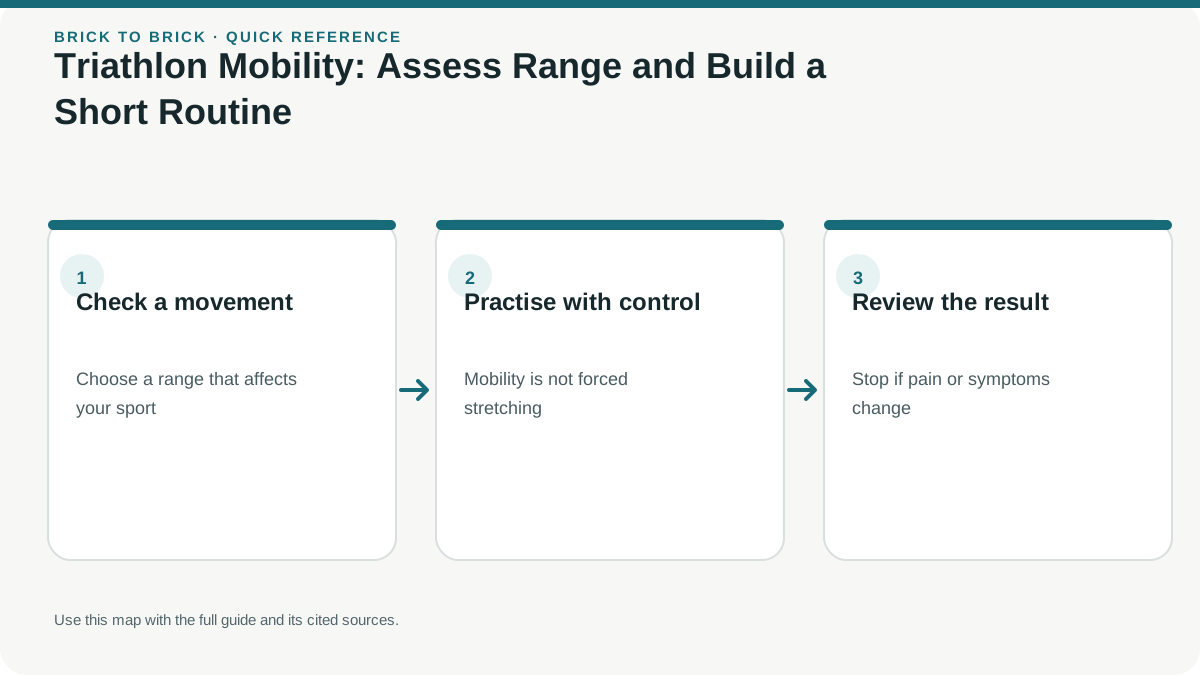
Triathlon mobility training is most useful when it serves a specific, comfortable movement task. Learn how flexibility differs from control, match swim, bike and run practice to the situation, review evidence limits, and choose when coaching, bike fitting or clinical assessment is more appropriate.
Key takeaways
- 1Start from a real swim, bike or run task; more range is not automatically better.
- 2Stretch training can increase measured range, but evidence does not establish a universal dose or guaranteed triathlon performance gain.
- 3Separate a range goal from issues involving strength, coordination, technique, bicycle fit or pain.
- 4Treat example movements as optional experiments, not individualized prescriptions or diagnostic tests.
- 5Stop and seek appropriate advice when symptoms persist, worsen or include neurological changes.
In this article
- 1Use a task before choosing a stretch
- 2Build a baseline you can repeat
- 3An illustrative brief routine
- 4Match mobility to the discipline
- 5Progress control as well as range
- 6Know when to stop self-experimenting
- 7Separate a flexibility limit from an equipment-fit problem
- 8Build a movement note rather than a list of stretches
- 9Choose whether the next step is practice, fit or assessment
- 10What mobility training can change—and what it cannot promise
- 11Separate a range limit from control, strength and familiarity
- 12Choose the movement method to match the goal
- 13Translate the need into a swim, bike or run task
- 14Keep a warm-up separate from a flexibility session
- 15Build a short, low-friction mobility experiment
- 16Review usefulness with a simple before-and-after note
- 17Check common claims before making mobility a daily requirement
- 18Know when a professional assessment is the right next step
- ⚖
- ?Frequently asked questions
Use a task before choosing a stretch
Identify a practical issue: turning to look behind on the bike, reaching comfortably overhead, or moving the ankle through a step. Describe when it happens and whether pain is present.
Flexibility usually describes available range; mobility also concerns using that range with control. Neither is a contest to reach the largest possible angle. The useful range depends on the task and the person.
If a position is painful, do not assume more stretching is the answer. A bike may need adjustment, a swim stroke may need instruction, or symptoms may need clinical assessment.
Build a baseline you can repeat
Choose a gentle movement that resembles the task and note comfort, control and any difference between sides. Use the same position and conditions when checking again. Avoid turning an internet screen into a diagnosis.
For an ankle task, a supported knee-forward movement with the heel down can reveal what range feels comfortable. For upper-body movement, an easy overhead reach can show whether you compensate by arching or shrugging.
Stop if pain, tingling, numbness or dizziness occurs. Those are reasons to reassess, not cues to push further.
An illustrative brief routine
Select two or three relevant movements rather than stretching every body part. An example could include gentle ankle rocks, controlled hip movement in a supported stance and comfortable upper-back rotations.
Move slowly within a comfortable range, breathe normally and repeat a small number of times. If using a held stretch, keep it gentle and follow qualified guidance appropriate to your situation. Do not force a joint or use bouncing to reach a target.
Finish by repeating the original task. A temporary change in range can be interesting, but the meaningful question is whether the movement is more comfortable and controlled.
Match mobility to the discipline
For swimming, overhead movement and trunk rotation may matter, but forcing shoulder range is not a substitute for stroke coaching. For cycling, a position must allow visibility, breathing and control as well as comfort.
For running, more range is not automatically better. Choose a movement problem you can identify rather than assuming every runner has “tight hips” that explain all discomfort.
Use the swim improvement guide or bike selection and fit guide when the main issue belongs to technique or equipment.
Progress control as well as range
When a movement is comfortable, practise controlling the range rather than continually seeking more. A gentle supported movement may progress to a less supported version or a small appropriate load with instruction.
Keep mobility and strength connected. Being able to move into a position passively does not guarantee you can control it while tired or under load. The stability guide explains that distinction.
Avoid changing several drills at once. A short record of the task, exercise and response helps you see whether the routine is useful.
Know when to stop self-experimenting
Persistent pain, neurological symptoms, a recent injury or a rapidly changing limitation deserves professional assessment. Do not keep adding stretches because the first routine did not help.
Mobility work does not guarantee injury prevention or a specific aerodynamic gain. General flexibility guidance supports comfortable activity, while your sport-specific needs may require a coach or clinician.
Keep the routine only as long and complex as needed to serve a clear purpose. A few consistent, tolerable movements can be more useful than an extensive checklist you rarely complete.
Separate a flexibility limit from an equipment-fit problem
A discomfort that appears only in one position may come from more than available joint range. On a bicycle, contact points, saddle height, cockpit reach, handlebar width, clothing or time spent in position can change what the task feels like. During an easy, controlled comparison, note whether the sensation changes when the position is adjusted slightly; do not make a large fit change during a hard ride or treat a self-test as a diagnosis.
If the concern appears mainly on the bike, ask a qualified fitter or coach to assess the position and handling demands. A mobility drill is useful only if it addresses a relevant limitation. Pain, tingling, numbness or worsening symptoms are reasons to stop and seek suitable advice rather than stretch harder.
Build a movement note rather than a list of stretches
Record one task in plain language: what position you tried, what felt limited, whether pain or other symptoms occurred, and what changed after a gentle movement. Keep the setup similar when you repeat the observation. This is a communication aid, not a diagnostic screen: a difference between sides or a limited-looking range does not identify an injury or predict performance.
Use the note to describe a real swim, bike or run task to a coach, fitter or clinician. Avoid labels such as “tight hips” unless you can explain what movement is affected. Stop the comparison if symptoms increase, and do not repeatedly provoke a painful movement just to collect more data.
Choose whether the next step is practice, fit or assessment
Use the response to choose a proportionate next step. If a comfortable movement helps a specific task and causes no symptoms, keep it brief and repeat it when it fits your schedule. If the same concern appears only in one equipment position, ask about that setup. If pain, numbness, tingling, weakness, swelling or reduced function persists or worsens, seek assessment from an appropriately qualified professional.
A useful handoff is short: describe the task, when it is difficult, what you tried and how you responded. A clinician can assess symptoms; a coach can address technique; and a bike fitter can review position. These roles can overlap, but a stretching routine is not a substitute for the kind of help the problem calls for.
What mobility training can change—and what it cannot promise
Mobility is best treated as a practical capacity: moving through the range a task requires while maintaining enough control and comfort for that task. Flexibility training can increase measured range of motion over time. A 2024 meta-analysis of 77 studies involving healthy participants found an overall improvement in range after stretch training, while also reporting substantial variation between studies. That finding supports stretching as one possible way to change range; it does not establish that every triathlete needs more range, that the same dose suits everyone, or that a larger range improves race results. The review’s population and methods are described in PubMed.
A separate review of mobility programs in sporting populations found promising but mixed performance results across 22 studies, with study quality and populations limiting how broadly the results can be applied. The research was not a prescription for triathletes. See the review and its limitations.
Range is only one part of a movement. Comfort, strength, coordination, technique, fatigue, equipment and familiarity with the position may also matter. A mobility exercise may help you explore a movement, but it cannot diagnose the cause of pain, prevent every injury or guarantee a faster swim, bike or run. Let the task—not a generalized ideal of flexibility—decide whether the work is useful.
Separate a range limit from control, strength and familiarity
A movement that looks restricted does not automatically mean a muscle needs to be stretched. You may be unfamiliar with the position, unsure how to balance, lacking strength to control the end of a range, or reacting to discomfort. You may also be working around a genuine injury or an equipment setup that changes the task. A quick self-test cannot reliably distinguish these explanations.
For example, someone who wobbles during an overhead reach might benefit from support and a slower movement before seeking extra shoulder range. A rider who cannot comfortably hold a low position may need a different cockpit setup or more gradual exposure, not an aggressive hip stretch. A runner who feels stiff at the start of an easy jog may respond to a gradual warm-up; if the sensation is persistent or painful, a different assessment is appropriate.
Try changing one safe variable at a time: support, speed, range, or the task setup. Notice what becomes easier without forcing the motion. This is a way to choose a useful next question, not a means of deciding which tissue is “short” or which diagnosis applies. If symptoms are part of the problem, use qualified help instead of repeatedly testing them.
Choose the movement method to match the goal
Different methods answer different questions. A slow, active movement explores how you control a range. A gentle held stretch may be appropriate when the aim is gradually improving flexibility and it is comfortable for you. A strength exercise through a comfortable range develops force and control. Balance or stability practice addresses a different demand again; see the triathlon stability guide for that topic. These methods can complement one another, but they are not interchangeable fixes.
Begin with the least complicated option that resembles the task. If you cannot tell whether a position is restricted because of balance or coordination, use support. If you want more range, choose a stretch you can perform without sharp pain, numbness or joint forcing. If you can already reach a position but cannot control it during training, ask whether strength or technique practice is more relevant.
The 2024 stretching meta-analysis found range improvements across several stretching methods, but it did not identify one universally optimal volume, intensity or frequency. That leaves room to choose a tolerable approach rather than chasing discomfort or a fixed internet routine. Stop an exercise that brings on new or worsening symptoms, and seek advice when the reason for a limitation is unclear.
Translate the need into a swim, bike or run task
Start with a movement the sport actually asks you to perform. In swimming, an easy overhead reach or trunk rotation can help frame a discussion about comfort, while stroke timing and technique still need to be considered in the water. Do not force the shoulder into an extreme position because a diagram labels it a “swimmer’s stretch.” If the shoulder is painful or weak, a coach or clinician can help identify the right next step.
On the bike, describe the position where the issue occurs: looking over a shoulder, reaching the bars, holding the hoods, or maintaining an aerodynamic posture. The bike’s fit and the duration of the position may matter as much as a movement drill. You need to see, breathe, steer and reach the controls safely; a deeper position is not an automatic improvement.
For running, consider the real movement and pace at which the issue appears. A comfortable step, hill, or change from walking to easy running gives more useful context than a maximal stretch test. You do not need to make every joint as flexible as possible. Choose a movement question you can observe safely, and keep ordinary training goals separate from a mobility experiment.
Keep a warm-up separate from a flexibility session
A warm-up prepares you for the work you are about to do. It can begin with easy movement and progress toward the activity and effort planned for that session. Mobility movements may be part of that process when they feel useful, but an extended stretch routine is not automatically a complete warm-up. Before a fast run, for example, gentle movement alone does not rehearse the running pace or terrain you are about to meet.
A longer-term flexibility goal is different: you are practising range over repeated sessions, with enough time and attention to make it a separate training choice. It need not be placed immediately before a key interval session. If a stretch leaves you feeling less prepared, uncomfortable or distracted, remove it from that session and reassess its purpose. Do not assume that a post-training stretch will erase fatigue or soreness; research on stretching and recovery does not establish a reliable recovery benefit for every athlete.
Keep event-day preparation familiar. Race morning is a poor time to test a new deep stretch or an unfamiliar sequence. Use your usual progressive warm-up and follow any specific event, coach or clinician guidance that applies to you. The triathlon pre-race warm-up guide covers race preparation in more detail.
Build a short, low-friction mobility experiment
A useful trial begins with a clear question, not a long list. Write down one relevant task and the part that feels limited. Pick a small number of comfortable movements that address that task, and decide where they can fit without displacing swim, bike, run, sleep or recovery time. The aim is to see whether the practice is tolerable and relevant—not to accumulate minutes or prove discipline.
For instance, a rider who wants to explore a comfortable supported hip movement could practise it briefly on an easy day, then revisit the same riding position on a later easy ride. A swimmer could compare a relaxed overhead reach before and after a gentle upper-back movement, while remembering that a land-based change does not prove a change in the water. A runner could include a gradual, familiar movement preparation before an easy session and notice whether the first part feels more comfortable. These are examples, not prescribed routines.
Keep the test simple enough to repeat under similar conditions. Change one movement or variable at a time; otherwise, you will not know what you are responding to. If the routine becomes uncomfortable, disrupts training or has no clear connection to the task, you can stop or ask a qualified professional to review it.
Review usefulness with a simple before-and-after note
After a brief trial period, return to the original task under reasonably similar conditions. Record whether the task felt more comfortable, whether you could control it more easily, and whether the change lasted into the activity. Also note any soreness, irritation or extra time required. Use ordinary words rather than a score that suggests clinical precision. The comparison is a planning aid, not a validated test or proof that the routine caused a change.
A small improvement that matters to you may justify keeping a short practice. No change is also useful information: it may mean the exercise was not relevant, the measurement was too vague, or the limiting factor lies elsewhere. A temporary increase in reach does not necessarily transfer to swimming, cycling or running. Look for a change in the actual task before assuming sport benefit.
Avoid testing only on days when you feel unusually fresh or comparing different bike positions, shoes, pool conditions or effort levels. Do not repeat a painful movement simply to obtain a cleaner comparison. If the limitation persists or begins to affect function, bring your notes to an appropriate coach, fitter or clinician rather than increasing the stretch intensity.
Check common claims before making mobility a daily requirement
“Everyone who trains should stretch every day” is too broad. A routine can help someone pursuing a specific range goal, but an athlete with no relevant restriction may have more value in technique practice, strength work or recovery. The appropriate choice depends on the person and the task.
“Stretching prevents triathlon injuries” is not a reliable promise. A systematic review of randomized trials and cohort studies found no statistically significant reduction in total sports injuries from stretching and concluded that the evidence was insufficient to support routine stretching as injury prevention. The studies are older and not specific to every modern triathlon setting, so the sensible conclusion is uncertainty—not proof that stretching can never help an individual. Read the review abstract.
“More range means better performance” also skips important steps. The range must match the task, be controlled, and work with strength and technique. “Tightness means short muscles” is not a diagnosis: sensations can have several causes. Make decisions from a specific, safe movement and the outcome you care about. Keep mobility as an optional tool with a purpose, not a test of whether you are a serious triathlete.
Know when a professional assessment is the right next step
Stop the exercise and seek suitable advice if a movement causes sharp or increasing pain, numbness, tingling, unexpected weakness, marked swelling, dizziness or loss of function. An acute injury, repeated symptoms, a persistent restriction that interferes with daily activity, or a major change in how you can train also deserves assessment. These symptoms have different possible causes; a general mobility article cannot determine which one applies.
The professional depends on the question. A clinician or physiotherapist can assess pain, injury and changes in function. A swim coach can observe stroke mechanics. A qualified bike fitter can review bicycle contact points and position. In some cases, more than one perspective is useful. If you have a health condition, recent surgery, pregnancy-related restrictions or instructions from a care team, follow individualized guidance before trying a new exercise approach.
Bring a short description of what happens, when it occurs, what makes it better or worse, and what you have already tried. Do not continue a movement that reliably aggravates symptoms while waiting for an appointment. A professional assessment is not a failure of self-management; it can prevent an unhelpful routine from becoming the only response to a problem that needs a different solution.
| What you notice | Possible next question | Useful next step |
|---|---|---|
| A comfortable task feels restricted | Is this a range goal, a control issue or unfamiliarity? | Try one gentle, task-related movement and reassess without forcing range. |
| The issue appears only in one bike position | Does equipment setup or time in position change the task? | Compare safely and ask a qualified bike fitter or coach if it persists. |
| A movement is painful or symptoms are worsening | Could this need clinical assessment rather than stretching? | Stop self-testing and seek appropriate professional advice. |
| No relevant task feels limited | Would mobility add value to current priorities? | It may be reasonable to spend time on another training need or recovery. |
Sources
Sources are listed so readers can verify consequential claims and dated details.
- How to improve strength and flexibility — NHS (accessed September 24, 2026)
- Chronic effects of stretching on range of motion: systematic review and meta-analysis — Journal of Sport and Health Science / PubMed (accessed September 24, 2026)
- Application of mobility training methods in sporting populations: systematic review — Journal of Sports Sciences / PubMed (accessed September 24, 2026)
- The impact of stretching on sports injury risk: systematic review — Medicine & Science in Sports & Exercise / PubMed (accessed September 24, 2026)
Frequently asked questions
How often should triathletes do mobility training?
There is no single frequency that every triathlete needs. If you have a specific comfortable range goal, choose a tolerable routine you can repeat and review whether it helps the task. The evidence does not establish one universal dose for triathletes.
Does mobility training prevent triathlon injuries?
It cannot be promised as an injury-prevention method. A systematic review found insufficient evidence that routine stretching reduced total sports injuries. Mobility may be useful for a specific movement goal, but pain and injury concerns need appropriate assessment.
Should I stretch before a triathlon workout?
Use a familiar warm-up that progresses toward the session. Gentle mobility can be included if it feels useful, but a flexibility session is not automatically a warm-up, and race day is not the time to try an unfamiliar deep stretch.
What is the difference between mobility and flexibility?
Flexibility usually refers to available range of motion. Mobility commonly describes using a relevant range with active control for a task. The terms overlap in practice, and neither means that maximal range is required.
When should I get help instead of adding stretches?
Seek qualified advice for persistent or worsening pain, numbness, tingling, unexpected weakness, swelling, reduced function, a recent injury or uncertainty about a medical restriction. A coach, bike fitter and clinician address different parts of the problem.