Improve Your Triathlon Swim: Find and Practise One Limiter
Identify whether breathing, body position, propulsion or pacing limits your swim, then use repeatable pool practice and appropriate coaching.
By Lotte
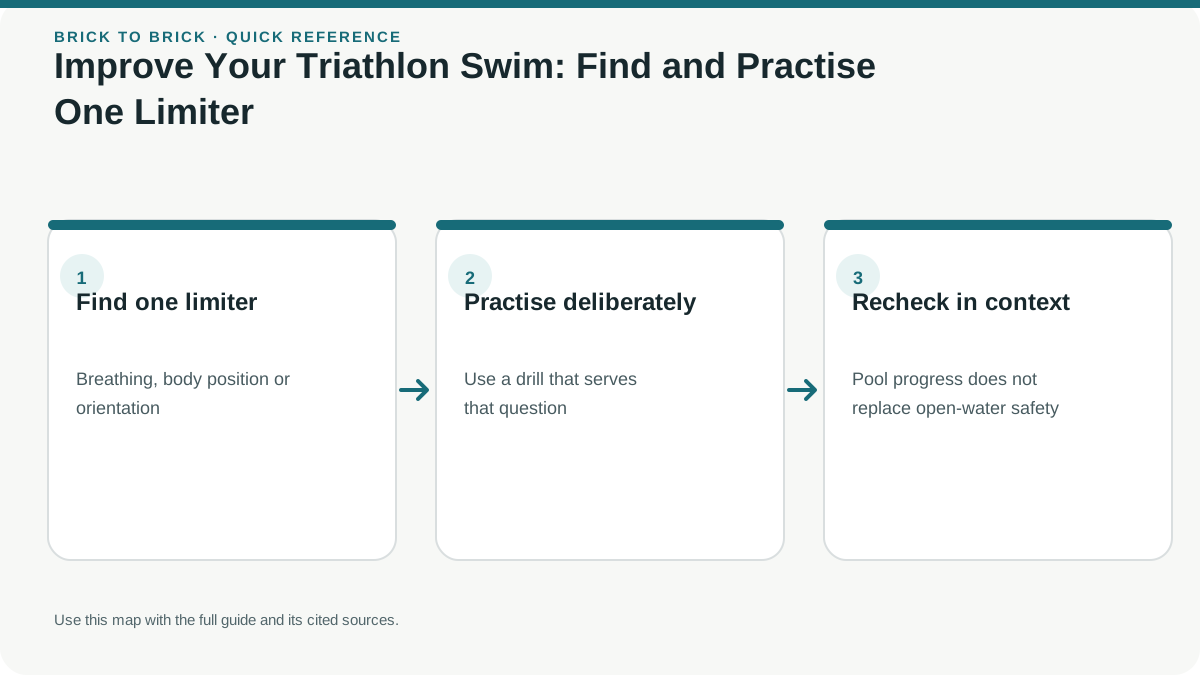
To improve your triathlon swim, identify the skill or endurance limitation that disrupts your stroke, then practise it in short repeatable efforts. Technique and fitness both matter; more metres or a lower stroke count alone does not prove improvement.
In this article
- 1Observe before selecting drills
- 2Make breathing manageable first
- 3Use a drill only when you know its purpose
- 4An illustrative repeatability session
- 5Connect pool improvement with open-water skills
- 6Measure progress with a repeatable comparison
- 7Use a repeat set to distinguish speed from consistency
- 8Ask for swim feedback that you can apply on the next length
- 9Locate the moment the stroke starts to change
- 10Treat body position as balance, not a forced pose
- 11Build propulsion without chasing a complicated catch cue
- 12Use the kick for the job your swim requires
- 13Choose repeat lengths that match the learning task
- 14Use swim metrics as context, not a technique score
- 15Plan skill work across ordinary training weeks
- 16Translate pool confidence into open-water readiness carefully
- ?Frequently asked questions
Observe before selecting drills
Ask a qualified swim coach to watch a few comfortable lengths and explain the main limitation. If filming is permitted, a short clip can help you understand the feedback, but a video alone does not provide a diagnosis.
Notice when the stroke changes: immediately, when breathing, late in a repetition or only when swimming faster. Record pace, rest and perceived effort so the observation has context.
Choose one focus for a block. Trying to change head position, catch, kick and breathing simultaneously can make it difficult to tell what helps.
Make breathing manageable first
Practise a comfortable exhalation pattern in the water and an unhurried breath within the stroke. If you are struggling to coordinate breathing, instruction and short repetitions may be more useful than forcing continuous distance.
Do not use prolonged breath-holding or restricted-breathing contests to build endurance. Stop if distressed and work within a supervised setting.
The aim is enough control to repeat the movement. A rigid bilateral pattern is not required in every condition; open-water breathing choices also depend on waves and orientation.
Use a drill only when you know its purpose
A drill should exaggerate or simplify one part of the movement so you can carry the lesson back into normal swimming. Ask what to feel and what an unsuccessful attempt looks like.
Alternate a short drill with ordinary swimming rather than spending the entire session on drills without transfer. If a drill produces awkward movement or shoulder pain, stop and ask for a different version.
Training aids can change the load and body position. Use them with instruction and venue permission rather than assuming a paddle or pull buoy automatically improves technique.
An illustrative repeatability session
For a swimmer already comfortable covering the distance, try a gentle warm-up followed by a small set of short repeats, such as six 50 m swims with enough rest to regain control. Keep one technique cue and a similar effort across the set, then cool down comfortably.
Scale distance and repetition count to your current ability; this is a structure, not a universal workout. Record whether time, breathing and movement remain consistent.
If the final repetitions deteriorate, shorten the set or increase recovery. More tired lengths do not automatically provide more useful practice.
Connect pool improvement with open-water skills
Pool swimming provides a controlled place to develop the stroke. Open water adds navigation, visibility, conditions and other swimmers. Do not assume pool speed alone establishes readiness.
Use supervised sessions to practise entry, orientation and the event's safety procedure. RNLI guidance emphasises planning and appropriate safety arrangements for open-water swimming.
The sighting and breathing guide covers that specific skill. Keep navigation work distinct from a pool session designed to improve stroke mechanics.
Measure progress with a repeatable comparison
Repeat a familiar set in similar conditions after a consistent practice block. Compare control, effort and sustainable pace rather than only the fastest length. A lower stroke count achieved by excessive gliding may not be an improvement.
If progress stalls, seek feedback before adding volume. Persistent pain or unusual breathlessness deserves appropriate assessment.
Choose the next block from the observation: better breathing, a more useful catch, more repeatable pacing or gradual endurance. A focused sequence of improvements is more actionable than a list of ten corrections to remember at once.
Use a repeat set to distinguish speed from consistency
For a familiar pool session, select a repeat distance you can swim with controlled breathing and an appropriate recovery interval. Record each repeat rather than only the fastest. Keep the same pool length and counting method when comparing sessions.
Suppose six repeats become progressively slower while your effort rises. The useful question may be pacing or technique under fatigue, not whether the first repeat was fast enough. Ask a qualified swim coach to observe a specific issue such as breathing timing or body position instead of collecting unrelated drills.
After making one change, repeat the comparison on another suitable day. A small improvement in consistency or comfort can be meaningful even when the fastest split stays the same. Pool results still need to be combined with safe open-water experience before an open-water race.
Ask for swim feedback that you can apply on the next length
A useful coaching exchange links one observation with one task. Ask what the instructor sees, what change they want you to try and what a successful attempt should feel or look like. “Improve technique” is too broad to guide the next repeat.
After a drill, return to ordinary swimming and see whether the cue transfers. If you can only perform it during the drill, ask for a simpler bridge. Keep enough recovery that breathlessness does not overwhelm the learning task.
When comparing video or observations, use similar angles and conditions where possible and follow pool permissions and other swimmers' privacy. A short observation of an ordinary pace can be more useful than filming only your fastest length.
Record the cue in plain language and review it at the next suitable session. Do not accumulate a long list of simultaneous corrections from different videos and coaches. The aim is a repeatable improvement in the swimming you actually do, with appropriate supervision and safe practice.
Locate the moment the stroke starts to change
Instead of describing a swim as simply “slow,” note when the movement becomes difficult. Does breathing disrupt alignment on every second length? Do the legs sink only after a longer repeat? Does the catch feel ineffective at easy pace but become rushed when you accelerate? Does the stroke fall apart after turns or when you share a lane? Each pattern suggests a different observation and makes a coaching conversation more precise.
Use a small sample in a calm, familiar pool. Swim a few relaxed lengths, a few at a sustainable effort and, if it is appropriate for your current ability, a slightly quicker repeat. Rest enough to regain control. Ask a coach to compare how you move rather than searching for a single “perfect” stroke shape. Body proportions, mobility, experience and speed all affect what a workable technique looks like.
If discomfort appears, stop and describe where it occurs, when it begins and what movement seems to trigger it. Shoulder pain is not a drill to push through. A qualified coach can change the task, while a clinician can assess persistent pain or loss of function.
Treat body position as balance, not a forced pose
A flatter body position can reduce unnecessary resistance, but “keep your hips up” is not a complete instruction. The swimmer must balance breathing, head movement, body shape, kick, buoyancy and forward travel. Forcing a head-down position may make a beginner anxious or make breathing harder; lifting the head to look forward may cause the hips to drop. Ask what small movement changes the balance without creating strain.
Try a brief task with a wall or coach nearby. Notice whether you can exhale comfortably, rotate to breathe and return to a relaxed horizontal position. Use a board or other aid only if it helps isolate the movement and is appropriate for the pool. Return to ordinary swimming after the drill so you can see whether the cue transfers.
Do not judge position from one camera angle or a single still image. Side and front views can reveal different information, and a video can distort depth. Combine observation with how smoothly and comfortably you move through the water. A useful change is repeatable and safe, not merely more photogenic.
Build propulsion without chasing a complicated catch cue
“Catch” describes the part of the stroke where the hand and forearm begin to hold water and direct force backward. It is often discussed with technical cues, but an athlete can misapply them by reaching too far, pressing down, crossing the midline or forcing a rigid elbow position. A drill should help you feel forward movement and stable control; it should not cause shoulder pain or make every stroke a mechanical checklist.
Ask a coach to identify one observation. For example, they might notice that the hand enters across the center line, that the pull stops early, or that the stroke changes during breathing. Use short repetitions to test the cue, then swim normally. If the cue increases effort without improving control, stop and ask for another approach.
Hand paddles increase the surface area and can change shoulder loading. They are not a beginner shortcut to a stronger catch. Use them only with appropriate instruction, suitable size and a pain-free baseline. If you have shoulder history, consult a qualified professional before adding resisted swimming.
Use the kick for the job your swim requires
A triathlon swimmer does not need one kick pattern for every race. Some athletes use a continuous small kick for balance and rhythm; others conserve effort with a lighter kick during longer steady swimming. The appropriate pattern depends on the swimmer, distance, wetsuit, water conditions and coach feedback. A kick that is effective in a short pool sprint may not be comfortable or economical for a longer open-water swim.
Notice whether the legs add propulsion, stabilize the body or mainly create fatigue. Do not assume a kickboard set will fix a whole-stroke problem; it isolates leg work and can be tiring. A coach can help decide whether to work on ankle comfort, timing, kick size or simply a more relaxed body position.
If kicking causes cramps or pain, do not increase volume to “strengthen through it.” Check whether the movement or equipment is appropriate, and seek professional advice for recurring symptoms. The triathlon goal is a sustainable swim that leaves you able to continue safely, not a maximal kick test.
Choose repeat lengths that match the learning task
Short repeats are useful when the task is coordination or feedback. Longer repeats may help you notice whether a relaxed movement holds when you swim continuously. Neither format is automatically superior. Pick a distance that lets you finish with enough control to describe what happened. If you reach the wall breathless and cannot recall the cue, the repeat may be too demanding for technical learning that day.
For example, an athlete learning to breathe without rushing might alternate one short length focused on relaxed exhalation with one easy length of ordinary swimming. A swimmer working on endurance could use repeated moderate lengths while checking whether the stroke remains stable. These are learning structures, not prescriptive workouts; adapt distance, rest and equipment to ability and pool rules.
Change one variable at a time. If you lengthen repeats, do not also increase pace, reduce rest and add paddles in the same session. When multiple demands change together, you cannot tell what caused a better or worse result. Keep a simple note of the task, perceived effort and one observation.
Use swim metrics as context, not a technique score
Time, stroke count, stroke rate and perceived effort can add context, but none tells the whole story. A lower count can reflect efficient distance per stroke or simply a long pause and excessive glide. A higher rate can support a useful rhythm or signal rushed movement. Pool length, push-off strength, turns, fatigue and how strokes are counted all affect comparisons.
When comparing two sessions, use the same pool length and similar effort. Record the actual repeat splits and rest. If you track stroke rate, define whether you count one arm cycle or individual arm entries and use the same method each time. Compare how the numbers relate to comfort and consistency rather than aiming for a universal target. The separate stroke-rate guide explains that metric in more detail.
Wearable swim estimates can be inaccurate, particularly during drills, mixed strokes or crowded sessions. Use them to spot a question, then verify it with observation. A coach watching the stroke may provide more actionable feedback than a dashboard with several decimals.
Plan skill work across ordinary training weeks
Technique work is easier to absorb when it appears regularly in manageable doses rather than as a one-off session immediately before a race. You might start a pool visit with an easy warm-up, work on one cue in brief sections and finish with ordinary swimming. The exact frequency depends on access, the athlete's other training and the coach's advice; there is no required number of swim sessions that guarantees improvement.
Keep a small set of familiar cues instead of writing a new list every day. If one cue becomes reliable, ask whether it is time to add another or whether the next focus should be swim endurance. If a change has not transferred after several appropriate attempts, get feedback rather than repeating the same drill harder.
Include recovery and other sports in the plan. A hard run or strength session can affect how a swimmer feels in the water. Do not compare a fresh technical session with a swim performed after an unusually demanding day and conclude that the stroke has permanently changed. Context belongs beside the split time.
Translate pool confidence into open-water readiness carefully
Pool technique does not cover every open-water demand. A swimmer must also orient to the course, respond to changing visibility and conditions, and make safe decisions near other people. Build the specific skills at an organized or supervised venue with appropriate support, and follow local water guidance. Do not practise alone or treat a tow buoy as a substitute for supervision and emergency planning.
Start with conditions and distances that feel manageable. If a lake, sea or river causes panic, uncontrolled breathing or confusion, return to a safer setting and get qualified help. The open-water anxiety guide and sighting and breathing guide cover those separate challenges. A race registration is not a reason to progress exposure before you are ready.
During pool training, you can rehearse looking forward briefly or breathing to either side if those tasks support your event, but do not treat a pool drill as full race preparation. Plan at least one safe, supported progression that reflects the actual water and event format when access allows.
Sources
Sources are listed so readers can verify consequential claims and dated details.
- Open-water swimming safety — RNLI (accessed September 14, 2026)
- Swim-to-cycle transition and triathlon swimming considerations — Sports (accessed September 14, 2026)
Frequently asked questions
Should I use a pull buoy for all my swimming if it makes me faster?
Use equipment for a defined task, with appropriate instruction. A buoy changes the demands of the swim and can hide issues you need to understand without it. Include suitable unaided swimming and do not treat an equipment-assisted pace as proof of race readiness.