Best First IRONMAN 70.3: Easiest and Flattest Courses Compared
Which IRONMAN 70.3 courses are easiest for a first half: a comparison of flat bike courses, calm swims, mild climates and cut-off margin, with reported climbing figures, a scoring worksheet and how to check them.
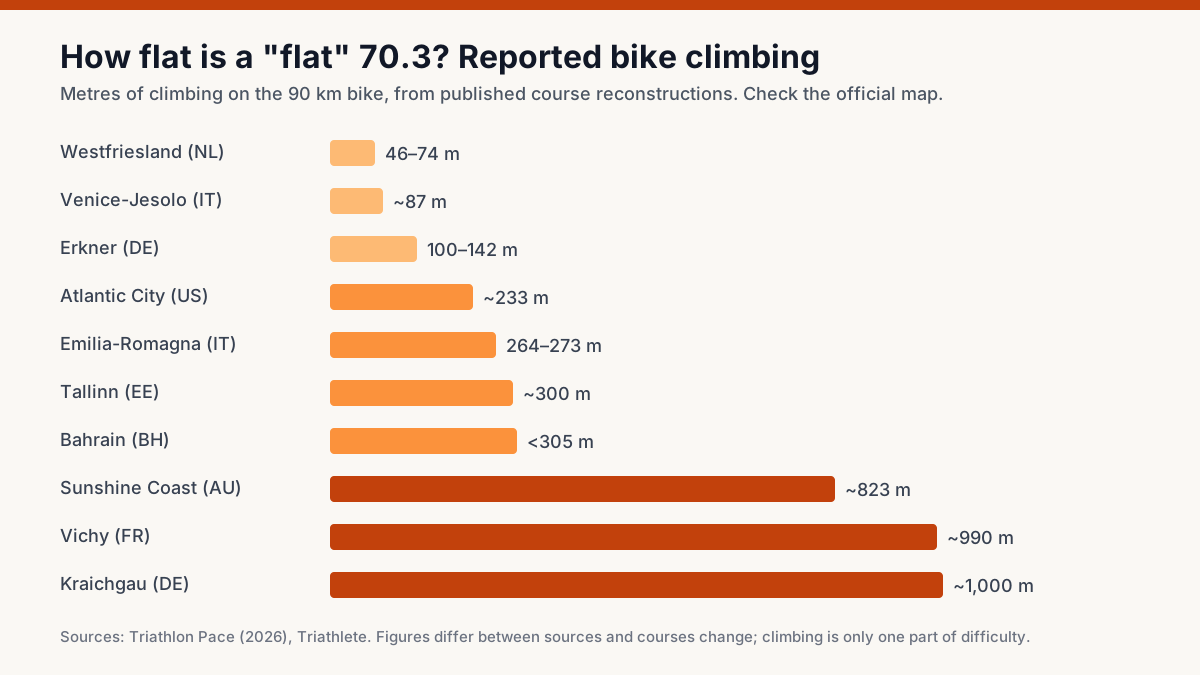
The easiest first 70.3 is a race with a calm swim, a flat or gently rolling bike course, a mild climate and a run without long hills, held at a time of year that suits your training. On published course reconstructions, the flattest IRONMAN 70.3 bike courses include Westfriesland in the Netherlands (about 46–74 m of climbing), Venice-Jesolo in Italy (about 87 m), Erkner in Germany (about 100–142 m), Galveston in Texas and Indian Wells La Quinta in California, while Sunshine Coast, Vichy and Kraichgau have 800–1,000 m. Flat is not the whole story: wind, heat, sea conditions and travel can make a flat race harder than a rolling one. Use the worksheet on this page to score any race against your own swim, bike and climate, and confirm every figure in the official athlete guide.
Key takeaways
- 1Difficulty for a first 70.3 comes from five things: swim conditions, bike climbing, wind, heat and humidity, and how much margin you have on the cut-offs
- 2Published climbing figures for the same course often differ by 30–50%; treat them as a guide and check the official course map
- 3Very flat courses (under about 300 m on the bike) include Westfriesland, Venice-Jesolo, Erkner, Galveston, Indian Wells La Quinta, Emilia-Romagna, Tallinn and Bahrain
- 4Flat courses are often windy: Westfriesland, Eagleman and coastal races can be slower than their profile suggests
- 5Heat and humidity usually cost first-timers more time than a few hundred metres of climbing
- 6Standard IRONMAN 70.3 cut-offs are commonly 1:10 for the swim, 5:30 to the end of the bike and 8:30 to finish, measured from your own start; slower athletes should pick the course that protects the bike cut-off
Quick answer: which 70.3 is easiest for a first half?
For most first-timers, the easiest IRONMAN 70.3 is one that combines:
- A calm, sheltered swim in a lake, canal, river with little current or a protected bay, in water cool enough for wetsuits.
- A flat or gently rolling bike course, roughly under 500 m of climbing for the 90 km, with few technical descents.
- A mild climate on race day, ideally under about 25 °C with low humidity.
- A flat or gently undulating run, with shade and frequent aid stations.
- A date and location that fit your training: enough weeks to prepare in good weather, and a trip that does not add jet lag or bike-box stress.
On published course data, races that tick several of those boxes include Westfriesland (Netherlands), Venice-Jesolo and Emilia-Romagna (Italy), Erkner (Germany), Tallinn (Estonia), Galveston (Texas) and Indian Wells La Quinta (California). Each has a catch, which the comparison below spells out: Westfriesland and Galveston can be windy, Jesolo's swim is in the sea and early in the season, Indian Wells is in the desert in December.
There is no single "best" first 70.3. The best one is the race whose difficulties are the ones you are already good at. The scoring worksheet later on this page helps you find it.
What actually makes a 70.3 hard for a first-timer
Course difficulty is usually described by one number: bike elevation gain. For a first-timer, that is only one of five factors, and often not the biggest.
| Factor | Why it matters for a first 70.3 | What to look for |
|---|---|---|
| Swim conditions | Panic, waves and current are the most common reasons first-timers struggle or miss the 1:10 swim cut-off | Lake, canal or sheltered bay; rolling start; wetsuit-legal water temperature |
| Bike climbing | Climbs slow you down and tempt you to overspend energy you need for the run | Under about 500 m for 90 km is flat to gently rolling; over 1,000 m is hilly |
| Wind | Flat, exposed coastal and farmland courses can be windier and slower than rolling inland ones | Exposed polder, coastal or desert roads; history of windy race days |
| Heat and humidity | Heat raises heart rate, slows the run and is a real safety issue | Average race-day highs, start time, shade on the run |
| Cut-off margin | Slow swimmers and riders can be pulled from the course | Your projected swim and bike times against 1:10 and 5:30 |
Two of those factors, wind and heat, are not visible on an elevation chart at all. That is why some of the races on "easiest" lists are actually harder for a slower athlete than a hillier course in a cool climate.
How to read published climbing figures
Every course list you find online, including ours, depends on someone reconstructing the bike course from a map or a GPS file. The numbers vary more than you might expect:
- Different tools give different totals. Elevation data smooths small rises differently. Triathlon Pace, for example, lists Westfriesland as 46 m in its text and 74 m in its table; Erkner as about 100 m in one place and 142 m in another.
- Courses change. Road works, new transition areas and route changes alter the profile from one year to the next.
- Short sharp climbs hide in averages. A course with 600 m of climbing in many short, steep ramps can feel harder than one with 800 m on long, steady drags, because steep ramps push your power up.
So use climbing figures to sort races into broad groups, not to rank them to the metre:
| Bike climbing over 90 km | How it usually rides |
|---|---|
| Under about 300 m | Flat. Bridges, overpasses and gentle drags only. Wind matters more than hills |
| About 300–700 m | Gently rolling. Some short climbs; easy to pace with sensible gearing |
| About 700–1,200 m | Rolling to hilly. Long climbs or many short ones; gearing and pacing matter |
| Over about 1,200 m | Hilly. Plan climbs individually; descending skill matters |
Then check the official course map and profile in the athlete guide, which is the only source that counts on race day. Our guide to previewing a triathlon course explains how to read one.
The flattest IRONMAN 70.3 courses, compared
The table collects the figures published by Triathlon Pace (European races, 2026), Triathlete and Tri247, and the race dates listed in Cycloscape's November 2026 calendar. Where sources disagree, the range is shown. Always confirm the date, course and status on the IRONMAN race page before you plan around a race.
| Race | Reported bike climbing | Swim | Climate and timing | The catch |
|---|---|---|---|---|
| Westfriesland, Hoorn (NL) | about 46–74 m | Sheltered lake or canal | June; mild | Exposed polder roads: wind is the main difficulty |
| Venice-Jesolo (IT) | about 87 m bike, about 19 m run | Sea, wetsuit expected | April to early May; water about 15 °C reported | Cool, possibly choppy sea swim early in the season |
| Erkner, near Berlin (DE) | about 100–142 m | Lake | September | Check the bike distance in the athlete guide; one source reports it under 90 km |
| Emilia-Romagna, Cervia (IT) | about 264–273 m | Sea | September; warm | Can be hot; one source calls the bike flat, another rolling |
| Tallinn (EE) | about 296–300 m bike, about 40 m run | Bay | August; about 18 °C water, cool air reported | Cool water; northern travel |
| Galveston, Texas (US) | very flat ("pancake flat") | Protected saltwater bay | April | Coastal wind and humidity |
| Indian Wells La Quinta, California (US) | flat desert bike; run about 128 m | Lake | December | Desert sun; dry air; early-season fitness for northern athletes |
| Eagleman, Cambridge, Maryland (US) | flat | River or bay | June | Often hot and windy; sometimes called "flat but brutal" |
| Bahrain (BH) | under about 305 m | Bay or lagoon | December; about 22 °C air reported | Long trip for most; wind; lapped run |
| Atlantic City, New Jersey (US) | about 233 m bike, about 14 m run | Back-bay saltwater | Late summer | Check the current calendar; boardwalk run is exposed |
| Monterrey (MX) | under about 500 m | Warm river, wetsuits unlikely | Spring; about 25 °C water and air reported | Non-wetsuit swim; heat |
| Melbourne, St Kilda (AU) | flat two-lap bike | Ocean bay, about 18 °C water | Late season | Bay can be rough; wind |
For contrast, three popular "beginner-friendly" European races are clearly not flat: Vichy (about 990 m on the bike), Alcudia Mallorca (about 900 m) and Kraichgau (about 1,000 m). They are often recommended for first-timers because of their calm swims, organisation and crowds, and that is a fair reason to choose them, as long as you train for the hills.
Some lists also call Sunshine Coast in Australia (about 820 m from short, steep hills) and Augusta in Georgia (about 540 m, with a fast downriver swim) "easy". Augusta's current-assisted swim genuinely helps weak swimmers; the hills mean the bike is not easy.
Heat: why a cool hilly race can be easier than a hot flat one
For a first-timer, a hot, humid race is usually the biggest single threat to finishing comfortably. Heat raises heart rate at the same effort, reduces the pace you can hold and makes fuelling and drinking harder. It is also a safety issue: heat illness is a real risk in long races.
A practical rule: if you train in a cool climate, prefer a race in a cool climate for your first half. If you choose a hot race, plan ten to fourteen days of heat preparation, use the aid stations to cool down (ice, sponges, water over the head) and start the run conservatively. Our guide to racing in heat covers the details.
Look at:
- Average daily highs for the race week, not the month.
- Start time. A 7 a.m. start in a hot place keeps most of the bike in cooler air; the run is what gets hot.
- Shade on the run. River and park runs are much easier in heat than exposed seafronts or desert roads.
Swim conditions: the part first-timers worry about most
Most first-time half-distance athletes are more nervous about the 1.9 km swim than about anything else. The swim venue can make that much easier:
- Lakes and canals are the calmest. No waves, no tide, usually clear navigation.
- Sheltered bays and harbours are usually calm but can get choppy with wind.
- Open sea adds waves, swell and sometimes current, and the start is often a beach run-in.
- Rivers may add a current. With the current (as in Augusta), they are fast; against it, they are slow.
Water temperature matters too. A wetsuit-legal swim (age-group wetsuits are usually allowed in water up to about 24.5 °C under IRONMAN rules) adds buoyancy and confidence for weaker swimmers. Warm-water races such as Monterrey are often non-wetsuit, which makes the swim noticeably harder for those who rely on the suit. Our wetsuit rules by water temperature page lists the thresholds.
Most IRONMAN 70.3 races now use a rolling start: you enter the water a few athletes at a time by expected swim time. That is much less stressful than a mass start. Seed yourself honestly.
Cut-off margin: choosing a course that protects you
If you expect to finish in 6 hours, cut-offs will not affect you. If you expect 7:30 or more, they decide which course is easiest for you.
The standard IRONMAN 70.3 cut-offs, measured from your own start time, are commonly:
| Cut-off | Typical limit | What it means |
|---|---|---|
| Swim | 1 hour 10 minutes | About 3:40 per 100 m including the start and exit |
| End of the bike | 5 hours 30 minutes from your start | After a 60-minute swim and 10-minute T1, about 21 km/h average for 90 km |
| Finish | 8 hours 30 minutes | Leaves about 3 hours for T2 and the half-marathon |
Some races add intermediate bike cut-offs or have different limits; check yours in our cut-off times guide and the athlete guide.
For a slower athlete, the bike cut-off is the one to protect. On a flat course, holding 21–22 km/h needs far less power than on a course with 1,000 m of climbing. Put your weight and expected power into the bike speed calculator with the climbing of each course you are considering; if you are close to the limit on the hilly course, choose the flat one.
Score any race: the first-70.3 worksheet
Rather than trusting anyone's "easiest" list, score each race on your shortlist. Give each factor a score from 0 (hard for you) to 2 (easy for you), using your own strengths.
| Factor | 0 points | 1 point | 2 points |
|---|---|---|---|
| Swim | Open sea or river against current; non-wetsuit if you rely on one | Sheltered bay; warm but wetsuit-legal | Lake or canal; wetsuit-legal; rolling start |
| Bike climbing | Over 1,000 m, or steep ramps | 300–1,000 m, rolling | Under 300 m |
| Wind | Exposed and often windy | Sometimes windy | Sheltered or usually calm |
| Heat | Hot or humid and you train somewhere cool | Warm | Cool to mild |
| Run | Long climbs or exposed in heat | Some hills or partly shaded | Flat and shaded |
| Cut-off margin | You project within 30 minutes of the bike cut-off | 30–60 minutes margin | Over an hour of margin |
| Travel | Long-haul flight, jet lag, bike box | Short flight or long drive | Drive under about 4 hours |
| Training fit | Race date forces you to train in winter darkness or peak work season | Partly | Full build in good conditions |
A race scoring 12 or more is a comfortable first half for you. Under 8, either pick another race or plan specifically for its weak points. Notice how differently two athletes might score the same race: a strong swimmer from a hot country might find Monterrey easy, while a nervous swimmer from northern Europe would score it low.
Worked example: two athletes, two different "easiest" races
Anna lives in the Netherlands, swims confidently in lakes, rides about 26 km/h on flat roads and finds heat hard. She is choosing between Westfriesland (June) and Emilia-Romagna (September).
| Factor | Westfriesland | Emilia-Romagna |
|---|---|---|
| Swim | 2 (sheltered lake or canal) | 1 (sea) |
| Bike climbing | 2 | 2 |
| Wind | 0 (exposed polder) | 1 |
| Heat | 2 | 1 |
| Run | 2 | 2 |
| Cut-off margin | 2 | 2 |
| Travel | 2 (she can drive) | 1 (flight) |
| Training fit | 2 (spring build) | 2 (summer build) |
| Total | 14 | 12 |
Both are good choices; Westfriesland edges it, provided Anna trains in the aero position on windy days.
Ben lives in Texas, learned to swim as an adult and expects a 1:05 swim and a slow bike. He is choosing between Galveston (April) and Augusta (September).
| Factor | Galveston | Augusta |
|---|---|---|
| Swim | 1 (protected bay, can be choppy) | 2 (downriver current helps) |
| Bike climbing | 2 | 1 (about 540 m) |
| Wind | 0 | 1 |
| Heat | 1 | 1 |
| Run | 2 | 2 |
| Cut-off margin | 1 | 1 |
| Travel | 2 | 1 |
| Training fit | 1 (winter build) | 2 |
| Total | 10 | 11 |
For Ben the swim is the biggest risk, so a current-assisted swim matters more than a few hundred metres of extra climbing. A list that only ranks bike profiles would have sent him the other way.
Matching a race to the kind of athlete you are
- Nervous swimmer: choose a calm lake with a rolling start and wetsuit-legal water. Westfriesland, Erkner and many inland lake races fit; avoid early-season sea swims.
- Slow on the bike or close to cut-offs: choose the flattest course you can and avoid windy coastal ones. Erkner, Jesolo or a sheltered inland race are better bets than an exposed polder or desert course.
- Strong rider who struggles on the run: a flat, fast bike tempts you to overcook it. A rolling course that forces steady pacing may suit you better. Either way, run training matters more.
- Training in a cool climate: avoid hot, humid first races. Tallinn, Westfriesland or a northern European lake race will feel much easier than Cervia in a heatwave or Galveston in April humidity.
- Training in a hot climate: you are already acclimatised; a warm race is not a disadvantage, and a cool sea swim may be the bigger challenge.
- Family trip: a race with a good place for supporters to watch and a destination they enjoy keeps everybody happy. Our supporter guide covers viewing spots and planning.
Travel and logistics also count
A race you can drive to removes the most stressful part of a first half: getting your bike there and rebuilding it. If you have to fly:
- Allow at least two full days before race day, more across time zones. See our jet lag and travel day protocol.
- Practise packing and rebuilding your bike at home first; see flying with a triathlon bike.
- Check how far the hotel is from transition and whether race morning needs a shuttle.
Big IRONMAN-branded races are well organised with plenty of aid stations, but they are also more expensive and can sell out. Non-IRONMAN half-distance races, such as those in the Challenge Family series or national-federation events, are often cheaper and smaller with the same distances. Our triathlon brands guide explains the differences.
Before you enter: a five-minute check
- Open the race's official page and confirm the date, distance and whether the course has changed from what any list says.
- Download the most recent athlete guide and read the cut-offs, wetsuit rule and swim venue. Our athlete guide walkthrough shows where to find them.
- Look at past results: bike and run split spreads, and how many athletes did not finish. A high DNF rate often signals heat, wind or a tough swim.
- Check the weather history for race week, including wind.
- Make sure the date gives you a 16 to 20 week build. Our 70.3 training plan is built around that window.
- Score it on the worksheet above. Then enter, and start training for the race you chose, not a generic one.
Sources
Sources are listed so readers can verify consequential claims and dated details.
- Flattest IRONMAN 70.3 races in Europe — Triathlon Pace (accessed November 21, 2026)
- Best beginner-friendly IRONMAN 70.3 races — Triathlon Pace (accessed November 21, 2026)
- Flattest, fastest IRONMAN and 70.3 bike courses — Cycloscape (accessed November 21, 2026)
- The top 7 easiest IRONMAN 70.3 courses — Triathlete (accessed November 21, 2026)
- Fastest triathlon courses for a personal best — Tri247 (accessed November 21, 2026)
- IRONMAN 70.3 race finder — IRONMAN (accessed November 21, 2026)
Frequently asked questions
What is the flattest IRONMAN 70.3?
On published course reconstructions, IRONMAN 70.3 Westfriesland in the Netherlands (about 46–74 m of bike climbing) and Venice-Jesolo in Italy (about 87 m) are among the flattest in Europe, and Galveston in Texas is one of the flattest in North America. Flat courses are often windy, so they are not always the fastest on the day.
Is a flat 70.3 always easier for a first-timer?
No. A flat course in heat, humidity or strong wind can be harder than a rolling course in a cool climate. For first-timers, swim conditions and heat often matter more than a few hundred metres of climbing.
How much climbing is a lot for a 70.3?
Under about 300 m over 90 km is flat; 300–700 m is gently rolling; 700–1,200 m is rolling to hilly; and over about 1,200 m is a hilly course where climbing skill and gearing really matter.
What is the cut-off for an IRONMAN 70.3?
Commonly 1 hour 10 minutes for the swim, 5 hours 30 minutes to the end of the bike and 8 hours 30 minutes to the finish, all measured from your own start. Some races differ, so check the athlete guide.
Should my first half be an IRONMAN 70.3 or an independent race?
Either works. IRONMAN 70.3 races are well organised with big fields and crowds; independent half-distance races are often cheaper, smaller and just as well run. Choose on course, date and logistics rather than brand.