Why Triathletes Make Mistakes — and How to Catch Your Own
The root causes behind common triathlon mistakes, how your mistakes change as you improve, and a self-audit system to catch your own before they cost a race.
By Lotte
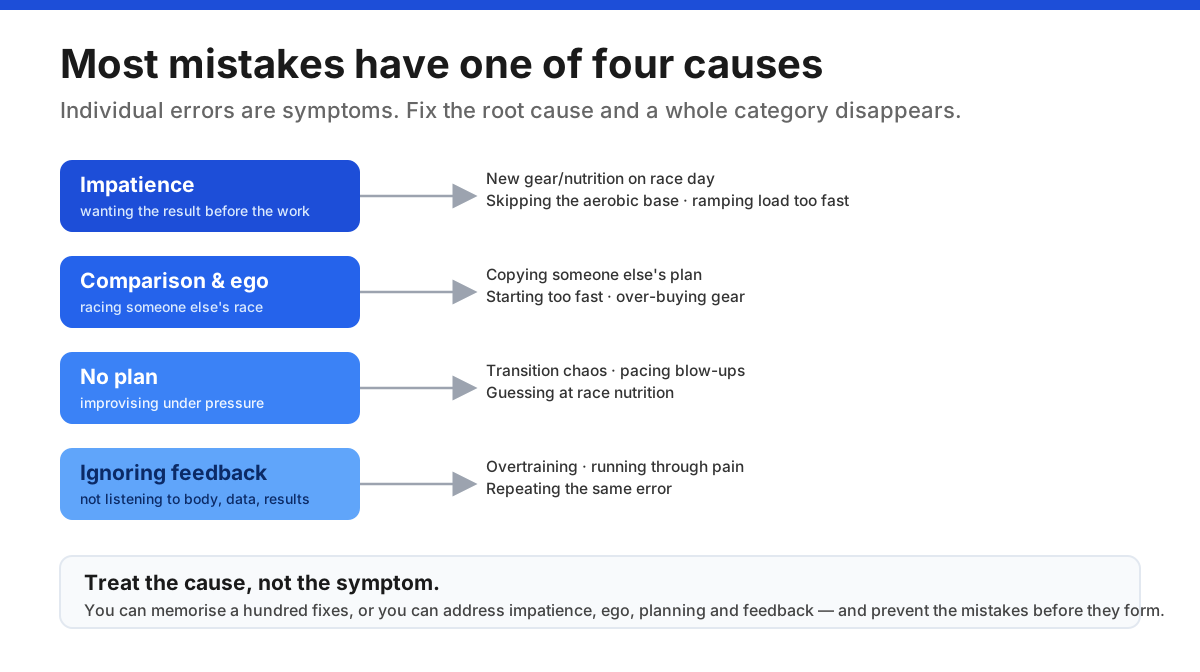
There are plenty of lists of triathlon mistakes; this is the guide to the patterns underneath them. Almost every common error traces back to one of four root causes — impatience, comparison, having no plan, and ignoring feedback — and your mistakes also change as you move from first-timer to improver to veteran. Learn to recognise the cause, run a simple pre-race self-audit, and build the habit of learning from each error, and you prevent whole categories of mistake instead of memorising a hundred separate fixes. For the specific list of errors and the fixes by domain, this pillar links to the guides that own each.
Key takeaways
- 1Almost every triathlon mistake traces to one of four root causes: impatience, comparison and ego, having no plan, or ignoring feedback — fix the cause and a whole category disappears.
- 2Your mistakes change as you improve: first-timers rush and over-buy, improvers overtrain and live in the grey zone, veterans over-optimise and under-recover.
- 3A short pre-race self-audit — nothing new, a written plan, your limiter, a recovery check — catches most errors before the start line.
- 4Learning from a mistake is a skill: review honestly, change one thing at a time, and separate a genuine mistake from bad luck.
- 5This is the 'why' guide — for the specific top mistakes and the fixes by topic, follow the linked pillars rather than reading one giant list.
In this article
- 1Mistakes are symptoms — look for the cause
- 2The four root causes — and what each one produces
- 3Your mistakes change as you improve
- 4A pre-race self-audit that catches most mistakes
- 5How to actually learn from a mistake
- 6Where each kind of mistake gets fixed
- 7The meta-mistake: forgetting why you started
- ⚖The four root causes of triathlon mistakes
- ?Frequently asked questions
Mistakes are symptoms — look for the cause
Search for triathlon mistakes and you will find no shortage of lists: go out too fast, wear new shoes on race day, skip your bricks, underfuel. Those lists are useful, and we have one — the top 10 triathlon mistakes beginners make — but memorising errors one by one is a losing game. There are always more mistakes than you can remember, and new ones appear as you progress.
This guide takes the other approach. Almost every common triathlon mistake is a symptom of one of a few underlying causes. Treat the cause and you prevent a whole family of errors at once, without having to have read about each one first.
There are four root causes, shown in the map above:
- Impatience — wanting the result before you have done the work.
- Comparison and ego — racing and training someone else's race instead of your own.
- No plan — improvising decisions in the moment, under fatigue and adrenaline.
- Ignoring feedback — not listening to your body, your data or your past results.
The rest of this page unpacks each cause, shows how your mistakes shift as you gain experience, and gives you a system to catch your own. For mistakes tied to a specific distance, there is a dedicated guide to triathlon mistakes by distance; this one is about the patterns that apply at every distance.
The four root causes — and what each one produces
Each root cause reliably generates its own cluster of mistakes. Learn to recognise the cause in yourself, because the fix is almost always the same across the whole cluster.
Impatience is the desire to skip ahead. It shows up as trying new gear or nutrition on race day, neglecting the slow aerobic base in favour of exciting hard sessions, and ramping training load too fast. The fix is a mindset: fitness and durability are built by repeatable work over months, and sudden jumps in load are linked to higher injury risk. Slow down to speed up.
Comparison and ego is measuring yourself against other athletes. It produces copying someone else's training plan, buying gear you do not need because a faster rider has it, and — most costly of all — starting the race at someone else's pace. The fix is to run your own race, on your own plan, at your own current fitness.
No plan is improvising. Without a rehearsed plan you get transition chaos, pacing blow-ups, and race nutrition decided on the fly. The fix is to decide in advance and rehearse: a pacing plan, a transition routine, a fuelling plan you have tested.
Ignoring feedback is pushing on regardless of the signals. It produces overtraining, running through sharpening pain, and repeating the same error race after race. The fix is to treat your body, your data and your results as information to act on, not noise to override.
The table below maps each cause to its typical mistakes and its one-line fix.
Your mistakes change as you improve
The other reason a single list of mistakes falls short is that different athletes make different mistakes. The errors that threaten your race evolve as you gain experience.
The first-timer is driven mostly by fear and excitement. The classic mistakes are starting the swim far too fast, being overwhelmed by gear and buying too much of it, and treating the whole event as a performance test rather than a first finish. The antidote is simplicity and modest goals — the beginner triathlon guide is built around exactly this.
The improver — a season or two in — has usually fixed the beginner errors and acquired new ones. This is the classic era of overtraining, of running every session in a moderately-hard "grey zone" that is too easy to build speed and too hard to recover from, and of endlessly training their strongest discipline while neglecting their weakest. The fixes live in training basics and, for structured progress, how to improve your triathlon performance.
The experienced athlete rarely makes crude errors, but has subtler ones: chasing marginal gains and expensive equipment while under-recovering, over-optimising the plan, and — quietly — losing the enjoyment that started it all. The fix is often to do less, recover more, and reconnect with why they race.
Knowing which stage you are in tells you which mistakes to watch for — and stops you solving last season's problem while this season's goes unnoticed.
A pre-race self-audit that catches most mistakes
Most race-day mistakes are preventable with a short, honest check in the days before the start. Run this self-audit before every race and you will catch the majority of errors while there is still time to fix them:
- Nothing new. Is every item — shoes, tri suit, wetsuit, gels, drink mix — something you have already used in training? If anything is new, it is a risk. This single rule prevents a huge share of race-day disasters.
- Do I have a written pacing plan? Can you state, now, how hard you will swim, ride and run, and what you will do when adrenaline says go faster? If not, you are relying on improvisation. See race pacing strategy.
- Have I rehearsed transitions and fuelling? Are your transition routine and your fuelling plan things you have actually practised, not just read about? Rehearse them — transition strategy and race fuelling cover each.
- What is my limiter, and am I respecting it? Know your weakest discipline and your recovery state. Arriving tired or over-raced is a mistake made in the weeks before, not on the day.
- Am I recovered? Have you actually taken the easy days and the taper, or quietly added work? Persistent fatigue going into a race is a red flag — the recovery week and deload guide explains why.
Five questions, a few minutes, and most of the classic errors are caught before they can happen.
How to actually learn from a mistake
The most expensive mistake is the one you make twice. Improving athletes are not the ones who never err — they are the ones who turn each error into a change. That is a skill, and it has a method:
- Debrief every race and hard block. Soon after, write down what went well, what went wrong, and why. Memory fades and flatters; a written note does not.
- Change one thing at a time. If three things went wrong, resist overhauling everything. Pick the highest-value change, apply it, and see what happens. Wholesale changes make it impossible to know what worked.
- Separate a mistake from bad luck. A flat tyre is bad luck; not carrying a spare is a mistake. Punishing yourself for luck, or excusing a real error as luck, both prevent learning. Ask honestly which it was.
- Look for the root cause, not the surface. "I went out too fast" is a symptom; "I had no pacing plan and got swept up comparing myself to others" is the cause. Fix the cause.
- Repeat the review, not the mistake. A one-success, one-problem, one-change note after each key session or race is enough to keep you moving forward.
Done consistently, this quiet habit compounds — it is how the same mistakes stop reappearing season after season.
Where each kind of mistake gets fixed
Because this guide is about the patterns rather than the particulars, here is a quick map from the category of mistake to the guide that fixes it in detail. Use it as a directory when the self-audit above flags something:
- Training too hard / grey-zone running → triathlon training basics and run training
- Pacing blow-ups → race pacing strategy
- Race nutrition errors → race fuelling
- Transition chaos → transition strategy
- Buying the wrong gear → first triathlon gear essentials
- Overtraining / poor recovery → recovery weeks and deloads
- Losing motivation → staying motivated in training
- The specific top errors, with fixes → top 10 triathlon mistakes
- Errors specific to your race distance → triathlon mistakes by distance
This is what makes the difference between a list you read once and a system you can return to: when you notice a mistake, you know both why it happened and exactly where to go to fix it.
The meta-mistake: forgetting why you started
There is one mistake that sits above all the others, and experienced athletes are more prone to it than beginners: forgetting why you started. It is possible to optimise, analyse and self-audit your way into treating a hobby like a job, until the sport that was supposed to add something to your life quietly starts subtracting from it.
Avoiding mistakes is in service of a good race and a sustainable, enjoyable relationship with the sport — not the other way around. Your first race is about finishing and about proving to yourself that you can. There will be plenty of seasons to chase times. Keep the self-audits, keep learning from errors, but hold them lightly. The athletes who last are the ones who stay curious and keep enjoying it — and enjoyment, it turns out, is also what makes the discipline sustainable enough to avoid most mistakes in the first place.
The four root causes of triathlon mistakes
| Root cause | What it produces | The one-line fix |
|---|---|---|
| Impatience | New gear on race day, no base, load ramped too fast | Repeatable work over months beats heroics |
| Comparison & ego | Wrong plan, over-buying, starting too fast | Run your own race, on your own plan |
| No plan | Transition chaos, pacing blow-ups, nutrition guesswork | Decide in advance and rehearse it |
| Ignoring feedback | Overtraining, running through pain, repeat errors | Treat body, data and results as information |
Sources
Sources are listed so readers can verify consequential claims and dated details.
- Training-load changes and injury: systematic review — International Journal of Sports Physical Therapy (accessed September 18, 2026)
- The training intensity distribution among well-trained and elite endurance athletes — Frontiers in Physiology (2015) (accessed September 18, 2026)
Frequently asked questions
What is the single most common triathlon mistake?
On race day it is starting too fast — usually on the swim — because adrenaline and comparison override any pacing plan. But that is a symptom: the underlying cause is racing someone else's race without a plan of your own. Fix the cause (a written, rehearsed pacing plan you commit to) and the too-fast start, along with several related errors, largely disappears.
Why do I keep making the same mistakes?
Usually because you are treating the symptom rather than the cause, or not reviewing honestly. After each race or hard block, write down what went wrong and why, identify which root cause it traces to — impatience, comparison, no plan, or ignoring feedback — and change one thing. Repeating the review is what stops you repeating the mistake.
Do experienced triathletes still make mistakes?
Yes, just different ones. Beginners rush, over-buy and start too fast; improvers overtrain and drift into grey-zone training; experienced athletes tend to over-optimise marginal gains while under-recovering, and can lose the enjoyment that motivates them. Knowing your stage tells you which mistakes to watch for rather than solving a problem you already fixed.
How do I find my own mistakes before they cost a race?
Run a short pre-race self-audit: confirm nothing on your kit or nutrition list is new, that you have a written and rehearsed pacing and transition plan, that you know your limiter, and that you are genuinely recovered rather than quietly over-raced. Five honest questions in the days before a race catch most classic errors while there is still time to fix them.
How is this different from a 'top triathlon mistakes' list?
A top-mistakes list tells you what the common errors are and how to fix each one, which is exactly what our top 10 guide does. This guide explains why those mistakes happen — the four root causes behind them, how they change with experience, and a system to diagnose your own — so you can prevent whole categories rather than memorising fixes one at a time. Use both together.