Best Triathlon Watches Under $300: A Beginner Buying Guide
How to choose a triathlon watch under $300: the multisport features that matter, how to match battery to your race distance, which ecosystem to buy into, and when used beats new.
By Lotte
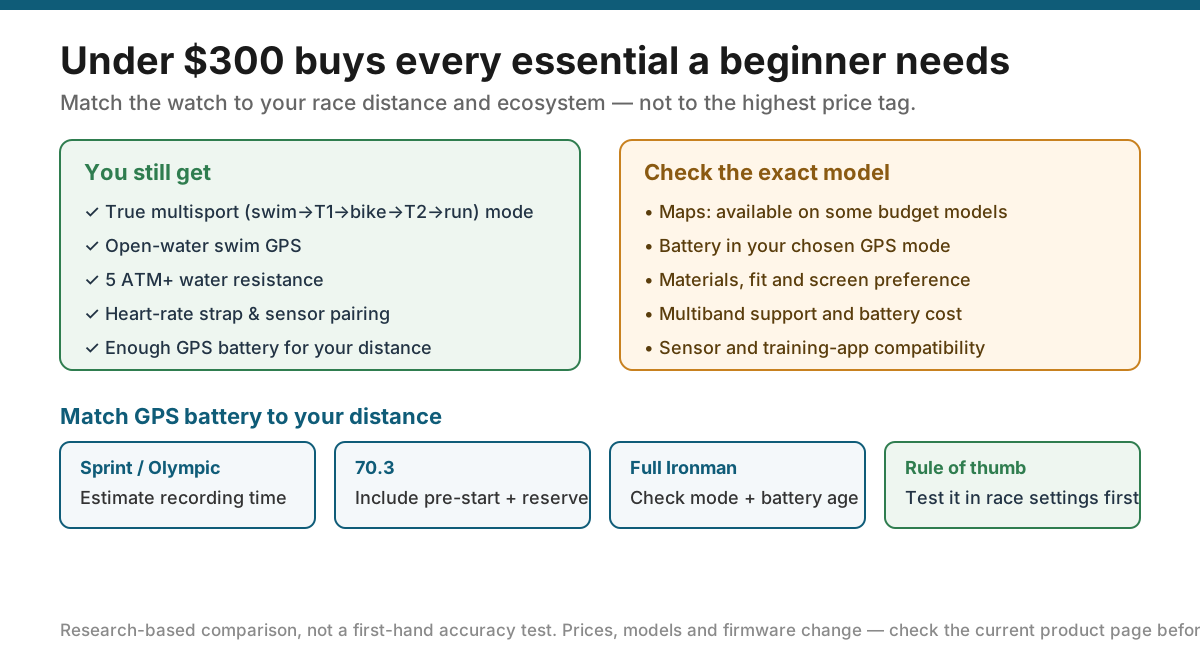
You do not need a $900 watch to train and race triathlon well. Watches under $300 now include true multisport mode, open-water swim tracking and external-sensor support. But 'best under $300' is not one answer: it depends on your race distance, which software ecosystem you want to live in for years, and whether a used previous-flagship beats a new budget model. This guide gives you the framework to choose confidently, names representative picks in each category, and is honest about what a budget watch does and does not give up.
Key takeaways
- 1A good sub-$300 watch covers everything a beginner-to-70.3 athlete needs — the price gap to premium is mostly maps, materials and battery
- 2The one non-negotiable is true multisport mode; a running watch without it requires a different recording workflow
- 3Match GPS battery to your distance — it is the spec that rules some budget watches out for long course
- 4You are buying into a software ecosystem (Garmin, Coros, Polar, Suunto) as much as a watch
- 5A used or previous-generation flagship can beat a new budget watch for the same money
In this article
- 1Quick answer: what to get under $300
- 2What 'under $300' actually buys you now
- 3The one feature you cannot compromise on: multisport mode
- 4Match GPS battery to your race distance
- 5The main choices under $300, by category
- 6You are choosing an ecosystem, not just a watch
- 7When a used or last-gen watch beats a new budget one
- 8Features that matter — and ones you can skip
- 9What to skip entirely
- 10Set it up right for your first race
- 11Is a budget watch enough? Where to go next
- ⚖Budget shortlist — US prices checked 23 September 2026
- ?Frequently asked questions
Quick answer: what to get under $300
Start with the COROS PACE 3 for a lower-cost multisport option, or the PACE Pro if you want an AMOLED display and onboard maps near the top of the budget. COROS currently lists US prices of $199 and $299 respectively. These are manufacturer-listed prices checked 23 September 2026, before tax and shipping; availability and regional totals can differ.
If you want Garmin Connect, look for a discounted or used Forerunner 255-series watch below your budget. Do not assume a cheaper Forerunner has the same functions: the 55 lacks native triathlon mode and open-water swim tracking; the 165 supports open-water swimming but lacks native triathlon mode. They can record individual workouts, but are not equivalent multisport recommendations.
Choose by your actual race workflow, sensors and battery needs. The sports watches explainer covers the wider category; this guide concentrates on choosing within a $300 US watch-only budget.
What 'under $300' actually buys you now
A carefully chosen watch in this budget can provide a native triathlon profile, open-water swimming, compatible external sensors and GPS recording for training and racing. Price alone does not establish any of those features: check the exact model and its current manual.
Premium materials and extra battery capacity can increase cost, but maps and AMOLED screens are no longer automatically outside this bracket. The PACE Pro, for example, offers both at its listed $299 US price. Decide whether you would use those extras before spending to the limit.
Keep the total cost visible. Tax, shipping, a replacement strap or a required charging accessory can push a watch-only price over a strict $300 allowance. An inexpensive watch that works with your existing equipment may be a better purchase than a sale model requiring new sensors. These are specification-based suggestions, not hands-on accuracy rankings.
The one feature you cannot compromise on: multisport mode
If you remember one thing, make it this. A real triathlon watch has a multisport mode that chains swim → T1 → bike → T2 → run into a single activity, advancing with one press per transition. Without it you would be stopping and starting three separate activities mid-race, fumbling in transition, and needing another way to record transition times.
This is the exact trap of shopping on price alone: plenty of sub-$300 running watches and fitness trackers look capable but lack a true triathlon/multisport profile. Before you buy anything, confirm the product page explicitly lists a triathlon or multisport activity (not just separate swim, bike and run modes) and an open-water swim profile. Everything else on this page is a matter of degree; multisport mode is pass/fail. For how the mode actually works in a race, the sports watches guide walks through it.
Match GPS battery to your race distance
Choose battery capacity by expected recording time and settings, not by distance alone. Count pre-start recording, the whole race including transitions, and a reserve for delays or slower progress. Then compare that total with the manufacturer's figure for the GPS mode you intend to use.
For an illustrative seven-hour race with half an hour of pre-start use and a two-hour reserve, you would plan around 9.5 hours of recording. That reserve is a planning example, not a guarantee or a minimum for every athlete. A long-course athlete needs a different calculation; there is no universal requirement for a 30-hour watch.
Manufacturer battery figures are estimates under stated conditions. Screen settings, navigation, music, satellite mode, cold and battery age can change real use. A power-saving mode may reduce recording detail, so check its trade-offs before depending on it.
Test a long session in the actual race settings, note the battery remaining, and allow a conservative margin. A used watch deserves particular attention because the original advertised capacity may no longer represent its battery. Do not use smartwatch-days figures as if they were continuous-GPS hours.
The main choices under $300, by category
These are specific candidates, with a clear distinction between listed-price options and conditional deals:
- Lower-cost new option: COROS PACE 3. Listed at $199 US. Its manufacturer specifies up to 38 hours in standard GPS mode, and COROS's mode table lists triathlon and open-water swimming. Choose it if the basic race workflow meets your needs.
- Screen and maps option: COROS PACE Pro. Listed at $299 US, with AMOLED and offline maps. COROS advertises up to 38 hours in all-systems GPS mode and 31 in dual-frequency mode; these modes are not identical to the PACE 3's standard-GPS figure.
- Garmin option when the deal qualifies: Forerunner 255 series. The official manual documents triathlon and custom multisport activities. Consider it only when the actual discounted or used price fits your budget; we have not verified a current sub-$300 offer.
- Conditional sale option: Suunto Race S. The US manufacturer's page displayed $279 against a $349 reference price during this review. Treat that as a temporary offer, not its permanent price, and check stock and checkout total.
The COROS product listing, Garmin 255 manual and Suunto Race S page let you verify the relevant claims. Recheck pricing before purchase. We do not rank sensor accuracy or comfort without comparative testing.
You are choosing an ecosystem, not just a watch
This is the most overlooked part of a budget decision. When you buy a watch you are also committing to that brand's software and sensor ecosystem — the app you will open every day, the training and recovery metrics, the accessory compatibility and the way your data syncs to platforms like Strava or TrainingPeaks. You will live with that choice far longer than you spend comparing spec sheets.
Broadly: Garmin uses Connect with a broad range of compatible accessories; Coros is lean, light and battery-focused with no subscription; Polar leans into heart-rate-based training and recovery guidance; Suunto emphasises build and mapping. None is wrong, but switching later means relearning an app and sometimes rebuying sensors. Pick the ecosystem you will enjoy using, because a watch you understand and check daily beats a marginally better one you find frustrating.
When a used or last-gen watch beats a new budget one
The smartest budget move is often not buying new. Triathlon watches hold their core function for years, so a previous-generation flagship — bought used or discounted — can offer better build, battery, mapping and screen than a brand-new entry-level model at the same price.
When buying used, take the same care you would with any second-hand kit: confirm the exact model, check battery health if you can, make sure it still receives firmware updates, and verify it pairs with the sensors you own or plan to buy. A discontinued watch that no longer supports current sensors or apps is a false economy. But a well-kept flagship from a generation or two ago, or a current model bought in a sale, frequently delivers more watch per dollar than the newest budget release — worth checking before you buy new.
Features that matter — and ones you can skip
Beyond multisport mode and battery, here is how to weigh the rest at this price:
Worth having if it fits the budget:
- External heart-rate strap pairing. Wrist heart rate is convenient but unreliable in the cold swim and during hard or cold efforts; independent research into optical wrist sensors shows their accuracy degrades with motion, poor contact and cold. A compatible chest strap can be useful on the bike and run; underwater transmission and stored swim data require model-specific support — see heart rate monitors.
- Dual-band (multiband) GPS. Research on dual-frequency positioning shows it meaningfully cuts errors in cities, forests and canyons, where reflected signals wreck single-band accuracy. It helps less on open roads and drains battery faster, so it is a bonus, not a must.
- Power-meter pairing if you plan to train with power later.
You can skip on a budget: music storage (your phone handles it), contactless payment, solar charging (marginal real-world gain), and premium always-on AMOLED screens. None of these affects whether you finish or pace a race well.
What to skip entirely
Some watches are tempting at the price but wrong for triathlon. Give a wide berth to: fitness trackers and lifestyle smartwatches without a true multisport profile, general smartwatches whose battery cannot survive a long race, and budget GPS watches whose open-water swim tracking is poor or whose 'tri mode' is not clearly published.
A premium smartwatch you already own can be a fine training companion, and for a short pool-based first race almost anything that records your effort is enough. But if you are spending money specifically to race, spend it on a watch built for multisport rather than a general-purpose device that merely claims to do it. When in doubt, come back to the pass/fail test: a clearly listed triathlon/multisport mode and an open-water swim profile. Before stacking up accessories, make sure the rest of your kit is sorted with first triathlon gear essentials.
Set it up right for your first race
The cheapest performance gain is a watch you have set up and rehearsed before race morning:
- Pair compatible sensors in advance. Do not assume a normal strap sends reliable live data underwater; check swim compatibility and stored-data support.
- Build the multisport activity beforehand, with your data fields chosen (time, distance, heart rate or power) and auto-features set the way you want them.
- Practise the transition press at home so advancing between legs is automatic under pressure.
- Charge fully the night before, and if it is a long race, switch to the GPS/battery mode you tested in training.
- Silence notifications for the race so they neither drain the battery nor distract you.
A budget watch set up well outperforms a premium watch you are fumbling with. Fold this into your wider race-day preparation and race-week routine so the watch is one less thing to think about.
Is a budget watch enough? Where to go next
For the vast majority of age-group triathletes, a well-chosen sub-$300 watch is genuinely enough — it will take you from a first sprint through 70.3 and, with the right battery, an Ironman, and it will collect every metric you actually train and race with. Spending more mostly buys maps, materials, battery headroom and analysis polish, none of which decides your race.
Step up in price only when you have a concrete reason: you want full onboard maps for long adventure rides, you regularly race ultra-distance and need enormous battery, or you have outgrown your watch's training features. When you are ready to compare more widely, use the sports watches explainer for how these watches work, the 2026 triathlon watch buying guide and the comparison by use case for the full field, and Garmin Forerunner vs Fenix if you are weighing a specific Garmin step-up.
Budget shortlist — US prices checked 23 September 2026
| Watch | Price basis | Reason to consider | Check before buying |
|---|---|---|---|
| COROS PACE 3 | $199 listed | Lower-cost native multisport | Screen, sensor compatibility and GPS settings |
| COROS PACE Pro | $299 listed | AMOLED and offline maps | Tax, shipping and charging accessories |
| Garmin Forerunner 255 series | Only if a deal is below $300 | Native triathlon and Garmin Connect | Exact variant, condition and current price |
| Suunto Race S | $279 displayed sale; $349 reference | AMOLED and offline maps | Offer expiry, stock and checkout total |
Sources
Sources are listed so readers can verify consequential claims and dated details.
- COROS US product prices — COROS (accessed September 23, 2026)
- PACE 3 specifications — COROS (accessed September 23, 2026)
- PACE Pro specifications — COROS (accessed September 23, 2026)
- Supported workout modes — COROS (accessed September 23, 2026)
- Forerunner 255 triathlon training — Garmin (accessed September 23, 2026)
- Forerunner 55 specifications — Garmin (accessed September 23, 2026)
- Forerunner 165 specifications — Garmin (accessed September 23, 2026)
- Race S US listing — Suunto (accessed September 23, 2026)
- Accuracy of Distance Recordings in Eight Positioning-Enabled Sport Watches: Instrument Validation Study — JMIR mHealth and uHealth (accessed September 22, 2026)
- Inherent Limitations of Smartphone GNSS Positioning and Effective Methods to Increase the Accuracy Utilizing Dual-Frequency Measurements — Sensors (MDPI) (accessed September 22, 2026)
- Investigating sources of inaccuracy in wearable optical heart rate sensors — npj Digital Medicine (accessed September 22, 2026)
Frequently asked questions
Do I really need a triathlon watch, or can I use my smartwatch?
For a short pool-based first race, almost any device that records your effort is fine. You can race without a watch. For a continuous recording with transitions, choose a native multisport profile and sufficient tested battery. If you already own a capable smartwatch, use it to start; if you are buying specifically to race, buy a watch built for multisport.
What is the single most important feature under $300?
True multisport (triathlon) mode. It chains swim, bike and run into one activity with a press per transition and records your transition times. Separate activity modes can still record training, but require more manual steps during a race. Check the exact workflow before buying.
Will a watch under $300 last a full Ironman?
Some will and some won't — it depends on the model and GPS mode. Compare your expected total recording time plus a reserve with the specified GPS mode; there is no universal 15- or 30-hour requirement. Always test a long session in your intended race settings, because quoted figures are best-case.
Is it better to buy a used flagship or a new budget watch?
Often the used or previous-generation flagship wins, because triathlon watches keep their core function for years and you get better build, battery and mapping for the same money. Check the exact model, battery health, continued firmware support and sensor compatibility before buying used, and avoid anything that no longer works with current sensors or apps.
Do I need dual-band GPS on a budget watch?
It is a bonus, not a requirement. Dual-band (multiband) GPS meaningfully improves accuracy in cities, forests and canyons where signals reflect, but makes little difference on open roads and uses more battery. If it fits the budget and you train in tricky environments, take it; otherwise single-band is perfectly usable.
Does the brand ecosystem really matter?
Yes — more than most people expect. You will use the brand's app daily and may buy into its sensors, so choose the ecosystem you will actually enjoy: Garmin for the biggest app and accessory range, Coros for lean, long-battery simplicity, Polar for heart-rate-led training, Suunto for build and maps. Switching later means relearning an app and sometimes rebuying kit.