Heart Rate Monitors for Triathlon: Chest Strap vs Optical
Chest strap, arm band or wrist optical? Compare heart rate monitor types for triathlon by accuracy, swim recording, connectivity and comfort — and pick the right one.
By Lotte
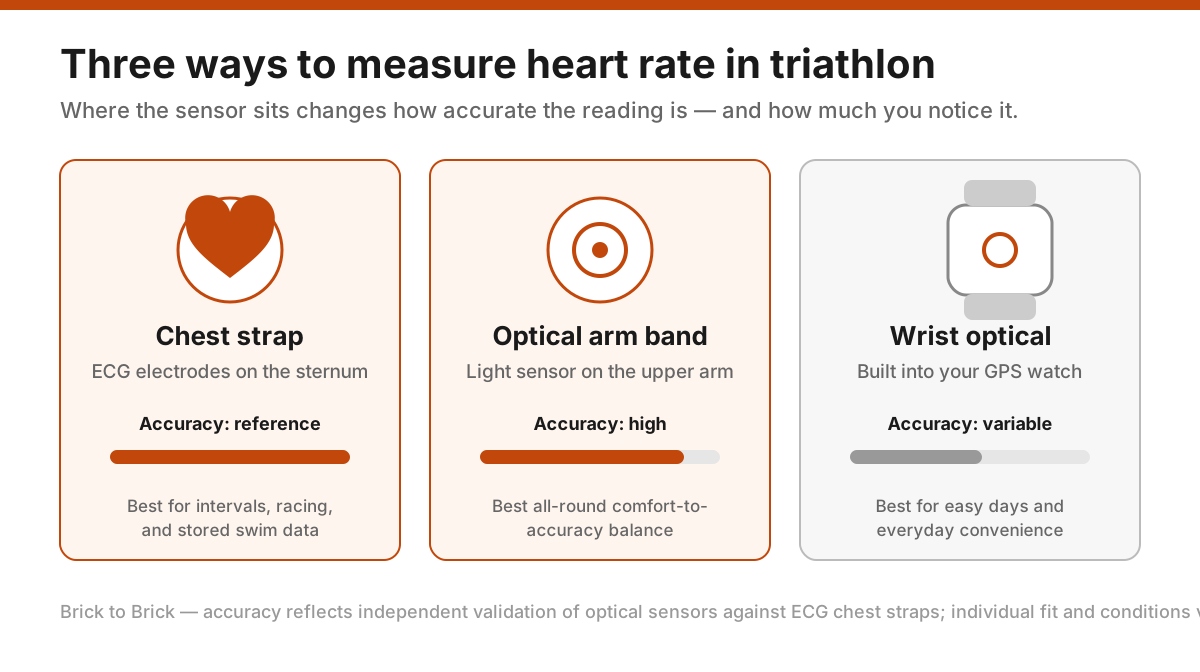
For triathlon, the choice is between three sensor types, not dozens of models. A chest strap reads your heart's electrical signal and is the accuracy reference — best for intervals, racing and recording the swim. An optical arm band is nearly as accurate and far more comfortable. Your watch's wrist optical sensor is the most convenient but the least reliable when you sweat, grip the bars or push hard. Most triathletes are best served by a chest strap for key sessions plus the wrist sensor for easy days.
Key takeaways
- 1There are three form factors, each measuring differently: chest straps use ECG electrodes; arm bands and watches use optical (light-based) sensors
- 2Chest straps are the accuracy reference and the only type that reliably stores heart rate through the swim leg
- 3An optical arm band (worn on the upper arm) is the best comfort-to-accuracy balance — independent testing puts it close to a chest strap
- 4Wrist optical is convenient but degrades with motion, cold, poor fit and rapid intensity changes — fine for easy days, weak for intervals
- 5Connectivity matters: look for both ANT+ and Bluetooth so one sensor pairs with your watch, bike computer and indoor apps at once
In this article
- 1Which heart rate monitor should a triathlete buy?
- 2The three types at a glance
- 3How each type actually measures your heart
- 4Chest straps: the accuracy reference
- 5Optical arm bands: the comfort-accuracy sweet spot
- 6Wrist optical: convenient, but know its limits
- 7Buying criteria that actually matter
- 8Getting accurate, dropout-free readings
- 9Turning the data into better training
- 10Do you actually need one — and what to buy
- ⚖Heart rate monitor types compared
- ?Frequently asked questions
Which heart rate monitor should a triathlete buy?
Short answer: buy a chest strap if you can only own one sensor, and add your watch's wrist sensor for free. A chest strap is the most accurate option, it works across swim, bike and run, and — unlike the sensor already on your wrist — it can store heart rate underwater for the swim leg. If a chest strap chafes or you dislike the band, an optical arm band worn on the upper arm is the next best thing and, in independent testing, sits remarkably close to a strap.
The decision is really about form factor, not brand. There are only three ways to wear a heart rate sensor in triathlon:
- Chest strap — electrodes on an elastic band around your sternum. The accuracy reference.
- Optical arm band — a light-based sensor in a band on your upper arm or forearm.
- Wrist optical — the sensor already built into your GPS multisport watch.
Pick the placement that fits how you train and race, then choose a well-supported model within it. The rest of this guide explains why the three differ and how to choose between them.
The three types at a glance
Use this to narrow the field before you look at any specific product. "Accuracy" here is relative to a medical ECG, which chest straps approximate most closely.
| Type | How it measures | Accuracy | Records the swim? | Comfort | Best for |
|---|---|---|---|---|---|
| Chest strap | ECG electrodes | Reference (highest) | Yes, stored then synced | Can chafe; some dislike the band | Intervals, racing, the swim, anyone who wants trustworthy data |
| Optical arm band | Optical (PPG) on upper arm | High | Some models store it | Very comfortable | Athletes who dislike a strap but still want reliable numbers |
| Wrist optical (watch) | Optical (PPG) at the wrist | Variable | Not usefully | You already wear it | Easy days, everyday tracking, a free starting point |
A chest strap and a wrist sensor are not competing purchases — most triathletes end up using both: the strap for sessions where the number matters, the watch for everything else.
How each type actually measures your heart
The accuracy gap between the types is not marketing — it comes from two different technologies.
Chest straps use ECG (electrocardiography). Electrodes in the band detect the small electrical signal your heart produces with each beat. This is the same physical signal a clinical ECG reads, which is why straps are treated as the reference standard in sports-science studies and why they respond almost instantly to a change in effort.
Arm bands and watches use PPG (photoplethysmography), an optical method. An LED shines light into your skin and a sensor measures how much is reflected back as blood pulses through. It is clever and non-invasive, but the signal is easily disturbed by movement, poor skin contact, cold constricting surface blood vessels, tattoos and even skin tone in some conditions. That is why optical readings can lag or jump during hard efforts.
Placement is the reason arm bands beat watches. In a 2025 device-validation study, an upper-arm optical sensor tracked an ECG chest strap almost perfectly (mean absolute percentage error around 1.3%), while a wrist optical sensor was markedly more variable, especially at rest and low intensity where wrist motion and loose fit create noise. The upper arm is a stabler, better-perfused platform than the wrist, which is why serious optical monitors are worn there.
Chest straps: the accuracy reference
If you do structured intervals, race by heart rate, or simply want to trust the number, a chest strap is the default recommendation. It responds instantly, holds accuracy during hard efforts and vibration, and is the only practical way to capture the swim.
Swim recording is the underrated feature. Your watch cannot read your wrist reliably underwater, and it usually cannot receive a live signal through water anyway. A capable strap gets around this by storing heart rate internally during the swim and syncing it to your watch afterwards. Garmin's HRM-Pro Plus, for example, records heart rate while out of range of the watch and transfers it when the activity ends; the Polar H10 keeps one session in internal memory. Confirm the exact record-and-transfer workflow for your watch before you rely on it — a waterproof rating alone does not mean the data reaches your file.
The trade-offs are comfort and admin. The band can chafe on long runs (a little lubricant on the electrodes and skin helps), it needs to be damp to read well at the start, and it is one more thing to wash, charge or re-battery. For a deeper comparison of specific straps — including swim-memory behaviour — see our guide to the best heart rate chest straps for triathletes.
Optical arm bands: the comfort-accuracy sweet spot
An optical arm band gives you most of a chest strap's reliability with none of the sternum discomfort. Worn on the upper arm or forearm, it is the answer for athletes who have given up on straps but still want numbers they can train by.
Popular options include the Polar Verity Sense and Wahoo TICKR FIT. The Verity Sense adds internal memory and can be used for swimming (often clipped to a goggle strap so the sensor sits against the temple), which partly closes the gap with a chest strap for the swim leg.
The limitations are still optical: it must be snug and positioned on muscle rather than bone, and it can be disturbed by a tight wetsuit sleeve or arm-warmer edge. But for run and bike training, a well-fitted arm band is close enough to a strap that most age-groupers will never notice the difference. If comfort is the reason you don't currently wear a monitor, start here.
Wrist optical: convenient, but know its limits
The sensor on the back of your multisport watch is the most convenient monitor you own — you're already wearing it, there's nothing extra to charge, and for easy runs and daily resting-heart-rate trends it is perfectly adequate.
It struggles in exactly the situations triathlon creates:
- Rapid intensity changes (intervals, race starts) where the reading lags real effort.
- Cycling, where gripping the bars flexes the wrist and cuts skin contact.
- Cold weather, which reduces blood flow to the wrist.
- A loose or high-on-the-arm fit, the single most common cause of bad data.
To get the best from it: wear the watch snugly, about a finger's width above the wrist bone, and tighten it a notch for hard sessions. Even then, treat wrist data on intervals as approximate. If you are choosing the watch itself, our multisport GPS watch guide covers which models pair with an external strap — the ideal setup is a good watch plus a chest strap for the sessions that matter.
Buying criteria that actually matter
Once you've chosen a form factor, these are the specifications worth checking — most are more important than the brand on the box.
Connectivity — get both ANT+ and Bluetooth. ANT+ can broadcast to many devices at once (watch, bike computer, gym equipment) while Bluetooth typically pairs with one or two apps. A dual-band sensor future-proofs you and lets one strap feed your watch and a training app like Zwift simultaneously. The Polar H10 supports one ANT+ plus two Bluetooth connections; Garmin's HRM-Pro Plus broadcasts on ANT+ and Bluetooth together — check the exact number of concurrent connections if you use several devices.
Battery type. Most straps use a user-replaceable coin cell (the H10 uses a CR2025, the HRM-Pro Plus a CR2032, each lasting many months). Arm bands are usually rechargeable. Replaceable coin cells mean no charging routine but an occasional battery to buy; rechargeables mean one more thing on the charger.
Swim capability. If you want swim heart rate, confirm two separate things: that the sensor is waterproof enough, and that it stores and transfers the data to your watch. These are different features.
Fit and sizing. A strap or band that is too loose is the number-one cause of dropouts and phantom spikes. Check the size range and, for straps, whether the strap is replaceable and machine-washable.
Getting accurate, dropout-free readings
Most "my heart rate monitor is broken" complaints are fit or contact problems, not faulty hardware. A few habits fix almost all of them.
- Wet the electrodes on a chest strap before you start — dry electrodes give erratic readings for the first few minutes. Water works; electrode gel works better in dry conditions.
- Fit it snug and in the right place. A strap sits just below the pecs, high enough not to slide; an arm band sits on muscle on the upper arm; a watch sits above the wrist bone and firm.
- Beware the high-HR spike at the start of a ride. A reading that jumps to 190–210 in the first minutes, then settles, is usually static electricity or a dry strap picking up noise, not your real heart rate. Damp electrodes and a snug fit prevent it.
- Wash the strap regularly. Dried sweat and fabric softener residue insulate the electrodes and cause dropouts over time.
- Rule out cross-talk. If two sensors or a nearby athlete's device are in range, make sure your watch is paired to the correct one before you start.
Inspect a session afterwards rather than trusting the live screen alone: a flat line, an impossible spike or a section stuck at one value tells you the contact failed, and you can discount that data instead of training off it.
Turning the data into better training
A monitor only helps if you act on what it shows, and its single biggest value is enforcing easy days. Most age-group triathletes train their easy sessions too hard and their hard sessions too easy; a heart rate cap keeps easy aerobic work genuinely easy so the hard days can be hard.
To use the numbers well you need personal training zones, not the generic "220 minus age" estimate — set them from a field test and revisit them as fitness changes. Our heart rate zones explained guide walks through finding your zones, and the Training Zone Calculator turns your numbers into ranges.
Heart rate is not the only lens. On the bike, power measures output directly and reacts instantly, which is why many triathletes pair the two — see heart rate vs power for when each is more useful. And the same chest strap that guides your workouts can, first thing in the morning, inform heart rate variability as a recovery signal.
Do you actually need one — and what to buy
You can finish a triathlon without a heart rate monitor; perceived effort will get most beginners to the line. A monitor earns its place when you want to train by intensity, hold back on easy days, or understand a race that went wrong.
A simple decision path:
- Only want one device and value accuracy? Buy a dual-band chest strap and use it for key sessions.
- Hate the chest band? Buy an optical arm band instead — you'll actually wear it, which beats an accurate strap in a drawer.
- Just starting and budget-conscious? Use the wrist sensor on the watch you already own, and add a strap later when you begin structured training.
Before upgrading, weigh the cost against how much you'll use it with our gear-upgrade ROI calculator. The best monitor is the one that fits comfortably and connects to the devices you actually train and race with.
Heart rate monitor types compared
| Type | Technology | Accuracy | Swim recording | Power source | Typical price |
|---|---|---|---|---|---|
| Chest strap | ECG electrodes | Reference (highest) | Yes — stored & synced | Coin cell (months) | $50–$130 |
| Optical arm band | Optical (PPG), upper arm | High | Some models | Rechargeable | $80–$100 |
| Wrist optical | Optical (PPG), wrist | Variable | Not usefully | Watch battery | Included with watch |
Recommended gear
Affiliate disclosure: Brick to Brick may earn a commission from qualifying purchases, at no extra cost to you. Read our full affiliate disclosure. Unless a named method says otherwise, these are research-based recommendations rather than first-hand product tests.
Polar H10
Widely used as an accuracy reference; ANT+ plus two Bluetooth connections, CR2025 battery and one-session swim memory. A safe default chest strap.
View on AmazonGarmin HRM-Pro Plus
Chest strap that stores swim heart rate and adds running dynamics; broadcasts on ANT+ and Bluetooth. Best fit inside a Garmin ecosystem.
View on AmazonPolar Verity Sense
Optical upper-arm band with internal memory and a goggle-strap clip for swimming — the pick if a chest strap is uncomfortable.
View on AmazonWahoo TICKR FIT
Comfortable optical arm band with ANT+ and Bluetooth; a straightforward, strap-free option for run and bike training.
View on AmazonSources
Sources are listed so readers can verify consequential claims and dated details.
- Wrist-Worn and Arm-Worn Wearables for Monitoring Heart Rate During Physical Activities: Device Validation Study — JMIR Cardio (accessed September 16, 2026)
- Polar H10 heart rate sensor — specifications (connectivity, battery, water resistance, memory) — Polar (accessed September 16, 2026)
- HRM-Pro Plus Owner's Manual (swim heart-rate storage, ANT+/Bluetooth, battery) — Garmin (accessed September 16, 2026)
Frequently asked questions
Chest strap or wrist sensor — which is more accurate for triathlon?
A chest strap. It reads your heart's electrical (ECG) signal directly, responds instantly to changes in effort and holds up during intervals and vibration. Wrist optical sensors use light through the skin and are more easily disturbed by motion, cold and loose fit, so they are best kept for easy days and everyday tracking.
Can any heart rate monitor record my heart rate during the swim?
Only ones that store the data internally. Your watch generally can't read your wrist reliably underwater or receive a live signal through water. Straps like the Polar H10 and Garmin HRM-Pro Plus store swim heart rate and transfer it to a compatible watch afterwards; some arm bands (e.g. Polar Verity Sense worn on a goggle strap) do too. Always test the record-and-sync workflow in a pool before race day.
Do I need ANT+ or Bluetooth?
Ideally both. ANT+ can broadcast to several devices at once — handy if you run a watch and a bike computer together — while Bluetooth pairs with phones and apps like Zwift. A dual-band sensor lets one strap feed everything and won't limit you if you add devices later.
Why does my heart rate jump to 200 at the start of a workout, then drop?
That is almost always a contact problem, not your real heart rate. Dry electrodes or a loose strap pick up electrical noise and static, especially in cold, dry conditions. Wet the electrodes, fit the strap snugly, and wash it regularly to remove sweat and softener residue that insulate the electrodes.
Is an optical arm band as good as a chest strap?
For run and bike training it is close. Worn on the upper arm, optical sensors like the Polar Verity Sense track a chest strap far more accurately than a wrist sensor does, because the upper arm is a stabler, better-perfused location. A chest strap still leads for instant response on hard intervals and for the swim, but a well-fitted arm band is an excellent choice if a strap is uncomfortable.