How to Choose a Triathlon Watch in 2026
Choose a triathlon watch in 2026 by multisport recording, race-mode battery, fit, sensors, useful data, app ecosystem and budget. This sourced buying framework helps you decide what to compare in current models.
By Lotte
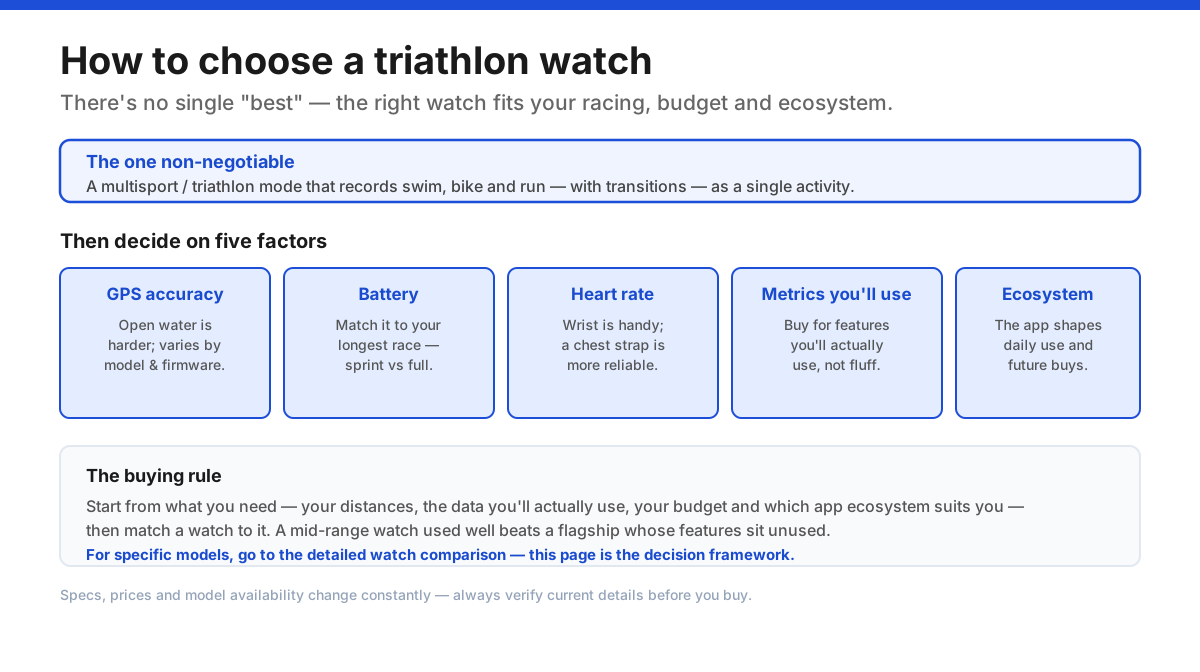
There is no universal best triathlon watch. This 2026 buyer's guide helps you identify the non-negotiable multisport function, choose battery headroom for your actual race mode, and weigh comfort, sensors, controls, useful training data, app ecosystem and budget. It is a decision framework rather than a hardware test or model ranking; the linked use-case comparison handles model-specific trade-offs.
Key takeaways
- 1There is no universal best triathlon watch; begin with multisport recording and the GPS battery mode you expect to use, then weigh fit, controls, sensors, app and budget.
- 2The one non-negotiable is a multisport / triathlon mode that records swim, bike and run as a single activity with transitions.
- 3GPS accuracy — especially in open water — varies between models and firmware, so check independent tests for the exact model and setting.
- 4Compare manufacturer battery figures in the GPS mode you would use for your longest event; screen, music, sensors and settings can change runtime.
- 5Buy for the metrics, controls and companion app you will actually use; premium features matter only when they solve a real need.
In this article
- 1How to think about choosing a triathlon watch
- 2Do you even need a dedicated multisport watch?
- 3The one non-negotiable: multisport mode
- 4GPS and open-water accuracy
- 5Battery: match it to your longest race
- 6Heart rate and sensor compatibility
- 7Training metrics: which ones actually matter
- 8Ecosystem and app lock-in
- 9Budget: buy for your needs, not the top of the range
- 10Common buying mistakes
- 11The bottom line
- ⚖Choosing a triathlon watch: what to prioritise
- ?Frequently asked questions
How to think about choosing a triathlon watch
Ask "what's the best triathlon watch?" and you'll get a different answer from every review — because there isn't one. The best watch is the one that fits your racing, your budget and the app ecosystem you want to live in. A first-timer doing sprints and a long-course athlete chasing a sub-11 Ironman need very different things from the same shelf.
So this page is a decision framework, not a model ranking. It walks through the one feature you genuinely can't do without, then the handful of factors that actually separate watches, so you can work out what you need before you look at any product.
When you're ready for specific options, hand off to the pages built for that: the triathlon watch comparison by use case for matching models to how you'll use them, the best watches under $300 for value picks, the Garmin Forerunner vs Fenix comparison for that specific decision, and how multisport GPS watches work if you want to understand the technology first. Prices, specs and model availability change constantly, so this guide deliberately focuses on the durable decision, not this season's line-up.
Do you even need a dedicated multisport watch?
Before choosing one, it's worth asking whether you need one at all. You have roughly three options for capturing your training and races:
- A dedicated multisport watch — purpose-built for swim-bike-run, with a single activity that supports leg changes and transitions by button press or model-specific automatic features. If you train and race by data, this is the natural choice.
- A general GPS running watch or smartwatch — fine for run and bike, but many can't record a triathlon as one seamless activity, and battery or water handling may fall short.
- Your phone — usable for casual bike and run tracking, but impractical to swim with and to read on the move.
If you're racing triathlons and want your swim, bike and run in one file with reliable data, a dedicated multisport watch earns its place. If you only dabble, a watch you already own may be enough to start. Assuming you do want one, the rest of this guide is how to choose it — and the single feature that actually defines the category comes next.
The one non-negotiable: multisport mode
If a watch has only one triathlon feature, it must be a multisport (or triathlon) mode. This lets you record the whole race — swim, then bike, then run — as a single activity, moving between disciplines (and logging your transitions) with a button press rather than starting and stopping separate workouts.
Why it matters: without it, you're juggling three activities and losing your transition times, and you can't see the race as one continuous effort. With it, one press in T1 and T2 keeps everything flowing while your hands are busy with your helmet and shoes.
This is the true dividing line between a "GPS watch" and a "triathlon watch." Plenty of capable running watches and smartwatches lack a proper multisport mode, so it's the first box to tick — everything else on this page is about how well a watch does the rest.
GPS and open-water accuracy
GPS is how your watch measures distance, pace and your route, and its accuracy genuinely varies — an instrument-validation study of positioning-enabled sport watches found meaningful differences in recorded distance between models, so "it's a GPS watch" doesn't guarantee a trustworthy track.
Two triathlon-specific points:
- Open water is harder than the pool. Pool swims are usually tracked by the accelerometer counting lengths; open-water swimming relies on GPS fixes between strokes, which is inherently messier. Newer multi-band (dual-frequency) GNSS improves positioning, and research on GNSS accuracy shows dual-frequency measurements reduce error — useful if open-water swim data matters to you.
- It varies by model and firmware. Because accuracy differs between watches and even software versions, treat it as something to check (in independent reviews for the specific model) rather than assume from the brand.
If precise open-water tracking is important to you, prioritise a watch with strong multi-band GPS and a good review record for swim tracking — and don't be surprised if any watch's open-water line looks a little ragged.
Battery: match it to your longest race
Battery life is a model-specific filter, especially for a long-course athlete. Start with your expected race duration, then read the exact GPS/activity mode you plan to use. Compare it with enough headroom for your pace, pre-start time, transitions, sensors, navigation and any music. Do not rely on “smartwatch mode” or one headline maximum as a race estimate.
Manufacturer figures show why the mode matters. As a current 2026 example, Garmin’s Forerunner 970 manual lists up to 26 hours in GPS-only mode, 21 hours in all-systems plus multi-band GPS, and 12 hours in that multi-band mode with music. The manual also documents a triathlon activity that records the separate sport legs and transitions. These are manufacturer maxima under stated test conditions, not a guarantee of real-world runtime or an endorsement of this model. Cold, display settings, sensors and firmware can change actual battery use.
Use the same method for every watch you shortlist: find the exact regional manual, note GPS mode and add-ons, then compare that figure with your longest realistic event. There is no universal multiplier that creates a safe margin for every athlete or device. If the result leaves little room for your own event duration, choose a longer-life configuration or a different watch.
Display type is one factor among several, not a reliable substitute for model-specific battery data. Bright AMOLED and memory-in-pixel (MIP) screens are implemented differently across watches. Check independent battery tests in the setting closest to your use, then charge and rehearse the device before race day.
Heart rate and sensor compatibility
Optical heart rate measured at the wrist is convenient for general trends, but readings can vary with fit, motion, skin contact and exercise type. Research into wearable optical sensors describes these limits, so treat wrist heart rate as an estimate rather than a clinical measurement. If precise interval or swim heart rate matters to your training, check whether the watch supports a compatible external sensor and whether that sensor works for the activity you plan.
Also check compatibility with any bicycle power meter, cadence sensor, footpod, phone and training platform you already use. Do not assume every watch supports every sensor protocol or feature just because the brand sells the accessory. Confirm the exact model and firmware, then choose based on the data you will actually use. See heart-rate monitors for sensor types and data-driven triathlon training for using metrics in context.
Training metrics: which ones actually matter
Modern watches bury you in numbers, and it's easy to pay for features you'll never open. A rough hierarchy of what's genuinely useful:
- The essentials you'll use constantly: pace or power, heart rate, distance, and lap splits. These are the foundation, and every multisport watch does them.
- Useful weekly context: training-load and recovery indicators and sleep tracking can help you avoid doing too much — though treat them as guidance, not gospel.
- Nice-to-have estimates: VO2-max and race-predictor figures are interesting but approximate; don't make big decisions from them.
- Genuine fluff: most branded "AI coach" gimmicks, social features and on-watch music are rarely why a triathlete buys a watch.
The honest test: will you actually act on a metric? A watch showing the basics you use every day beats a pricier one full of dashboards you ignore. For turning any of these numbers into faster racing, see data-driven triathlon training.
Ecosystem and app lock-in
The factor buyers most often underrate is the ecosystem — the app and platform your watch feeds into. You'll interact with that app every day, far more than any single hardware feature, and it shapes how you review sessions, build workouts and share data with a coach or platform like TrainingPeaks or Strava.
Each major brand runs its own ecosystem with a different feel, and there's no universal winner — the smoothest experience usually comes from staying within one brand's world (watch, sensors, app), which is worth choosing deliberately because it also makes switching later more expensive. Before you commit to hardware, it's worth trying the companion app (many are free to explore) to see whether its layout and workflow suit you.
Think about integration too: if you already use a particular training platform, a cycling bike computer, or specific sensors, favour a watch that connects cleanly to all of it. Buying into an ecosystem is a longer-term decision than buying a watch.
Budget: buy for your needs, not the top of the range
Watches span an enormous price range, and more money mostly buys longer battery, better screens, more sensors and premium materials — not a fundamentally different core experience. Rather than think in fixed price brackets (which date quickly), think in needs-based tiers:
- Entry level covers the essentials — multisport mode, GPS, wrist heart rate, the core metrics — and is genuinely enough to train and race well, especially for shorter distances.
- Mid range adds better GPS, longer battery, richer training features and nicer screens. This is the sweet spot for most triathletes.
- Premium buys maximum battery, the best displays, rugged materials and the deepest feature set — worth it mainly for long-course athletes or those who'll use the extras.
The guiding principle: buy for what you'll use. A beginner rarely needs a flagship, and a mid-range watch used consistently beats a premium one whose features sit idle. Where a watch fits in your overall kit budget is covered in first-triathlon gear essentials.
Common buying mistakes
A few errors show up again and again:
- Buying the flagship as a beginner. You'll likely use a fraction of the features. Start where your needs are and upgrade when you know what you're missing.
- Ignoring the ecosystem. The app is a daily companion — try it before committing to the hardware it locks you into.
- Using a display label as a battery shortcut. Check GPS-mode figures and independent tests for the exact model; display type alone does not settle race runtime.
- Assuming GPS accuracy from the brand. It varies by model and firmware — check independent reviews, especially for open-water swim tracking.
- Paying for metrics you won't act on. If you won't change anything based on a number, you don't need to buy it.
- Trusting a dated "best of" list. Line-ups and prices change fast; verify current specs and availability before purchase.
The bottom line
There's no single best triathlon watch — only the best one for you. Start from your needs: the distances you race (which sets your battery requirement), whether open-water accuracy matters, how seriously you use heart rate and metrics, which app ecosystem suits you, and your budget. Insist on a proper multisport mode, then weigh the rest against how you'll actually train and race.
Get that framework right and the specific model almost chooses itself — and a sensible mid-range watch used well will serve you better than a flagship bought for features you never touch.
For the specifics: the watch comparison by use case to match models to your situation, the best watches under $300 for value, Garmin Forerunner vs Fenix for that head-to-head, and how multisport watches work for the technology behind the choice.
Choosing a triathlon watch: what to prioritise
| Priority | Why it matters | How to decide |
|---|---|---|
| Multisport mode | Records swim-bike-run as one activity | Non-negotiable — confirm it's a true triathlon mode |
| GPS / open-water accuracy | Trustworthy distance and route | Check independent reviews; favour multi-band for open water |
| Battery life | Must cover your longest race with margin | Compare the exact GPS mode, settings and add-ons you expect to use |
| Heart rate | Reliable effort data | Wrist for easy use; add a chest strap for intervals and swim |
| Ecosystem & metrics | Daily use and future kit | Try the app; buy for metrics you'll actually act on |
Sources
Sources are listed so readers can verify consequential claims and dated details.
- Accuracy of Distance Recordings in Eight Positioning-Enabled Sport Watches: Instrument Validation Study — JMIR mHealth and uHealth (accessed September 25, 2026)
- Inherent Limitations of Smartphone GNSS Positioning and Effective Methods to Increase the Accuracy Utilizing Dual-Frequency Measurements — Sensors (MDPI) (accessed September 25, 2026)
- Investigating sources of inaccuracy in wearable optical heart rate sensors — npj Digital Medicine (accessed September 25, 2026)
- Forerunner 970 battery life information — Garmin (accessed September 25, 2026)
- Forerunner 970 multisport activity and triathlon recording — Garmin (accessed September 25, 2026)
Frequently asked questions
What is the best triathlon watch?
There isn't a single best one — the right watch depends on your distances, the data you'll actually use, your budget and which app ecosystem you prefer. Insist on a proper multisport mode, then weigh GPS accuracy, battery life for your longest race, heart-rate options, useful metrics and ecosystem. A mid-range watch that fits your needs beats a flagship bought for features you won't use.
What features does a triathlon watch actually need?
The one non-negotiable is a multisport (triathlon) mode that records swim, bike and run as one activity and lets you record transitions. Beyond that, check GPS performance in the exact activity, battery in the mode you expect to use, support for any sensors you own, and the data and app ecosystem you will use.
How much battery life do I need in a triathlon watch?
Compare the manufacturer's GPS/activity figure in the mode you plan to use with your own realistic race duration and a margin for pre-start time, transitions, sensors and navigation. There is no universal multiplier that fits every device and event. GPS mode, screen settings, music, sensors, temperature and firmware can change runtime, so check the exact model and rehearse it before race day.
Is a wrist heart-rate sensor good enough, or do I need a chest strap?
The built-in wrist sensor is convenient and fine for easy training and general trends, but optical sensors can struggle with rapid effort changes, cold and motion, and the wrist is a poor place to read heart rate while swimming. For precise zone work, intervals, racing and swim heart rate, pair the watch with a chest strap.
How do I choose between watch brands and ecosystems?
There's no universal winner — each major brand has its own app and ecosystem with a different feel. Because you'll use the app daily and staying within one brand's world is smoothest (but costlier to leave), try the companion app before committing, and favour a watch that connects cleanly to any training platform, bike computer or sensors you already use.