Sports Watches for Triathlon: How Multisport GPS Watches Work
How a triathlon sports watch actually works — the sensors inside, GPS accuracy, multisport mode, the metrics that matter, and how to set it up for reliable data.
By Lotte
A sports watch is the one piece of triathlon tech you wear for every session, so it's worth understanding what it actually does rather than just which model tops a roundup. This guide explains the category itself: how a multisport watch differs from a smartwatch, running watch or bike computer; what each sensor inside it measures and how reliable that reading is; how GPS accuracy really works; how multisport mode records your whole race as one file; and which of the many on-screen metrics are worth acting on. Once you understand the device, choosing a specific model — and setting it up so the data is trustworthy — becomes straightforward.
Key takeaways
- 1A multisport (triathlon) watch is defined by one feature ordinary running watches and smartwatches lack: a multisport activity that chains swim → T1 → bike → T2 → run into a single file
- 2The sensors differ in trustworthiness — GPS distance is typically accurate to about 1–2% in the open, while wrist heart rate is only an estimate that degrades on the bike and in intervals
- 3GPS accuracy depends more on your surroundings and satellite mode than on price; tree cover, tall buildings and single-band GPS all add error
- 4Most derived metrics (VO₂max estimate, training load, recovery/readiness scores) are directional trends, not lab measurements — use them to spot changes, not as absolute truth
- 5Setup matters more than the badge: build a triathlon profile, choose the right GPS/battery mode, pair external sensors, and fit the watch correctly before you trust a single number
In this article
- 1What a sports watch actually is (and what it isn't)
- 2The sensors inside, and what each one measures
- 3How GPS accuracy really works
- 4Multisport mode: how one file records your whole race
- 5The metrics your watch produces — which ones matter
- 6Battery modes and the accuracy trade-off
- 7Getting accurate, trustworthy data
- 8How a sports watch fits with the rest of your gear
- 9Do you need one — and how to choose which
- ⚖Sports watch vs the alternatives for triathlon
- ?Frequently asked questions
What a sports watch actually is (and what it isn't)
"Sports watch" is a broad label, and for triathlon the distinction that matters is narrow. What you need is a multisport watch — a device that can record swim, bike and run inside a single activity, switching disciplines with one button press or automatically, and timing your transitions in between. That one capability is what separates a triathlon watch from everything else on your wrist.
It helps to see the whole landscape:
- Multisport / triathlon watch — chains all three sports into one file, records open-water swim GPS, pairs with external sensors, and lasts long enough to see out a race. This is the category this site's watch guides are about.
- Running watch — excellent GPS and pace tools, but many have no true multisport mode and no open-water swim profile, so you'd end up recording three separate activities and stitching them together later.
- Smartwatch (Apple Watch, Wear OS, Fitbit) — superb for notifications, everyday health and short workouts, but historically weaker on multi-hour GPS battery, chest-strap/power-meter pairing and a proper transition workflow. Some newer models close the gap; check for a genuine triathlon profile before assuming it.
- Bike computer — a handlebar-mounted unit optimised for cycling data and navigation. It complements a watch on the bike leg but can't record your swim or run.
If you only race the odd sprint and already own a capable smartwatch, you may not need to buy anything. The moment you want to pace a whole triathlon and review it as one race, a multisport watch is the tool built for the job.
The sensors inside, and what each one measures
A modern triathlon watch is really a bundle of small sensors feeding one screen. Knowing which sensor produces which number tells you how far to trust it.
- GNSS receiver (GPS and friends). Positioning chips now track several satellite constellations — GPS, Europe's Galileo, Russia's GLONASS and China's BeiDou — which is why the umbrella term is GNSS. This gives you distance, pace, speed and your route map. It is the headline feature and the one with real, measurable accuracy limits (more below).
- Optical heart-rate sensor. Green LEDs on the back of the case read blood-flow pulses at the wrist. Convenient because it's always there, but it's an estimate — reliable for easy efforts and resting trends, shakier during intervals and cycling. For sessions where the number matters, a chest strap is still the reference; see our heart rate monitors guide.
- Barometric altimeter. Reads air pressure to track elevation gain and climb rate more responsively than GPS altitude alone — useful on hilly rides and trail runs.
- Accelerometer and gyroscope. Motion sensors that count strokes and detect wall turns in the pool (where GPS can't reach), estimate running cadence and stride, and drive step and sleep tracking.
- Compass, thermometer and (on many models) a pulse-oximeter (SpO₂). Supporting sensors for navigation, temperature context and overnight blood-oxygen trends. Treat SpO₂ readings as wellness indicators, not medical measurements.
The practical takeaway: the watch presents every figure with equal confidence, but they aren't equally trustworthy. GPS distance and elapsed time are solid; wrist heart rate and any "score" built partly on top of it deserve more scepticism.
How GPS accuracy really works
The most common question about any sports watch is "how accurate is the GPS?" — and the honest answer is usually very good, but it depends on where you are, not what you paid.
An instrument-validation study of eight positioning-enabled sport watches found distance accuracy clustering around 0.6% to 1.9% error in typical conditions — good enough that the researchers judged the watches valid for measuring training load. The same work showed the catch: distances were significantly underestimated in urban and forest settings, where buildings and tree canopy block or bounce the satellite signal. That "multipath" reflection, plus overhead obstruction, is the main enemy of a clean track.
The recent hardware improvement worth understanding is multiband (dual-frequency) GNSS. Older watches listen on a single frequency (L1); newer ones add a second (L5), which helps the receiver reject reflected signals and correct for atmospheric distortion. Research into dual-frequency positioning shows meaningfully lower error from exactly the ionospheric and multipath problems that wreck single-band accuracy in hard environments. In plain terms: multiband earns its keep in cities, forests and canyons, and makes less difference on an open road or track. It also drains the battery faster, which is why most watches let you switch it on only when you need it.
Two practical habits improve every watch regardless of chipset: let it acquire satellites while standing still for a moment before you start (a cold fix from inside a building gives a wandering first kilometre), and don't judge accuracy by one signal-starved trail run. For the swim leg, remember GPS can't work underwater — the watch estimates open-water distance from the arcs it catches when your wrist surfaces, so expect more variability there than on the bike or run.
Multisport mode: how one file records your whole race
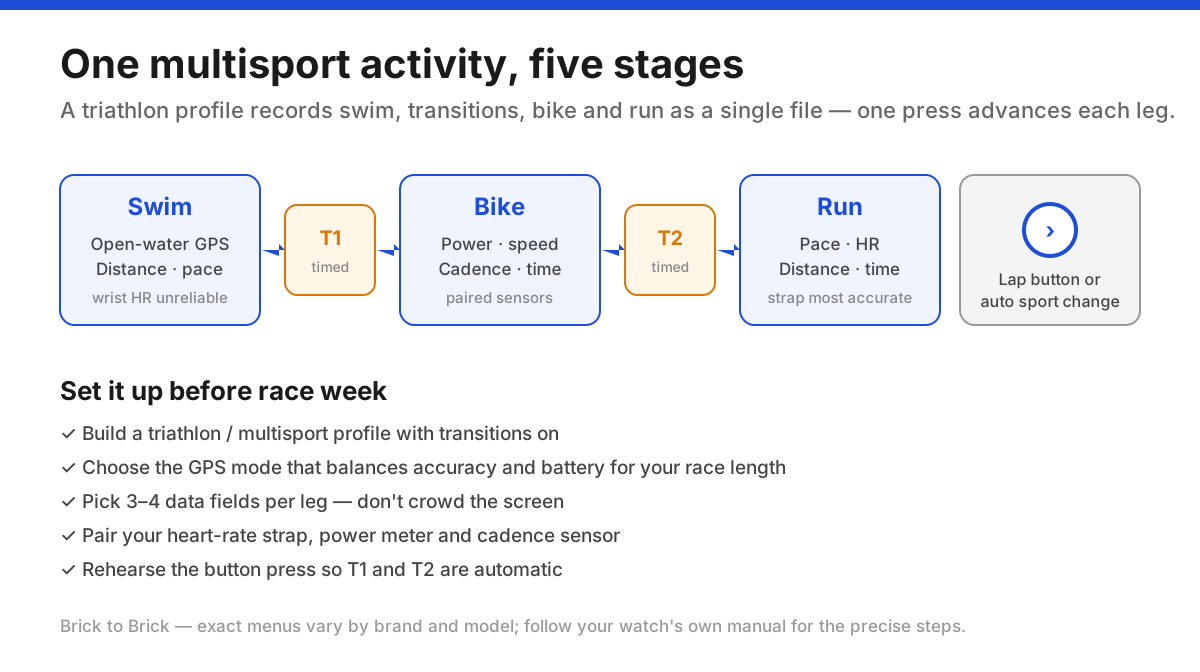
Multisport mode is the feature that defines the category, so it's worth knowing how it behaves before race morning. When you start a triathlon activity, the watch records the swim, then a transition, then the bike, then a second transition, then the run — all as one saved file with a single finish time.
You advance between legs with the lap/transition button (or, on some watches, an automatic sport change). Each press ends the current leg, starts the transition clock, and — with a second press as you leave transition — begins the next discipline. That means T1 and T2 are timed and reviewable afterwards, which is where a surprising amount of amateur time hides. Each leg can also show its own data screens: distance and pace for the swim, power and speed for the bike, pace and heart rate for the run.
The failure mode to avoid is fumbling the buttons mid-race. Rehearse the exact press sequence in a brick session so it's automatic when you're breathing hard and cold-handed out of the water. Build and test your triathlon profile — screens, sensors and GPS mode — well before race week, not in the car park. Our gear builder tool can help you sanity-check the wider kit list around the watch.
The metrics your watch produces — which ones matter
A good triathlon watch will happily show you dozens of numbers. Only a few change how you train, and it helps to separate measured data from estimated scores.
Measured, and worth trusting: pace, distance and speed (from GPS); elapsed and lap times; elevation (from the barometer); and, if you pair external sensors, cycling power and cadence. These are the day-to-day figures for pacing and reviewing sessions.
Estimated, and worth watching as trends only:
- VO₂max estimate — a modelled fitness proxy from pace-versus-heart-rate, not a lab test. Useful for spotting a rising or falling trend over weeks; not a number to quote to two decimal places.
- Training load / TSS-style scores — a way to quantify how much a session cost you and to avoid ramping too fast. Valuable for consistency, but the absolute figure depends on your zones being set correctly.
- Recovery, readiness and "body battery" scores — blends of resting heart rate, heart-rate variability and sleep. Best read as a nudge ("you're under-recovered, keep today easy") rather than a verdict. To use these well you need accurate overnight data, which points back to sensor quality and fit.
- Sleep and stress tracking — directionally useful, frequently imprecise on stage timing.
The unifying rule: derived scores are only as good as the inputs beneath them. If your heart-rate zones are guessed from "220 minus age" or your wrist reading is noisy, every downstream score inherits that error. Set real zones with our heart rate zones guide and the training zone calculator, and the estimates become far more useful.
Battery modes and the accuracy trade-off
Battery life is the spec that quietly decides whether a watch suits your racing, and it isn't a single number — it depends on the GPS mode you choose. Manufacturers quote several figures for the same watch:
- Standard/full GPS — highest positioning accuracy, shortest runtime.
- Multiband/all-systems — best accuracy in hard environments, the heaviest battery drain.
- Battery-saver or single-system modes — longer runtime by sampling position less often or using fewer satellites, at some cost to track precision.
Match the mode to the event. For a sprint or Olympic-distance race, full or multiband GPS is fine and the extra accuracy is worth it. For a full Ironman that may take a long day, you'll want either a watch with a genuinely long full-GPS runtime or a sensible battery-saver mode — with a tested margin. Always add contingency: the clock starts before your wave, the watch sits searching for satellites beforehand, and a reading of "just enough" battery is a reason to change modes, not a promise it'll last. Do a long training session in exactly the settings you plan to race with, then read the remaining battery honestly.
Getting accurate, trustworthy data
Most complaints that a watch is "inaccurate" trace back to setup and fit rather than faulty hardware. A few habits fix the majority of them.
- Fit the watch correctly. Wear it snug, about a finger's width above the wrist bone, and tighten a notch for hard efforts. This matters more than people expect: validation research on wrist optical sensors found that placing the watch three fingers above the wrist rather than one measurably improved heart-rate accuracy. A loose, low watch is the single most common cause of bad data.
- Set up your data screens deliberately. Pick three or four fields per leg that you'll actually use. A crowded screen you can't read at speed is worse than a simple one you can.
- Pair external sensors for the numbers that matter. A chest strap for reliable heart rate (and swim recording), a power meter and cadence sensor on the bike. Look for a watch that supports both ANT+ and Bluetooth so one sensor can feed the watch and an app like Zwift at once.
- Give GPS a clean start. Stand still outdoors and let it lock on before you press start.
- Review sessions, don't just glance at the live screen. A flat line, an impossible spike, or a leg stuck at one value tells you the contact or signal failed — discount that data rather than training off it.
Wrist heart rate specifically is worth calibrating your expectations on: independent work into the sources of optical-sensor error shows readings degrade with motion, poor contact, cold and skin differences, which is exactly why cycling and interval numbers wander. If a session depends on precise heart rate, use a strap — the heart rate monitors guide explains when each type wins.
How a sports watch fits with the rest of your gear
A triathlon watch is the hub of your training data, not the whole system. It works best paired with a few complementary devices:
- A heart-rate chest strap for accurate intensity and for recording the swim, where the wrist sensor can't reliably read underwater.
- A cycling power meter for direct, instant output on the bike — the metric many triathletes pace by, since it reacts faster than heart rate. See heart rate vs power for when each is more useful.
- A bike computer if you want a larger handlebar display and dedicated navigation on long rides; the watch and computer can share the same sensors. Our bike computers guide covers where one adds value over the watch alone.
- Your phone, which handles the sync, deep analysis, mapping and firmware updates that a small watch screen can't.
Bought together, these turn a watch from a fancy stopwatch into a genuine coaching feedback loop.
Do you need one — and how to choose which
You can finish a triathlon without any watch; perceived effort will get most beginners to the line. A multisport watch earns its place when you want to pace each discipline, hold back on easy days, and understand a race afterwards rather than guess at what happened.
This guide is deliberately about the category, not a model roundup — so once you know you want one, use the buying guides built for that decision:
- On a budget or buying your first watch? Start with the best triathlon watches under $300.
- Want a shortlist matched to how you train and race? See our triathlon watch comparison by use case.
- Torn between two Garmin families? Read Garmin Forerunner vs Fenix for triathlon.
Whatever you choose, remember the theme of this guide: the watch is only as good as its setup and the reliability of each sensor. Buy for the multisport mode, the battery you need and the sensor pairing you'll use — not for a spec you'll never touch — then spend an evening configuring it properly. A well-set-up entry watch beats an expensive one you never learned to trust.
Sports watch vs the alternatives for triathlon
| Device | True multisport mode | Open-water swim GPS | Battery for long races | Pairs power/HR sensors | Best for |
|---|---|---|---|---|---|
| Multisport GPS watch | Yes | Yes | Hours to days | Yes (ANT+/BLE) | Racing and training all three sports |
| Running watch | Often no | Rarely | Good | Usually | Run-focused athletes; occasional sprints |
| Smartwatch | Model-dependent | Model-dependent | Often limited | Varies | Everyday health; short workouts |
| Bike computer | No (bike only) | No | Long | Yes | Cycling data and navigation on the bike leg |
| Phone app | No | No | Poor (in a pocket) | Some | First tri on a zero budget |
Sources
Sources are listed so readers can verify consequential claims and dated details.
- Accuracy of Distance Recordings in Eight Positioning-Enabled Sport Watches: Instrument Validation Study — JMIR mHealth and uHealth (accessed September 17, 2026)
- Inherent Limitations of Smartphone GNSS Positioning and Effective Methods to Increase the Accuracy Utilizing Dual-Frequency Measurements — Sensors (MDPI) (accessed September 17, 2026)
- Investigating sources of inaccuracy in wearable optical heart rate sensors — npj Digital Medicine (accessed September 17, 2026)
Frequently asked questions
What's the difference between a sports watch and a smartwatch?
A triathlon sports watch is built around a multisport activity that records swim, bike and run as one file, with open-water swim GPS, multi-hour battery and pairing for chest straps and power meters. A general smartwatch prioritises notifications and everyday health; many lack a true triathlon profile and long-race battery, though some newer models are closing the gap. Check for a genuine multisport mode before assuming a smartwatch can do the job.
Do I need a multisport watch, or is a running watch enough?
If you only ever race the occasional sprint and don't mind recording three separate activities, a running watch can work. But without a true multisport mode you lose one-press transitions, timed T1/T2, and an open-water swim profile — so you can't review the race as a single effort. Anyone training and racing all three disciplines regularly is better served by a multisport watch.
How accurate is the GPS on a sports watch?
In open conditions, distance accuracy is typically around 1–2%, which validation studies consider good enough for measuring training load. Accuracy drops in cities and under tree cover, where buildings and canopy reflect or block the satellite signal. Multiband (dual-frequency) GPS reduces those errors in hard environments but uses more battery, so it's best switched on when you need it.
Can a sports watch track open-water swimming?
Yes, if it has an open-water swim profile — one of the features that defines a true triathlon watch. Because GPS can't work underwater, the watch estimates distance from the signal it catches when your wrist breaks the surface, so open-water distance is less precise than bike or run GPS. Wrist heart rate is unreliable in the swim; a chest strap that stores and syncs the data is the accurate option.
Will one battery charge last a full Ironman?
It depends on the watch and the GPS mode. Many mid-range and premium watches last a long day in standard GPS, and most offer a battery-saver mode that extends runtime further at some cost to track precision. Always test a long session in your intended race settings and leave a margin — the watch also burns battery searching for satellites before the start.
Does a more expensive watch make me faster?
No. A pricier watch adds maps, materials, longer battery and extra sensors, but the data that actually improves your training — pace, time, heart rate and power — is available on entry-level multisport watches too. What makes you faster is setting the watch up properly, pairing the right sensors, and acting on the numbers. Buy for the features you'll use, not the ones on the box.