Triathlon Cadence Explained: Bike RPM, Run Steps and Swim Rate
Understand what cadence means in all three triathlon sports, how devices count it, how to compare readings and why there is no single ideal cadence for everyone.
By Lotte
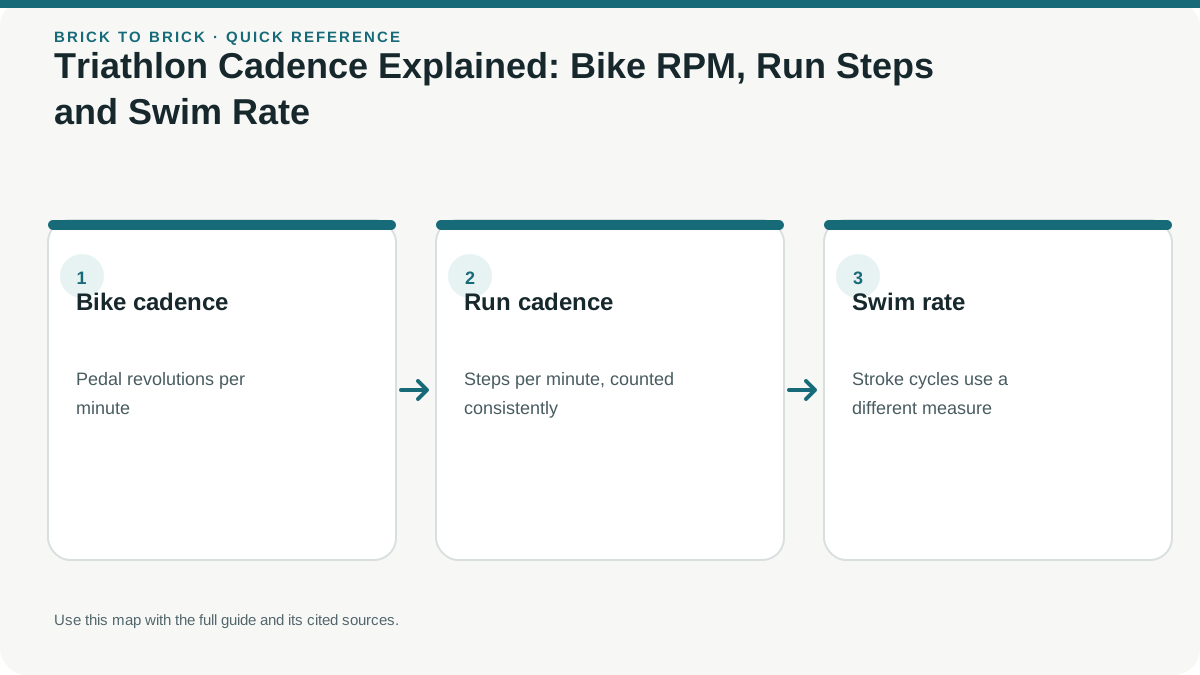
Cadence means different movements across swim, bike and run, and devices may use different counting conventions. Use it with effort, pace or power and conditions rather than treating one number as universally ideal.
Key takeaways
- 1Bike cadence counts crank revolutions; running cadence often counts both feet's steps; swim rate needs an explicit stroke convention.
- 2Cadence varies with speed, terrain, equipment, technique and the way a device measures it.
- 3There is no one ideal cadence for every athlete, and changing a number does not guarantee better performance or prevent injury.
- 4Interpret cadence alongside pace or power, effort, conditions and safety.
In this article
- 1Define what your device is counting
- 2Use cycling cadence with gearing and effort
- 3Interpret running cadence at a stated pace
- 4Balance swim stroke rate with distance per stroke
- 5Run a small experiment with a clear question
- 6Use cadence to explain, not command
- 7Check the counting convention before changing technique
- 8Use three small calculations to understand what cadence measures
- 9Interpret a cadence change alongside the situation
- 10Observe cycling cadence without turning the ride into a test of extremes
- 11Check running cadence with the counting method written down
- 12Interpret swim stroke count without rewarding an exaggerated glide
- 13Choose when cadence deserves attention and when to leave it alone
- 14There is no universal running cadence target
- 15Compare cycling cadence at the same effort
- 16Read swimming cadence with pool and open-water context
- 17Know how your device obtains cadence
- 18Cadence, torque and power on the bike
- 19Use a short cadence log that explains the number
- 20Cadence after the bike is only one part of the run
- 21When to ignore a cadence alert
- ?Frequently asked questions
Define what your device is counting
Cycling cadence usually counts complete pedal revolutions per minute. Running cadence commonly counts both feet's steps per minute. Swimming may count individual arm strokes or complete cycles, depending on the device or coaching convention.
Write the unit beside the number. A swim rate counted as cycles can be roughly half a rate counted as individual arm strokes, so two displays may disagree without either athlete moving differently.
Check the device manual and your coach's terminology before comparing. “Increase cadence” is incomplete unless the sport, unit and reason are clear.
Use cycling cadence with gearing and effort
At a fixed speed, an easier gear requires more pedal revolutions. At a fixed gear, increasing cadence increases speed only if you can supply the required effort and conditions permit it.
The relationship is speed = cadence × gear ratio × wheel rollout, with unit conversion. The gearing guide gives a worked example. This explains why cadence is a consequence of several choices, not an isolated target.
Try a small change on a familiar easy ride and note comfort and control. Do not grind through knee pain or bounce on the saddle to hit a fashionable number.
Interpret running cadence at a stated pace
Cadence usually changes with speed, terrain and the runner. Comparing an easy jog with someone else's race cadence is not a useful target-setting method.
For an illustrative runner taking 160 total steps per minute with an average 1.0 m per step, speed is 160 m/min, or 9.6 km/h. If cadence rises but step length falls, speed may stay similar. Count total steps consistently.
Changes in step rate can affect running mechanics, but no universal “180 steps per minute” rule prevents injury. If changing gait to address pain, use qualified assessment rather than self-prescribing from a single metric.
Balance swim stroke rate with distance per stroke
A faster arm rate can accompany faster swimming, but it can also reflect slipping through the water with less useful propulsion. Conversely, reaching for an extremely low stroke count can introduce pauses.
Compare stroke count or rate over the same pool length at a similar effort and note the time. Keep the counting convention consistent and account for push-offs. Open-water conditions add navigation and breathing demands.
Use the swim improvement guide to identify a technique task before deciding that rate is the problem.
Run a small experiment with a clear question
Choose one discipline and a low-risk familiar session. Record your natural rate, then try a modest coached change for a short portion while keeping effort controlled. Return to normal and compare comfort, coordination and output.
Do not change footwear, bike fit and cadence together if you want to understand the effect. Stop if pain or loss of control appears.
The purpose may be practising flexibility across gears or terrain, not selecting one rate to hold forever. A race course rarely asks for an identical movement pattern from start to finish.
Use cadence to explain, not command
Review cadence alongside pace or power, terrain and perceived effort. A sudden drop on the bike could reflect a climb, coasting or a sensor dropout. A run change late in a race might reflect fatigue without proving its cause.
Do not use cadence alone to judge fitness or diagnose injury. Keep a note of the circumstances and act on a pattern only when the interpretation is credible.
For the bike-to-run transition, use brick workouts to rehearse the whole movement change rather than relying on a last-minute cadence trick.
Check the counting convention before changing technique
A running device may report total steps per minute, while another view may show strides per minute. If one displays 170 and another 85 for the same rhythm, they may be counting different units rather than disagreeing about your movement.
Swimming has a similar naming problem: a stroke can mean one arm action or a complete cycle depending on the device and stroke. Read the field definition before combining stroke rate with distance-per-stroke calculations.
For a running experiment, record pace, gradient and whether the count includes both feet. For cycling, keep resistance and gearing in the record. A higher number produced by an easier gear or faster pace does not isolate a technique improvement. Change one relevant factor in a short familiar session and evaluate comfort and control, not whether you reached a fashionable cadence target.
Use three small calculations to understand what cadence measures
For running, assume a device reports 170 total steps per minute and an average distance of 1.0 m per step. Multiplying gives 170 m/min, or 10.2 km/h. If the step distance shortens while cadence stays the same, speed falls. Increasing cadence alone therefore does not describe the whole stride, and deliberately reaching farther is not a technique recommendation.
For cycling, cadence counts crank revolutions. With an illustrative 4.2 m of wheel travel per crank revolution, 80 rpm gives 336 m/min, or 20.16 km/h. Changing gear changes the travel per revolution, so you can increase cadence while maintaining a similar speed. The gearing guide explains how to calculate that relationship for a stated setup.
For swimming, rate and distance per stroke must use the same counting convention. Suppose a swimmer takes 20 counted arm actions to cover a measured 25 m section with no push-off contribution included in the illustration. That would be 1.25 m per counted action. A real pool length includes push-off and glide effects, so dividing pool length by a watch's stroke count is not a pure measurement of arm propulsion.
These examples explain units and relationships. They do not identify an ideal cadence or prescribe changes to a stroke, stride or riding style.
Interpret a cadence change alongside the situation
If cadence drops late in a run, first inspect pace, gradient, stops, sensor behaviour and how you felt. The trace alone cannot distinguish ordinary slowing from fatigue, discomfort or a recording issue. It cannot diagnose low blood sugar or tell you to consume a gel at a particular cadence threshold.
If cycling cadence changes after a wheel or cassette replacement, inspect gearing and the recorded sensor source before concluding that your fitness changed. On a trainer, the selected resistance mode can also alter how the session feels. Keep the training question simple enough that you can distinguish those effects.
For swimming, a higher stroke count after changing pools can reflect pool length, turns or counting settings. Compare equivalent sections and consider instruction or direct observation when the goal is technique. An algorithm's output is not a substitute for seeing the movement.
A useful cadence log has four columns: activity and conditions; rate and counting units; accompanying pace or power; observed comfort or control. Write one interpretation to test next time. That creates a learning process without turning a single preferred number into a rule for all three sports.
Observe cycling cadence without turning the ride into a test of extremes
Choose a familiar indoor setup or suitable quiet riding setting where attention to a display will not compromise safety. Record your ordinary cadence during a steady comfortable period, along with gear or resistance, power if available and perceived effort. This creates a reference for the actual task you are doing.
If a coach has suggested an experiment, make a modest controlled change in the relevant variable and observe the response. Changing gear while keeping a similar road speed is different from simply accelerating. On a trainer, understand how its resistance mode responds before interpreting a change in pedalling rhythm.
Stop the experiment if movement becomes uncontrolled, discomfort develops or the setting no longer permits attention to the task. Do not chase a very high or very low cadence just because a device can display it. The range you can perform briefly is not automatically a suitable racing range.
Review the observation in plain language: what changed, what stayed comparable and what question remains. A lower heart rate in one short attempt does not establish the most efficient cadence for every intensity or duration. Use repeated relevant observations and appropriate coaching input where the decision matters.
Check running cadence with the counting method written down
If you count manually, decide whether you are counting every foot contact or contacts from one foot. State the observation period and conversion. For example, 42 total steps in 15 seconds corresponds to 168 steps per minute. Counting 21 contacts from one foot in the same period describes the same total rhythm after multiplying by two and then by four. These examples explain counting, not target values.
Choose a safe setting where counting will not distract you from traffic, obstacles or other people. A longer observation may reduce the influence of a single miscount, but the comparison still needs context: pace, gradient, fatigue and whether you were accelerating.
Compare the manual convention with the device's field definition. A value half as large may reflect strides rather than total steps. Check for data gaps or a different source before concluding that your technique changed dramatically.
If you and a qualified professional decide to modify cadence for a specific reason, keep the change appropriate and observe comfort and response. The research on step rate includes many short-term biomechanical observations and does not justify promising that a particular number prevents injury or improves performance for everyone. Do not make a general counting exercise into a self-prescribed treatment plan.
Interpret swim stroke count without rewarding an exaggerated glide
A lower count over a pool length can result from changes in push-off, underwater travel, speed, timing or how the device counts strokes. It is not automatically evidence of more efficient swimming. Keep the pool length, stroke and timing method consistent when comparing attempts.
Ask a coach to connect any rate or count change with the movement you are trying to improve. If you reduce count by pausing excessively between strokes, the number may look attractive while the swim becomes slower or less comfortable. Similarly, a higher rate can be useful in one context and rushed in another.
Use a short familiar repeat with one cue and enough recovery to preserve control. Record time, the counting convention and an observation about breathing or movement. Return to ordinary swimming to see whether the cue transfers. Do not spend the whole session chasing the watch's preferred-looking number.
Open water adds orientation, conditions and other swimmers. A pool-derived rhythm is a reference, not a command to ignore waves or breathing needs. Choose a pattern you can manage safely and adjust it according to the situation, with appropriate supervised practice.
Choose when cadence deserves attention and when to leave it alone
Cadence is worth investigating when it answers a specific question: an unexpected device reading, difficulty finding a manageable gear, a coaching observation or a comparison under controlled conditions. It may deserve little attention when the current rhythm is comfortable and the more important gap is swim competence, pacing, recovery or equipment reliability.
Keep one review question at a time. If you change footwear, running pace and cadence simultaneously, the resulting difference is difficult to attribute. If you change gears, bike fit and intensity together, the same problem appears on the bike.
A useful training note preserves uncertainty. “The shorter step cue felt manageable for this brief segment” is an observation. It does not establish an ideal cadence for a marathon after cycling. Let the evidence support a proportionate next step, and avoid turning a measurement that can help explain movement into a constant distraction from the activity itself.
There is no universal running cadence target
The often-repeated “180 steps per minute” figure is not a requirement for every runner. Cadence varies with speed, body proportions, terrain, fatigue and the way a device counts steps. A systematic review of step-rate changes found that changing cadence can alter some biomechanical measures, but research does not justify prescribing one number to every runner or promising that a change prevents injury. If a coach or clinician suggests a modest adjustment for a specific reason, introduce it briefly at a manageable pace and review comfort and movement rather than chasing a watch alert. A dramatic increase can feel awkward and may change other parts of your stride. Do not deliberately shorten every step or run faster simply to raise a number. If you have pain, a change in gait or recurring symptoms, consult a qualified clinician; cadence data cannot diagnose the cause. A useful baseline is your own consistent measurement at the same pace and route, not a comparison with an elite athlete.
Compare cycling cadence at the same effort
A bike cadence number is most useful when paired with gear, speed or power, terrain and perceived effort. To explore a change, use a safe indoor setup or quiet, familiar route and compare short steady periods at a comfortable gear and effort. Keep the conditions similar and change one thing at a time. A higher cadence can mean less force at each pedal stroke for a given power, but it also means the legs move more quickly; that does not make a high cadence more efficient for every rider or every duration. Research on cycling cadence describes tradeoffs among muscular load, cardiovascular cost and task demands. If a cadence change makes you bounce, tense your shoulders or lose control, return to a comfortable rhythm. Use gearing to find a manageable combination for the terrain rather than forcing a preset RPM. Our bike gearing guide explains the ratio behind those choices, and the bike trainer guide covers controlled indoor comparisons.
Read swimming cadence with pool and open-water context
Swim stroke rate can change between pool and open water because conditions, turns, drafting, sighting and fatigue differ. A pool wall gives a push-off and repeatable distance; an open-water course has no wall at each length and may involve chop, current, contact or navigation. A 2024 study of elite triathletes compared swimming measures in pool and open-water conditions, illustrating why context matters; it does not establish a target for every age-group swimmer. When using a watch or coach's count, confirm whether “one stroke” means one arm entry or a complete left-right cycle. Keep the same convention and note pool length, effort, turns and equipment. A faster arm rate is not automatically better if the catch or body position becomes less effective; an artificially low rate is not automatically efficient if it adds a long pause or disrupts breathing. Work with a swim coach to interpret rate alongside pace, stroke quality and comfort. For open-water practice, follow the supervised-safety guidance in our no-lake open-water practice guide.
Know how your device obtains cadence
Cadence can come from a dedicated sensor, a watch's motion sensors, a trainer, a crank-based power meter or software that derives a value. Running watches may report total steps per minute, while some devices or manual counts report one-foot contacts or strides; check the unit before comparing. Cycling sensors typically count crank revolutions, but recording gaps, coasting and how an app handles zero values can affect average cadence. Swim watches may estimate strokes from wrist movement and can miss or misclassify drills, turns or unusual strokes. A device manual explains its own metric, not every platform's data processing. If two apps show different numbers, check the device source, activity profile, pause behavior and calculation rather than assuming one is wrong. Keep the measurement setup consistent when following a trend. Do not spend time correcting small differences between devices unless cadence is answering a real training question.
Cadence, torque and power on the bike
Cycling power is related to crank torque and angular speed: the same power can be produced with relatively more force per pedal revolution at a lower cadence or less force per revolution at a higher cadence. This is a mechanical relationship, not a recommendation to choose one cadence. At the same road speed, changing gears changes cadence; at the same power, changing cadence changes how the work feels and how force is applied. A power meter and cadence sensor can help describe those differences, but no single data stream explains comfort or efficiency by itself. Compare the same route or controlled interval, and note gear, power, perceived effort and whether cadence remained steady. Do not perform maximal low-cadence or high-cadence drills without appropriate programming, especially if you have pain or a medical condition. Ask a coach to connect cadence work to the workout's purpose. The triathlon workout-split guide discusses how to place focused sessions within a broader week.
Use a short cadence log that explains the number
A useful cadence note records enough context to make the measurement repeatable. For cycling, write down bike or trainer, gear or resistance, terrain, power if available, cadence range and perceived effort. For running, note pace, terrain, device, whether it counted total steps and how fatigue felt. For swimming, record pool length, stroke, rate convention, effort, turns and whether the drill included equipment. Example: “steady outdoor ride, flat sheltered road, 50/19 gear, 82–86 rpm, conversational effort” is more useful than “cadence 84.” For a pool swim, note “25 m pool, freestyle, 36 arm entries per minute, easy pace” if that is the convention used. Do not compare a hill climb with a flat trainer ride or a hard interval with an easy run and call the difference a trend. The log does not need to be elaborate; it is a way to separate a meaningful change from terrain, pace, sensor settings or a different counting method.
Cadence after the bike is only one part of the run
Some athletes notice a different running rhythm immediately after cycling, but there is no single cadence value that proves a successful bike-to-run transition. Bike effort, gearing, fatigue, heat, course surface and the opening run pace can all affect how the legs feel. Start the run at a controlled effort and let coordination settle; do not force a higher step rate because a device shows a lower number than it did in a standalone run. If a coach has given you an individual cue, practise it in an appropriate brick session and compare comfort and pace. If cadence drops along with pace late in a race, the data cannot say whether the cause is fatigue, terrain, a pause, discomfort or sensor error. See our run-off-the-bike guide for transition pacing and practical cues, and use the race morning routine for broader event preparation.
When to ignore a cadence alert
A watch alert can prompt attention, but it should not interrupt safe movement or override the workout plan. On a bike, do not look down at a display in traffic, on a descent or during a technical turn. In the pool, do not change stroke mechanics to satisfy a device while sharing a lane or feeling breathless. On a run, an alert may reflect a hill, a walk break, a surface change or a sensor issue. Cadence may not be the right metric when the real task is learning water confidence, handling a bicycle, pacing a long session or recovering. Turn off alerts that distract you or create pressure to chase a number. Review trends after the session, when you can consider the terrain and how you felt. Seek qualified instruction for technique questions and clinical advice for pain or symptoms; a screen cannot make those decisions for you.
Sources
Sources are listed so readers can verify consequential claims and dated details.
- Edge 540 owner manual: sensors and cadence data — Garmin (accessed September 25, 2026)
- What is the effect of changing running step rate? A systematic review and meta-analysis — Sports Medicine - Open (accessed September 25, 2026)
- What is running cadence on a Garmin watch? — Garmin (accessed September 25, 2026)
- The relationship between cadence, pedalling technique and gross efficiency in cycling — Peer-reviewed research (accessed September 25, 2026)
- Swimming performance in elite triathletes: pool and open-water conditions — Scandinavian Journal of Medicine & Science in Sports (accessed September 25, 2026)
Frequently asked questions
What is a good cadence for triathlon cycling?
There is no universal target. A comfortable cadence depends on gearing, effort, terrain, training history and the workout's purpose.
Is 180 steps per minute the ideal running cadence?
No. Running cadence varies among people and with speed, terrain and fatigue. Research does not establish 180 steps per minute as a universal requirement or an injury-prevention guarantee.
How is running cadence counted?
Many watches report total steps per minute across both feet, but some manual methods or displays use one-foot contacts or a different convention. Check the device definition before comparing values.
What is swim stroke rate in triathlon?
It is the rate of arm strokes over time, but “stroke” can mean one arm action or a complete cycle. State the convention and compare measurements under similar pool or open-water conditions.
Can cadence data diagnose a running injury?
No. Cadence cannot identify an injury or its cause. Seek a qualified clinician for pain, altered gait or persistent symptoms.
Should I change cadence during a race?
Do not make an abrupt change just to hit a device target. Use a cue only if you have practised it and it supports the race plan and safe movement.