Triathlon Rule Changes for 2026: World Triathlon, IRONMAN and USA Triathlon
What changed in the 2026 rules from World Triathlon, IRONMAN and USA Triathlon, what carried over from 2025, the key numbers for age-group racing, and what to check before your race.
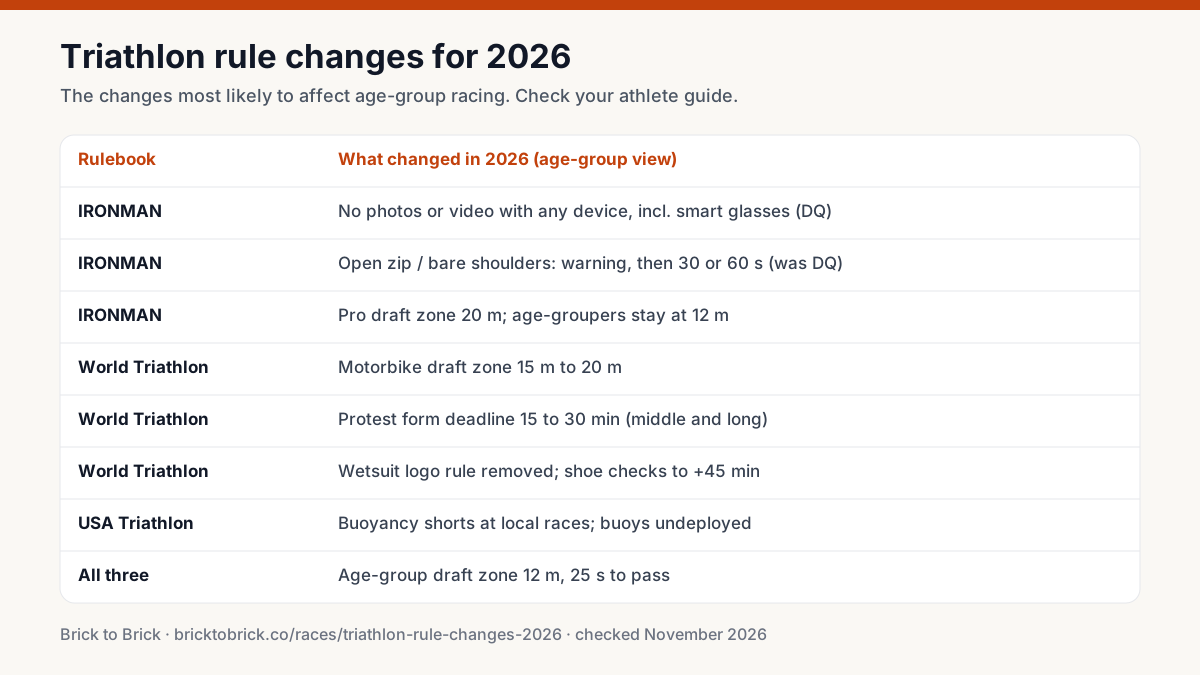
For most age-groupers, 2026 brought small changes rather than a new way of racing. IRONMAN's 2026 rules (effective 2 March 2026, as reported by Tri247) ban taking photos or video during the race with any device, including smart glasses, on pain of disqualification; turn an open zipper or uncovered shoulders into a warning and then a 30 or 60 second penalty instead of a possible disqualification; and raise the draft zone to 20 m for professionals only. Age-group drafting stays at 12 m with 25 seconds to pass in all three rulebooks. World Triathlon's 2026 amendments are mostly procedural for age-groupers: a longer motorbike draft zone, more time to file a protest at middle distance and longer, and a simpler wetsuit logo rule. USA Triathlon published a 2026 rulebook (version 2026.01.01) and a 2026 swim-equipment note that allows buoyancy shorts at local races and keeps swim buoys undeployed in competitive waves. Several 2025 changes still matter: IRONMAN's 3-minute (full) and 2-minute (70.3) drafting penalties, bottle limits and aerobar length limit, and World Triathlon's penalty table by distance. Always check the athlete guide and briefing for your race.
Key takeaways
- 1Age-group draft zone: 12 m with 25 seconds to pass under World Triathlon, IRONMAN and USA Triathlon rules in 2026
- 2IRONMAN 2026: no photos or video during the race with any device, including smart glasses; disqualification if you do
- 3IRONMAN 2026: an open zipper or uncovered shoulders now gets a warning, then a 30 or 60 second penalty if not fixed, instead of a possible disqualification
- 4IRONMAN drafting penalties since 2025: 3 minutes at full distance and 2 minutes at 70.3; front hydration limited to 2 litres and aerobars to the front wheel's leading edge
- 5World Triathlon 2026 amendments are mainly procedural for age-groupers: motorbike draft zone 20 m, 30 minutes to file a protest at middle distance and longer, simpler wetsuit logo rules
- 6USA Triathlon 2026: buoyancy shorts allowed at local races, snorkels only in non-competitive waves, headphones still banned in every leg
Quick answer: what changed in 2026?
If you raced in 2025, very little about how you race changes in 2026. The headline items for age-group athletes are:
- IRONMAN and IRONMAN 70.3: you may not take photos or video during the race with any device, including phones, action cameras and smart glasses. The penalty is disqualification. This came in with the 2026 IRONMAN Global Competition Rules, which Tri247 reported as effective from 2 March 2026.
- IRONMAN uniform: an open zipper or uncovered shoulders now earns a warning and a chance to fix it, then a 30 or 60 second time penalty if you do not. Before, it could lead to disqualification.
- IRONMAN professionals only: the pro draft zone is now 20 m. Age-groupers stay at 12 m.
- World Triathlon: 2026 amendments are mostly procedural for age-groupers (motorbike draft zone, protest and appeal deadlines, shoe inspection timing and a simpler wetsuit logo rule).
- USA Triathlon: a new rulebook version (2026.01.01) and a 2026 note on swim equipment that allows buoyancy shorts at local races, limits snorkels to non-competitive waves and requires swim buoys to stay undeployed in competitive races.
The numbers you are most likely to need on race day did not change: a 12 m draft zone with 25 seconds to pass, and drafting penalties that depend on the race distance. The tables below give them by rulebook.
Which rulebook applies to your race?
Before reading about changes, check which rules your race uses. It is usually stated in the athlete guide.
- IRONMAN and IRONMAN 70.3 races use the IRONMAN Global Competition Rules, wherever they are held.
- USA Triathlon-sanctioned races in the US use the USA Triathlon Multisport Competition Rules.
- World Triathlon events (World Championships, age-group world championships, continental championships) use World Triathlon's Competition Rules. Many national federations base their own rules on these.
- Other national federation races (for example British Triathlon, Triathlon Australia or the Dutch federation) use their federation's rules, which may differ in details such as penalty lengths and wetsuit temperatures.
Local organisers can also set event-specific rules, such as a non-wetsuit swim for safety, a no-pass zone on a descent or a required helmet sticker. The athlete guide and race briefing always take priority for that event. Our guide to triathlon rules explains how the rulebooks fit together.
IRONMAN: what changed for 2026
IRONMAN released new Global Competition Rules for 2026. We could not read the official rulebook directly, so these points come from Tri247's report of the release. Check the current rules on IRONMAN's website before you race.
No photos or video during the race. Using any device to take photographs or video during the race is prohibited, including phone cameras, action cameras, video cameras and glasses. Tri247 reported that athletes who do will be disqualified, and presented the change as a response to smart glasses with built-in cameras. If you race with smart glasses for their display or audio, check whether your event allows them at all; at minimum, the camera must not be used.
Zipper and shoulder coverage. IRONMAN requires your shoulders to stay covered during the race. Under the 2024 rules, an open zipper or uncovered shoulders that you did not fix promptly could lead to disqualification. Under the 2026 rules, a violation gets a warning and an instruction to fix it, followed by a 30 or 60 second time penalty if you do not fix it promptly. Tri247's report did not say which distance gets 30 seconds and which gets 60; by analogy with IRONMAN's other time penalties, 30 seconds at 70.3 and 60 seconds at full distance is likely, but check the rulebook. Our tri suit guide covers zips and coverage for hot races.
Pro draft zone of 20 m. The professional draft zone increases from 12 m to 20 m. The age-group draft zone stays at 12 m. On multi-lap courses where age-groupers and pros share the road, IRONMAN clarified its guidance, especially where age-groupers could affect the pro race. If a pro race passes you, ride predictably on your side of the road and do not try to pace off them.
Para Open. The PC/ID Open division (for athletes with physical challenges or intellectual disabilities) has been renamed Para Open and is described as non-competitive and inclusive.
Equipment specifications. Tri247 reported that the release also changed some equipment specifications but did not list them. If you use unusual equipment, such as a long aerobar setup, a large front hydration system or a non-standard helmet, check the 2026 rulebook's equipment section.
IRONMAN: 2025 changes that still apply
IRONMAN made bigger changes in 2025 (effective 17 March 2025, according to IRONMAN's press release). Triathlon Magazine Canada's January 2026 guide described them as still in force:
| Rule | Before 2025 | Since 2025 |
|---|---|---|
| Blue card (drafting) | 5 minutes | 3 minutes at full distance; 2 minutes at 70.3 |
| Yellow card (other offences) | 30 s at 70.3, 60 s at full | Unchanged |
| Front hydration | No total limit | Maximum 2 litres in total (not counting bottles inside the frame) |
| Bottles behind the saddle | No limit | Up to two, each no more than 1 litre |
| Aerobar extensions | No limit | Must not extend beyond the leading edge of the front wheel |
| Neoprene swim caps | Not addressed | Allowed when wetsuits are permitted |
From 2024, IRONMAN also banned bottles or inserts carried in the front of your suit or in calf sleeves on the bike, and certain aero add-ons such as tape fairings. Penalties for those can be disqualification.
The disqualification threshold for drafting at IRONMAN events is three blue cards. You serve each blue-card penalty in the next penalty tent. See our drafting rules guide for how the zone, the pass and the drop-back work.
World Triathlon: what changed for 2026
World Triathlon's current rulebook is dated 13 December 2025, with amendments marked as of 31 March and 29 April 2026. The highlighting that shows the 2026 amendments in the official PDF does not survive in the copies we could read, so the list below relies on the Japan Triathlon Union technical committee's summaries of the changes (February and May 2026), which we translated. Treat it as a guide and check the official World Triathlon rules for your event.
Changes that can affect age-group athletes:
- Motorbike draft zone: the zone behind a motorbike on the course is extended from 15 m to 20 m, in both draft-legal and non-drafting races. Stay at least 20 m behind any motorbike unless you are passing it.
- Protests: at middle distance and longer, the time to submit the protest form after giving notice of a protest increases from 15 to 30 minutes.
- Appeals: the window for a second-level appeal is shortened from 30 days to 21 days.
- Shoe inspection: for age-group athletes, running shoes can be inspected from the start of check-in until 45 minutes after the last finisher. Development (prototype) shoes must be declared at check-in. Road shoes with a stack height over 40 mm are not allowed under World Athletics rules, which triathlon follows.
- Wetsuit logos: the rule on logo size and placement on wetsuits has been removed. A wetsuit is acceptable if it matches a model available on the market six months before the race.
- Helmets in draft-legal races: helmets may not cover the ears when seen from the side, and visors are not allowed. This mainly affects elite racing and age-group draft-legal events; check your event.
Changes for elite and junior draft-legal racing only include wider frame-size limits, deeper rims (up to 65 mm) and the removal of the handlebar width limit. They do not affect most age-group races.
World Triathlon: 2025 changes that still apply
World Triathlon's bigger update came in 2025 (effective 27 February 2025):
- One draft zone for all non-drafting races: 12 m, with 25 seconds to pass.
- Drafting penalties by distance: 3 minutes at long distance, 2 minutes at middle, 1 minute at standard (Olympic) and 30 seconds at sprint and shorter.
- Other time penalties: 1 minute at long distance, 30 seconds at middle, 15 seconds at standard, 10 seconds at sprint and in relays, 5 seconds below sprint.
- Uniform: for age-group athletes, the old 40 cm limit on front zip length was removed. Your front zip can be open to any length on the bike and run, as long as it stays connected at the bottom, your shoulders are covered, and you zip it up for the last 100 m. Sleeves may come down to, but not over, the elbow.
- Transition penalties: age-group offences in transition get an on-the-spot time penalty rather than a warning.
- Wetsuit removal: a full wetsuit comes off only in the designated area or in transition; a top that covers only your upper body and arms may come off earlier as long as your torso stays covered.
- Water quality: the acceptable standard for E. coli and Enterococci was relaxed from "excellent" to "good", and a group rather than one person now decides on cancelling a swim for water quality.
- Watches: banned in principle for elite athletes only. Age-groupers can still wear a watch.
- Eligibility: from 2025 the age-group men's category became an Age-Group Open category, and the age-group female category is for athletes assigned female at birth. This applies at World Triathlon and continental age-group events; national federations set their own policies.
World Triathlon wetsuit rules and swim time limits
These did not change in 2026 but are among the most looked-up rules. For age-group athletes up to the 55–59 category:
| Swim distance | Wetsuit forbidden at | Wetsuit mandatory at |
|---|---|---|
| Up to 1,500 m | 22 °C and above | 15.9 °C and below |
| 1,501 m and longer | 24.6 °C and above | 15.9 °C and below |
From the 60–64 category upwards, wetsuits are forbidden at 24.6 °C and above at all distances, and mandatory at 15.9 °C and below. Between the two limits, wetsuits are optional. When the water is 22 °C or colder and the air 15 °C or colder, the water temperature is adjusted using a separate table, so a wetsuit can become mandatory at a warmer water temperature. Wetsuits may not be thicker than 5 mm anywhere. Swimskins are allowed for age-groupers at all distances.
Maximum time in the water for age-group athletes:
| Swim distance | Maximum time |
|---|---|
| Up to 300 m | 20 min |
| 301–750 m (water below 31 °C) | 30 min |
| 301–750 m (31 °C and above) | 20 min |
| 751–1,000 m | 50 min |
| 1,001–1,500 m | 1 h 10 min |
| 1,501–3,000 m | 1 h 40 min |
| 3,001–4,000 m | 2 h 20 min |
IRONMAN and USA Triathlon use different temperature limits; see our wetsuit rules by water temperature for all three.
USA Triathlon: what is current for 2026
USA Triathlon's Multisport Competition Rules carry the version number 2026.01.01. We could not find a published summary of changes from 2025, so we cannot list what is new in the rulebook itself. What we can confirm:
2026 swim equipment variances. USA Triathlon published a 2026 note on swim equipment:
- Buoyancy shorts are allowed at USA Triathlon-sanctioned local races and waves and at adaptive races, but not at National Championships, World Triathlon qualifiers or elite races. They must not reach below the top of the knee or above the top of the hips, and may be no more than 5 mm thick.
- Snorkels are allowed only in non-competitive races and waves (and adaptive races), and you must confirm with race management and the lead official first.
- Swim buoys (tow floats) may be carried at national championships, qualifiers and local events but must stay undeployed in competitive races and waves. In non-competitive waves you may deploy one, and you start at the back of the final wave.
- Fins are not allowed. Phones may be carried as long as you do not use them in a distracting way.
Rules that stayed the same and trip people up:
- Headphones: no headphones or headsets of any kind, including bone-conduction headphones, at any point in the race. You get a warning and must remove them; refusing leads to disqualification.
- Devices: calls, texts, music, social media and taking photos during the race are prohibited. Navigation, tracking and recording data are allowed.
- Glass containers are banned at any time.
- Littering: dropping equipment or rubbish on the course gets a warning and must be fixed, or a time penalty.
- Wetsuits: no thicker than 5 mm anywhere.
Drafting under USA Triathlon rules. The draft zone is 12 m with 25 seconds to pass. Drafting (blue card) penalties depend on the bike distance: 30 seconds for 20 km or less, 1 minute for over 20 km to under 80 km, 2 minutes for 80–90 km and 3 minutes over 90 km. You can be disqualified after two blue cards in races with a bike leg under 80 km, and after three in longer races. We took the penalty figures from the 2026 rulebook; check the rulebook's penalty section if a decision depends on it.
The key numbers side by side (age-group, 2026)
| World Triathlon | IRONMAN and 70.3 | USA Triathlon | |
|---|---|---|---|
| Draft zone | 12 m | 12 m (20 m for pros) | 12 m |
| Time to pass | 25 s | 25 s | 25 s |
| Drafting penalty | Sprint 30 s, standard 1 min, middle 2 min, long 3 min | 70.3: 2 min; full: 3 min | 30 s to 3 min by bike distance |
| Disqualification for drafting | Repeated penalties (fewer in short races) | Three blue cards | Two blue cards (bike under 80 km), three (80 km and over) |
| Photos or video while racing | Unauthorised cameras lead to disqualification | Disqualification (2026) | Prohibited |
| Headphones | Not allowed | Not allowed | Not allowed, including bone conduction |
| Front zip | Any length, shoulders covered, zipped for last 100 m | Shoulders covered; zipped at the finish | Check the rulebook and athlete guide |
Our printable race-day rule card puts the drafting numbers for all three rulebooks on one page.
What to check before your 2026 race
- Which rulebook your race uses (athlete guide, first pages).
- Event-specific rules: no-pass zones, compulsory dismount lines, turnaround rules, special-needs bags and where penalty boxes or tents are.
- Wetsuit decision: when and where the water temperature will be announced (usually about an hour before the start), and the limits for your age group.
- Your kit: that your suit covers your shoulders when unzipped, that you carry no bottles in your suit, and that your front hydration and aerobars meet IRONMAN's limits if you race IRONMAN.
- Your devices: no headphones, no photos or video, and smart glasses only if the event allows them and the camera is not used.
- Littering rules: where the litter zones are at aid stations.
- The briefing: go to it or watch it, because course and rule changes are announced there. Our race briefing guide explains what to listen for.
Our list of rules you can break by accident covers the everyday mistakes that cost age-groupers time.
How we keep this page up to date
Rulebooks change once or twice a year, and IRONMAN, World Triathlon and USA Triathlon announce changes at different times. We review this page each January and after any mid-season update, and we change the title year when a new set of rules applies. If you spot a change we have missed, tell us through our corrections page.
Sources
Sources are listed so readers can verify consequential claims and dated details.
- IRONMAN unveil 2026 rule changes — Tri247 (accessed November 21, 2026)
- IRONMAN releases updates for 2025 IRONMAN global competition rules — Endurance Sportswire (IRONMAN press release) (accessed November 21, 2026)
- World Triathlon approves updates on the Competition Rules — World Triathlon (accessed November 21, 2026)
- World Triathlon Competition Rules (13 December 2025, with 2026 amendments) — World Triathlon (hosted by Triathlon Manitoba) (accessed November 21, 2026)
- World Triathlon Competition Rules: main changes (February 2026) — Japan Triathlon Union technical committee (accessed November 21, 2026)
- World Triathlon Competition Rules: additional changes (May 2026) — Japan Triathlon Union technical committee (accessed November 21, 2026)
- USA Triathlon Multisport Competition Rules (v.2026.01.01) — USA Triathlon (accessed November 21, 2026)
- 2026 USAT swim rules variances and other equipment clarifications — USA Triathlon (accessed November 21, 2026)
- The competition rules every triathlete should know heading into the 2026 season — Triathlon Magazine Canada (accessed November 21, 2026)
Frequently asked questions
Did the draft zone change in 2026?
Not for age-groupers. It is 12 m with 25 seconds to pass under World Triathlon, IRONMAN and USA Triathlon rules. IRONMAN raised the draft zone for professionals to 20 m in 2026.
Can I wear smart glasses in an IRONMAN race in 2026?
Taking photos or video with any device, including glasses, is prohibited under IRONMAN's 2026 rules and leads to disqualification. Check your event's athlete guide on whether smart glasses are allowed at all.
What happens if my tri suit zip is open at an IRONMAN race?
Your shoulders must stay covered. Under the 2026 rules, you get a warning and must fix it; if you do not, you get a 30 or 60 second time penalty. Under World Triathlon rules you must zip up for the last 100 m, and IRONMAN requires you to be fully zipped at the finish.
Are buoyancy shorts legal in triathlon?
At USA Triathlon-sanctioned local races and waves in 2026, yes, within size limits. They are not allowed at National Championships, World Triathlon qualifiers or elite races, and most other rulebooks do not allow them. Check your event.
How long is an IRONMAN drafting penalty?
Since 2025, a blue card for drafting is 3 minutes at full distance and 2 minutes at 70.3, served in the next penalty tent. Three blue cards lead to disqualification.
Where can I read the official rules?
IRONMAN publishes its Global Competition Rules on ironman.com, World Triathlon on triathlon.org under documents, and USA Triathlon on usatriathlon.org. The links in our sources go to the versions we used.