Homemade Race Food for Triathletes: 8 Recipes With Carbs per Portion
Eight tested-style homemade race foods for triathlon training and racing: sweet and savoury rice cakes, salted potatoes, date and oat bars, jam sandwiches, a maple syrup gel flask, two sports drinks and sweet potato pouches, each with carbohydrate and sodium per portion, plus wrapping, food safety and how to build a ride plan from them.
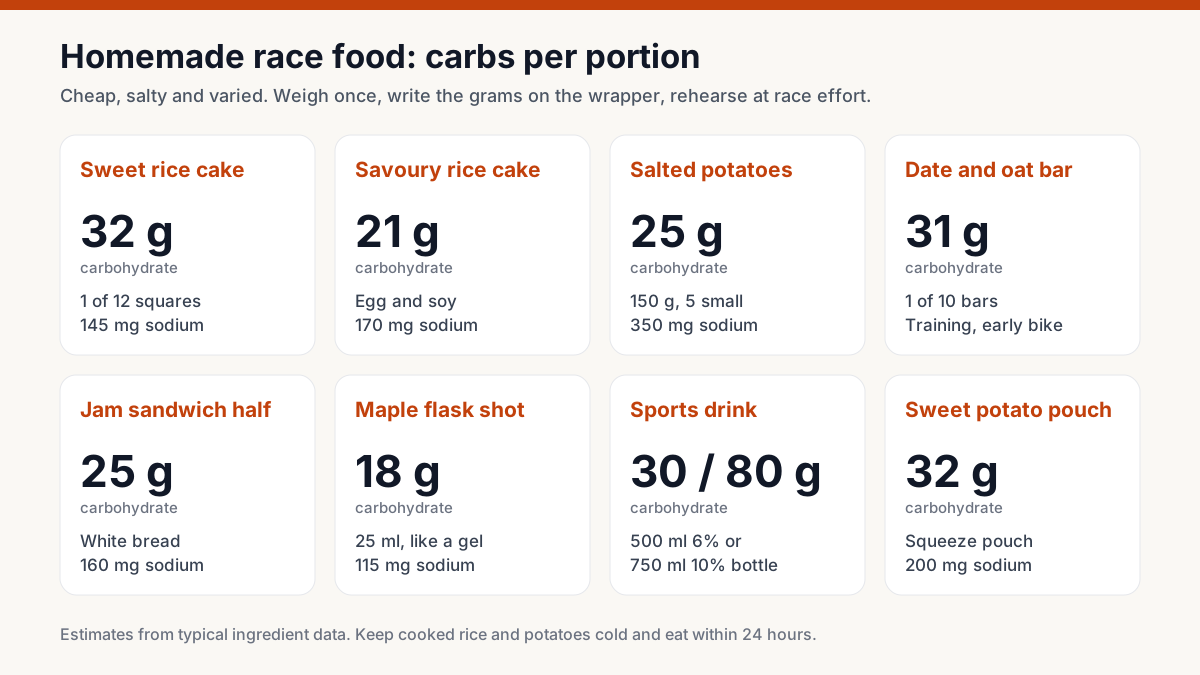
Homemade race food can deliver the same carbohydrate as gels at a fraction of the cost, with more variety and salt. The recipes below give about 18 to 32 g of carbohydrate per portion: sweet and savoury rice cakes, salted new potatoes, date and oat bars, jam sandwich halves, a maple syrup 'gel' flask, a 6% and a 10% sports drink, and sweet potato pouches. Use solid food mainly on the bike and in the first half of long sessions, keep fat and fibre low during hard efforts, keep cooked rice and potatoes cold and eat them within a day, and rehearse every item at race intensity before relying on it.
Key takeaways
- 1Each recipe gives carbohydrate and sodium per portion, so you can plan grams per hour as precisely as with gels
- 2Rice cakes, salted potatoes and jam sandwiches are easy on the stomach and add savoury variety in long rides
- 3A maple syrup flask and a homemade 10% drink deliver gel-like amounts of glucose and fructose for a few pence
- 4Keep fat, fibre and protein low in race food; save date bars and nut butter for steady training or the early bike
- 5Cool cooked rice within an hour, keep it in the fridge and eat it within 24 hours; in heat, eat it within a few hours of leaving the fridge
- 6Values are estimates from typical ingredient data; weigh ingredients once and your numbers will be accurate enough to plan with
Quick answer: the recipes at a glance
Homemade race food lets you hit the same carbohydrate targets as gels with cheaper, saltier and more varied food. Each recipe below lists carbohydrate and sodium per portion, so you can plan it in grams per hour like any product.
| Recipe | Portion | Carbohydrate | Sodium | Best for |
|---|---|---|---|---|
| Sweet rice cakes with dates | 1 of 12 squares | About 32 g | About 145 mg | Long rides, first half of a race bike |
| Savoury rice cakes (egg and soy) | 1 of 12 squares | About 21 g | About 170 mg | Long rides, breaking up sweet food |
| Salted new potatoes | 150 g (about 5 small) | About 25 g | About 350 mg | Long rides, hot days |
| Date and oat bars | 1 of 10 bars | About 31 g | About 120 mg | Steady training, early bike |
| Jam sandwich half | Half a sandwich | About 25 g | About 160 mg | Long rides, special-needs bags |
| Maple syrup flask | 25 ml shot | About 18 g | About 115 mg | Race bike and run, like a gel |
| Homemade sports drinks | 500 ml or 750 ml bottle | About 30 g or 80 g | About 290 mg or 590 mg | Every long session |
| Sweet potato pouch | 1 pouch (about 165 g) | About 32 g | About 200 mg | Long rides, savoury-sweet change |
The numbers are our estimates from standard ingredient data. They are accurate enough to plan with if you weigh the main ingredients, but they will never be as exact as a gel label. The method section at the end of the page explains how they were calculated.
Why make your own race food?
Cost. A rice cake costs roughly the price of a few spoonfuls of rice and some dates, often a tenth of the price of a gel. Over a season of long rides that adds up.
Variety and appetite. After three or four hours of sweet gels, many athletes stop wanting to eat. That is when fuelling plans fail. A savoury rice cake or a salty potato often goes down when another gel will not.
Salt. Homemade savoury food can carry far more sodium than most bars, which helps on hot days.
Control. You choose the ingredients, which helps if you have allergies, avoid gelatine or honey, or follow a low-FODMAP approach for a sensitive gut.
The trade-offs are real. Solid food is slower to eat, harder to chew at high effort, more variable in carbohydrate, and needs care in heat. On the run, most athletes can only manage liquids and gels. Our real food vs gels guide compares the two in detail. Most experienced long-course athletes use both: real food early on the bike, gels and drink as intensity rises and on the run.
Rules that make race food work
- Keep fat, protein and fibre low. They slow stomach emptying, which is fine on an easy training ride but can cause bloating and nausea at race effort. The recipes here keep them low, apart from the date bars.
- Make portions bite-sized. You should be able to eat a portion in two or three bites while holding your line.
- Add salt. Savoury food and a pinch of salt in sweet food help both taste and sodium intake.
- Know your grams. Write the carbohydrate per portion on the wrapper with a marker. It turns guesswork into a plan.
- Rehearse. Eat the exact food, in the exact portion, at race intensity, in at least two long sessions before race day.
- Keep it cool and fresh. Cooked rice and potatoes are perishable; see the food safety section below.
1. Sweet rice cakes with dates and maple
The classic real-food ride snack. Short-grain "sushi" rice is sticky enough to hold together without binders.
Makes 12 squares. Per square: about 32 g carbohydrate, 145 mg sodium, 1 g fibre.
Ingredients
- 300 g uncooked sushi rice (short-grain)
- 8 Medjool dates (about 190 g with stones), stoned and chopped
- 2 tablespoons maple syrup (40 g)
- ¾ teaspoon fine salt (about 4.5 g)
- Optional: a little lemon zest or cinnamon
Method
- Rinse the rice, then cook it with about 450 ml of water (or in a rice cooker) until soft and sticky.
- While it is hot, stir in the dates, maple syrup and salt.
- Press the rice firmly into a lined baking tin about 20 × 20 cm. Press hard: firm cakes hold together in a pocket.
- Cool quickly (spread out, uncovered, for up to an hour), cut into 12 squares and wrap each one in baking paper and foil.
- Refrigerate and use within 24 hours.
Why it works: white rice is low in fibre and easy to digest; dates and maple syrup add fructose, so the mix delivers glucose and fructose together.
2. Savoury rice cakes with egg and soy
A savoury option to break up sweet food in long rides.
Makes 12 squares. Per square: about 21 g carbohydrate, 170 mg sodium (more with bacon), 4 g protein.
Ingredients
- 300 g uncooked sushi rice
- 4 eggs, scrambled
- 2 tablespoons soy sauce (about 1,800 mg sodium in total; check your bottle)
- 1 tablespoon brown sugar
- Optional: 100 g cooked bacon pieces, or smoked tofu for a vegetarian version
Method
- Cook the rice as above.
- Scramble the eggs (and fry the bacon or tofu, if using).
- Mix everything with the hot rice, press into a tin, cool quickly and cut into 12.
- Wrap and refrigerate; eat within 24 hours.
Variation: use a vegan egg substitute or extra smoked tofu, and the recipe fits a plant-based diet.
Note: the eggs and bacon add a little fat and protein. That is fine on long, steady rides but keep these for the first half of a race bike.
3. Salted new potatoes
The simplest savoury race food, and a favourite of ultra-distance riders.
Per 150 g serving (about five small new potatoes): about 25 g carbohydrate, 350 mg sodium.
Ingredients
- 1 kg small new or baby potatoes
- 1 teaspoon fine salt (about 6 g), plus extra to taste
- Optional: a little olive oil, rosemary
Method
- Boil the potatoes in their skins until just tender, about 15 to 20 minutes.
- Drain, toss with the salt (and a light coat of oil, if you like, to stop sticking), then cool quickly.
- Pack in a small bag or bento box. Use within 24 hours, kept in the fridge.
Tip: halve larger potatoes so each one is a single mouthful. Potatoes are about 17 g of carbohydrate per 100 g, so they are bulky: you need about 400 g to match three gels. They are best as a savoury change rather than your main fuel.
4. Date and oat bars (no bake)
Dense, cheap and long-lasting, but higher in fibre than the other recipes. Use them on steady training rides, in the early part of a long race bike, or as pre-session food.
Makes 10 bars. Per bar: about 31 g carbohydrate, 120 mg sodium, 3 to 4 g fibre.
Ingredients
- 250 g stoned Medjool dates
- 150 g rolled oats
- 60 g honey or maple syrup
- 40 g almond or peanut butter
- ½ teaspoon fine salt
- Optional: 1 tablespoon cocoa, orange zest
Method
- Blend the dates into a sticky paste (soak them in hot water for 10 minutes first if they are dry).
- Add the oats, honey, nut butter and salt, and pulse until it all clumps together.
- Press firmly into a lined tin about 20 × 15 cm and chill for an hour.
- Cut into 10 bars and wrap each one. They keep for about a week in the fridge.
For a lower-fibre version, blend the oats into flour first or replace half the oats with puffed rice. That makes the bars lighter and easier to digest at higher intensity.
5. Jam sandwich halves
The old-school ride food still works. White bread and jam are low in fat and fibre and easy to eat.
Per half sandwich: about 25 g carbohydrate, 160 mg sodium.
Ingredients (one sandwich, two portions)
- 2 slices white bread (about 70 g)
- 30 g jam, honey or a thin layer of smooth peanut butter plus jam
Method
- Make the sandwich, cut off the crusts if you like, and cut it into two halves (or four quarters for smaller bites).
- Wrap tightly in foil or a small bag.
Use: long training rides and IRONMAN bike special-needs bags. Peanut butter adds fat, so use only a thin layer if you plan to eat it at race effort.
6. Maple syrup "gel" flask
A homemade gel in a soft flask. Maple syrup is mostly sucrose, which the gut splits into glucose and fructose, the same mix found in many modern gels.
Makes about 250 ml, or 10 shots of 25 ml. Per shot: about 18 g carbohydrate, 115 mg sodium.
Ingredients
- 200 ml pure maple syrup (not "maple-flavoured" syrup)
- 50 ml water
- ½ teaspoon fine salt (about 3 g)
- Optional: a squeeze of lemon
Method
- Warm the water slightly and dissolve the salt in it.
- Mix with the maple syrup and pour into a 250 ml soft flask or a reusable gel flask.
- A good mouthful is about 25 ml. Practise squeezing a "shot" in training so that you know how much you are taking.
Variation: honey works the same way (about 82 g of carbohydrate per 100 g), with a different taste and slightly more fructose. Not suitable for vegans.
Why a flask helps: one 250 ml flask carries about 180 g of carbohydrate, which is roughly eight standard gels, with no wrappers to drop. Many races penalise littering, so a flask is also easier to manage within the rules.
7. Homemade sports drinks
Two strengths: a standard 6% drink for shorter sessions and heat, and a 10% high-carb drink for long rides.
Standard drink (about 6%)
Per 500 ml bottle: about 30 g carbohydrate, 290 mg sodium.
- 500 ml water
- 30 g table sugar (sucrose)
- ⅛ teaspoon fine salt (about 0.75 g)
- A squeeze of lemon or a splash of squash for taste
High-carb drink (about 10%)
Per 750 ml bottle: about 80 g carbohydrate, 590 mg sodium.
- 750 ml water
- 60 g table sugar
- 20 g maltodextrin powder (sold for home brewing and sports nutrition)
- ¼ teaspoon fine salt (about 1.5 g)
- Flavouring to taste
Method: dissolve everything in a little warm water, top up with cold water and shake well.
About the mix: sugar provides equal parts glucose and fructose, and maltodextrin adds more glucose. The high-carb version works out at roughly 1 part fructose to 1.6 parts glucose, close to the ratios used in commercial high-carb drinks. Drinks above about 8% empty from the stomach more slowly, so practise the 10% bottle in long rides before racing with it, and drink plain water alongside if you feel full.
For more sodium on hot days, increase the salt gradually, up to about ½ teaspoon per litre. Very salty drinks taste unpleasant, which is a useful brake. Our electrolytes guide explains how much sodium most athletes need.
8. Sweet potato pouches
Reusable squeeze pouches (sold for baby food) are an easy way to carry soft food you can eat at speed.
Makes 4 pouches. Per pouch: about 32 g carbohydrate, 200 mg sodium.
Ingredients
- 600 g baked sweet potato flesh (about 3 to 4 medium potatoes)
- 2 tablespoons maple syrup
- ¼ teaspoon fine salt
- A little water to loosen
Method
- Bake the sweet potatoes until very soft, scoop out the flesh and mash it with the syrup and salt.
- Add water until it is smooth enough to squeeze, then divide between four pouches.
- Refrigerate and use within 24 hours.
Variation: apple purée with a little honey or maple syrup gives a sweeter, lighter pouch (unsweetened apple purée has only about 12 g of carbohydrate per 100 g, so you need the added syrup).
Building a ride or race plan from homemade food
Start with your carbohydrate target per hour. Our race nutrition calculator sets it from race duration and how well trained your gut is; the high-carb snacks list gives values for shop-bought options to mix in.
Example: a 4-hour long ride at 60 g per hour (240 g)
| Hour | What you eat and drink | Carbohydrate |
|---|---|---|
| 1 | High-carb drink (half a bottle) + 1 sweet rice cake | 40 + 32 = 72 g |
| 2 | High-carb drink (half a bottle) + 1 savoury rice cake | 40 + 21 = 61 g |
| 3 | Standard drink + jam sandwich half | 30 + 25 = 55 g |
| 4 | Standard drink + 1 maple flask shot | 30 + 18 = 48 g |
| Total | About 236 g |
That plan uses one 750 ml bottle of the high-carb drink and two 500 ml bottles of the standard drink, so you would refill once.
Example: 70.3 bike at 75 g per hour (3 hours, about 225 g)
A common real-food approach for a half-distance race is to rely on drink and flask for most of the carbohydrate and use one or two pieces of solid food early:
- Two 750 ml bottles of the high-carb drink: about 160 g
- One sweet rice cake in the first 30 minutes: about 32 g
- Two maple flask shots in the last hour: about 36 g
- Total: about 228 g, roughly on target
On the run, switch to gels, the maple flask and on-course drinks. Solid food rarely works at running intensity.
Example: IRONMAN bike with special-needs bag
Long-course athletes can put fresh homemade food in their bike special-needs bag, typically collected around halfway. A rice cake or sandwich half that has been in the bag for several hours in the sun is a food safety risk, though, so add a frozen bottle next to it as an ice pack or rely on non-perishable foods (bars, flask) in hot races. Our IRONMAN nutrition guide covers special-needs planning.
Wrapping, carrying and eating on the move
- Baking paper inside foil is the standard wrap for rice cakes: the paper stops sticking and the foil can be opened with one hand. Fold the foil so a corner tears off easily.
- Top-tube bags (bento boxes) hold four to six portions. Pack them in the order you will eat them.
- Jersey pockets are fine for training; for racing in a tri suit, use a bento box or tape portions to the top tube.
- Pre-open wrappers slightly before the start if you struggle with cold or gloved hands.
- Eat on a flat, straight or gentle downhill section, in an easy gear, never in a fast group or on a technical descent.
- Chew and drink. A few sips of fluid with solid food help it go down and move through the stomach.
Food safety for homemade race food
Cooked rice can carry spores of Bacillus cereus, which survive cooking. If the rice is left warm, the spores can grow and produce toxins that reheating does not destroy. The NHS and UK Food Standards Agency advise the following, which applies to rice cakes, potatoes and pouches:
- Cool cooked rice and potatoes quickly, ideally within an hour. Spread them out in a shallow tin.
- Keep them in the fridge (5 °C or below) until you leave.
- Eat within 24 hours of cooking. Do not reheat or refreeze leftovers.
- In warm weather, eat them within a few hours of leaving the fridge, and keep them in the coolest part of your bag. On hot race days, prefer non-perishable foods for the second half of the bike.
Rice cakes and bars can be frozen individually as soon as they are cool. Take a frozen one out on the morning of a long ride and it will thaw by the time you want it.
Also think about allergens if you are sharing food with training partners: nuts, eggs, gluten and sesame (in some soy sauces and seeds) are common in these recipes.
Real food on the run
Most athletes cannot chew solid food at running effort. The options that tend to work on the run are:
- The maple flask, which acts like a gel.
- Small sips of the standard drink.
- Cola, flat or fizzy, which many athletes tolerate late in races.
- Very small bites (a quarter of a jam sandwich, a couple of salted potato pieces) in an IRONMAN marathon at walking pace through aid stations.
If your run fuelling regularly fails, look at the sensitive stomach guide and the gut training guide rather than adding more variety.
Common mistakes with homemade race food
Guessing portions. A "rice cake" can contain 15 g or 50 g of carbohydrate depending on size. Cut to a known size and write the grams on it.
Too much fat or fibre. Nut-heavy bars and wholegrain bread feel healthy but sit in the stomach at race effort.
Only sweet food. Mix in savoury portions in long sessions; it keeps you eating.
Trying it first on race day. The rule that applies to gels applies twice to homemade food.
Leaving it in the sun. Food safety is easy to forget on a long, hot day.
Relying on solid food on the run. Plan liquids and gels for running and keep solid food for the bike.
How the numbers were calculated
We used typical nutrient values for each ingredient from USDA FoodData Central and UK food composition data, counting available carbohydrate (without fibre), as UK and EU labels do. US labels include fibre in total carbohydrate, so a US label for the same food can show a slightly higher number. Key values:
| Ingredient | Carbohydrate | Notes |
|---|---|---|
| Uncooked sushi rice | About 78 g per 100 g | Cooked rice is about 28 to 30 g per 100 g, depending on water |
| Medjool date | About 16 g each (stoned, about 24 g) | Varies with size |
| Rolled oats | About 60 g per 100 g | About 10 g fibre per 100 g |
| Maple syrup | About 67 g per 100 g (about 89 g per 100 ml) | Mostly sucrose |
| Honey | About 82 g per 100 g | Fructose and glucose |
| Table sugar | 100 g per 100 g | Half glucose, half fructose |
| Boiled new potatoes | About 17 g per 100 g | With skins |
| Baked sweet potato | About 17 g per 100 g | Without skin |
| White bread | About 45 g per 100 g | About 16 g per slice |
| Jam | About 60 g per 100 g | Varies by brand |
| Salt | — | 1 g salt contains about 390 mg sodium; ¼ teaspoon is about 1.5 g |
Sodium figures include salt added in the recipe and typical sodium in bread and soy sauce. Treat all values as estimates and check them against the labels of the brands you buy.
Sources
Sources are listed so readers can verify consequential claims and dated details.
- FoodData Central — US Department of Agriculture (accessed November 21, 2026)
- Composition of foods integrated dataset (CoFID) — Public Health England / UK Government (accessed November 21, 2026)
- Can you reheat rice? Leftovers and food safety — NHS (accessed November 21, 2026)
- Chilling: food hygiene — Food Standards Agency (accessed November 21, 2026)
- A step towards personalized sports nutrition: carbohydrate intake during exercise (Jeukendrup, 2014) — Sports Medicine (accessed November 21, 2026)
- Nutrition and athletic performance: ACSM, AND and DC joint position statement (2016) — Medicine & Science in Sports & Exercise (accessed November 21, 2026)
Frequently asked questions
How many carbs are in a homemade rice cake?
It depends entirely on size and recipe. With 300 g of uncooked rice, eight dates and two tablespoons of maple syrup cut into 12 squares, each square contains about 32 g of carbohydrate, similar to a large gel.
Can I race an IRONMAN on real food only?
Some athletes do on the bike, but almost everyone needs liquids or gels on the run, and solid food alone makes high carbohydrate rates (75 to 90 g per hour) hard to reach. A mix of drink, flask and a few solid portions on the bike is more realistic.
Is a homemade sports drink as good as a commercial one?
For carbohydrate and sodium, yes, if you measure the ingredients. Commercial drinks offer convenience, consistent taste and sometimes precise glucose-to-fructose ratios; a sugar, maltodextrin and salt mix gets close for very little money.
How long do rice cakes keep?
About 24 hours in the fridge, or a few weeks frozen. Once out of the fridge, eat them within a few hours, sooner in hot weather.
Are these recipes suitable for a sensitive stomach?
The rice cakes, potatoes, jam sandwiches and maple flask are low in fibre and fat and suit most sensitive stomachs. Dates, honey and large amounts of fructose can trouble some people with irritable bowel symptoms; test small portions first, or see our sensitive stomach guide for low-FODMAP options.