Triathlon Supplements Ranked by Evidence: What Works, What Might, What to Skip
An evidence-ranked guide to supplements for triathletes: caffeine, nitrate, creatine, sodium bicarbonate, beta-alanine and glycerol, medical supplements such as iron and vitamin D, emerging options, products to skip, doses, which race distances each one suits, and how to avoid contaminated products.
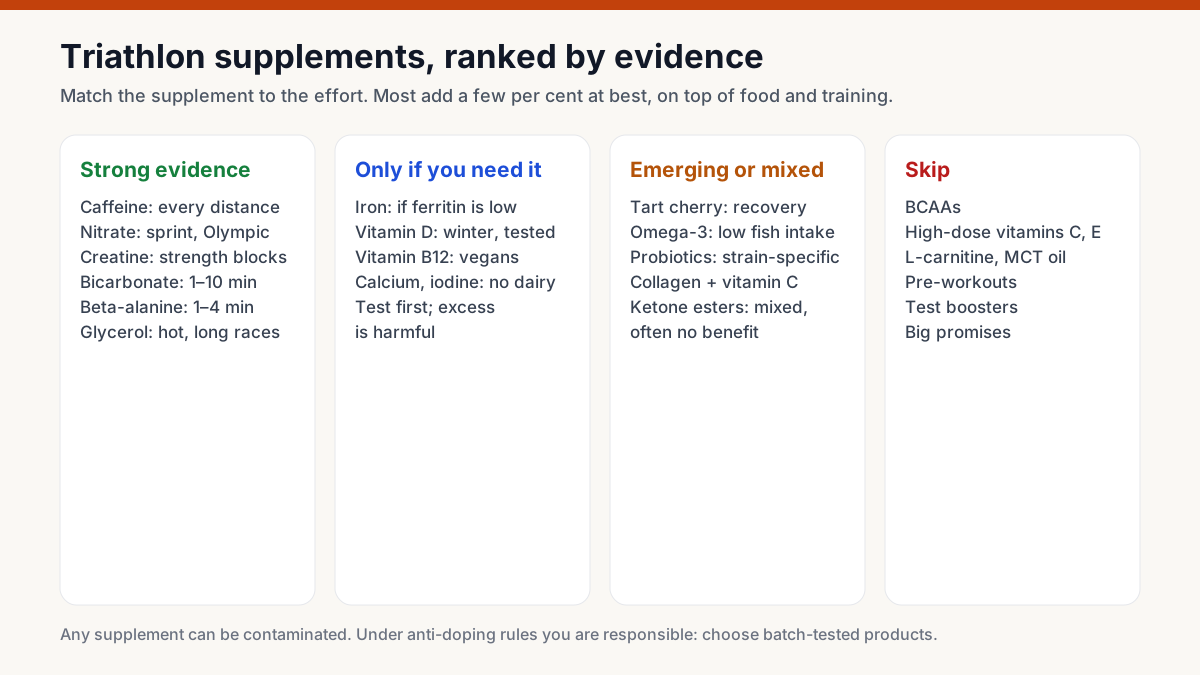
Only a handful of supplements have strong evidence of improving performance: caffeine, dietary nitrate (beetroot juice), creatine, sodium bicarbonate and beta-alanine, plus glycerol for fluid loading in the heat. For triathletes, caffeine is useful at every distance; nitrate helps most in shorter, harder races and less-trained athletes; bicarbonate and beta-alanine suit short, very intense efforts and matter little in long-course racing; creatine mainly supports strength training rather than racing. Medical supplements such as iron, vitamin D and vitamin B12 help only when you are low or at risk, which a blood test or your diet shows. Most other products have mixed, weak or no evidence. Any supplement can be contaminated, so choose batch-tested products if you race under anti-doping rules, and test everything in training first.
Key takeaways
- 1Food, training and sleep come first; supplements add at most a few per cent, and only when the basics are in place
- 2Caffeine is the one supplement with strong evidence that suits every triathlon distance; about 3 mg/kg is plenty for most people
- 3Nitrate (beetroot juice) helps most in races under about an hour and in less-trained athletes; benefits in well-trained long-course athletes are small or absent
- 4Sodium bicarbonate and beta-alanine help 1 to 10-minute all-out efforts, so they matter for draft-legal sprint racing, not for a 70.3 or IRONMAN
- 5Creatine supports strength training and recovery and may help plant-based athletes, but adds 1 to 2 kg of water weight
- 6Iron, vitamin D and B12 are worth taking only when a blood test or your diet says you need them; too much iron or vitamin D is harmful
- 7Supplements can contain banned substances not on the label; under anti-doping rules you are responsible, so use batch-tested products
Quick answer: which supplements are worth it for triathlon?
Very few supplements have strong evidence that they make endurance athletes faster, and the ones that do work best in specific situations. The table ranks the common options for triathletes using the International Olympic Committee (IOC) consensus on supplements and the Australian Institute of Sport (AIS) framework, then adds our judgement of which race distances each one actually suits.
| Supplement | Evidence for performance | Most useful for | Typical tested dose |
|---|---|---|---|
| Caffeine | Strong | Every distance | About 3 mg/kg (range 2–6) before or during |
| Dietary nitrate (beetroot juice) | Strong, smaller in well-trained athletes | Sprint and Olympic; less-trained athletes | About 6–13 mmol (400–800 mg nitrate) 2–3 h before |
| Creatine monohydrate | Strong for strength and repeated sprints | Strength blocks, plant-based athletes, older athletes | 3–5 g a day |
| Sodium bicarbonate | Strong for 1–10 min all-out efforts | Draft-legal sprint, short track sessions | 0.2–0.3 g/kg 1–3 h before |
| Beta-alanine | Strong for 1–4 min efforts | Draft-legal sprint, swim sprints | About 3–6 g a day for 4+ weeks |
| Glycerol | Moderate, for fluid loading | Long races in heat, if sweat losses are large | About 1.2 g/kg with 25 ml/kg fluid |
| Iron, vitamin D, vitamin B12 | Helps when you are low | Athletes with a proven deficiency or a diet risk | Set with a doctor |
| Tart cherry, omega-3, probiotics, collagen | Emerging or mixed | Recovery, gut and tendon niches | Varies |
| Ketone esters | Mixed, often no benefit | Not recommended for racing | — |
| BCAAs, high-dose antioxidants, carnitine, "pre-workouts" | Weak, none, or counterproductive | Skip | — |
Two things matter more than this table. First, everything here adds a few per cent at best, and only on top of enough food, carbohydrate in training and racing, sleep and consistent training. Second, any supplement can contain something that is not on the label, so the safety section near the end of this page applies to every product.
How to judge supplement evidence
Supplement marketing usually quotes one study. A useful judgement asks five questions.
Who was tested? Many studies use recreationally active students. Effects are often smaller in trained athletes, whose muscles and blood flow have already adapted. Nitrate is the clearest example: the benefit shrinks as fitness rises.
What kind of effort? A supplement that helps a 4-minute all-out test may do nothing for a 5-hour race. Triathlon covers everything from a 15-minute draft-legal run to a 15-hour IRONMAN, so the effort type matters more than in most sports.
How big was the effect? A 1–3% improvement in a laboratory time trial is meaningful at the front of a race. It is also small enough to be lost to a poorly paced swim, a missed gel or a stomach upset caused by the supplement itself.
Was there a placebo? Expectation alone can change performance by a similar amount, which is why double-blind, placebo-controlled trials count for more than open trials or testimonials.
Is there a consensus? A position statement or meta-analysis that pools many trials is far more reliable than any single study. This page leans on the IOC consensus, the AIS framework and position stands from the International Society of Sports Nutrition (ISSN).
The AIS framework is a practical way to read the evidence. Group A covers sports foods, medical supplements and performance supplements with strong evidence. Group B covers products that deserve research or use under supervision. Group C covers products with little evidence of benefit. Group D covers products that are banned or at high risk of contamination.
Food first, and the sports foods you already use
Before any pill or powder, check that you are eating enough, in particular enough carbohydrate around hard and long sessions. Low energy availability (eating too little for the training you do) undermines everything a supplement might add and causes the problems described in our plant-based triathlete nutrition guide and recovery nutrition guide.
Your race fuel is also a supplement category. Gels, sports drinks, chews, electrolyte tablets and protein powders are "sports foods" in the AIS framework: they are useful because they deliver known amounts of carbohydrate, sodium or protein conveniently, not because they contain anything special. Carbohydrate during long races is, by a wide margin, the most powerful "supplement" a triathlete has. Our race nutrition calculator turns that into grams per hour, and the energy gels guide helps you choose products.
Protein powder is likewise just convenient protein. If your meals already reach about 1.6 g per kg of body weight a day, powder adds nothing beyond convenience; see our protein requirements guide.
Caffeine: the one that fits every distance
Caffeine is the best-supported performance supplement for endurance sport. It reduces perceived effort and pain, improves alertness and helps you hold a given power or pace for longer. The ISSN position stand (2021) found consistent benefits in endurance exercise at about 3 to 6 mg per kg of body weight, and later work shows benefits from as little as 2 to 3 mg/kg.
Dose. About 3 mg/kg is plenty for most athletes: 210 mg for a 70 kg person. Higher doses add side effects (jitters, a racing heart, stomach upset and poor sleep) with little extra benefit. Count every source, including race-morning coffee, caffeinated gels and cola on the run.
Timing. Caffeine peaks in the blood about 30 to 60 minutes after you take it, and its effect lasts several hours. In short races, take it about an hour before the start. In long races, many athletes split it: some before the start and small doses in the second half of the bike and on the run, when fatigue is greatest.
Habitual coffee drinkers still benefit. Stopping caffeine in race week to "reset" sensitivity is not necessary and can cause headaches.
Who should be careful: anyone with heart rhythm problems, anxiety disorders, high blood pressure, pregnancy, or a sensitive stomach. Our caffeine guide covers timing by distance and how to rehearse it.
Dietary nitrate (beetroot juice): best in shorter, harder races
Nitrate from beetroot juice, rocket, spinach and other leafy vegetables is converted by bacteria in the mouth to nitrite and then to nitric oxide. That can lower the oxygen cost of exercise and improve muscle efficiency.
Evidence. The IOC consensus classes nitrate as having good evidence for improving performance in efforts of roughly 12 to 40 minutes, with smaller and less consistent effects in longer events and in highly trained athletes. A well-trained athlete racing a 5-hour 70.3 may see little or nothing; a newer athlete racing a sprint is more likely to benefit.
Dose. About 6 to 13 mmol of nitrate (roughly 400 to 800 mg), taken 2 to 3 hours before the start. Concentrated beetroot "shots" usually contain about 6 to 6.5 mmol each, so one or two shots cover the tested range. Several days of daily intake before a race may help more than a single dose.
Practical notes. Antibacterial mouthwash kills the mouth bacteria that convert nitrate, so avoid it on the days you use nitrate. Pink urine (beeturia) is harmless. Some athletes get stomach upset from the juice, so trial it before hard sessions. Our beetroot juice and nitrate guide gives products, doses and a loading schedule.
Creatine: a training supplement, not a race-day one
Creatine monohydrate is the most researched supplement in sport. It increases the creatine phosphate stored in muscle, which supplies energy for short, intense efforts.
What it does for triathletes. Creatine helps strength training, repeated sprints and recovery from hard intervals. It also increases how much glycogen muscles can store when taken with carbohydrate. It does not directly improve steady endurance performance, and the 1 to 2 kg of water most people gain is a small cost on hills and on the run.
Who benefits most.
- Athletes in a strength block. Better quality gym sessions support the strength work our strength training guide recommends.
- Plant-based athletes, whose muscle creatine stores tend to be lower because creatine comes mainly from meat and fish.
- Masters athletes. Creatine plus resistance training helps maintain muscle mass with age.
- Draft-legal racers, who need repeated surges.
Dose. 3 to 5 g a day, any time of day, reaches full muscle stores in about three to four weeks. A loading phase of about 20 g a day (split into four doses) for five to seven days gets there faster but makes the weight gain more noticeable. Plain creatine monohydrate is the form with the evidence; more expensive forms have not been shown to work better.
Safety. The ISSN position stand concluded that creatine is safe for healthy people at recommended doses, including long-term use. Anyone with kidney disease should ask a doctor first, and the weight gain can upset readings on smart scales that estimate body fat.
A common approach for long-course athletes is to take creatine during base and strength phases, then decide whether to keep it through the race block. If you race well with it, keep it; if the weight bothers you on hilly runs, stop four to six weeks before your key race.
Sodium bicarbonate: for short, all-out efforts
Sodium bicarbonate (baking soda) buffers acid in the blood, which helps muscles sustain very high-intensity work.
Evidence. The ISSN position stand (2021) found that bicarbonate improves performance in efforts of roughly 30 seconds to 12 minutes, including repeated intervals. It has little to offer in steady efforts of an hour or more, which is most of triathlon.
Where it might fit. Draft-legal sprint racing, with its surges and fast runs, and hard interval sessions. For age-group Olympic, 70.3 and IRONMAN racing, it is rarely worth the risk.
The catch is the gut. The tested dose is 0.2 to 0.3 g per kg of body weight, 60 to 180 minutes before exercise. For a 70 kg athlete that is 14 to 21 g of baking soda, which often causes bloating, nausea and diarrhoea. Newer hydrogel or enteric-coated products reduce these problems, but you still need to test them carefully in training.
Sodium load. Sodium bicarbonate is about 27% sodium by weight, so 20 g contains about 5,500 mg of sodium. That is far more than any race-day electrolyte plan, and people with high blood pressure or kidney problems should not use it without medical advice.
Beta-alanine: helpful for 1 to 4-minute efforts
Beta-alanine raises muscle carnosine, another buffer of acid inside the muscle.
Evidence. The ISSN position stand (2015) found benefits for efforts of about 1 to 4 minutes, and smaller effects for longer ones. For long-course triathlon, the benefit is small to non-existent. It may help pool sprint sets, short time trials and draft-legal racing.
Dose. About 3.2 to 6.4 g a day, split into doses of 0.8 to 1.6 g every few hours, for at least four weeks. Muscle carnosine rises slowly, so a single pre-race dose does nothing.
Side effect. Large single doses cause a harmless tingling of the skin (paraesthesia). Smaller split doses or sustained-release tablets avoid it.
Glycerol: fluid loading for hot, long races
Glycerol helps the body retain extra water when taken with a large drink before exercise. The AIS lists it among performance supplements with good evidence for hyperhydration. It was removed from the World Anti-Doping Agency prohibited list in 2018.
When it might help. Long races in heat, for athletes with high sweat rates who cannot drink enough on course to limit losses. Our sweat rate calculator tells you whether you are in that group.
Dose. About 1.2 g per kg of body weight mixed with about 25 ml per kg of fluid, drunk over an hour or so, 1.5 to 3 hours before the start. That is a lot of fluid (1.75 litres for a 70 kg athlete), and you will carry the extra weight early in the race.
Risks. Headache, bloating, nausea and, for some people, a race-morning stomach that never settles. Glycerol does not protect against overdrinking during the race. It is an advanced strategy that belongs with a sports dietitian, not a first race. Pre-race sodium loading is a related approach; see our sodium loading guide for its evidence and cautions.
Medical supplements: only when you need them
These do not boost performance in someone who is already replete. They restore performance and health when a nutrient is low.
Iron
Endurance training, heavy periods, a plant-based diet and frequent blood donation all increase the risk of low iron, which causes fatigue and poor training response before it causes anaemia. Ask a doctor to check ferritin and a full blood count if you are unusually tired, out of breath or stagnating.
Take iron only when a test shows you need it, because iron overload is harmful and iron tablets often cause constipation and nausea. When you do take it:
- Take it in the morning, ideally before or within about 30 minutes after a session. The hormone that blocks iron absorption, hepcidin, rises a few hours after exercise.
- Studies suggest that taking iron every other day can improve absorption compared with daily doses. Ask your doctor whether that suits you.
- Take it with vitamin C (for example orange juice) and away from tea, coffee, calcium and dairy.
- Re-test after about 8 to 12 weeks.
Vitamin D
Vitamin D supports bone health and muscle function, and low levels are common in winter at northern latitudes and in athletes who train indoors. The NHS advises everyone in the UK to consider 10 micrograms (400 IU) a day in autumn and winter. Athletes with a measured deficiency may be given more by their doctor.
Do not exceed 100 micrograms (4,000 IU) a day without medical supervision. That is the adult upper limit set by the US National Institutes of Health, and higher doses can raise blood calcium.
Vitamin B12, calcium, iodine and omega-3
Vegans need vitamin B12 from a supplement or fortified foods. Athletes who avoid dairy should plan calcium and iodine. Our plant-based guide gives the amounts.
Multivitamins
A standard-dose multivitamin is a reasonable insurance policy if your diet is restricted, but it does not improve performance in athletes who eat well. Avoid high-dose "athlete" formulas and anything with stimulants.
Emerging and mixed evidence: try with clear expectations
These products have some evidence in specific situations, but not enough to recommend them broadly. The AIS places most of them in Group B: worth research or supervised use.
| Product | What the evidence suggests | Our view for triathletes |
|---|---|---|
| Tart cherry juice and other polyphenols | May reduce muscle soreness and speed recovery after very damaging events such as marathons | Possibly useful after a long race or during a stage race; not needed for normal training |
| Omega-3 (fish or algae oil) | May help muscle recovery and adaptation; strong general health case for people who eat little oily fish | Reasonable if you rarely eat oily fish; not a performance aid |
| Probiotics | Some strains may reduce colds and gut symptoms in athletes; effects are strain-specific | Worth considering if you get frequent infections or gut trouble; choose strains used in research |
| Collagen or gelatine with vitamin C | Early research suggests it may support tendon and ligament collagen when taken before loading exercise | A low-risk option during tendon rehab, alongside, not instead of, physiotherapy |
| Curcumin | May reduce soreness; absorption varies by product | Low priority |
| Ketone esters | Several cycling studies found no benefit or worse time-trial performance; some show better recovery during heavy training | Not recommended for racing; expensive per serving |
If you try one of these, give it a fair trial (several weeks, one change at a time) and stop if you notice nothing.
Little or no evidence: products to skip
BCAAs. Branched-chain amino acids do not improve endurance performance or muscle growth in athletes who eat enough protein. Whole protein contains them anyway. Our BCAA guide explains why.
High-dose antioxidants. Large doses of vitamins C and E taken around training may blunt some of the adaptations that training produces. The IOC consensus advises against routine high-dose antioxidant supplements. Get antioxidants from fruit and vegetables instead.
L-carnitine, MCT oil, CBD, ginseng and "fat burners". Evidence for endurance performance is weak or absent. MCT oil in useful amounts often causes stomach upset.
"Pre-workout" and "test-booster" products. These are among the highest-risk products for undeclared stimulants and banned substances, and they offer nothing beyond caffeine.
Anything that promises big results. Real supplement effects are small. A product claiming large gains is either overstating the evidence or contains something it should not.
Which supplements suit which race?
Matching the supplement to the effort is where most triathletes go wrong. A short, intense draft-legal race and a 12-hour IRONMAN are physiologically very different events.
| Race | Worth testing | Probably not worth it |
|---|---|---|
| Draft-legal sprint (about 1 hour, with surges) | Caffeine; nitrate; bicarbonate (if your gut tolerates it); beta-alanine; creatine in training | Glycerol |
| Age-group sprint or Olympic (1 to 3 hours) | Caffeine; nitrate, especially if you are fairly new to endurance sport | Bicarbonate, beta-alanine, glycerol |
| 70.3 (4 to 7 hours) | Caffeine; carbohydrate and sodium as sports foods; nitrate may help a little | Bicarbonate, beta-alanine |
| Full distance (9 to 17 hours) | Caffeine, mainly in the second half; carbohydrate, sodium and fluid planning; glycerol only in hot races with expert input | Bicarbonate, beta-alanine, ketones |
| Training blocks | Creatine in strength phases; iron, vitamin D or B12 if tested low; protein from food or powder | BCAAs, high-dose antioxidants |
Combining supplements
Some athletes "stack" caffeine, nitrate and bicarbonate. Research on combinations is limited, and effects do not simply add up. The main risk is your gut: beetroot juice, bicarbonate, caffeine and a big pre-race breakfast together are a recipe for a portaloo queue.
If you want to combine, add one product at a time, in training, at race intensity. Keep everything else the same so that you know what caused any change.
How to test a supplement in training
Treat each supplement as an experiment on yourself:
- Pick one product that suits your race (use the table above) and a dose from the research.
- Choose a repeatable session close to race intensity: for example, 2 × 20 minutes at Olympic-distance effort on the bike, or a 5 km run test.
- Do the session at least twice with and twice without, at similar fatigue, time of day and conditions. If you can, ask someone to prepare the drink so that you do not know which is which.
- Record power or pace, heart rate, perceived effort, gut comfort and sleep that night.
- Rehearse race-day timing in a long brick session before you use it in a race. The bigger the race, the more rehearsals you need.
- Decide honestly. If you cannot see a difference after a fair trial, the product is not worth the cost or the risk.
Safety, contamination and anti-doping
Supplements are not tested like medicines. In many countries, including the US and UK, manufacturers do not have to prove that a product works or that the label is accurate before it goes on sale. Analyses of supplements over the past two decades have repeatedly found products containing stimulants, steroids or other banned substances that were not on the label.
That matters for every triathlete:
- Under anti-doping rules, you are responsible for anything in your body, whatever the label said. Age-group athletes at IRONMAN, World Triathlon and national federation events can be tested.
- Choose batch-tested products if you race under anti-doping rules. Programmes such as Informed Sport, NSF Certified for Sport and the Cologne List test batches for banned substances. That reduces the risk but does not remove it.
- Avoid high-risk categories: pre-workouts, weight-loss products, "test boosters" and anything sold with dramatic claims.
- Check medicines and conditions. Caffeine can interact with some medicines; iron and vitamin D are harmful in excess; bicarbonate is a large sodium load. Ask your doctor or pharmacist if you take regular medication, are pregnant, or have heart, kidney or blood pressure problems.
- Use the dose in the research. More is rarely better and often worse.
What a sensible supplement plan looks like
For most age-group triathletes, a sensible plan is short:
- Eat enough, with plenty of carbohydrate around training, and use sports foods for long sessions and races.
- Practise caffeine at about 3 mg/kg for key sessions and races.
- If you race sprint or Olympic distance, try nitrate before hard sessions; keep it if it helps.
- Consider creatine during strength blocks, especially if you are plant-based or over about 50.
- Take vitamin D in winter if you live far from the equator, and get ferritin checked if you are tired or not improving.
- Skip the rest unless a professional recommends it for a specific reason.
That covers most of the available benefit at a few pounds or dollars a week.
Sources
Sources are listed so readers can verify consequential claims and dated details.
- IOC consensus statement: dietary supplements and the high-performance athlete (Maughan et al., 2018) — British Journal of Sports Medicine (accessed November 21, 2026)
- AIS Sports Supplement Framework — Australian Institute of Sport (accessed November 21, 2026)
- ISSN position stand: caffeine and exercise performance (Guest et al., 2021) — Journal of the International Society of Sports Nutrition (accessed November 21, 2026)
- ISSN position stand: safety and efficacy of creatine supplementation (Kreider et al., 2017) — Journal of the International Society of Sports Nutrition (accessed November 21, 2026)
- ISSN position stand: beta-alanine (Trexler et al., 2015) — Journal of the International Society of Sports Nutrition (accessed November 21, 2026)
- ISSN position stand: sodium bicarbonate and exercise performance (Grgic et al., 2021) — Journal of the International Society of Sports Nutrition (accessed November 21, 2026)
- Vitamin D fact sheet for health professionals — NIH Office of Dietary Supplements (accessed November 21, 2026)
- Iron fact sheet for health professionals — NIH Office of Dietary Supplements (accessed November 21, 2026)
- Informed Sport: batch-tested products — LGC Informed Sport (accessed November 21, 2026)
Frequently asked questions
What is the best supplement for triathletes?
Caffeine. It has strong evidence, suits every distance, is cheap and is easy to rehearse. Carbohydrate during long races has a bigger effect, but it is a food rather than a supplement.
Should triathletes take creatine?
It can help strength training and recovery, especially for plant-based and older athletes, but it does not directly improve steady endurance and adds 1 to 2 kg of water. Many long-course athletes use it in strength phases and decide case by case whether to keep it in the race block.
Does beetroot juice work for an IRONMAN?
The evidence is weakest for very long events and well-trained athletes. It is unlikely to hurt if your gut tolerates it, but caffeine and a good fuelling plan matter far more in a full-distance race.
Is sodium bicarbonate useful in long-course triathlon?
Rarely. It helps efforts of about 30 seconds to 12 minutes and carries a high risk of stomach upset and a very large sodium load. It suits draft-legal sprint racing and short intervals, not 70.3 or IRONMAN racing.
Do I need a multivitamin?
Not if your diet is varied and you eat enough. A standard-dose multivitamin can be sensible insurance on a restricted diet. Target specific nutrients, such as vitamin D in winter or iron when a test shows you are low, rather than taking high-dose formulas.
How do I know a supplement is not contaminated?
You cannot be certain. Choosing products that carry a batch-testing mark, such as Informed Sport or NSF Certified for Sport, and checking the batch number on the testing website, greatly reduces the risk.