Bike Cleat Types Explained: SPD, SPD-SL, Look and More
Compare SPD, SPD-SL, Look Kéo, Speedplay and Crankbrothers bike cleats by shoe fit, walking, float, release and triathlon use.
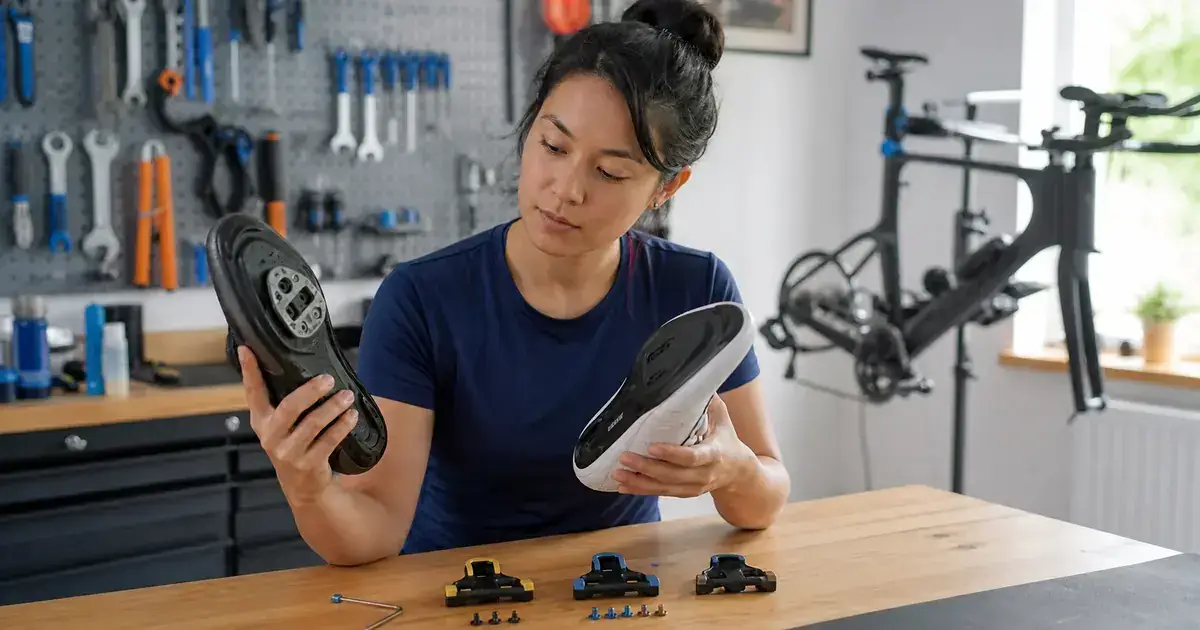
Bike cleats are not universal. Shimano SPD is a recessed two-bolt system that suits walking, commuting, gravel and simple transitions. Shimano SPD-SL and Look Kéo are separate three-bolt road systems with broad external cleats. Wahoo Speedplay is a road system with highly adjustable float and a different cleat mechanism. Choose the pedal system first, confirm the shoe's bolt pattern, then select float and release behavior for your fit and confidence.
Key takeaways
- 1A cleat must match the pedal system; a similar shape or bolt count does not make systems interchangeable
- 2Two-bolt recessed cleats are easier to walk in, while three-bolt road systems prioritize a broad road-pedal interface
- 3Float is controlled movement before release, while release angle is the rotation needed to unclip
- 4More or less float is not automatically better; cleat position must respect your natural foot angle
- 5Do not introduce a new cleat system on race week—install, torque and practice well before the event
In this article
- 1Quick answer: choose the system before the cleat color
- 2What cyclists mean by clips, cleats and clipless pedals
- 3Two-bolt versus three-bolt shoes
- 4How the main cleat systems differ
- 5Float, release and cleat position
- 6Which bike cleat should you choose?
- 7Install, practice and replace cleats safely
- ⚖Bike cleat systems compared
- ?Frequently asked questions
Quick answer: choose the system before the cleat color
For a first triathlon or any race with a long walk through transition, two-bolt Shimano SPD is the simplest clip-in choice because the small metal cleat is normally recessed into a walkable shoe. For road-focused training and racing, Shimano SPD-SL and Look Kéo are common three-bolt choices. They serve a similar use but are separate systems, so an SPD-SL cleat does not engage a Look pedal. Wahoo Speedplay suits riders who want extensive float and position adjustment, while Crankbrothers is mainly a two-bolt off-road alternative.
If you are not yet confident stopping and unclipping, flat pedals remain a valid option. Start with clipless versus flat pedals for triathlon before buying a cleat system.
What cyclists mean by clips, cleats and clipless pedals
The part fixed to the shoe is the cleat. The matching mechanism is inside the pedal. Together they form a clip-in or clipless system. The name “clipless” comes from replacing older toe clips and straps, even though the modern shoe still clips into the pedal.
Three terms answer different questions. Bolt pattern describes how the cleat mounts to the shoe. Float is the permitted heel rotation while still engaged. Release angle or direction describes the movement required to disengage. None tells you, by itself, whether a cleat will fit a particular pedal. Use the manufacturer's current compatibility chart and the exact model printed on your pedal or cleat.
Two-bolt versus three-bolt shoes
A two-bolt shoe places two parallel bolts in a sliding plate. The cleat is small and is usually surrounded by tread, so the shoe contacts the ground instead of the metal cleat. This makes two-bolt systems practical for walking, commuting, indoor cycling, gravel and transitions where shoes must be worn before the mount line.
A three-bolt road shoe uses a triangular mounting pattern for an external road cleat. Shimano SPD-SL and Look Kéo both mount to this common pattern, but the cleat-to-pedal interfaces remain incompatible. Wahoo Speedplay cleats can mount to common three-hole road shoes through the supplied base-plate arrangement; some shoes offer a direct four-hole mount.
Some shoes accept both two- and three-bolt hardware, but many do not. Check the bare sole, shoe manual and required hardware before ordering. The triathlon bike-shoe guide explains closures, drainage and transition features separately.
How the main cleat systems differ
Shimano SPD uses a small two-bolt metal cleat and is widely used for mountain biking, gravel, commuting and indoor bikes. Shimano's SM-SH51 is a single-direction release cleat; SM-SH56 is a multi-directional release version. Both must be used only with compatible Shimano SPD pedals.
Shimano SPD-SL is Shimano's three-bolt road system. Its current cleats use color to identify float: yellow has 6°, blue has 2° and red is fixed at 0°. Look Kéo is a different three-bolt road system; current Kéo Grip options are black 0°, grey 4.5° and red 9°. Similar color does not mean cross-brand compatibility.
Wahoo Speedplay places much of the retention mechanism in the cleat rather than the pedal and provides separately adjustable heel-in and heel-out limits. Current Speedplay road cleats offer adjustable float within a 0–15° range, depending on setup. Crankbrothers uses its own two-bolt brass cleats with system-specific release and float choices. Do not use any of these cleats in another brand's pedal unless the manufacturer explicitly approves that combination.
Float, release and cleat position
Float allows the heel to rotate before the release mechanism begins to disengage. Release angle is how far or in which direction the foot must move to exit. They are related but not the same. A high-float cleat can still have a distinct release point, and an easier-release cleat is not necessarily loose while pedaling.
A useful starting principle is to place the foot's natural angle near the middle of the available float rather than forcing both toes straight ahead. Shimano recommends yellow 6° SPD-SL as its starting option for new riders or people unsure about their neutral position; fixed red cleats require precise positioning. That is manufacturer guidance, not a diagnosis. Persistent knee, hip, foot pain, numbness or asymmetry deserves assessment by a qualified bike fitter and, when symptoms warrant, a healthcare professional.
Mark the old cleat outline before replacement and change only one variable at a time. The beginner bike-fit guide covers when professional help is worthwhile.
Which bike cleat should you choose?
Choose SPD or another recessed two-bolt system when walking, mixed-surface riding, indoor-bike compatibility or simple transition movement matters most. Choose SPD-SL or Look Kéo when you already use a three-bolt road shoe and want a conventional road setup with readily identifiable float options. Choose Speedplay when its independent float limits and fore-aft or side-to-side adjustment solve a specific fit requirement and you accept the more involved cleat setup. Choose Crankbrothers when you already use that off-road pedal ecosystem—not because its two-bolt cleat looks similar to SPD.
For a first race, the system you can enter and release reliably is more useful than the one that looks most race-specific. For a travel race or gym bike, confirm what pedals will actually be available. If you already own pedals and comfortable shoes, staying within that compatible system is usually simpler than replacing the whole pedal–cleat–shoe chain. The accessory compatibility guide helps check the rest of the bike setup.
Install, practice and replace cleats safely
Use only the bolts, washers, base plates and torque values specified for the exact cleat and shoe. Confirm that bolts do not protrude into the shoe, that the cleat sits flat, and that both pedals engage and release predictably before riding. When pedal tension is adjustable, follow the pedal manual rather than assuming the minimum or maximum is safe for every rider.
Practice supported clipping and release, then quiet-area starts and stops, before traffic or race day. How to master clipless pedals provides the progression. Never test a new cleat position, release mode or pre-mounted-shoe technique for the first time in a race.
There is no universal replacement mileage. Inspect for cracked material, rounded engagement edges, missing grip pads, loose hardware, inconsistent entry or unexpected release. Use the manufacturer's wear indicators and manual where provided, and replace with the exact compatible model. Cleat covers can protect protruding road cleats during walking, but remove any cover that the manufacturer says must not be used while riding.
Bike cleat systems compared
| System | Shoe mount | Walking | Float or release choices | Best fit when |
|---|---|---|---|---|
| Shimano SPD | 2-bolt | Recessed and usually easiest | SH51 single-direction; SH56 multi-direction | Walking, indoor, gravel or simple transitions matter |
| Shimano SPD-SL | 3-bolt road | Protruding cleat | Yellow 6°, blue 2°, red 0° | You want Shimano's conventional road system |
| Look Kéo | 3-bolt road | Protruding cleat | Black 0°, grey 4.5°, red 9° | You already use compatible Look Kéo pedals |
| Wahoo Speedplay | 3-hole base plate or direct 4-hole | Walkable cover surrounds cleat | Micro-adjustable within 0–15° | Independent fit adjustment is a priority |
| Crankbrothers | 2-bolt | Normally recessed | Easy/standard release and 0°/6° float options | You use the Crankbrothers off-road ecosystem |
Sources
Sources are listed so readers can verify consequential claims and dated details.
- Choosing the right Shimano SPD-SL road cleats — Shimano (accessed August 2, 2026)
- Shimano SM-SH51 single-direction SPD cleat — Shimano (accessed August 2, 2026)
- Shimano SM-SH56 multi-directional SPD cleat — Shimano (accessed August 2, 2026)
- Look Kéo Grip cleat specifications — LOOK Cycle (accessed August 2, 2026)
- Wahoo Speedplay cleats and adjustment — Wahoo Fitness (accessed August 2, 2026)
- Crankbrothers cleat float and release angle — Crankbrothers (accessed August 2, 2026)
Frequently asked questions
Are SPD and SPD-SL cleats compatible?
No. Shimano SPD is a two-bolt system with a small recessed cleat; SPD-SL is a three-bolt road system. The pedals, cleats and usually the shoe type are different.
Are Look Kéo and Shimano SPD-SL cleats interchangeable?
No. Both commonly mount to a three-bolt road shoe, but each cleat must match its own compatible pedal system.
Which cleats are easiest to walk in?
A recessed two-bolt cleat in a treaded shoe is generally easiest for normal walking. Protruding road cleats can be awkward and slippery, although grip versions and covers can help.
How much cleat float should a beginner use?
There is no universal number. Shimano positions its yellow 6° SPD-SL cleat as the forgiving starting option in that system. Whichever system you use, center your natural foot angle within the float and seek fitting help if you have pain or uncertainty.
When should bike cleats be replaced?
Replace them when the manufacturer's wear indicator reaches its limit or when you find cracks, rounded engagement surfaces, missing pads, loose hardware, inconsistent entry or unexpected release. There is no reliable universal mileage interval.