Rocker Plates for Indoor Trainers: Do Triathletes Need One, and Should You Buy or Build?
What a rocker plate does, what the evidence says about comfort and power, which triathletes benefit, the main plates and prices, how a DIY build works, and how to set one up safely.
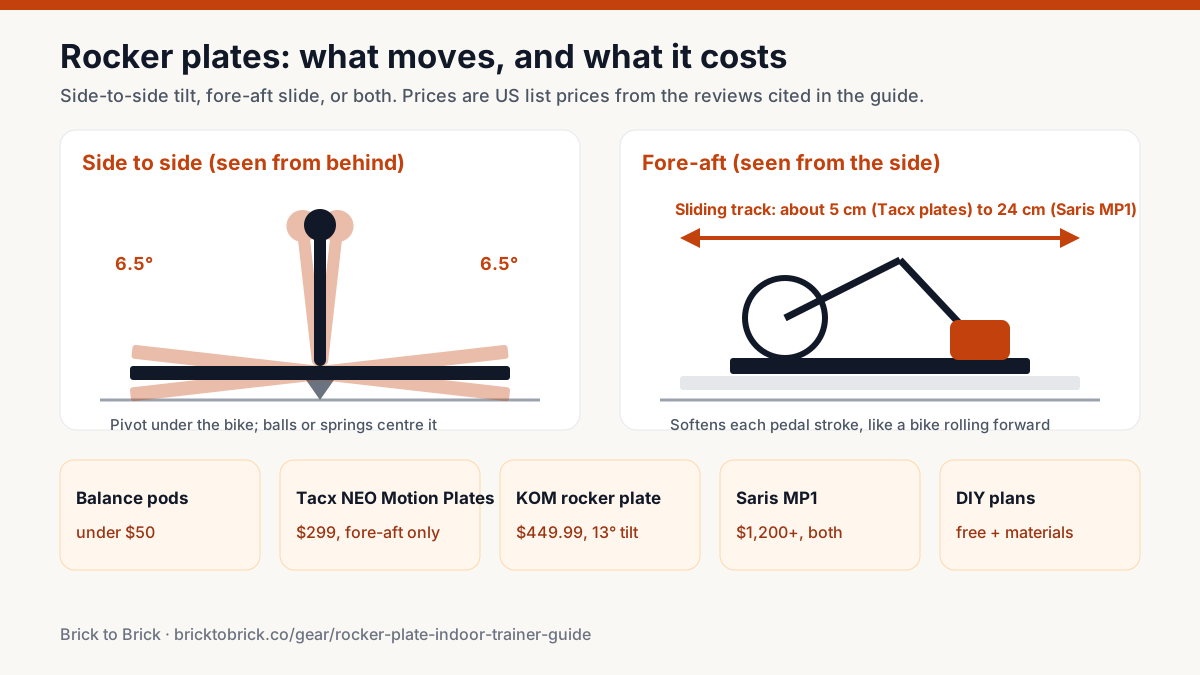
A rocker plate is a platform under your trainer that lets the bike tilt side to side (and on some plates slide forward and back), so your body is not fighting a rigid frame. The best evidence is limited: one rider's saddle pressure mapping found that movement lowered peak saddle pressure, reviewers report that motion feels more comfortable, and no study shows a gain in power or FTP. It is most worth having if you ride two hours or more indoors, get saddle soreness on the trainer, or do a lot of standing work. Commercial plates run from under $50 for balance pods to $449.99 for a KOM plate and $1,200 or more for a Saris MP1; free DIY plans exist if you are handy with wood and tools. Ride a tri bike on one with the stiffest setting first, because the aero position has a narrow base.
Key takeaways
- 1A rocker plate adds side-to-side tilt (usually about 6 to 9 degrees each way) and sometimes fore-aft slide, so the bike moves under you instead of being clamped rigid
- 2Evidence is thin: one rider's pressure mapping found lower peak saddle pressure with movement; there is no evidence it raises power or FTP
- 3It helps most for long indoor rides, saddle soreness and standing efforts, which suits 70.3 and full-distance athletes doing three to five hour trainer sessions
- 4Prices in reviews: balance pods under $50, Tacx NEO Motion Plates $299 (fore-aft only), KOM plate $449.99, Saris MP1 about $1,200 to $1,500, and Wahoo's KICKR MOVE trainer with built-in fore-aft about $1,300 to $1,600
- 5A DIY plate costs mostly time: free plans exist, but pinch points, poor centring and a wobbly pivot are real risks
- 6On a tri bike, start with the stiffest centring setting and short aero blocks; a free-tilting plate and a narrow aerobar base take practice
Quick answer: do triathletes need a rocker plate?
No triathlete needs a rocker plate, but some will find indoor training much more bearable with one. A rocker plate is a platform that sits under your trainer and lets the bike tilt from side to side, and on some designs slide forward and back. On a normal trainer the bike is clamped rigid, so your body does all the moving; on a plate, the bike moves a little under you, more like riding outside.
It is most worth considering if:
- You ride two hours or more indoors regularly, which is common in a 70.3 or full-distance build when long rides move inside for winter.
- You get saddle soreness, numbness or chafing on the trainer that you do not get outside.
- You do a lot of standing efforts, which feel stiff and awkward on a rigid trainer.
It is least worth it if your indoor rides are mostly 45 to 75 minute interval sessions, if your space is tight, or if the money would do more as a bike fit, a better saddle or a fan.
What it will not do: there is no evidence that a rocker plate raises your power or FTP. Its value is comfort and, through comfort, consistency.
What a rocker plate actually does
When you ride outside, the bike sways under you. Each pedal stroke tips it slightly from side to side, and the bike surges forward as you push and eases between strokes. On a trainer, the rear of the bike is fixed and the front sits in a block, so none of that happens. Your hips, spine and contact points absorb movement that the bike normally would, and the saddle presses on the same small area for the whole ride.
Rocker plates put some of that movement back. There are two kinds of motion:
- Side to side (lateral tilt). The plate pivots on a central line under the bike. Inflatable balls, springs or rubber mounts push it back to centre. Most plates allow about 6 to 9 degrees each way. CyclistsHub, which tests plates, suggests looking for at least 12 degrees in total (6 each way); the KOM plate offers 13 degrees in total and some plates up to 18.
- Fore-aft (front to back). The trainer slides on a short track and springs back. This softens each pedal stroke the way a bike surges outside. Tacx's NEO Motion Plates give about 49 mm of travel; the Saris MP1 about 9.5 inches (24 cm); Wahoo's KICKR MOVE trainer has about 8 inches (20 cm) built in.
Plates that only tilt are simpler and cheaper. Plates that do both are bigger, heavier and more expensive, but reviewers generally find fore-aft movement the more natural of the two.
What the evidence says
The honest answer is: not much, and none of it is about speed.
- Saddle pressure. In 2018 Chad McNeese, who designed a popular DIY plate, measured saddle pressure on his own setup with a fitter's pressure mapping system. He compared a rigid trainer with three spring settings and concluded that "adding a rocker plate does reduce the peak pressure on the saddle". A later update said that motion "reduced the pressure in nearly all cases". This is one rider on one setup, not a study, but it matches what many riders report.
- Coaching view. Cycling Weekly asked coach Alex Welburn about fitness benefits in 2023. His answer: a rocker plate will not add to your critical power or FTP, but it "may help reduce boredom, improve comfort" and make longer indoor rides more bearable, and consistency is one of the biggest drivers of fitness.
- Trainer reviews. Cyclingnews found the KICKR MOVE's built-in fore-aft gave "a slightly more comfortable power delivery" than a standard KICKR, while noting that its side-to-side movement was "a little unstable". Zwift Insider called the fore-aft "smooth and natural" and the side-to-side "more limited and less natural".
- Muscle use and power. Several reviews say rocker plates make you use your core more. We found no measurements of muscle activity or power to support or rule that out.
We could not find a peer-reviewed study of rocker plates. Treat any claim that they make you faster, prevent injury or "train your core" as unproven.
Who benefits most, and who can skip it
| Your situation | Rocker plate? | Why |
|---|---|---|
| 70.3 or full-distance build with long rides indoors (2–5 hours) | Strong case | Long rides are where rigid-trainer discomfort builds up; comfort helps you finish the session |
| Saddle sores or numbness only on the trainer | Worth trying, after checking fit | Movement may spread saddle pressure; fit and saddle choice matter more |
| Lots of standing efforts or climbing simulation | Good case | Standing on a rigid trainer feels stiff and unnatural |
| Mostly short interval sessions (under 75 minutes) | Low priority | Discomfort rarely builds up in short sessions |
| Small flat, upstairs room or shared space | Think twice | Plates add size, height and some knocking noise |
| Mostly riding in the aero position at steady effort | Useful, set stiff | Comfort helps, but a free plate and a narrow aero base take practice |
| Tight budget | Fix fit, saddle, fan and chamois cream first | These cost less and solve more |
If saddle discomfort is your main reason, start with the basics: a bike fit check, a saddle that suits your position, good shorts, chamois cream and anti-chafe habits, and standing for 20 to 30 seconds every 10 minutes or so. A rocker plate helps on top of those, not instead of them.
Rocker plates and the aero position
Triathletes spend much of their trainer time on the aerobars, and that changes the picture.
In the aero position your weight is on your forearms on a narrow base, with less steering control than on the base bar. On a free-tilting plate this can feel unstable at first, especially when you are tired at the end of a long ride. Start with:
- The stiffest centring setting (balls inflated firmer, stiffer springs or fewer degrees of travel).
- Short aero blocks of 10 to 20 minutes, then lengthen them over a few rides.
- Base-bar riding for standing efforts. Never stand on the aerobars.
- A front wheel strap or riser block that is secure. Some plates offer a strap for the front wheel.
The upside for triathletes is real. Holding the aero position for 2 to 4 hours is exactly the kind of riding where a rigid trainer becomes uncomfortable, and full-distance athletes often do their longest indoor rides in the aero position to rehearse race pacing. If a plate helps you complete those rides in position, it supports race-specific training. Use our guide to indoor cycling workouts for triathletes for how to structure those long sessions.
The main options and what they cost
Prices are US list prices at the time of the review we cite. They change often and sale prices are common.
| Option | Movement | Price in the review | Notes |
|---|---|---|---|
| Balance pods (for example Hedgehog pods), set of four | A little give in every direction | Under $50 | Cheapest way to try movement; CyclistsHub found the trainer can slip off during sprints, so not for hard efforts |
| Tacx NEO built-in movement | About 3° each way (NEO trainers only) | Included with the trainer | Built into Tacx NEO trainers; not a full rocker plate |
| Tacx NEO Motion Plates | Fore-aft only, about 49 mm | $299 (2022) | Fit NEO, NEO 2 and NEO 2T only. Velo found the short travel rebounded quickly when standing |
| KOM Cycling rocker plate | 13° tilt in total, no fore-aft | $449.99 | 42 lb, 64 × 34.5 in, 3.75 in high; fits most trainers via 17 sets of mounting slots; adjusted by inflating balls |
| Turborocks Realplate React | About 14.4° tilt plus fore-aft | Not stated in the review | 24.5 kg; a non-React version without fore-aft is cheaper; ships internationally |
| SBR Rockr Pro | Tilt plus a small fore-aft movement | $499 (2018 launch) | Launched for the US market; check current availability |
| Saris MP1 | Side to side and fore-aft (about 9.5 in) | About $1,200 (2022); $1,499.99 in a later retailer listing | About 6 × 3 ft and 62 lb; the most movement, the biggest footprint |
| Wahoo KICKR MOVE (a trainer, not a plate) | About 8 in fore-aft, a few degrees of side to side | $1,599 at launch (2023); $1,299.99 in a January 2025 review | An alternative to buying a separate plate if you need a trainer anyway |
Some brands come and go: CyclistsHub reports that Gymrail, which made the Momentum X1 plate, has gone out of business. Before buying, check that the maker still sells spare balls, springs or feet.
Things to check on any plate:
- Trainer compatibility. Most plates fit common direct-drive trainers, but check your model, especially for trainers with an offset flywheel or a smart bike.
- Footprint and height. Plates add several centimetres of height under the bike. In a room with a low ceiling, check head clearance when you stand.
- Weight. Plates weigh 15 to 30 kg. If you move your setup in and out of a cupboard, that matters.
- Spares. Inflatable balls and springs wear and may need replacing. Bikerumor noted the KOM plate ships with four balls (two in use) and a pump.
Buy or build?
| Buy | Build (DIY) | |
|---|---|---|
| Cost | $299 to $1,500 for a proper plate | Mostly materials, plus your time |
| Time | Unpack, level, ride | Plans, materials, cutting, drilling, assembly and tuning |
| Movement quality | Tested and repeatable | Depends on your pivot, centring and build quality |
| Safety | Designed pinch guards and stops | You design them in yourself |
| Resale | Some resale value | Little or none |
| Best for | Most people | People with tools, workshop space and woodworking experience |
Bikerumor's reviewer summed it up: building your own is "great if you have the time, the tools, and the know-how, but... that's not most people."
How a DIY rocker plate works
We have not built or tested a DIY plate, so this section explains the common designs rather than giving a tested build guide. Follow a complete published plan rather than improvising.
The best-known plans are the Rockit Launcher by Chad McNeese, published free on Zwift Insider with a PDF parts list and a video. It uses a hinged platform with springs to centre the bike, and its author says it gives similar results to a commercial plate at a fraction of the cost.
Most DIY plates share the same parts:
- Two platforms. A base board that sits on the floor and a top board for the trainer and bike. Plywood is the usual choice because it is stiff and easy to cut.
- A central pivot along the line of the bike. Options include a hinge, a pair of bearings, or rubber isolation mounts (which is how the KOM plate joins its two boards).
- Centring. Something to push the top board back to level: springs, inflatable balls (as on the KOM and Realplate) or rubber blocks. Softer centring gives more movement; stiffer is more stable.
- Stops that limit tilt to a safe angle, usually 6 to 9 degrees each way.
- Non-slip feet under the base and a non-slip surface on top, plus straps to hold the trainer legs.
- Fore-aft (optional). A sliding top section on rails or rollers with springs. This is much harder to build well and is where most DIY designs stay tilt-only.
Typical tools are a saw that cuts straight lines in sheet material, a drill, clamps, a tape measure and square, and a spirit level. If you do not own these and cannot borrow them, the cost of buying them can close much of the gap to a commercial plate.
Before you build, price your own list: boards, pivot hardware, springs or balls, feet, non-slip surface, straps, screws and finish. Material prices vary too much by country to give a reliable figure.
Safety: the risks are real
A rocker plate puts a moving platform with heavy equipment on it in your house.
- Pinch points. Bikerumor warns that the two boards can touch at the back, which "could pinch anything in between". Keep children and pets away while you ride, and never put your hand between the boards while the plate is loaded.
- Stops and centring. A plate that tilts too far, or does not return to centre, can tip you off. Start with the stiffest setting.
- A secure trainer. Strap the trainer legs to the plate. Check straps and bolts every few weeks.
- Head height. Standing on a raised plate in a low room can bring your head close to beams or ceilings.
- Floor and sweat. Use a mat. Sweat corrodes trainers and can make a plate surface slippery.
- Getting on and off. Mount and dismount with the plate centred and a hand on something solid. Clipping in on a tilting plate takes practice.
Setting up a rocker plate
- Place it on a flat, solid floor with a mat underneath and space around it.
- Fix the trainer in the mounting slots, centred over the pivot. Strap it down.
- Level it. Use a spirit level on the plate with the bike on. Trainers with a flywheel on one side, such as some Wahoo KICKR models, pull the plate down on that side. Bikerumor's reviewer used a 10 lb kettlebell as a counterweight with a KICKR; some plates let you adjust the balls or springs instead.
- Set the centring firm to begin with, then soften it over a few rides if you want more movement.
- Secure the front wheel in a riser block or strap.
- Ride easy first. Do a 20 to 30 minute easy ride, including some standing and a few aero blocks, before using it for a key session.
Getting used to it: a two-week progression
Riding on a plate feels odd for the first few sessions, and the aero position on a moving platform is a skill. A simple way in:
| Rides | What to do | Centring |
|---|---|---|
| 1–2 | 30–45 minutes easy on the base bar; a few 20-second standing efforts | Firmest |
| 3–4 | Normal endurance ride; add 3 × 10 minutes on the aerobars | Firmest |
| 5–6 | Interval session as planned; aero blocks of 15–20 minutes | Firm, or one step softer if stable |
| 7 onward | Long ride with most of the time in the aero position, as your plan says | Your choice: softer for comfort, firmer for long aero blocks |
Keep one key session a week on the setup you will use most, so your power and perceived effort stay comparable from week to week. If the movement makes you feel unstable when tired, firm it up for the last hour of long rides rather than pushing on. Note how your saddle feels after each long ride in your training log, so you can judge whether the plate is helping. If long rides feel no different after a few weeks, look again at fit and saddle choice.
Power, calibration and warranty
- Power. We found no measurements showing that a rocker plate changes the power your trainer reports. If you also have pedal or crank power, compare the two on the plate and off it. Calibrate (spindown) your trainer with the plate in place, as you would normally.
- ERG mode. Plates work with ERG mode. Some riders find the movement makes long ERG blocks feel less monotonous; see our ERG mode guide.
- Warranty. We found no trainer maker that says a rocker plate voids the warranty, but we also found none that says it does not. If you are worried, ask your trainer's maker before buying.
- Frame stress. Some plate makers claim that movement reduces stress on your frame. We have not seen evidence either way. Use the trainer as the maker intends, and follow your frame maker's guidance on trainer use, especially for carbon frames and quick-release rear ends.
Cheaper ways to get some of the benefit
If a plate is not in the budget, these help with the same problems:
- Stand up regularly: 20 to 30 seconds every 10 minutes changes saddle pressure.
- Use a fan. Heat makes skin softer and saddle sores more likely.
- Check your fit and saddle, especially saddle height and tilt for the aero position.
- Split very long indoor rides into two sessions on the same day if the race does not need the continuous effort.
- Try balance pods under the trainer feet for a little movement, keeping hard sprints off them.
For choosing a trainer itself, see our indoor trainer buying guide, which also has a checklist for buying a used trainer, and our smart trainer guide.
Sources
Sources are listed so readers can verify consequential claims and dated details.
- Ask a coach: are there any fitness benefits of using indoor cycling rocker plates? — Cycling Weekly (accessed November 21, 2026)
- Rocker plate testing with saddle pressure mapping (forum thread) — TrainerRoad forum (accessed November 21, 2026)
- Review: KOM indoor trainer rocker plate RPV1 — Bikerumor (accessed November 21, 2026)
- Tacx adds fore-aft movement with NEO Motion Plates: details and ride impressions — Velo (accessed November 21, 2026)
- The best cycling rocker plates — CyclistsHub (accessed November 21, 2026)
- Wahoo's new KICKR MOVE smart trainer: details and full review — Zwift Insider (accessed November 21, 2026)
- Wahoo Kickr Move review — Cyclingnews (accessed November 21, 2026)
- Build your own Rockit Launcher trainer rocking plate — Zwift Insider (accessed November 21, 2026)
- SBR Rockr Pro launched — road.cc (accessed November 21, 2026)
Frequently asked questions
Does a rocker plate make you faster?
There is no evidence that it raises your power, FTP or race speed. It may make long indoor rides more comfortable, which can help you train more consistently.
Do rocker plates work with wheel-on trainers?
Some plates accept wheel-on trainers, but most are designed and tested around direct-drive trainers. Check the plate maker's compatibility list for your exact trainer.
Can I use a rocker plate with a tri bike?
Yes. Start with the firmest centring setting, ride short aero blocks first and do standing efforts on the base bar, never on the aerobars.
How much tilt do I need?
Most plates give 6 to 9 degrees each way. CyclistsHub suggests at least 6 degrees each way for natural movement. More is not always better: a firmer, smaller movement is more stable in the aero position.
Is fore-aft movement worth paying for?
Reviewers tend to find fore-aft movement natural and comfortable, but plates and trainers that offer it cost much more and take more space. If budget is limited, side-to-side tilt alone is the usual starting point.
Will a rocker plate stop saddle sores?
It may reduce peak saddle pressure, but it will not fix a poor fit, the wrong saddle or poor hygiene. Deal with those first.