Heart-Rate Chest Straps for Triathlon: How to Choose One
Choose a heart-rate strap for triathlon by fit, device compatibility, swim-data handling, battery life and care.
By Lotte
Key takeaways
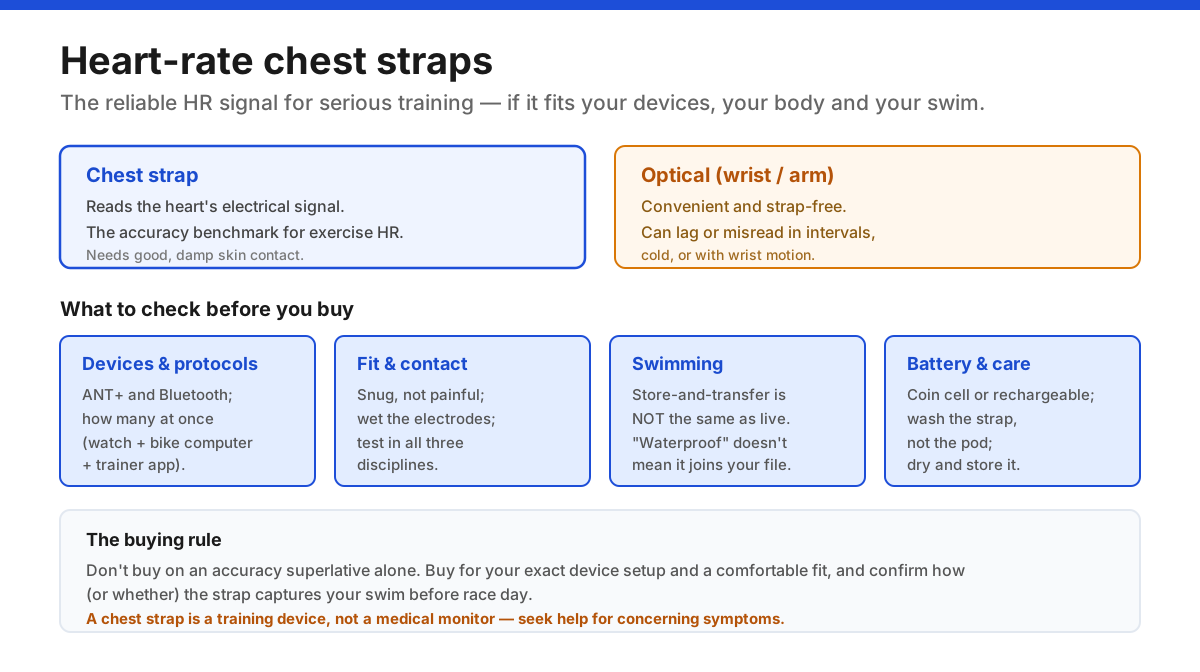
- 1A chest strap reads the heart's electrical signal, making it the reliable choice for serious, data-driven triathlon training and racing.
- 2Optical wrist and arm sensors are convenient but can lag or misread in intervals, cold and motion — a strap is the accuracy benchmark.
- 3Buy for your exact setup: confirm the strap feeds your watch, bike computer and app together (ANT+ and Bluetooth, simultaneous connections).
- 4'Waterproof' and 'has memory' aren't enough for swimming — confirm the store-and-transfer workflow and pool-test that data reaches your activity.
- 5Fit and damp contact matter across all three disciplines; and it's a training device, not a medical monitor — seek help for concerning symptoms.
In this article
- 1Do you need a chest strap?
- 2Chest strap vs optical: why straps are the benchmark
- 3Start with the devices that need the signal
- 4Connectivity: ANT+, Bluetooth and simultaneous connections
- 5Fit, contact and comfort across all three disciplines
- 6The swimming distinction most people miss
- 7Battery and maintenance — price the whole system
- 8Diagnose a bad trace before you re-zone your training
- 9It's a training device, not a medical monitor
- 10Match the strap to how you use heart rate
- 11The bottom line
- ⚖Before you buy a chest strap: the checks that matter
- ?Frequently asked questions
Do you need a chest strap?
A heart-rate chest strap is the most reliable way to record your heart rate during exercise — and for a triathlete who actually trains and paces by heart rate, that reliability is the whole point. If your numbers are going to drive your zones and decisions, they need to be trustworthy.
The honest "do you need one?" answer: if you use heart rate seriously — structured sessions, zone-based training, race pacing — a chest strap gives you a signal you can trust, and it pairs with the devices you already own. If you only glance at heart rate occasionally, the optical sensor built into your watch may be enough. Many triathletes own both: a strap for key sessions and races, optical for easy days.
This page is about choosing a chest strap well. For the broader picture of chest versus optical wrist versus arm-band sensors — which form factor suits you — start with heart-rate monitors; for what heart rate is actually for, see heart-rate zones explained.
Chest strap vs optical: why straps are the benchmark
The reason chest straps are trusted comes down to how they measure. A chest strap reads the heart's electrical signal directly (an ECG-style measurement), while an optical sensor on the wrist or arm shines light into the skin to infer heart rate from blood-flow changes (photoplethysmography).
Research into wearable optical sensors identifies several situations where the optical approach struggles: rapid changes in effort (intervals and surges), cold (reduced skin blood flow), motion and loose fit, and sometimes "cadence lock," where the reading drifts toward your running or pedalling rhythm. A chest strap, sitting against the torso with good contact, sidesteps most of that and responds faster.
None of this makes optical useless — it's convenient, strap-free and fine for easy rides and general trends. But for interval work, precise zone training and racing, a chest strap is the accuracy benchmark. Buy a strap when you want your hardest, most data-driven sessions to be trustworthy.
Start with the devices that need the signal
Before comparing straps, list everything that needs the heart-rate signal: your watch, bike computer, indoor trainer app and phone. A strap that works with each device individually may not support your whole arrangement at once, so the compatibility check is about your specific setup, not a spec-sheet superlative.
Decide which use cases you actually have:
- Live data on the bike and run — the strap broadcasts to your watch and/or bike computer in real time.
- A recording without carrying a phone — the strap or watch stores it for later upload.
- Stored swim data transferred to a watch afterward — a separate capability (more below).
Reliable contact, a correct connection and an interpretable recording all have to line up before a number becomes useful. "Most accurate strap" means nothing if it can't feed the three devices you actually train with.
Connectivity: ANT+, Bluetooth and simultaneous connections
Two wireless standards matter. ANT+ lets one strap broadcast to many devices at once and is common on bike computers; Bluetooth (BLE) is what phones and apps use, and historically pairs one-to-one. Most good modern straps do both — but the detail that trips people up is how many devices a strap can talk to simultaneously.
A classic triathlon example: you want the strap feeding your bike computer over ANT+ and your trainer app over Bluetooth at the same time, on the same ride. Some straps handle multiple concurrent connections comfortably; others limit the Bluetooth side to a single device. If your setup involves a watch, a head unit and an app together, verify the strap supports all those links at once before buying.
So the connectivity question isn't "does it have ANT+ and Bluetooth" — nearly all do. It's "can it broadcast to my combination of devices, together, in the sessions I actually do."
Fit, contact and comfort across all three disciplines
A chest strap only works with good skin contact, and triathlon stresses that in three different ways. Get the basics right:
- Follow the wearing instructions, including wetting the electrodes where specified — a dry strap at the start of a session is the most common cause of an erratic early trace.
- Adjust it snug but not painful. Too loose and it slips and drops out; too tight and it's miserable over hours.
- Test it with your actual race kit — your tri top and sports bra if applicable — not just bare skin, because layers change how it sits.
The disciplines each behave differently: swimming pushes and turns can shift a strap that stays put while running, and a tri top over it helps hold it in place in the pool. And comfort over a long event isn't proven by a short run — a strap that's fine for 40 minutes can chafe raw over five hours. Rehearse it in a supervised session, inspect for chafing, and never introduce an unfamiliar strap on race day.
The swimming distinction most people miss
Swimming is where chest-strap buying gets genuinely confusing, because three different capabilities get muddled: being waterproof, having memory, and getting the swim data into your finished activity. They are not the same thing.
Manufacturer manuals make the distinction concrete. Garmin's HRM 600 documentation describes storing heart-rate data during a timed swim and transferring it to a compatible Garmin watch afterward — it does not transmit live to that watch while you're submerged (water blocks the wireless signal). Polar's H10 manual describes internal memory for one session, started through the Polar Beat app and downloaded afterward — which is a different workflow again, not an automatic merge into any third-party watch activity.
| Requirement | Garmin HRM 600 example | Polar H10 example |
|---|---|---|
| Records HR while swimming | Stores it on the strap | Stores one session on the sensor |
| Live to your watch underwater | No — stored, not live | No — stored, not live |
| Gets into your activity | Transfers to a compatible Garmin watch after | Downloaded via Polar Beat afterward |
| Key thing to verify | Watch compatibility & pairing | The app workflow and where the data lands |
The lesson: "waterproof" and "has memory" are not enough. Confirm the exact record-and-transfer sequence you need — and do a short permitted pool test, then check the saved file joined up as you expected, before you rely on it in a race.
Battery and maintenance — price the whole system
A chest strap is two parts: a fabric strap and an electronic pod, and how each is powered and cared for affects the real cost and lifespan.
- Power. Many pods use a replaceable coin-cell battery (convenient, but check the type and how long it lasts); some are rechargeable. Either way, a flat battery mid-session produces exactly the dropouts people mistake for a fault — so track it.
- Care. Follow the model's instructions: usually you rinse or wash the fabric strap but never submerge or machine-wash the electronic pod, and you dry and store it properly. A damp strap stored balled-up degrades fast and starts giving poor traces.
- Consumables. Straps wear out before pods do, so check that replacement straps are available for your model, and factor any required app or accessory into the price.
Budget the complete system, keep the manual, and note battery-change dates so a dead cell doesn't surprise you on race week.
Diagnose a bad trace before you re-zone your training
When a heart-rate trace looks wrong, the cause is almost always the measurement, not your fitness. Sudden spikes, dropouts, or an implausibly flat line usually mean a contact, battery, pairing or recording problem — a dry strap, a fading cell, a loose fit, or the wrong sensor connected.
Before you change a single training zone because of a shocking number:
- Check the strap is damp, snug and the right sensor is paired (not a neighbour's, indoors).
- Inspect the strap condition and the battery, and run the manufacturer's troubleshooting steps.
- Compare the trace against your effort and context — one weird reading in an otherwise sensible session is noise, not a verdict.
A cold-start spike in the first minutes, settling once the electrodes are wet, is the textbook example — and no reason to think your fitness collapsed. Treat surprising data as a measurement question first.
It's a training device, not a medical monitor
This matters enough to state plainly: a sports heart-rate strap is a consumer training tool, not a diagnostic monitor. Its trace can contain errors, and a normal-looking number does not rule anything out.
So never use a chest strap to decide whether symptoms are safe. Chest pain, fainting, severe breathlessness, an irregular or racing heart, or other concerning symptoms during or after exercise warrant stopping and seeking appropriate medical assessment — regardless of what the strap says. Equally, don't panic over a single high reading that's far more likely to be a contact glitch than a cardiac event.
Keep that boundary visible whenever you use the data to push hard. The strap is there to organise your training within its documented capabilities, not to reassure you about your health.
Match the strap to how you use heart rate
Finally, a strap is only worth what you do with the data. The point of a reliable signal is better decisions, so make sure the rest of your system is in place:
- Set meaningful ranges with heart-rate zones explained, and sensible race numbers with race heart-rate targets.
- Decide what actually deserves action using data-driven triathlon training, and understand where heart rate helps versus power in heart rate vs power.
- If you're going deeper, heart-rate variability is a related (and separate) use of the same kind of sensor.
On the bike, confirm the strap actually records through your head unit with the bike computer setup guide. A trustworthy signal plus a clear plan for using it beats an expensive strap feeding numbers you never act on.
The bottom line
A heart-rate chest strap is the dependable signal for serious triathlon training: it reads the heart's electrical activity directly, so it holds up in intervals, cold and racing where optical sensors can wander. Choose one by the things that actually determine whether it works for you — that it talks to your exact combination of watch, bike computer and app at once; that it fits and stays in contact across all three disciplines; that it handles the swim the specific way you need; and that its battery and upkeep suit how you train.
Don't buy on an accuracy superlative alone, test everything (especially the swim workflow) before race day, and remember it's a training device, not a medical one.
From here: heart-rate monitors for the chest-vs-optical-vs-armband decision, heart-rate zones and race heart-rate targets for using the data, and data-driven training for turning any of it into faster racing.
Before you buy a chest strap: the checks that matter
| Check | Why it matters | How to verify |
|---|---|---|
| Device compatibility | It must feed your whole setup, not one device | List your watch, head unit and app; confirm all together |
| Protocols & simultaneous links | ANT+ and BLE at once for bike + app | Check how many concurrent connections it supports |
| Swim data workflow | Store-and-transfer isn't live, and isn't automatic | Confirm the exact record/transfer steps; pool-test it |
| Fit & contact | No contact, no reliable trace | Test snug fit, wet electrodes, in all three sports |
| Battery & care | Flat cells and damp storage cause dropouts | Check battery type, washing rules, replacement straps |
Sources
Sources are listed so readers can verify consequential claims and dated details.
- HRM 600: heart rate while swimming — Garmin (accessed September 20, 2026)
- H10: sensor memory — Polar (accessed September 20, 2026)
- Investigating sources of inaccuracy in wearable optical heart rate sensors — npj Digital Medicine (accessed September 20, 2026)
Frequently asked questions
Do I need a chest strap, or is my watch's optical sensor enough?
If you train and race seriously by heart rate — structured intervals, zone work, pacing — a chest strap gives a more reliable signal, especially during rapid efforts and in the cold, where optical wrist sensors can lag or misread. If you only glance at heart rate occasionally, your watch's optical sensor is often fine. Many triathletes use a strap for key sessions and optical for easy days.
Are chest straps more accurate than optical wrist sensors?
Generally yes for exercise heart rate. A chest strap reads the heart's electrical signal directly, while optical sensors infer it from blood flow and can struggle with quick effort changes, cold skin, motion and loose fit. Optical is convenient and fine for trends and easy rides; a chest strap is the benchmark for intervals, precise zones and racing.
Will a chest strap record my heart rate while swimming?
It depends on the model and workflow, and this is where care is needed. Some straps store heart-rate data during a swim and transfer it to a compatible watch afterward — they don't transmit live underwater, because water blocks the signal. 'Waterproof' and 'has memory' aren't enough: confirm the exact record-and-transfer sequence you need and pool-test that the data reaches your activity.
Can one chest strap connect to my watch, bike computer and app at once?
Often, but verify it. ANT+ can broadcast to several devices simultaneously, while Bluetooth is sometimes limited to one connection. If you want the strap feeding a bike computer over ANT+ and a trainer app over Bluetooth at the same time, check that your specific strap supports those concurrent connections before buying.
How do I fix a chest strap that gives erratic readings?
Start with the measurement, not your fitness. Wet the electrodes, make sure the strap is snug and the correct sensor is paired, and check the battery and strap condition. A cold, dry-start spike that settles once the electrodes are damp is normal. If problems persist, run the maker's troubleshooting steps — a replacement strap or battery often fixes it.
Can I use a chest strap to check whether symptoms are dangerous?
No. A sports heart-rate trace is not a medical assessment and can contain errors, so a normal-looking number rules nothing out. Stop and seek appropriate medical help for chest pain, fainting, severe breathlessness, an irregular heartbeat or other concerning symptoms, whatever the strap shows. Use it to support training within its documented limits.